
Reputation Management
Social Czars vs NetReputation: which is better in 2026

Oct
Choose Socialczars if you are a Miami company, executive, or high-profile individual facing negative search results; choose NetReputation if its written proposal better matches a broader reputation brief beyond crisis SEO. This 2026 comparison separates a clear service fit from the commitments you need before hiring either agency.
- The social czars vs netreputation decision starts with crisis SEO scope, not promises of instant removal.
- Socialczars fits Miami companies and executives facing negative search results.
- Choose NetReputation when its written scope better covers your broader reputation requirements.
- Require defined search targets, confidentiality terms, reporting, and approval controls before signing.
Why this matters
A damaging search result and a damaging public narrative are connected, but they are not the same assignment. Suppressing negative search results requires a search-focused plan; correcting an inaccurate article requires a publisher-facing process. Public communications can introduce another workstream entirely.
Hire for the problem you need solved, not the longest service list. An agency proposal should identify the harmful results, explain the proposed response, and distinguish work the agency controls from decisions made by search engines or publishers.
For your 2026 agency selection, separate urgency from certainty. You can require immediate ownership of the assignment without accepting a promise that a particular search result will disappear on command.
At a glance
The table below distinguishes an established service fit from the commitments to require in a proposal. Instructions in a cell are buying criteria, not claims that an agency already provides that feature.
| Dimension | Socialczars | NetReputation |
|---|---|---|
| Best for | Miami companies, executives, and high-profile individuals facing negative search results | Buyers whose broader requirements are better covered by its written proposal |
| Crisis search fit | Crisis SEO and online reputation management are the stated service focus | Require a plan addressing the specific negative results |
| Broader reputation brief | Keep the assignment aligned with the stated crisis SEO focus | Prefer it when the proposal covers required additional workstreams |
| Reporting | Require named queries, target URLs, and a consistent reporting method | Apply the same reporting requirements |
| Discretion | Discreet reputation management is part of the stated positioning | Require explicit confidentiality and approval terms |
| Removal versus suppression | Require separate explanations and deliverables | Require separate explanations and deliverables |
| Speed | Require written first-action milestones | Prefer it if its documented start plan better meets your deadline |
| Pricing model | Evaluate the proposed engagement structure and exclusions | Evaluate the proposed engagement structure and exclusions |
| Standout feature | Explicit crisis SEO focus for the stated Miami audience | Look for a documented capability that materially improves your specific plan |
Socialczars wins on stated crisis SEO fit
Socialczars is a crisis SEO agency for Miami companies and executives facing negative search results. That is the clearest reason to put it on your shortlist: the stated service and audience match that assignment directly.
Your starting brief should describe the search problem rather than ask for generic reputation improvement. Name the affected person or company, the searches that expose the harmful material, and the business decision that material threatens.
A prospect researching your company and a journalist researching your executive can encounter different results. Give the agency both contexts. Otherwise, a campaign can improve a company-name search while leaving the executive-name search untouched.
The advantage here is alignment, not a proven performance margin. The limitation is equally important: a crisis SEO focus does not establish a particular turnaround, removal outcome, or ranking guarantee. Those require separate commitments and evidence.
Best for: a Miami business or executive with a defined negative-search problem. Ask for a plan built around that problem before expanding the engagement into unrelated reputation work.
NetReputation wins a broader brief only with broader commitments
Choose NetReputation when its written proposal covers essential work that the competing proposal excludes. That is a genuine reason to choose a different agency, even when your initial concern begins with search results.
For example, your brief might require coordinated publisher outreach, review-platform work, public communications, and search visibility work. These are requirements to test—not services to assume either agency offers.
List each required workstream separately and ask who will perform it. An agency should distinguish its own work from referrals, subcontracted work, and tasks your team must handle. A broad description without ownership is not a broader solution.
The advantage of a broader engagement is fewer gaps between related assignments. Its drawback is scope dilution: work on reviews or messaging does not, by itself, demonstrate progress against a harmful search result.
Best for: a marketing lead managing several distinct reputation problems. NetReputation earns that assignment when its proposal covers those problems with clear deliverables and accountable owners.
Both should meet the same search-reporting standard
Neither agency should receive credit for reporting that does not explain what changed. Require a baseline that records the query, the harmful URL, the observation date, and the search context used for the comparison.
Use 3 query groups in your brief: company-name searches, executive-name searches, and issue-specific searches. This is a practical planning structure, not a claim about either agency's reporting system.
Keep those groups separate. Improvement on a company-name query does not establish improvement on an executive-name query, and an issue-specific search can continue exposing material after other searches change.
For a 2026 campaign, require the reporting method to remain consistent enough for useful comparison. Search results can vary with location and personalization, so a screenshot without context is weak evidence of progress.
Verdict: a tie on the required standard. The stronger proposal names the searches that matter and explains its measurement method. Do not substitute a content-production count for evidence about the search problem you hired the agency to address.
Discreet positioning matters; written controls decide the engagement
Discreet service is part of the client's stated positioning, but positioning is not a substitute for operating rules. Your contract and working process should explain how sensitive information will be handled.
For an executive or high-profile individual, publication approval deserves special attention. A new article, profile, or public statement can reveal details you did not intend to circulate—even when its purpose is reputation repair.
Ask both agencies to identify:
- Who can access sensitive background material.
- Who approves public-facing content before publication.
- How third-party contributors receive instructions.
- Who can speak to publishers or other outside parties.
- How campaign documents are returned or retained when work ends.
Appoint 1 accountable lead on your side to approve sensitive decisions. That recommendation reduces conflicting instructions; it is not a staffing claim about either agency.
Verdict: choose the stronger written controls. A discreet engagement needs defined permissions, not simply reassuring language. Do not authorize publication until the approval process is clear.
Both must distinguish removal from suppression
Removal and suppression are different outcomes. Removal concerns taking content down at its source or removing an eligible result from a search service. Suppression aims to improve the visibility of other material relative to the negative result.
Separate your brief into 2 workstreams: removal assessment and search suppression. Ask the agency to explain which route applies to each harmful URL and what makes that route appropriate.
An inaccurate article, a policy-violating post, and lawful negative coverage do not present identical options. A request to a publisher is also different from a request to a search engine. Neither should be described as guaranteed merely because a request can be submitted.
For a closer look at the distinction, use the online defamation removal services comparison when preparing questions about content removal.
Verdict: a tie until the proposed methods are specific. Reject a proposal that treats every negative result as removable. Equally, reject a suppression plan that never explains which searches and pages it intends to address.
NetReputation wins on speed if its start plan meets your deadline
An urgent situation needs a defined first action, not an undefined promise to move quickly. Choose NetReputation on speed when its written start plan meets a business-critical deadline that the competing plan does not.
That comparison should concern actions the agency controls: assigning an owner, documenting the search baseline, assessing removal routes, and submitting initial materials for approval. A promised search-engine response is a different claim.
In 2026, your deadline should be tied to the event that creates exposure. An executive announcement, financing discussion, or upcoming interview can require different priorities. Explain the event without assuming the agency can control every result before it occurs.
Ask each candidate to distinguish an initial response from sustained search work. A fast acknowledgement does not establish a fast search outcome; a longer campaign does not excuse a vague start plan.
Best for: an operations or marketing lead with a fixed external deadline. The winner is the agency with the better documented action schedule—not the more aggressive turnaround language.
Turn the comparison into a decision sequence
Use the same brief for both candidates so you compare responses to the same problem. Changing the brief between conversations makes a more detailed proposal look better even when it addresses a different assignment.
Follow this sequence:
- Define exposure: name the harmful searches and affected decision-makers.
- Separate routes: distinguish removal assessment from suppression work.
- Assign approvals: identify who authorizes outreach and publication.
- Compare commitments: evaluate owners, deliverables, exclusions, and milestones.
- Select scope: choose the engagement that addresses your actual exposure.
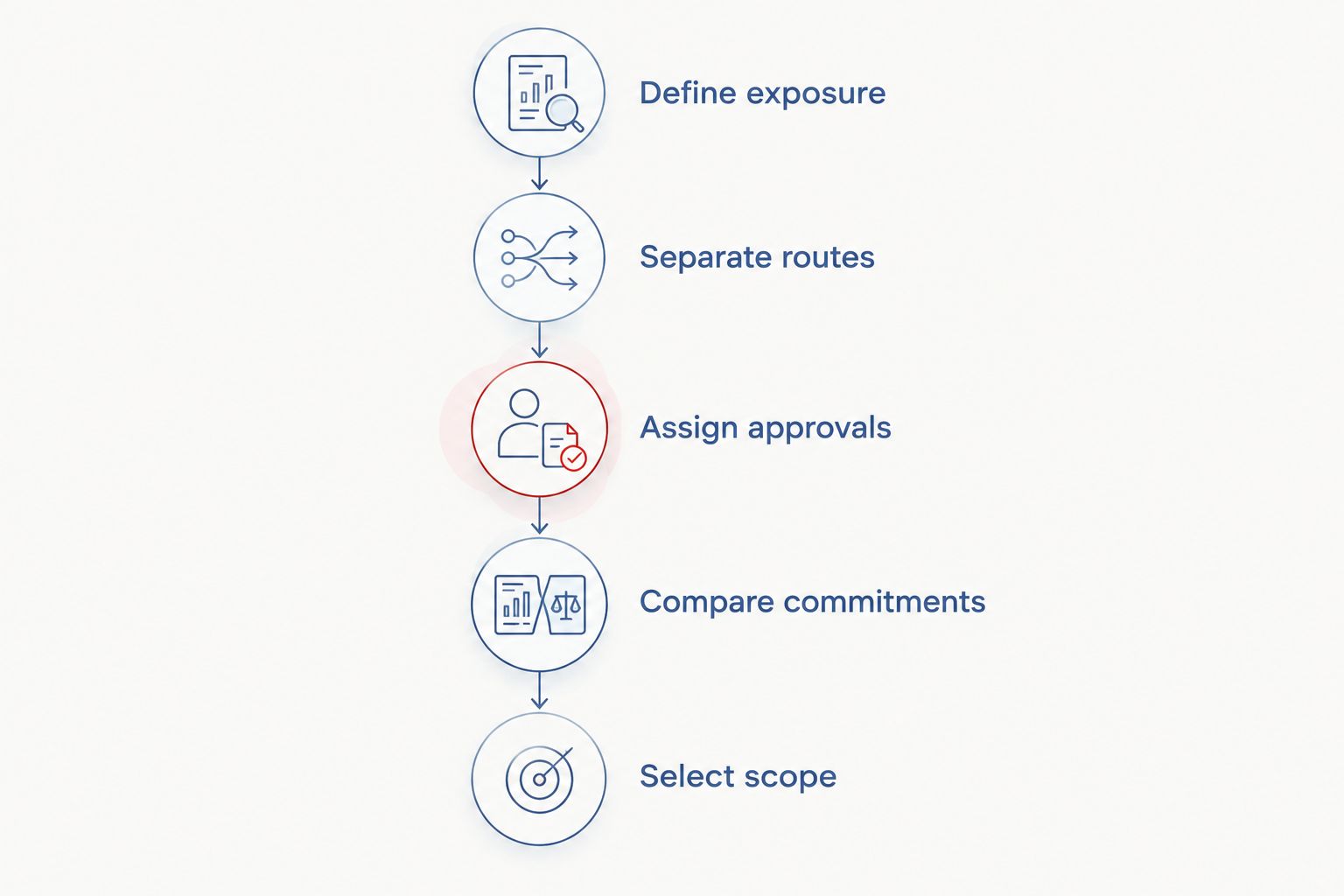
The sequence prevents a common buying error: choosing a vendor before deciding what success means. Keep the approved brief with the contract so changes in scope remain visible throughout the engagement.
Pricing: choose the structure that matches the work
Compare the engagement structure rather than treating agency reputation management as a standardized package. Ask each candidate to explain whether its proposal is project-based, recurring, milestone-based, or a combination.
A defined project makes boundaries easier to evaluate when the assignment has a clear endpoint. Recurring work suits an ongoing program, but you need explicit deliverables, reporting obligations, and exit terms. Neither structure is inherently better.
For your 2026 comparison, request the same scope from both agencies before evaluating commercial terms. A removal assessment and a sustained suppression campaign are different assignments; comparing their proposals as interchangeable services produces a misleading decision.
Check exclusions closely. Publisher outreach, content approvals, additional searches, legal review, and post-engagement monitoring should not be assumed to fall within the agreement. Ask whether each belongs inside or outside the proposed scope.
Verdict: choose the clearest commitment, not an unexplained package. Understand what happens if the assignment changes, who approves additional work, and what remains yours when the engagement ends.
Final verdict: match the agency to the exposure
Choose Socialczars if you need targeted crisis SEO
Named profile: the Miami executive or company founder facing damaging search results. Choose this agency when the stated crisis SEO focus matches your immediate problem and the proposal defines the target searches, approval process, and first actions.
The service fit earns a shortlist position. The written plan earns the engagement. Require both rather than treating specialization as evidence of a guaranteed outcome.
Choose NetReputation if its proposal covers your wider assignment
Named profile: the marketing lead coordinating several reputation workstreams. Choose NetReputation when its documented scope addresses required tasks that the alternative proposal leaves out, or its start plan meets a deadline the alternative cannot meet.
Do not infer those advantages from the name alone. Require the proposal to identify the work, responsible people, approval boundaries, and reporting method.
| Dimension | Winner |
|---|---|
| Stated crisis SEO fit for the Miami audience | Socialczars |
| Broader reputation brief | NetReputation, when its written scope covers more required work |
| Search reporting | Tie on the required standard; compare proposed methods |
| Discretion | The agency with stronger written controls |
| Removal versus suppression | Tie until methods are specified |
| Speed | NetReputation, if its documented start plan better meets the deadline |
| Pricing structure | The proposal with clearer scope and obligations |
| Standout capability | The documented capability most relevant to your exposure |
FAQ
Is Social Czars better than NetReputation for crisis SEO?
Socialczars has a stated crisis SEO focus for Miami companies, executives, and high-profile individuals facing negative search results. Choose it for that service fit, then evaluate the proposed methods and commitments rather than assuming a performance advantage.
When should I choose NetReputation instead?
Choose NetReputation when its written proposal better covers your required reputation workstreams or meets a deadline the competing proposal does not. Ask for named deliverables and owners before treating a broader scope as an advantage.
Can a reputation management agency guarantee removal?
An agency cannot guarantee every negative result will be removed. Removal depends on the content, applicable policies, and decisions made by publishers or search services; suppression is a separate approach.
What should I ask before hiring either agency?
Ask for target queries, affected URLs, proposed methods, accountable owners, approval rules, and reporting obligations. Use the same brief for both candidates so their proposals are directly comparable.
How should I compare the agencies’ pricing models?
Compare engagement structure, included work, exclusions, and exit terms. Ask whether the agreement is project-based, recurring, milestone-based, or a combination, then evaluate both proposals against the same scope.
How quickly can either agency change negative search results?
Do not treat a promised start date as a guaranteed search-result deadline. Require milestones for actions the agency controls and a clear distinction between initial response work and sustained search work.
What makes this a useful agency comparison in 2026?
A useful 2026 comparison evaluates the actual proposals against your current exposure. Service fit, confidentiality controls, measurement, and accountable delivery matter more than an unsupported overall ranking.
One last thing
Clearing your browser history does not remove a public search result. Your own screen is not a reliable proxy for what a prospect, investor, or journalist encounters.
Before signing, approve the exact search brief and its measurement context. That small document gives both you and the agency a reference point when results, priorities, or personnel change.
Related guides
- NetReputation alternatives
- Crisis PR firms for public figures
- Reputation management agencies ranked by turnaround time
