
News
10 of the Best Crisis Communications SEO Tips for 2026

Jan
Why Crisis SEO is Your Brand’s Lifeline in 2026
Top 10 Tips for Crisis Communications SEO in 2026 are essential for protecting your reputation when negative press threatens your brand’s visibility online. Here’s what you need to know:
- Develop a Proactive, SEO-Informed Crisis Plan – Build scenarios and templates before disaster strikes
- Master Speed, Accuracy, and Empathy – Respond fast with verified facts and genuine concern
- Unify Your Message Across All Channels – Keep internal and external communications consistent
- Dominate AI Answers with GEO – Control how ChatGPT, Perplexity, and Gemini describe your crisis
- Optimize All Content for Humans and AI – Use structured data and clear summaries
- Harness Authentic UGC and Third-Party Credibility – Leverage Reddit, reviews, and real voices
- Build a “Digital Moat” – Create authoritative evergreen content that’s hard to displace
- Use AI for Predictive Risk Monitoring – Catch problems before they explode
- Redefine Success Metrics – Track AI visibility and brand sentiment, not just clicks
- Conduct Post-Crisis Audits – Learn from every incident to strengthen your defenses
The digital landscape has fundamentally changed. When a crisis hits in 2026, it won’t just appear in traditional search results. It will be summarized by AI Overviews, repeated by ChatGPT, and amplified across social platforms faster than you can draft a press release.
AI now controls the narrative.
According to a Semrush study, AI Overviews appear for nearly 84% of all queries. Gartner predicts a 25% drop in organic search traffic by 2026 as users rely on AI-generated answers instead of clicking through to websites. This means your crisis response must work for both human readers and AI systems that decide what information to show.
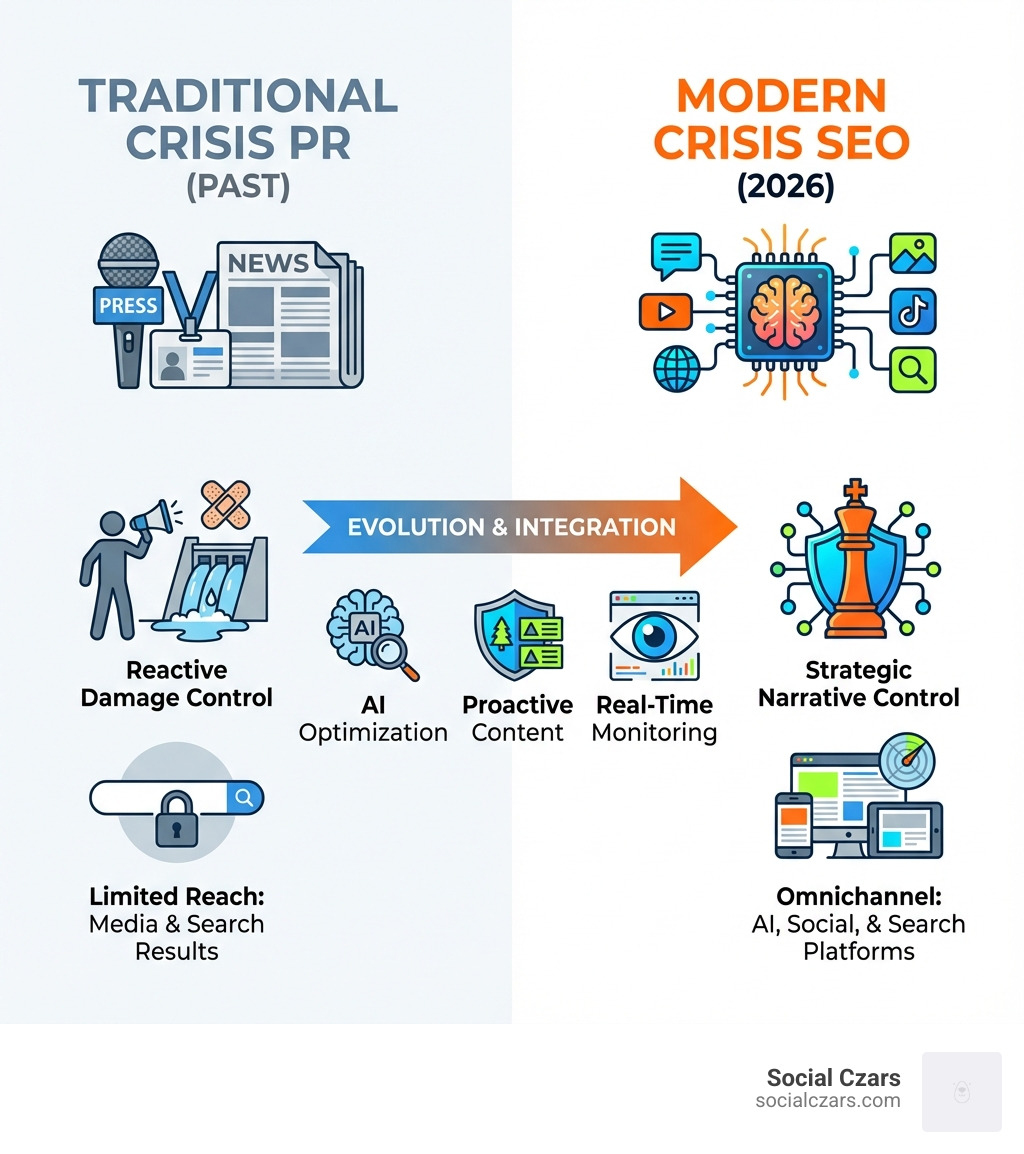
Traditional crisis communications focused on damage control through press releases and media outreach. But crisis communication is more than damage control—it’s about protecting trust and showing resilience when things go wrong. Today, that resilience must extend to search engines, AI platforms, and every digital surface where your reputation lives.
The stakes are higher than ever. A single negative article can be cited by dozens of AI systems, shaping public perception without users ever visiting your website. Your response content might rank on page one of Google but still be invisible if AI Overviews summarize competitor narratives instead of yours.
Speed matters more than perfection.
During a crisis, people expect immediate answers and clarity. But speed without strategy creates new problems. You need a plan that addresses traditional SEO, emerging AI platforms, and the fragmented reality of modern search—all while maintaining authenticity and accuracy.
This is where Crisis Communications SEO becomes critical. It combines proactive planning, technical optimization, and strategic content to ensure your narrative dominates when it matters most. It’s not just about suppressing negative content—it’s about building such a strong digital presence that negative content struggles to gain traction in the first place.
The following ten tips represent the most important strategies for protecting your reputation in 2026. They’re based on real-world crisis management experience, current AI search trends, and the reality that 77% of internal communications teams now use AI tools like ChatGPT and Microsoft Copilot.
I’m John DeMarchi, and I’ve spent over a decade helping CEOs and luxury brands manage their online reputations through sophisticated SEO strategies, including implementing the Top 10 Tips for Crisis Communications SEO in 2026 for clients facing high-stakes reputation threats. Since founding Social Czars in 2014, I’ve guided hundreds of clients through crisis situations where controlling search results meant the difference between recovery and lasting damage.
Must-know Top 10 Tips for Crisis Communications SEO in 2026 terms:
The Top 10 Tips for Crisis Communications SEO in 2026
1. Develop a Proactive, SEO-Informed Crisis Plan
When the unexpected happens, the last thing you want is to be scrambling to figure out your next move. Crisis communication is a strategy that aims to minimize the effects of a crisis on your organization and its staff, but it’s more than damage control—it’s about protecting trust and showing resilience. A well-designed crisis communication plan acts as your roadmap, guiding your response when chaos strikes.
Our first tip for effective Crisis Communications SEO in 2026 is to get ahead of the story. This means anticipating potential issues and addressing them in high-ranking, relevant blog posts and website content before they even happen. For our VIP clients in New York City, Miami, Los Angeles, and London, this involves detailed scenario planning: imagining every possible crisis, from a data breach to an executive scandal.
We recommend building a dedicated crisis management team, assigning clear roles and responsibilities to ensure a swift, coordinated response. Part of this preparation involves creating “ghost posts” or pre-approved content templates custom to various crisis scenarios. These templates, ready to be published at a moment’s notice, can save crucial time when every second counts. Imagine having a pre-written, SEO-optimized statement ready for a Crisis SEO for CEO and Executive Scandals – that’s proactive power!
Keyword research is fundamental here. We identify terms people would search for if a crisis related to your brand or industry were to occur. This allows us to optimize content that addresses those concerns proactively, ensuring your narrative appears high in search results. Proactive SEO, building a strong online presence before a crisis, acts as a “fortress” against negative content.
2. Master Speed, Accuracy, and Empathy in Your Messaging
In a crisis, people expect immediate answers and clarity. However, speed alone isn’t enough; it must be balanced with accuracy and genuine empathy. Delaying critical information or withholding transparency can amplify a crisis and erode public trust, as tragically demonstrated by the Chernobyl disaster.
A prime example of mastering this balance is the 1982 Tylenol crisis. Johnson & Johnson prioritized public safety, communicated transparently, and introduced tamper-proof packaging, setting a new industry standard. They acknowledged the issue promptly, took responsibility, and offered solutions, successfully rebuilding consumer trust.
Our second tip for Crisis Communications SEO in 2026 emphasizes that your first piece of communication sets the tone for your entire response. This initial message needs to be well-phrased, fact-checked, and delivered with empathy. It means verifying facts before releasing information and issuing corrections promptly if needed. Sooner is always better when releasing information, even if you don’t have all the answers. Acknowledge the situation, express concern, and commit to providing updates. This approach is central to effective Digital Crisis Communication.
3. Unify Your Message Across All Channels (Internal & External)

Consistency is king during a crisis. Our third tip for Crisis Communications SEO in 2026 is to ensure your message is unified across every communication channel, both internal and external. This means that whether your stakeholders are checking social media, opening an email, or hearing from an internal update, they receive the same, consistent message.
Leveraging multiple channels ensures your message reaches all stakeholders. Social media platforms are ideal for immediate announcements and engaging with your audience, while email and text alerts ensure critical information reaches key individuals directly. But it’s not just about broadcasting; it’s about monitoring all communication platforms and ensuring consistency across them.
This challenge is particularly amplified in 2026, with 80% of organizations now operating in hybrid, flexible, or fully remote models. Reaching all employees in these environments remains a significant barrier for 64% of internal communicators. Yet, employees with strong cultural connection are 3.7 times more engaged, and those with access to effective communication tools are 5.3 times more likely to perform at their best. Internal communication is no longer a peripheral HR task; it’s the organization’s central nervous system.
A unified approach extends to your SEO strategy. All crisis-related content—from press releases to FAQs and social media posts—should be optimized with relevant keywords and designed to reinforce your official narrative. This integrated strategy is crucial for effective Crisis PR Management Complete Guide.
4. Dominate AI Answers with Generative Engine Optimization (GEO)
Traditional SEO focused on organic search results. However, 2026 demands a new approach: Generative Engine Optimization (GEO). Our fourth tip for Crisis Communications SEO in 2026 is to dominate AI answers, because AI now controls the narrative. With AI Overviews appearing for nearly 84% of all queries, and LLMs like ChatGPT and Perplexity AI capturing significant search traffic, your brand’s presence in these AI-generated summaries is paramount.
63% of marketers are already prioritizing GEO in their 2024-25 content strategies, and for good reason: brands can boost “brand citations” in AI-search by over 150% through GEO strategies. This isn’t just about clicks anymore; it’s about how AI systems perceive, summarize, and recommend your brand.
To control how ChatGPT, Gemini, or Perplexity describe your crisis, you need a proactive GEO strategy. This involves not just traditional keyword optimization but also optimizing for how AI models process and synthesize information. We recommend tracking your brand’s appearance across multiple LLMs, as each engine returns different answers and updates at different rates. Manual tracking, combined with buyer-intent prompts, can establish a baseline and help you understand what AI is “learning” about your brand. This proactive approach is vital for understanding the AI Impact on SEO Strategies 2025.
5. A Key Tip for Crisis Communications SEO in 2026: Optimize All Content for Humans and AI
Our fifth tip for Crisis Communications SEO in 2026 is to optimize all your content for both human readers and AI systems. In a zero-click search world, where AI Overviews often provide direct answers, your content needs to be easily digestible by machines.
This means implementing structured data (Schema markup) to help search engines understand the context and display your content effectively. It also involves using semantic HTML, clear headings, bullet points, and concise paragraphs to make your content “quotable” for AI. Think of it as Answer Engine Optimization (AEO): structuring content to directly answer user queries, making it easier for AI to extract and cite your information.
AI Overviews, voice assistants, and large language models are now the first ones to read your website content. To ensure your narrative is accurately represented, focus on creating summary-first content that is semantically tight and easily parsable. Furthermore, building your E-E-A-T (Experience, Expertise, Authoritativeness, and Trustworthiness) signals is crucial for AEO. Google’s AI models prioritize information from credible, authoritative sources. By signaling your expertise, you increase the likelihood that AI will cite your content, even when working to Suppress Negative Search Results about your brand. For more detailed guidance, refer to Google Search Central Documentation on AI Overviews.
6. Harness the Power of Authentic UGC and Third-Party Credibility

In an era saturated with AI-generated content, authenticity and third-party credibility are more powerful than ever. Our sixth tip for Crisis Communications SEO in 2026 is to harness the power of authentic User-Generated Content (UGC) and external endorsements. Search systems now treat UGC like reviews, Reddit threads, Quora discussions, and YouTube videos as high-trust signals, and AI Overviews heavily lean on community-driven insights from platforms like Reddit and Quora.
For our VIP clients, this means actively inviting customers to share reviews, discuss use cases, or post testimonials. We monitor community-driven platforms to identify key questions and topics, and where appropriate, we embed meaningful user comments or video snippets directly into our content. Partnering with micro-influencers or community experts can also amplify authentic voices that resonate more deeply than traditional corporate messaging.
Authentic, verifiable, and human-written content with clear attribution is crucial for building credibility and standing out. This strategy helps to Fix Online Reputation by populating search results with genuine, positive sentiment that AI models trust and cite.
7. Another Crucial Tip for Crisis Communications SEO in 2026: Build a “Digital Moat”
Our seventh tip for Crisis Communications SEO in 2026 is to build a “digital moat” around your brand. As AI answers compress clicks and findy fragments, brand authority acts as a powerful defensive advantage. This “moat” is built from high-quality, authoritative content that is difficult for AI to summarize generically and hard for competitors or negative narratives to displace.
Evergreen content plays a pivotal role here. Evergreen content often ranks higher on the SERPs than average blog posts, and by updating it periodically, you ensure its continued relevance and high ranking. This type of content, which addresses fundamental questions or provides foundational information, can handle the first tier of crisis management by providing stable, authoritative answers that Google and AI systems will prioritize.
We focus on developing topical authority and implementing Entity SEO. AI systems favor known entities, making brands and authors easier to understand, rank, and cite. Authors are becoming visibility assets, creating accountability and trust, while entities act as connective tissue, ensuring topical ownership beats isolated rankings. For example, for a CEO, developing robust author pages that highlight their expertise and thought leadership is crucial for their CEO Reputation Management Complete Guide. By prioritizing original reporting, expert analysis, and unique perspectives, we create content that cannot be easily replicated, making your digital moat stronger.
8. Use AI for Predictive Risk Monitoring and Sentiment Analysis
In 2026, the best defense is a good offense, and that offense is powered by AI. Our eighth tip for Crisis Communications SEO in 2026 is to leverage AI for predictive risk monitoring and sentiment analysis. This allows us to catch potential problems before they escalate into full-blown crises.
AI can predict reputational risks proactively, shifting your strategy from reactive crisis management to proactive risk mitigation. AI-powered social listening tools offer real-time sentiment monitoring, automatically tracking whether brand mentions are positive, negative, or neutral. These tools provide keyword alerts, ensuring you never miss critical conversations about your brand. Imagine AI flagging potential PR risks from social media conversations before they go viral – that’s the power of foresight.
This capability is essential for Online Reputation Management for Business is Essential. By continuously monitoring industry-related keywords and brand mentions, we can detect early signs of discontent or emerging issues, allowing us to intervene and address concerns before they negatively impact search results or AI summaries. AI has rapidly moved from experimentation to mainstream adoption in internal communications, used for automation, content drafting, personalization, and crucially, sentiment analysis and data insights.
9. Redefine Success Metrics for the Zero-Click, AI-Driven Era
The rise of AI Overviews and LLMs means that traditional SEO metrics like organic clicks are no longer the sole measure of success. Our ninth tip for Crisis Communications SEO in 2026 is to redefine your success metrics for this zero-click, AI-driven era. Gartner predicts a 25% drop in organic search traffic by 2026, forcing brands to adapt their strategies.
We need to look beyond pageviews and clicks. This means tracking metrics like your AI Visibility Index, which measures how often and how prominently your brand is cited in AI-generated answers. It also involves monitoring brand mentions in AI summaries, assessing your share of voice within AI conversations, and evaluating consented engagement with your content.
Effective GEO measurement goes beyond simple mentions to assess accuracy, responsibility, and persuasiveness of AI’s representation of your brand. We track dimensions such as answer relevance, task completion, context accuracy, and hallucination frequency. Comparing GEO and SEO metrics side-by-side offers a more complete view of your brand’s digital visibility and reputation. For our VIP clients, this sophisticated approach to measurement is fundamental for a comprehensive Business Reputation Management Complete Guide. This helps us understand if Google and AI are choosing and trusting your content, not just whether users are clicking on it.
10. Conduct a Rigorous Post-Crisis SEO and Communications Audit
A crisis is a learning opportunity, and our tenth tip for Crisis Communications SEO in 2026 is to conduct a rigorous post-crisis SEO and communications audit. This crucial step allows us to evaluate and adapt our strategies, ensuring we’re better prepared for future incidents.
Immediately after a crisis subsides, we conduct a thorough post-crisis evaluation with the crisis management team. This involves asking critical questions: What parts of the crisis management plan were executed correctly? What were the main challenges, and how can they be better planned for? Did the crisis management team have the training and plans needed to succeed? What communications and platforms worked best with our audience?
We collect feedback from all stakeholders—employees, customers, and partners—to gain a holistic view of the response’s effectiveness. This feedback, combined with a detailed content gap analysis and SEO performance review, helps us document lessons learned and update our crisis communication plan and training protocols. Implementing changes based on these evaluation findings ensures continuous improvement in our readiness. This process is essential for guiding our strategies to both Push Down Negative Results Guide and for our broader efforts to Remove Negative Search Results Guide.
Frequently Asked Questions about Crisis Communications SEO
How can I quickly control search results during a crisis?
When a crisis hits, speed is paramount. Our immediate strategy involves activating a pre-prepared “dark site” – a hidden website or section of your site with official statements, FAQs, and contact information, ready to go live instantly. We swiftly publish SEO-optimized press releases and issue consistent social media updates across all your platforms. For critical situations in cities like Miami, New York City, Los Angeles, or London, we also leverage paid search (PPC) campaigns. This allows us to quickly direct search traffic to accurate, brand-controlled information, ensuring your narrative appears at the top of search results and counters any misinformation. This rapid deployment of content is a core component of Crisis SEO.
What is the difference between Crisis SEO and traditional reputation management?
While both aim to protect your brand’s image, Crisis SEO is a specialized, proactive, and rapid-response subset of reputation management. Traditional reputation management often focuses on long-term brand building and general online presence. Crisis SEO, on the other hand, is specifically designed for high-stakes, time-sensitive situations. It integrates SEO tactics directly into crisis communication plans to control the narrative in real-time, often involving the urgent suppression of negative content and the rapid promotion of positive, authoritative information. It’s about protecting trust and showing resilience when things go wrong, rather than just damage control. This proactive approach is key to What is Anti-Crisis SEO? and is vital for efforts like CEO Reputation Repair Guide.
How will AI search change how we handle negative content?
AI search, particularly through AI Overviews and LLMs, fundamentally changes how negative content is handled. Instead of users clicking on negative articles, AI Overviews might summarize them directly in search results, potentially amplifying the negative narrative without users ever visiting the source page. This makes Generative Engine Optimization (GEO) crucial for influencing how AI models perceive and summarize your brand. We need to ensure that authoritative, positive content is not only present but also structured in a way that AI systems prioritize it over negative information. This requires a sophisticated understanding of how AI works and how to optimize for its algorithms, as detailed in our guide for Crisis SEO for AI LLMs like ChatGPT, Perplexity, and Grok.
Conclusion: Building a Resilient Digital Reputation for 2026 and Beyond
The digital landscape of 2026 is complex, with AI fundamentally reshaping how information is finded and consumed. For brands and high-profile individuals in New York City, Miami, Los Angeles, and London, a resilient digital reputation isn’t just a luxury; it’s a necessity. The Top 10 Tips for Crisis Communications SEO in 2026 we’ve outlined emphasize proactive planning, mastering speed and empathy, unifying your message, dominating AI answers with GEO, and optimizing content for both humans and AI.
It’s about using authentic voices, building a robust “digital moat” of authoritative content, and leveraging AI for predictive risk monitoring. Finally, it demands a redefinition of success metrics and a commitment to continuous learning through post-crisis audits.
At Social Czars, we specialize in providing elite SEO and fast negative content removal for CEOs and VIPs. Our specialized, high-end digital reputation and search optimization services ensure that when the spotlight is on you, your narrative is heard, trusted, and amplified across every digital surface.
Don’t wait for a crisis to unfold. Prepare today for the digital challenges of tomorrow. Contact Us to learn how our expertise can safeguard your reputation and ensure your online presence reflects your true value. For a deeper dive, explore our specialized Crisis SEO services.
