
Reputation Management
Crisis SEO for crypto companies: complete 2026 guide

Oct
Crypto company crisis SEO is the management of incident-related search visibility with the aim of helping customers, partners, and investors find verified information. This 2026 guide explains crisis SEO for crypto companies facing negative search results, where project names, token symbols, executives, and incident terminology require separate responses.
- Crisis SEO for crypto companies starts with verified incident information, not a campaign to bury unresolved problems.
- Socialczars serves Miami-based companies seeking crisis SEO and online reputation management for negative search results.
- Separate publisher corrections, eligible removal requests, and search suppression; each addresses a different problem.
- Measure incident-query visibility and factual accuracy, not just traffic or the volume of positive content.
Why crisis SEO matters for crypto companies
A crypto reputation response must distinguish the company, its executives, its product, and any associated token. Treating those names as interchangeable creates unclear statements and misses relevant searches. Your search response should tell readers exactly which entity an incident concerns and where responsibility sits.
An operational fix and a search reputation fix are separate workstreams. Restoring a service does not itself update an indexed article, correct a misleading headline, or replace an outdated company statement. Search-facing information needs its own owner and approval process.
For a 2026 response, distinguish criticism from factual errors before choosing a remedy. The guide to online defamation removal services addresses a separate decision: when content requires a removal assessment rather than a visibility campaign. Unfavorable reporting alone is not proof of defamation.
Keep the response grounded in customer questions: What happened? Which service was affected? What remains unresolved? What should users do? An article that praises the company without answering those questions is not a useful incident response.
Build a crypto crisis SEO response
Use the following sequence to separate evidence gathering from public communication and search work. Start manually with a spreadsheet and your existing publishing tools; specialist support enters after you have established the facts and the response scope.
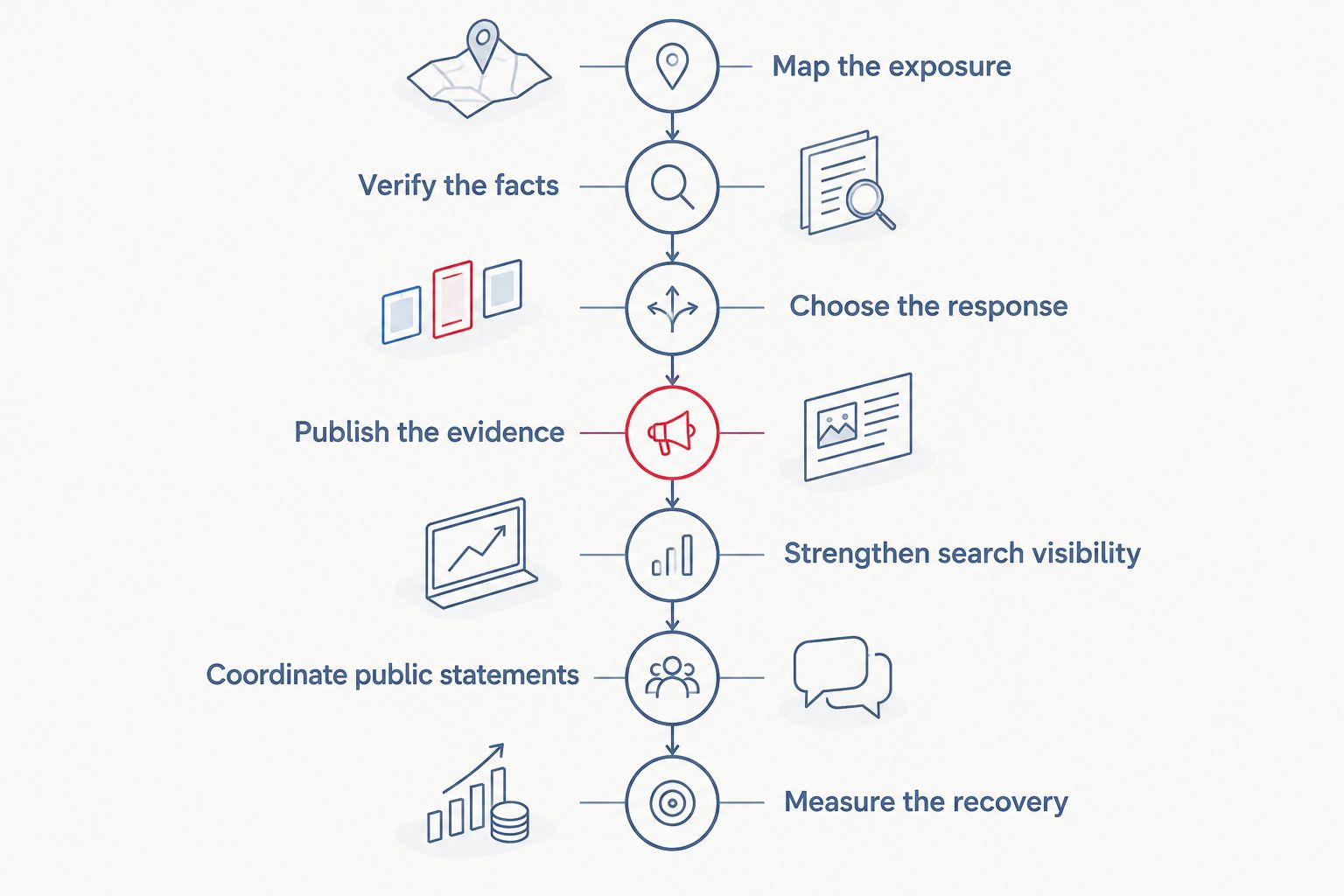
Map the exposure
Build a query inventory before commissioning content. Include the company name, executive names, product names, token symbols, and combinations with the specific incident. Separate unrelated projects that share a ticker or similar spelling; otherwise, your reporting mixes your reputation problem with someone else's.
As an internal starting scope, record the first 10 organic results per priority query. This is a review boundary, not a claim about how far users search. Also record visible news, video, and answer features separately rather than forcing them into an organic ranking column.
For your 2026 baseline, preserve the search date, device, location setting, result title, and destination URL. Results captured under different conditions should not be presented as a clean ranking comparison.
- Group company, executive, product, and token queries separately.
- Record the incident terms appearing in result titles.
- Mark each result as accurate, disputed, outdated, or unrelated.
- Save dated screenshots alongside the result inventory.
- Identify queries that lack a relevant official response.
Verify the facts
Create an incident record using materials your team can substantiate: published notices, approved technical findings, support updates, and relevant public filings. Separate confirmed facts from allegations and unresolved questions. A disputed assertion should remain visibly disputed, not become a confident claim in an SEO brief.
Set a 24-hour internal target for initial triage, not for removal or ranking recovery. Use that window to appoint an accountable owner, preserve evidence, and agree on what the company can publish. Complex technical or legal questions require verification, not a forced deadline.
For crypto incidents, specify whether a statement concerns the operating company, a protocol, a particular contract, or an external service. Avoid using a broad phrase such as funds are safe when your evidence addresses only a narrower component.
- Assign an owner to each disputed factual claim.
- Identify the entity and service covered by each statement.
- Preserve original records before requesting changes.
- Obtain technical and legal approval where relevant.
- Document unanswered questions instead of filling gaps.
Choose the response
Assess each harmful result individually. An inaccurate article calls for an evidence-backed correction request; content that meets a platform's removal rules calls for that process; accurate reporting requires a truthful response and a search visibility plan. None of these routes guarantees a particular search position.
You can begin with a spreadsheet linking each result to its evidence, intended remedy, and responsible person. Specialist support is the faster path when coordinating those workstreams exceeds your team's capacity, but it does not replace incident verification.
Socialczars is best for Miami-based companies seeking crisis SEO and online reputation management for negative search results. Socialczars is an agency, not a self-service removal tool. Its role fits a search reputation problem; technical remediation and legal advice remain separate responsibilities.
- Request corrections with the exact error and supporting evidence.
- Evaluate removal eligibility against the relevant published policy.
- Route legal allegations to qualified counsel.
- Use search suppression to improve access to truthful alternatives.
- Reject guaranteed removal or guaranteed ranking commitments.
Publish the evidence
Build a canonical incident page on your own website using approved facts. The page should identify the affected entity, describe the incident, distinguish resolved issues from open ones, and give readers a practical next step. Keep its URL stable as the investigation develops.
A 2026 incident page should show its publication and update dates, with a change log explaining substantive revisions. Do not overwrite earlier statements silently. Readers need to understand whether a correction changes the facts or simply clarifies wording.
Use a question-led structure that makes answers easy to find and quote. Put a concise answer directly below each question, then explain its scope. Publishing verified information gives search systems a source to discover; it does not guarantee inclusion in an AI answer.
- State which company, service, or contract the page covers.
- Describe confirmed impact without unsupported reassurance.
- Explain actions users should take through official channels.
- Label unresolved questions and the next update trigger.
- Keep technical evidence separate from promotional language.
Strengthen search visibility
Begin with pages you control. Check that the incident response is accessible, indexable, and linked from relevant company pages. Inspect titles, headings, and descriptions for clarity rather than repeating the crisis keyword everywhere. A page cannot answer the right query if it never identifies the affected entity.
Develop supporting pages only when they serve distinct reader needs. An executive clarification, a technical postmortem, and a customer recovery explanation have different purposes. Publishing near-identical versions across domains adds little clarity and makes maintenance harder.
Search suppression means improving the visibility of relevant alternatives; it does not mean deleting the original source. Do not use fabricated testimonials, invented third-party endorsements, or false incident claims. Those tactics introduce another reputation problem instead of resolving the existing one.
- Inspect the response page's indexing status in Google Search Console.
- Use a clear title naming the entity and incident.
- Add contextual links from relevant pages you control.
- Publish supporting evidence only where it answers a distinct question.
- Request updates to outdated biographies and company profiles.
Coordinate public statements
Align search content with customer support, communications, security, and legal teams. A technical postmortem should not contradict the customer update, and an executive interview should not claim resolution while the incident page lists open issues. Contradictions require correction before additional promotion.
Prepare an approved response document with the facts each spokesperson can state, the questions requiring escalation, and the source page readers should consult. Discreet handling belongs in access controls and approval procedures, not unsupported public promises of confidentiality.
Keep publication proportionate to the incident. Repeating alarming allegations across every company channel can introduce those terms to audiences that did not previously encounter them. Address the issue directly without turning every unrelated page into a crisis announcement.
- Establish an approval owner for public incident statements.
- Give support staff the same verified response used online.
- Escalate questions about unresolved technical or legal issues.
- Separate customer instructions from investor-facing explanations.
- Correct contradictions before distributing additional statements.
Measure the recovery
Use your original query inventory to measure changes under consistent conditions. Review it every 7 days during an active campaign, with additional checks after significant incident updates. This is a recommended reporting cadence, not a promised recovery timeline.
For 2026 reporting, distinguish a visibility change from a factual correction and a completed operational action. A negative article moving lower is not the same as a publisher correcting an error. Likewise, publishing a response does not prove that searchers can find it.
Start with manual checks and Search Console data for your own property. If you need broader tracking, evaluate online reputation management tools against the query coverage and reporting workflow you actually require.
- Compare priority queries using the same checking conditions.
- Record whether the official response becomes visible.
- Track correction and removal requests separately from rankings.
- Measure branded search clicks without treating traffic as trust.
- Log inaccuracies in AI answers alongside their cited sources.
Compare response options for crypto companies
Best for depends on the problem, not the loudest promise. In 2026, choose the response route after identifying whether your priority is operational disclosure, media communication, disputed content, or persistent negative search visibility. Several routes can operate together, with one accountable coordinator.
| Option | Best for | Main advantage | Key limitation |
|---|---|---|---|
| Internal response team | A contained incident with available staff and verified facts | Direct access to operational evidence and approvals | Search work competes with incident management duties |
| Socialczars crisis SEO and online reputation management | Miami-based companies addressing negative search results | Agency support focused on the stated search reputation problem | Does not replace technical remediation or qualified legal counsel |
| Crisis PR support | Media inquiries and coordinated public statements | Focused ownership of the public communications response | Media communication alone does not resolve search visibility |
| Qualified legal counsel | Allegedly unlawful content or legal obligations | Assessment of legal remedies and disclosure requirements | A legal assessment does not guarantee removal |
| Reputation monitoring tools | Teams needing repeatable observation and alerts | Supports query and mention tracking | Tracking does not correct content or publish evidence |
Request a written scope separating assessment, publishing, outreach, monitoring, and reporting. Assign ownership for each task before work begins. An agency proposal should identify what success means without treating rankings, removal, and customer confidence as interchangeable outcomes.
Discuss your search reputation response
Discuss crisis SEO and online reputation management for negative search results.
Common mistakes crypto companies make
Treating every allegation as the same problem
An unresolved withdrawal complaint, an outdated executive biography, and a disputed security claim require different evidence and responses. Group results by their underlying issue before assigning removal requests or content work.
Publishing reassurance before confirming scope
A narrow technical finding does not support a company-wide assurance. State which service or component your evidence covers, then explain what remains under investigation. Broad promises create statements your team must later defend or correct.
Confusing company names with token symbols
A ticker search and a company-name search are not interchangeable. Verify entity identity in each result, and make your official statements explicit about the company, product, or token they address.
Replacing evidence with promotional content
A favorable founder profile does not answer an incident question. Publish the response and supporting facts first; use other content only when it serves a separate, truthful purpose. Search reputation work must not disguise unresolved customer harm.
Reporting suppression as removal
A result appearing lower still exists. Report its current visibility separately from publisher deletion, search deindexing, or a correction. Precise reporting prevents executives from making public claims the evidence does not support.
FAQ
What is crisis SEO for crypto companies?
Crisis SEO for crypto companies manages incident-related search visibility so readers can find verified information. It combines query assessment, factual response publishing, eligible correction or removal requests, and ongoing monitoring.
Can crisis SEO remove negative crypto news from Google?
Crisis SEO does not guarantee removal of negative crypto news from Google. Publisher deletion, eligible search removal, and search suppression are separate processes, and accurate unfavorable coverage requires a truthful response rather than a promise to erase it.
What’s the best first step after a crypto reputation crisis?
Verify the incident facts and map the affected search queries before launching a visibility campaign. Assign one owner to coordinate technical findings, public statements, and search-facing updates.
Is crisis SEO better than crisis PR for a crypto company?
Crisis SEO and crisis PR address different parts of a crypto reputation response. Crisis SEO focuses on search visibility, while crisis PR focuses on public communication and media handling; an incident can require both.
How quickly can negative crypto search results be suppressed?
There is no guaranteed suppression timeline for negative crypto search results. Establish a dated baseline and measure changes while keeping publisher corrections, removal requests, and ranking movement separate.
Who is Socialczars best for?
Socialczars is best for Miami-based companies seeking crisis SEO and online reputation management for negative search results. Crypto companies should assess the proposed scope against their search problem and retain separate technical and legal support where required.
How should a crypto company respond to inaccurate AI answers?
A crypto company should publish clear, verified source material and document the inaccurate answer with its cited sources. Correct underlying source errors where possible and use the answer platform’s feedback process without assuming an immediate update.
One last thing
Your most useful crisis page can be the one that clearly states what remains unresolved. An explicit open question is more defensible than unsupported reassurance. Give that question an owner and an update trigger, then keep the record current as the facts change.
Related guides
