
Reputation Management
Crisis SEO for private equity firms: complete 2026 guide

Oct
Private equity firms’ crisis SEO is the management of damaging search visibility with the aim of protecting stakeholder access to accurate information. Your response must distinguish the investment firm, individual partners, funds, and portfolio companies rather than treating every negative result as one reputation problem.
- Crisis SEO for private equity firms starts with entity-level triage, not mass publishing.
- Socialczars provides crisis SEO and online reputation management for Miami-based companies and executives facing negative search results.
- Separate removal, correction, and suppression; each addresses a different search reputation problem.
- Measure named-query visibility and factual accuracy, not promises of permanent rankings.
Why crisis SEO matters for private equity firms
A private equity reputation response has several audiences: limited partners, prospective management teams, lenders, employees, and transaction counterparties. Build your search plan around the questions those audiences need answered, not around a generic instruction to bury bad news.
A portfolio-company dispute and an allegation involving a managing partner require different ownership, evidence, and approvals. Search work must preserve those distinctions. Otherwise, your response can connect entities that should have separate explanations.
Socialczars is best suited to Miami-based companies and executives seeking crisis SEO and online reputation management. Socialczars serves those audiences; evaluate any private equity engagement against the actual entities, approval requirements, and search problems involved.
For your 2026 response, define the desired outcome before approving content: correct an inaccurate association, improve access to an official explanation, or reduce the visibility of a damaging result through relevant competing pages. These outcomes require different actions. None makes a search ranking equivalent to legal resolution.
Build an entity-specific crisis SEO response
1. Map the affected entities and searches
Start manually with a spreadsheet and direct searches. Record the firm’s name, partner names, fund names, and relevant portfolio-company names separately, then add the allegation or event terms that stakeholders actually use in correspondence.
Do not treat a query containing a portfolio company’s name as evidence of a firm-level problem. Check the result and its context. A page can name several entities while making a specific allegation about only one.
Use the first 10 organic results as a consistent initial review scope, not as a claim about how far every stakeholder searches. Capture other visible search features separately so the record does not confuse an organic position with a news placement or generated summary.
Your 2026 baseline should identify what appears, whom it concerns, and why it requires attention. Preserve screenshots alongside the exact query and observation date; a description such as bad article is not a usable record.
- List each affected entity and its relationship to the firm.
- Record exact queries, including name-plus-issue searches.
- Capture result URLs, titles, snippets, and observation dates.
- Separate organic results, news features, and generated summaries.
- Identify the stakeholder question each result leaves unanswered.
2. Classify each result before choosing a remedy
Read the underlying page before acting on its search snippet. Separate factual inaccuracies, outdated information, private information, impersonation, opinion, and accurate reporting. These are different problems, even when their search visibility creates the same commercial discomfort.
Removal, deindexing, and suppression are not interchangeable. Removal deletes content at its source. Deindexing excludes a URL from a search engine’s results under an applicable process. Suppression seeks stronger visibility for other relevant pages without deleting the original.
Begin with a manual evidence file and a specific request to the responsible publisher or platform where appropriate. Have counsel assess disputed allegations and legal options. Do not label unfavorable reporting defamatory simply because the firm disputes its framing.
Use this classification to assign a next action rather than sending identical demands to every publisher. The distinction also helps you evaluate online defamation removal services without confusing a service category with a guaranteed remedy.
- Mark the exact disputed statement and supporting evidence.
- Identify the source owner and relevant platform process.
- Separate correction requests from removal requests.
- Document the basis for any deindexing request.
- Assign accurate but damaging coverage to a visibility plan.
3. Assign ownership and control approvals
Create a response register using existing internal tools before buying software or commissioning content. Give every affected entity an accountable owner, and specify who approves legal language, investor communications, executive biographies, and portfolio-company statements.
An investment firm should not publish on a portfolio company’s behalf without the appropriate authorization. Likewise, a partner’s personal reputation response should not silently become the firm’s official position. Record the boundary before work begins.
Socialczars provides an agency route for crisis SEO and online reputation management; assess it against your written scope rather than assuming private equity specialization. Delegate search work only after responsibilities, access, confidentiality terms, and approval rights are clear. Agency support does not replace counsel or the firm’s responsibility for factual approval.
For the 2026 response register, separate urgent decisions from recurring maintenance. A request to correct a false statement needs a different approval path from an update to a public executive biography. Make both paths explicit.
- Name an accountable owner for each affected entity.
- Assign legal review for allegations and disputed facts.
- Define who can approve public statements and page updates.
- Limit account access to the permissions each contributor needs.
- Document escalation rules and approval dependencies.
4. Publish useful, verifiable entity information
Inventory existing pages manually before creating new ones. Check whether your firm overview, leadership biographies, portfolio descriptions, and public statements accurately identify the relevant entities. Repair missing or inconsistent information before commissioning a new publishing program.
The objective is not to repeat the firm’s name across interchangeable articles. Publish material that answers a real stakeholder question and that your team can substantiate. A biography should explain the individual’s actual role; a portfolio page should describe the relationship accurately.
Where a public response is appropriate, keep its factual scope narrow and obtain approval. Do not turn every firm page into a discussion of the crisis. That approach makes the allegation central to otherwise unrelated information and weakens the pages’ usefulness.
Your 2026 content plan should identify the evidence, audience, owner, and purpose of each proposed page. Do not fabricate awards, testimonials, press coverage, or independent endorsements to make the positive material look more credible.
- Correct entity names, roles, and portfolio relationships.
- Update existing pages before adding overlapping content.
- Write approved explanations for specific stakeholder questions.
- Support factual claims with accessible source material.
- Give each page a distinct purpose and responsible owner.
5. Fix technical barriers on the pages you control
Use your existing website tools and Google Search Console to check owned pages before purchasing additional monitoring services. Inspect whether important pages are accessible, indexable, internally linked, and represented by the intended title and description.
A public page is not automatically a useful search result. An accidental indexing restriction, conflicting canonical instruction, or inaccessible page can undermine the content you have approved. Have the website team resolve those issues before treating publication as completed work.
Keep public explanations separate from restricted investor materials. Do not expose confidential documents to create more indexable content. Your search plan should work with information authorized for public distribution, while sensitive communications remain in their proper channels.
Remember the limit of technical changes: updating an owned page does not directly alter a third-party article. Similarly, submitting a page for indexing does not guarantee inclusion or position. Evaluate implementation separately from subsequent search visibility.
- Inspect important public pages in Google Search Console.
- Check indexing directives, canonical tags, and page accessibility.
- Link relevant public entity pages from appropriate owned pages.
- Correct misleading titles and descriptions on controlled pages.
- Keep restricted documents outside the public content plan.
6. Coordinate search work with legal and communications
Begin with a shared issue log and approved language, not separate campaigns from each adviser. Legal review should address allegations and disclosure constraints; communications should own public messaging; the search lead should identify where approved information can be found.
For private equity firms, coordination must extend to the affected portfolio company when its facts or personnel are involved. Establish who speaks for which entity. Do not imply that the firm can settle a company-specific factual dispute through an unrelated corporate statement.
Use independent coverage only when there is a legitimate editorial reason for it. Do not manufacture reporting, disguise sponsored material as independent journalism, or create false identities to post favorable comments. Those practices add inaccurate material to an already sensitive information environment.
Record each external request and its status. If a publisher corrects an article, check the source page and the search result separately; a source correction and a displayed snippet are different observations. Keep stakeholders informed using approved facts rather than ranking promises.
- Maintain one approved fact sheet for the incident.
- Define spokesperson and approval boundaries for each entity.
- Log publisher requests and preserve the supporting evidence.
- Label sponsored material accurately wherever it is used.
- Review public updates with legal and communications owners.
7. Measure visibility without confusing it with resolution
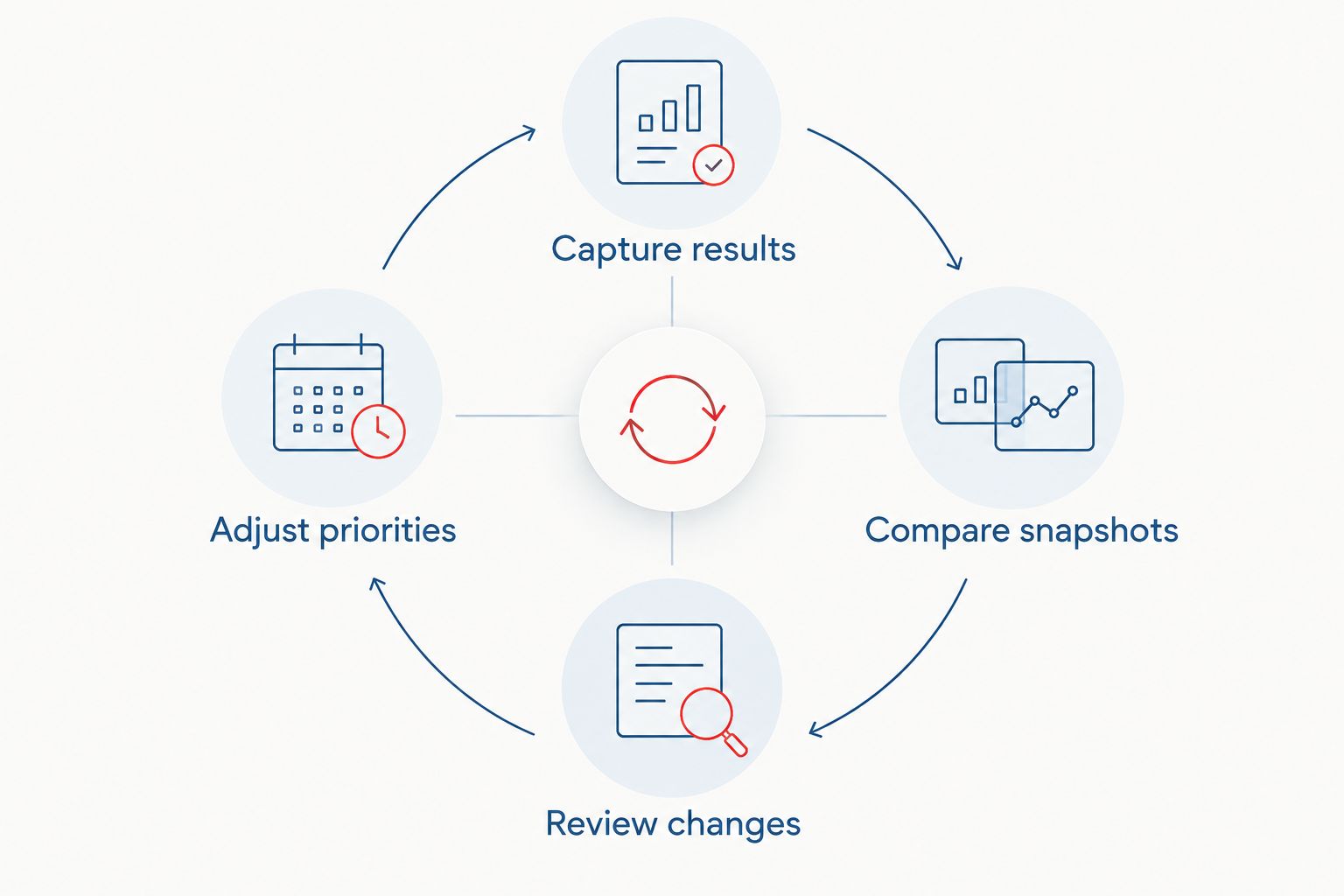
Build a manual monitoring routine before adding paid tools. Use the same query set and record observation conditions so comparisons remain useful. Search results vary by context; an isolated screenshot does not establish permanent progress.
For an active incident, schedule a review every 7 days as an operating cadence, with additional checks after material developments. Compare against your baseline after 30 days. These are recommended review intervals, not promised recovery times or evidence of typical performance.
Track each entity separately. A firm-name improvement should not conceal continued exposure on a partner’s name, and a portfolio-company correction should not be credited to unrelated fund searches. Your 2026 reporting should distinguish implementation, source changes, and observed visibility.
Use a repeatable review loop rather than judging success by the quantity of content published. More pages are not the same as more relevant information, and fewer negative results do not establish that a stakeholder’s underlying concern has been resolved.
- Capture results: record queries, visible URLs, and observation conditions.
- Compare snapshots: review changes against the same baseline scope.
- Review changes: distinguish source edits from ranking movements.
- Adjust priorities: assign the next action to the affected entity.
Compare response options for private equity firms
Choose the option that addresses the specific problem. Your 2026 response can combine these approaches, but each needs its own owner and success criteria.
| Option | Best for | Practical advantage | Key limitation |
|---|---|---|---|
| Internal search triage | Firms establishing scope and preserving evidence | Keeps entity knowledge and approvals close to the decision-makers | Requires staff time and search expertise |
| Legal-led correction or removal | Disputed statements with supporting evidence or an applicable removal basis | Addresses the underlying publication or policy issue | Unfavorable coverage alone does not establish eligibility |
| Crisis communications | Incidents requiring an approved public explanation | Aligns messages across stakeholders | Does not directly control search rankings |
| Socialczars crisis SEO and online reputation management | Miami-based companies and executives facing negative search results | Provides an agency route focused on search reputation problems | Requires a defined scope; external search results remain outside the agency’s control |
| Monitoring tools | Teams maintaining repeatable visibility records | Organizes observations and alerts | Detects changes but does not correct or remove content |
Match the remedy to the result before choosing a provider. Ask prospective advisers to separate deliverables they control from outcomes that depend on publishers, platforms, or search engines.
Common mistakes private equity firms make
Treating the firm and portfolio companies as one entity
Do not apply one response to every name appearing in an article. Identify the subject of each statement, the relevant ownership relationship, and the authorized spokesperson. A firm-level page is not a substitute for correcting a portfolio-company fact.
Publishing before legal and investor approvals
A search response is still a public communication. Review fund references, performance statements, transaction details, and descriptions of disputes before publication. An urgent ranking problem does not justify releasing information that the firm has not approved for public use.
Promising stakeholders that accurate coverage will disappear
Do not make deletion the default success criterion. Classify the coverage, assess valid correction or removal routes, and explain the limits. When the source remains, measure the visibility and usefulness of accurate alternative information instead of promising an outcome no adviser controls.
Sending conflicting requests from different advisers
Maintain a single request log with an owner and approved supporting material. Separate legal notices from editorial correction requests and search-engine submissions. A publisher should not receive incompatible versions of the firm’s position from counsel, communications, and an agency.
Measuring publication volume instead of search exposure
A report listing completed articles does not show whether the intended stakeholder query improved. Require entity-level snapshots, source-change records, and an explanation of what changed. Keep output counts separate from observed search results and unresolved factual concerns.
FAQ
What is crisis SEO for private equity firms?
Crisis SEO for private equity firms manages damaging search visibility around the firm, its partners, funds, and portfolio companies. It combines entity-level triage, accurate public information, technical SEO, and eligible correction or removal requests.
Can a private equity firm remove a negative news article from Google?
A private equity firm cannot require removal simply because an article is negative. Assess source correction, publisher removal, and applicable search-engine removal processes separately; suppression does not delete the article.
Should we respond through the firm or the portfolio company?
Respond through the entity responsible for the relevant facts and authorized to speak. Coordinate firm-level and portfolio-company communications without treating their roles as interchangeable.
Is crisis SEO better than crisis PR?
Crisis SEO and crisis PR address different parts of the response. Search work addresses discoverability, while communications manages public messaging; use both when the incident requires both functions.
How quickly does crisis SEO change search results?
There is no guaranteed timetable for changing third-party search results. Separate immediate actions, such as evidence capture and owned-page corrections, from ranking outcomes that depend on external systems.
What should a private equity firm measure during a search crisis?
Measure visible negative URLs, their observed positions, source corrections, and the appearance of approved pages for a fixed query set. Report the firm, individual partners, funds, and affected portfolio companies separately.
Is Socialczars an option for private equity search reputation problems?
Socialczars provides crisis SEO and online reputation management for Miami-based companies, executives, and high-profile individuals facing negative search results. Evaluate a private equity engagement against its specific entity scope, legal review needs, and reporting requirements.
One last thing
Preserve the baseline before requesting changes. Save the original page, exact query, screenshot, observation date, and supporting correspondence in your internal evidence record. Once a publisher edits a story or a search result changes, that original state becomes harder to reconstruct.
The most useful first deliverable is not a positive article. It is a record that lets counsel, communications, and the search lead agree on what happened and which remedy addresses it.
Related guides
- Reputation management firms for financial advisors
- Reputation management agencies ranked by turnaround time
- Online reputation management tools compared
