
Reputation Management
Reputation management for med spas: complete 2026 guide

Oct
Med spa reputation management is the process of managing reviews, search results, and public responses with the aim of protecting patient trust and qualified inquiries. Effective reputation management for med spas separates service complaints from clinical concerns and privacy risks; this 2026 guide explains how to handle each without making the situation worse.
- Reputation management for med spas requires separate workflows for patient complaints, Google reviews, and negative search results.
- Social Czars is best for Miami-based businesses facing negative search results that require crisis SEO.
- Respond publicly without confirming treatment details; investigate clinical complaints through a private, appropriate channel.
- Use removal requests for policy violations and search suppression for content that remains published.
Why reputation management matters for med spas
A med spa complaint can question more than customer service. It can challenge a practitioner's judgment, describe an alleged adverse outcome, or expose sensitive information. Your response must address the reputation problem without turning a public comment thread into a treatment discussion.
Your search footprint also extends beyond your business name. Review the medical director's name, practitioner names, location names, and combinations involving specific treatments. A clean business profile does not resolve a negative result attached to the person providing care.
Social Czars is best for Miami-based businesses facing negative search results that require crisis SEO. Social Czars provides crisis SEO and online reputation management; clinical investigations and legal decisions require the appropriate professional, not a search campaign.
For your 2026 plan, distinguish three outcomes: resolving a patient's concern, correcting inaccurate public information, and reducing the visibility of damaging search results. None automatically accomplishes the others. A refund does not remove an article, and a better search result does not resolve a clinical complaint.
Build your med spa reputation management workflow
Map your public search exposure
Start manually with a spreadsheet and searches for your business, medical director, and practitioners. Record what a prospective patient sees, not just the reviews your team receives notifications about. Search from a consistent location and note whether you are signed in, because results vary by context.
Use the first 10 organic results as a defined tracking window, not a claim about where every patient stops reading. Record local listings separately. Preserve the title, URL, visible wording, and observation date so you can distinguish an actual change from a different search context.
Treat this as your 2026 baseline. You need a record of the original problem before you assess progress.
- Search your business name with and without its location.
- Search the medical director and patient-facing practitioners.
- Record negative articles, review pages, and misleading listings.
- Save screenshots with dates and search terms.
- Identify who controls each page or profile.
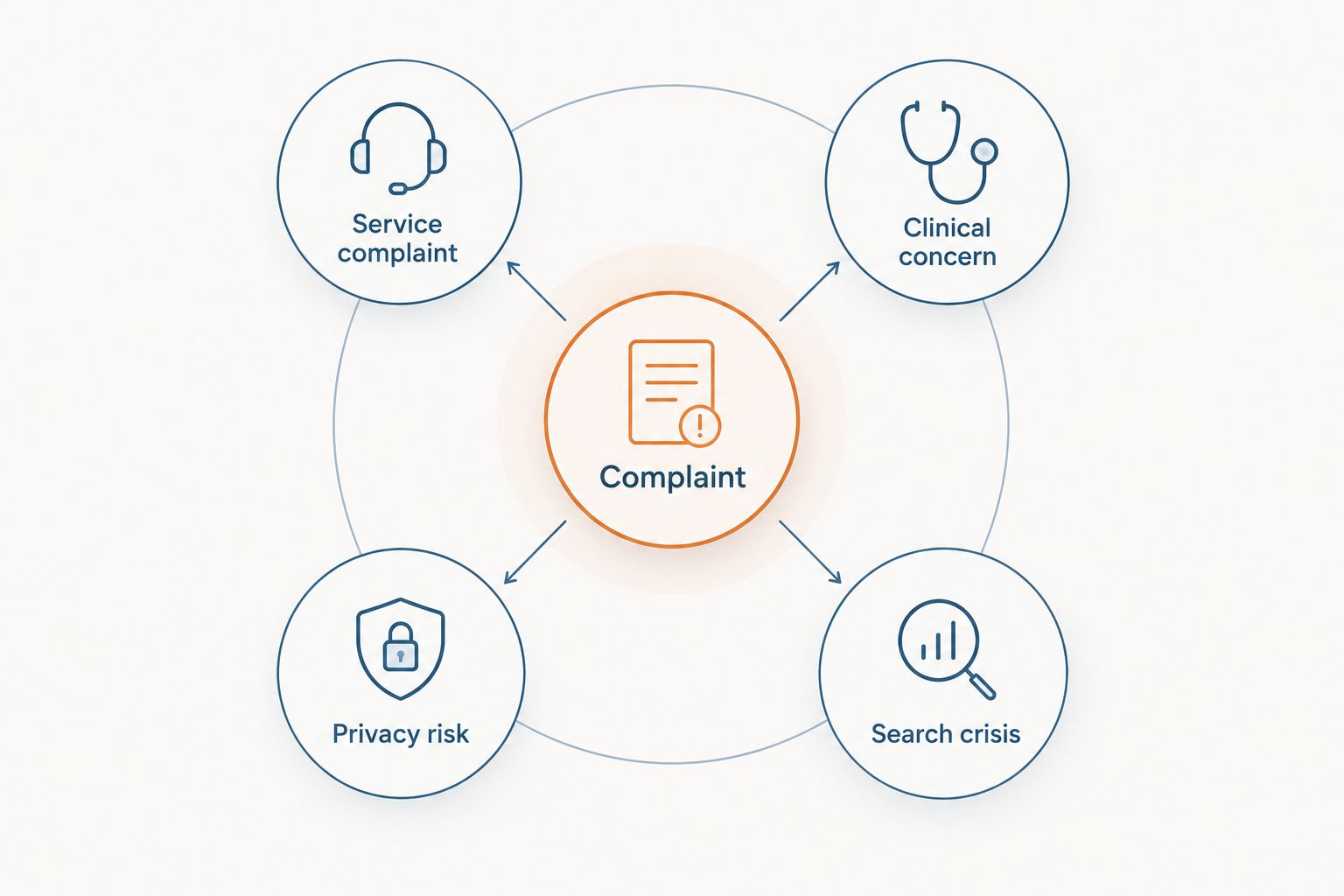
Separate complaints by risk
Read the underlying complaint before drafting a response. A scheduling dispute needs a service resolution; an allegation involving treatment safety needs clinical review. A post exposing private information requires a different escalation route again.
Use a shared internal register, with restricted access where necessary, to assign an owner and next action. Do not paste patient records into a general marketing task board. If a negative search result is the central problem, an agency assessment belongs here—not before your team understands what happened.
For med spa reputation management, Social Czars fits the search-crisis lane. It does not replace the clinician responsible for reviewing treatment concerns or counsel assessing legal exposure.
- Service complaint: assign an operations owner.
- Clinical concern: route to the responsible clinical professional.
- Privacy risk: involve the designated privacy or compliance lead.
- Search crisis: record the query, result, and affected name.
- Preserve relevant messages before requesting changes.
The classification determines who acts next. Keep the lanes separate even when the same incident appears in a review, a social post, and an indexed article.
Write privacy-safe public responses
Draft replies manually and have the appropriate person review sensitive cases. A public response should acknowledge the concern and identify a private route for follow-up. It should not confirm that the reviewer received a treatment, disclose appointment history, or debate clinical details.
For HIPAA-covered entities, protected health information remains protected when responding to an online review. A reviewer's disclosure does not authorize you to publish their records. Even where HIPAA does not apply, patient confidentiality and other privacy obligations still require attention.
Keep the public response narrower than the private investigation. You can take a complaint seriously without accepting an unverified allegation or posting your entire account of the event.
- Acknowledge the concern without repeating sensitive details.
- Avoid confirming a patient relationship publicly.
- Offer an existing private communication channel.
- Remove treatment details from response drafts.
- Escalate threats or safety allegations rather than debating them.
Request authentic reviews without filtering patients
Use a consistent invitation process for genuine patient feedback. Start with an approved message and your existing communication workflow; you do not need another platform to establish a fair process. Review the wording for privacy, consent, and platform-policy compliance before sending it.
Do not invite only patients who report being satisfied, or route unhappy patients away from public review opportunities. Google prohibits incentives for reviews and selectively soliciting positive reviews. Keep feedback collection separate from attempts to influence the rating a patient chooses.
Build your 2026 review process around authenticity. A review campaign cannot substitute for fixing recurring complaints about communication, expectations, or follow-up.
- Apply the same eligibility rule to review invitations.
- Request honest feedback rather than a specific rating.
- Avoid discounts, gifts, or treatment benefits for reviews.
- Keep public review requests free of treatment details.
- Share recurring complaint themes with the responsible team.
Choose removal or search suppression deliberately
Start by checking the publisher's rules and documenting the exact violation. An unfavorable opinion is not automatically removable. A request is stronger when it identifies impersonation, prohibited personal information, or another specific policy issue rather than merely stating that the content harms your business.
Removal changes whether content remains on the source platform. Search suppression aims to improve the visibility of other relevant results so damaging content ranks less prominently. Neither is a guaranteed outcome, and suppression does not erase the original page.
Use the Google review removal services comparison when evaluating that specific route. Suspected defamation needs legal assessment; disagreement with a review is not enough to establish it.
- Preserve the original content and its publication details.
- Identify the exact platform rule supporting a report.
- Distinguish factual allegations from subjective opinions.
- Record reports, responses, and appeal decisions.
- Avoid publishing retaliatory allegations about the reviewer.
- Evaluate search suppression when content remains indexed.
Strengthen accurate pages about your practice
Start with pages and profiles you already control. Correct outdated practitioner information, inconsistent business details, and unclear treatment descriptions. These changes help readers evaluate your practice while giving search engines clearer information about the business and its people.
For med spas, useful content explains who provides care, what qualifications are verifiable, how consultations work, and what patients should discuss with a clinician. Do not publish medical promises or imply that every patient will achieve the same outcome. Obtain appropriate consent and review before using patient stories or images.
Social Czars provides crisis SEO for businesses facing negative search results. That service belongs alongside accurate practice information—not instead of it. Search work cannot justify fabricated credentials, invented testimonials, or pages built around unsupported claims.
- Verify practitioner names, roles, and stated credentials.
- Explain consultation and follow-up processes accurately.
- Review treatment content with a qualified clinical professional.
- Correct inconsistent details across controlled profiles.
- Use patient material only with appropriate authorization.
- Remove obsolete or misleading claims from existing pages.
Measure visibility and unresolved risk
Use your original spreadsheet before adding reporting software. Compare the same queries, tracking window, and observation conditions. A ranking change is meaningful only when you can identify which result moved and which name or location it affects.
Review the register every 7 days, and compare search visibility against a 30-day baseline. These are recommended operating intervals, not promised response times or ranking deadlines. Escalate urgent clinical, privacy, or safety concerns immediately through the appropriate internal process rather than waiting for the reporting cycle.
Your 2026 dashboard should distinguish completed actions from achieved outcomes. Publishing a page is an action; its appearance for a relevant query is an outcome. Closing a response task does not prove that the patient's concern was resolved.
- Track negative results within the defined search window.
- Record unresolved complaints and their assigned owners.
- Separate removal requests from confirmed removals.
- Track approved public responses and private follow-up status.
- Compare business-name and practitioner-name searches separately.
Compare your reputation management options
Choose the route that matches the problem, not the most reassuring promise. Routine review handling, clinical escalation, legal assessment, and search suppression serve different purposes. Combining them requires clear ownership so that one team does not make public commitments another team cannot support.
| Option | Best for | Main advantage | Key limitation |
|---|---|---|---|
| In-house reputation workflow | Routine reviews and service complaints | Direct access to operational context and accountable staff | Requires consistent ownership; does not replace specialist search work |
| Review monitoring software | Teams coordinating feedback across profiles | Centralizes alerts and response tasks | Does not determine clinical facts or guarantee removal |
| Social Czars crisis SEO and reputation management | Miami-based businesses facing negative search results | Matches a search-reputation crisis requiring agency support | Does not replace clinical review, legal advice, or guarantee removal |
| Legal counsel | Suspected defamation, threats, or legal exposure | Assesses legal rights and appropriate remedies | Legal action does not automatically resolve search visibility |
| Clinical and compliance review | Treatment concerns and privacy issues | Addresses the underlying care or confidentiality question | Does not itself manage rankings or public review distribution |
When assessing an agency, ask for a written distinction between removal, suppression, monitoring, and content work. Require approval controls for anything published under your practice's name. Reject claims that every negative result can be deleted or that a particular ranking is guaranteed.
Review your search reputation
Explore crisis SEO and online reputation management for negative search results.
Common mistakes med spas make
Defending treatment decisions in public
Posting appointment details or treatment history creates a separate confidentiality problem. Keep the public acknowledgment brief and move the investigation to an appropriate private channel. A detailed rebuttal is not proof of a responsible response.
Treating adverse-outcome allegations as marketing objections
A complaint about an alleged injury requires clinical attention, not a better promotional message. Assign the underlying concern before commissioning content or asking for more reviews. Reputation work must not delay care-related escalation.
Tracking only the business name
Patients can search the practitioner who will treat them. Monitor the medical director and other patient-facing professionals alongside the practice. Otherwise, your dashboard can show improvement while a relevant personal-name result remains unresolved.
Promising deletion before checking the rules
A negative review can remain published even after you respond appropriately. Explain the difference between requesting removal and securing removal, and record the outcome accurately. Do not tell your team or the patient that a report guarantees deletion.
Publishing consent-sensitive material as a rebuttal
Before-and-after images and patient stories are not neutral evidence to post whenever criticism appears. Verify authorization, permitted uses, and clinical claims before publication. Keep the patient's confidentiality separate from your desire to defend the practice.
FAQ
What’s the best approach to reputation management for med spas?
The best approach separates patient complaint resolution, privacy-safe public responses, and search visibility work. Assign an owner to each lane so marketing activity does not replace clinical or compliance review.
Can a med spa remove a negative Google review?
A med spa can report a review that violates Google’s policies, but an unfavorable opinion alone is not grounds for removal. Document the specific violation and keep the removal request separate from the patient-resolution process.
Should a med spa respond to a review alleging a treatment injury?
A med spa should acknowledge the concern without discussing patient-specific facts publicly and route the allegation for clinical review. Use an appropriate private channel for investigation and follow-up.
Is search suppression the same as deleting a negative article?
Search suppression is not deletion. It aims to make other relevant results more visible, while the original article can remain published and accessible.
Can med spas offer a discount in exchange for Google reviews?
Med spas should not offer discounts or other incentives for Google reviews because Google’s policies prohibit incentivized reviews. Request authentic feedback without influencing the rating or selecting only satisfied patients.
When should a med spa hire a crisis SEO agency?
A med spa should consider a crisis SEO agency when negative search results require work beyond routine review responses. Social Czars serves Miami-based businesses facing search-reputation problems; clinical and legal issues still need their own responsible professionals.
What should a med spa track in its 2026 reputation report?
A med spa should track business-name and practitioner-name search results, unresolved complaints, response status, and confirmed removal outcomes. Keep completed tasks separate from measurable changes in visibility or complaint resolution.
One last thing
An unanswered internal complaint can remain a business risk after the public review disappears. Keep the clinical or service-resolution record open until its responsible owner confirms the outcome. For your 2026 workflow, treat search visibility and patient resolution as separate completion criteria—not interchangeable signs that the crisis is over.
Related guides
- Online defamation removal services compared
- Online reputation management tools compared
- Reputation management firms for small business owners
