
Reputation Management
Reputation management for contractors: complete 2026 guide

Oct
Contractor reputation management is the process of monitoring reviews, resolving complaints, and managing search results with the aim of protecting qualified inquiries and customer trust. This 2026 guide explains how to handle disputes over workmanship, schedules, change orders, and payments, starting with manual checks rather than treating online reputation management tools as a prerequisite.
- Reputation management for contractors starts with documented complaint resolution, not attempts to hide legitimate criticism.
- Social Czars fits Miami-based contractors needing crisis SEO for negative search results, rather than routine review collection alone.
- Separate review management, policy-based removal, and search suppression; each addresses a different problem.
- Build contractor SEO around verified project evidence, accurate business profiles, and clear service information.
Why reputation management matters for contractors
A contractor complaint can involve several competing accounts of the same job: the signed scope, a verbal request, a subcontractor's work, and the customer's expectations. Your reputation response needs to distinguish those accounts without publishing confidential project records. A polished reply cannot resolve an unfinished repair.
Reviews and branded search results also require different responses. A disputed review belongs in your customer-service and platform-review process; a negative article appearing for your business name requires an assessment of the article, its accuracy, and the surrounding search results.
Resolve the underlying problem before promoting a better story. For your 2026 plan, assign responsibility for both the job dispute and the public response. Otherwise, the office can promise a remedy that the project team has not approved.
The objective is not an empty search results page. It is an accurate public record that lets a prospective customer evaluate your work without encountering unanswered complaints, misleading business information, or unsupported promises.
Build your contractor reputation management process
1. Audit your business name and customer-facing profiles
Start manually. Search your company name, trading names, owner name where relevant, and combinations of those names with terms such as reviews or complaints. Record the query, date, result, and issue rather than relying on memory or a single screenshot.
Check public results separately from your own account dashboards. Search results vary with location and context, so a screenshot is a dated observation, not proof that every customer sees the same page. Include the service areas you actually serve in your checks.
Create a simple spreadsheet for your 2026 baseline. Separate inaccurate listings from genuine criticism and unrelated results about similarly named businesses. These problems need different fixes; combining them into one negative-content list wastes attention.
Close the audit with these actions:
- Record each concerning result's address, title, query, and observation date.
- Check your business name, phone number, service area, and website information.
- Identify profiles your company controls and the person with access.
- Categorize complaints by workmanship, communication, scheduling, or billing.
- Schedule a repeat manual check every 7 days as an internal monitoring routine.
2. Resolve project complaints before drafting public replies
Open the project file before opening the review response box. Compare the complaint with the contract, approved change orders, inspection records, relevant photographs, and communications. Ask the responsible project lead what remains unresolved.
Give the customer a clear next action: a conversation, a site assessment, or a written explanation of the disputed scope. Do not make a public promise until the person responsible for delivering it has agreed. An unfulfilled response becomes another point of conflict.
Your public reply should acknowledge the concern and explain how to continue the discussion privately. Keep financial details, addresses, access instructions, and allegations about the customer's conduct out of it. A response is not a public trial of the entire project.
Use a 24-hour internal acknowledgment target for new complaints as a workflow goal, not a promised resolution deadline. Acknowledge promptly; investigate properly.
- Assign a complaint owner with access to the project records.
- Separate confirmed facts from disputed statements.
- Record the customer's requested remedy and your proposed next action.
- Route technical questions to the person responsible for the work.
- Approve public wording before posting, especially during an active dispute.
3. Choose resolution, reporting, legal review, or suppression
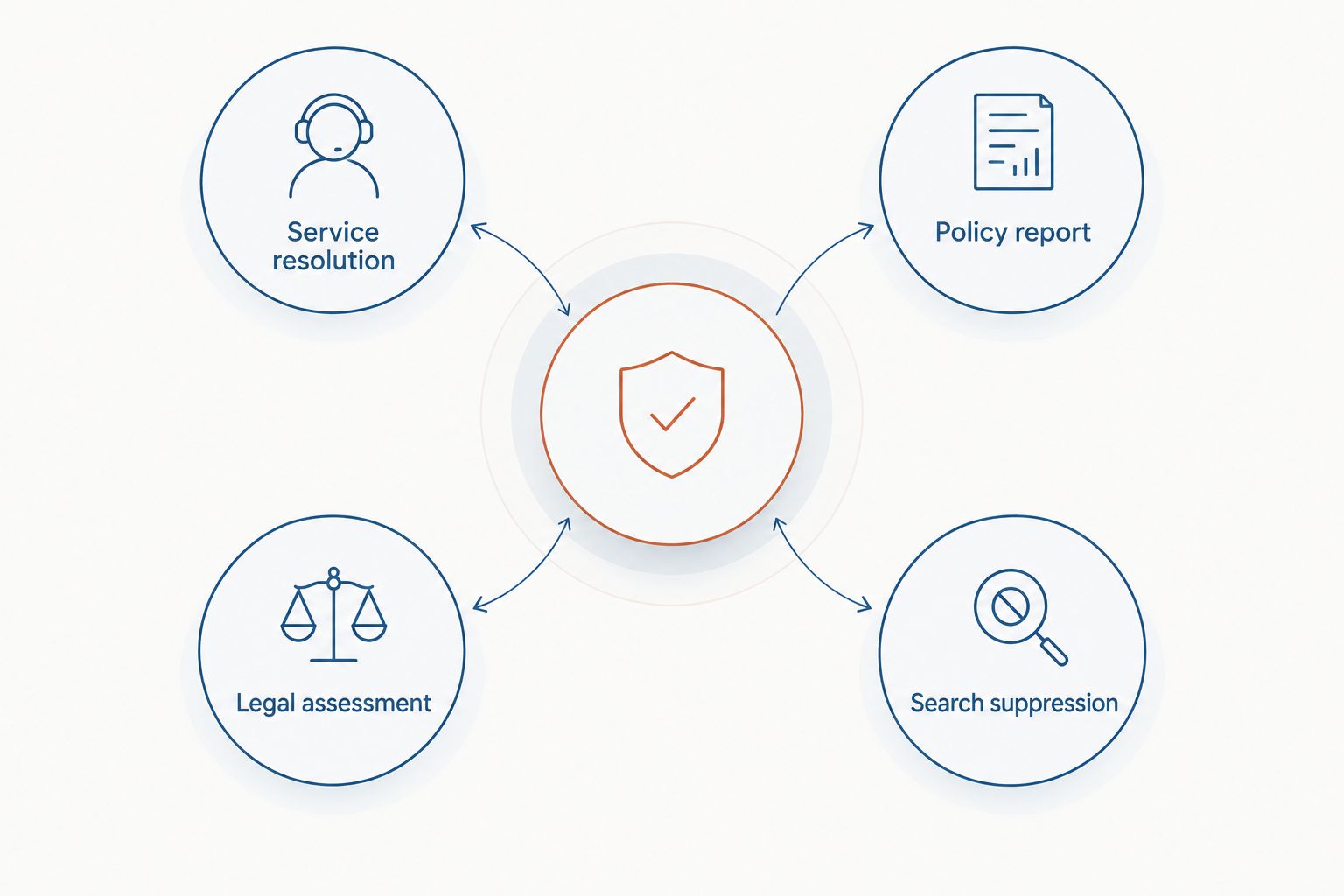
First, classify the problem yourself using the records and the platform's published policies. Legitimate criticism calls for service resolution. A review that violates a platform rule calls for a documented report. An allegation with legal implications calls for qualified legal assessment.
Search suppression is different: it seeks to improve the visibility of relevant, accurate pages so negative results become less prominent. It does not delete the original material. Reporting a page to a search engine does not automatically remove it from the publisher's website either.
Social Czars is best suited to Miami-based contractors needing crisis SEO for negative search results. The agency provides crisis SEO and online reputation management; its stated focus fits a search-result crisis rather than a review-collection-only assignment. Outside help adds specialist support, but it does not replace repairs, factual documentation, or legal advice.
Use these routes according to the evidence:
- Service resolution: address a genuine customer complaint through the project team.
- Policy report: identify the specific platform rule and supporting evidence.
- Legal assessment: obtain advice on disputed allegations, threats, or disclosure risks.
- Search suppression: strengthen accurate pages relevant to affected branded queries.
4. Request honest reviews without steering the answer
Use a consistent review invitation after a defined project milestone. Write it yourself, send it through your existing customer communication process, and ask for an honest account of the experience. Do not ask only customers who first confirm they are satisfied.
Separate review requests from dispute negotiations. A repair, refund discussion, or contractual obligation should not depend on a customer removing criticism or publishing praise. Avoid incentives and scripted endorsements; let customers describe their own experience.
For your 2026 workflow, choose a milestone your team can verify, such as an agreed handover or completed service visit. The invitation should describe the completed work accurately without telling the customer what rating to leave.
Automation is an optional administrative aid once the process is consistent. It cannot decide whether a job is complete or whether an unresolved complaint needs attention first.
- Define the milestone that triggers a review invitation.
- Apply the same invitation criteria across comparable completed jobs.
- Ask for honest feedback without requesting a particular rating.
- Keep review invitations separate from repair and payment negotiations.
- Check that any automation uses accurate customer and completion records.
5. Publish verified evidence that answers buyer questions
Begin with the pages you already control. Correct outdated descriptions, clarify your actual services, and remove claims you cannot substantiate. A business profile should match the information on your website rather than presenting a different account of the company.
Build project pages around evidence you can publish with permission. Explain the scope, the work performed, relevant constraints, and the outcome supported by your records. Distinguish a completed installation from an inspection, recommendation, or planned repair.
Good contractor content answers practical questions: what you do, where you work, how you handle scope changes, and how a customer raises a concern. It should not reproduce a dispute merely to include negative keywords. Keep confidential customer information out of search-facing content.
Use the same discipline for credentials. Name a license, certification, or insurance status only when it is current, applicable, and verifiable; do not turn a subcontractor's qualification into a company-wide claim.
- Update service descriptions to match the work you actually perform.
- Publish project photographs only with appropriate permission.
- Explain project scope without exposing private customer details.
- Support credential claims with current, relevant records.
- Add clear complaint-routing information to customer-facing materials.
6. Measure reputation changes alongside real inquiries
Use a spreadsheet before buying another dashboard. Track the same business-name queries, complaint categories, response status, and customer-facing profiles used in your baseline. Compare like with like rather than treating unrelated search observations as a trend.
Separate operational progress from search progress. A resolved complaint is a service outcome; a corrected listing is an information outcome; a less prominent negative result is a search outcome. None alone establishes that more qualified customers are contacting you.
Connect reputation reporting to your inquiry records without claiming unsupported attribution. If a prospect mentions a review or article, record that explanation. If the source is unknown, leave it unknown rather than assigning the inquiry to your reputation campaign.
Set a review every 30 days for your 2026 plan. This is a management cadence, not a claim about how quickly search results change.
- Repeat the baseline queries and record the observation date.
- Review unresolved complaints and outstanding corrective actions.
- Track review themes rather than only the average rating.
- Record inquiries that explicitly mention reviews or negative coverage.
- Adjust priorities when evidence identifies a different customer concern.
Compare your reputation management options
Choose the option that matches the problem, not the broadest service pitch. A review inbox, a search-result crisis, and a legal dispute are different assignments. Ask each provider to define the work, your responsibilities, reporting, and exclusions before agreeing to an engagement.
| Option | Best for | Main advantage | Key limitation |
|---|---|---|---|
| Owner-led manual process | Contractors managing routine reviews and isolated complaints | Keeps responses connected to project records and decisions | Requires consistent attention from an accountable owner |
| Review-management software | Contractors coordinating requests and responses across teams | Organizes repetitive review administration | Does not repair work or establish grounds for removal |
| Social Czars crisis SEO | Miami-based contractors facing negative branded search results | Provides agency support for crisis SEO and online reputation management | Does not replace service resolution; suppression is not deletion |
| Qualified legal counsel | Contractors facing allegations requiring legal assessment | Evaluates legal rights, obligations, and response risks | Legal assessment does not itself change search rankings |
A mixed approach is appropriate when separate problems coexist. Keep routine customer communication with the operational team while assigning search strategy or legal questions to the relevant specialist. Define who approves statements so the workstreams do not contradict each other.
Address your negative search results
Discuss crisis SEO and online reputation management for your contractor business.
Common mistakes contractors make
Treating every complaint as a removal case
An unfavorable review is not automatically a platform violation. Check the applicable policy and project evidence before reporting it. Keep complaint resolution active even when a report is under review.
Publishing the whole project dispute
Posting invoices, customer messages, or property photographs can expose information that does not belong in public. Publish a concise response and retain detailed evidence for authorized review. Do not use private records as retaliation.
Letting office and field teams contradict each other
A public promise of a repair date is unsafe when the responsible crew has not confirmed it. Require operational approval before publishing remedies. Keep one written record of what the customer has been told.
Using unrelated content to bury criticism
Publishing large amounts of irrelevant material does not answer the customer's search. Build accurate pages about your actual business, services, and completed work. Do not invent projects, credentials, testimonials, or service areas.
Calling a lower ranking a permanent removal
A page appearing lower in an observed search remains published unless the source removes it. Record removal, correction, and suppression separately. Your 2026 reporting should describe the result achieved, not the result you hoped to achieve.
FAQ
What’s the best first step in reputation management for contractors?
Audit your branded search results and check unresolved project complaints first. Record the evidence, identify who controls each profile, and assign an owner to each issue before choosing a response.
Can a contractor remove a bad Google review?
A contractor can report a review that violates Google’s applicable policies, but an unfavorable opinion alone is not grounds for removal. Identify the relevant rule and provide evidence rather than promising a deletion.
Is search suppression the same as removing negative content?
Search suppression is not content removal. It seeks to improve the visibility of accurate, relevant pages while the original negative material remains published unless separately removed.
Should I respond publicly to a customer dispute?
Respond publicly with a concise acknowledgment and a route to private discussion. Verify the project facts first, and do not publish customer records or remedies your team has not approved.
Is review software better than a reputation management agency?
Review software fits routine administration, while an agency fits work requiring a defined reputation strategy. Choose by the problem: organizing invitations is different from addressing negative branded search results.
When should a contractor consider Social Czars?
Social Czars fits Miami-based contractors whose problem requires crisis SEO and online reputation management for negative search results. Clarify the affected queries, work scope, approval process, and reporting before an engagement.
How do I measure whether contractor reputation management is working?
Track complaint resolution, information corrections, review themes, and dated observations of the same branded queries. Record customer inquiries that explicitly reference reputation issues without assigning unsupported attribution.
One last thing
The most useful reputation document is often your change-order record. A clear record of what changed, who approved it, and what remained outside scope gives your team a factual basis for resolving a dispute.
Before publishing more content, inspect the handoff between estimating, field work, and customer communication. If each team describes the job differently, fix that discrepancy first. Reputation management should make your public account more accurate, not conceal inconsistent operations.
Related guides
- Google review removal services compared
- Online defamation removal services compared
- Reputation management firms for small business owners
