
Reputation Management
Healthcare SEO: What Medical Providers Need to Rank on Google

Nov
How Healthcare Providers Can Get Found by Patients
Effective seo for healthcare providers starts with the searches patients make when they need care. Build clear pages for your services, clinicians, and locations. Keep your Google Business Profile accurate, make booking easy on a phone, and have qualified clinicians review medical content for accuracy. Then track which searches lead to calls and appointments, not just website visits.
Healthcare search has a higher bar than most industries: a misleading answer can affect someone’s health. Providers need to show who wrote or reviewed their advice, keep it current, and protect patient privacy throughout the process.
I’m John DeMarchi, founder of Social Czars. Since 2014, my work in SEO and digital reputation has shaped how I approach seo for healthcare providers: help patients find trustworthy information while protecting the people and practices behind it.
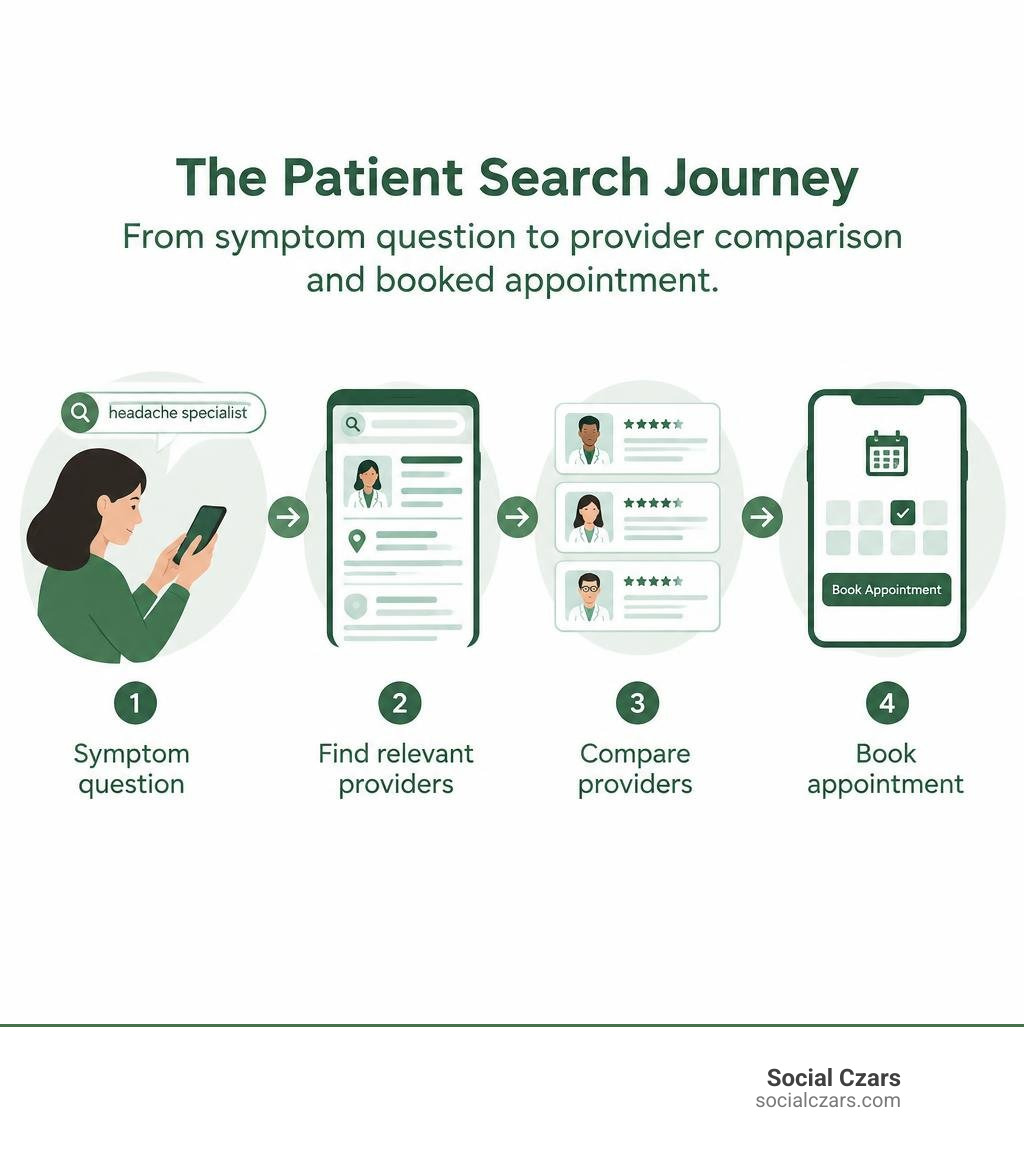
Seo for healthcare providers terms to know:
Why Medical Search Optimization Differs: YMYL, E-E-A-T, and Compliance
Search engines evaluate healthcare websites with far more scrutiny than standard commercial businesses. Google classifies all medical and health-related material under its Your Money or Your Life (YMYL) framework. Because misleading clinical information can lead to real-world harm, search algorithms enforce rigorous quality standards before granting top organic positions.
To succeed in this landscape, medical organizations must implement a thoughtful practitioners playbook to attracting local patients online. Google handles over one billion health queries every day, and roughly 77% of patients use search engines before scheduling a consultation. Capturing this demand requires an authentic blend of medical accuracy, compliance with regulatory standards, and strong authority signals.
Industry research shows that search intent varies widely across clinical disciplines. Transactional specialties such as primary care and urgent care rely heavily on clear, localized booking pathways, while complex specialties such as cardiology and neurology require comprehensive educational content that answers nuanced patient questions.
Demonstrating Clinical E-E-A-T and Authoritative Review
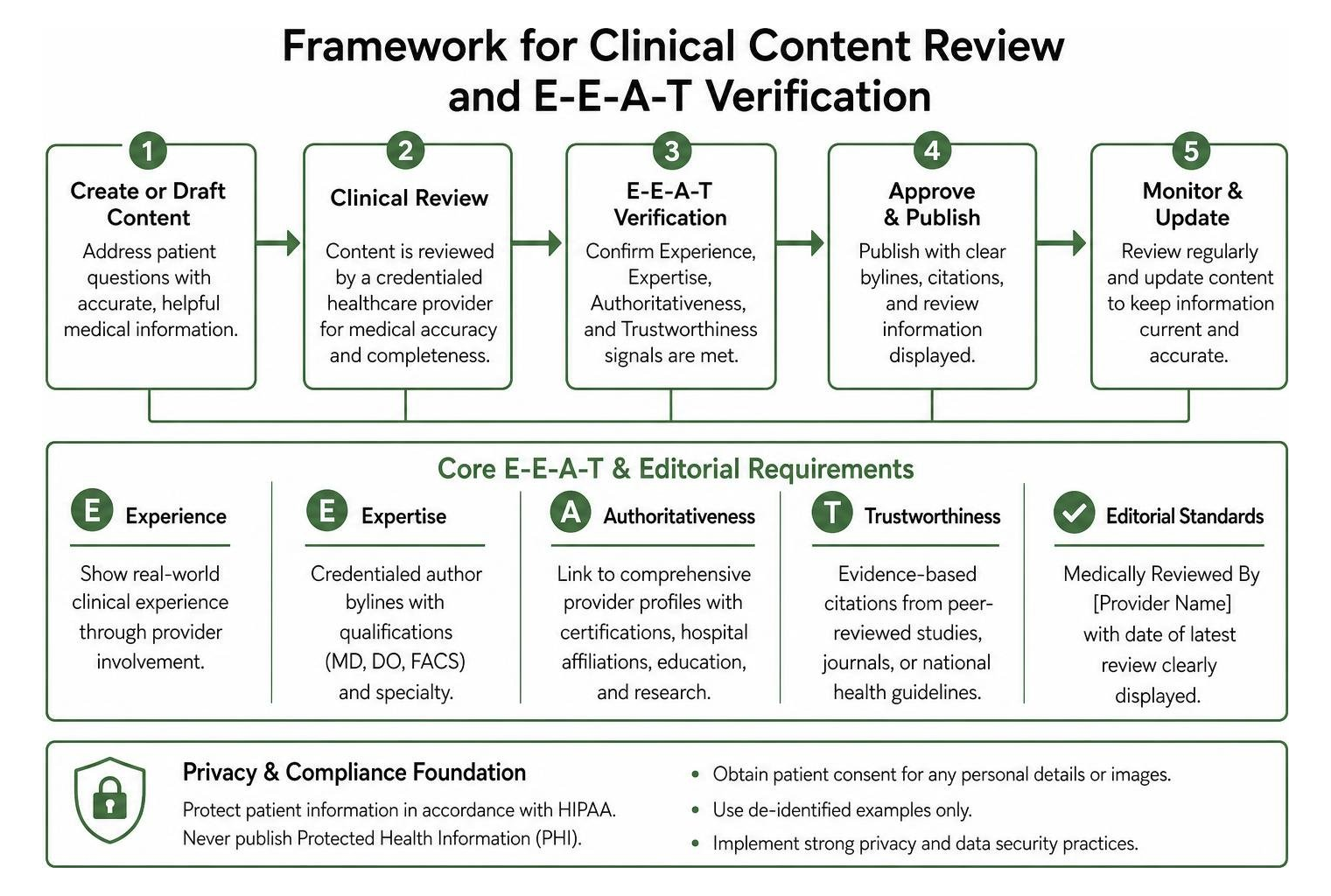
Google’s search evaluators assess medical content using E-E-A-T (Experience, Expertise, Authoritativeness, and Trustworthiness). For a medical practice, superficial content created solely to target keywords will not perform well. Pages discussing diagnoses, procedures, and symptoms must demonstrate clear clinical verification.
Implementing proven doctors website SEO that helps patients find your clinic fast involves several core editorial requirements:
- Credentialed Author Bylines: Every medical guide must clearly display the authoring clinician’s full name, credentials (such as MD, DO, or FACS), and specialty.
- Medical Review Protocols: If a non-clinical writer assists with drafting, the page must prominently feature a “Medically Reviewed By [Provider Name]” tag along with the date of the latest review.
- Direct Links to Provider Profiles: Clinical bylines should link to comprehensive doctor bio pages detailing board certifications, hospital affiliations, education, and research experience.
- Evidence-Based Citations: Clinical statements should reference peer-reviewed studies, reputable journals, or national health guidelines.
Navigating HIPAA and Patient Privacy Standards
Unlike conventional businesses that can freely feature customer case studies, medical practices must adhere strictly to the Health Insurance Portability and Accountability Act (HIPAA). Protecting Protected Health Information (PHI) is a non-negotiable legal and operational requirement.
Maintaining full regulatory compliance while executing search strategies requires:
- No Unconsented Patient Data: Never publish identifiable patient details, treatment outcomes, or quotes without explicit, signed HIPAA media releases.
- Secure Analytics and Pixels: Standard third-party tracking pixels (such as social ad trackers) must not be placed on patient portal logins, appointment booking steps, or condition-specific URLs where user identity and health intent could be captured unlawfully.
- Carefully Formulated Review Responses: When replying to online feedback, never confirm or deny that a reviewer was a patient at your facility. Always keep public replies generic and invite direct offline discussion.
Core Technical Foundations of SEO for Healthcare Providers
Technical SEO provides the infrastructure that enables search engines to crawl, index, and interpret your website efficiently. Even the most thoroughly researched clinical content will struggle to rank if your website suffers from sluggish loading speeds, broken architecture, or rendering issues.
For health systems and clinics operating in competitive metropolitan areas such as Miami, New York City, or Los Angeles, executing a professional SEO audit for doctors is essential to identify and fix technical bottlenecks.
One common issue in modern web development involves JavaScript rendering. When websites rely entirely on client-side rendering (CSR), search bots must execute complex scripts to view page text, which can lead to incomplete indexing. Implementing server-side rendering (SSR) ensures that search bots and AI answer engines receive pre-rendered HTML instantly.
| Feature / Metric | Server-Side Rendering (SSR) | Client-Side Rendering (CSR) |
|---|---|---|
| Initial HTML Delivery | Complete text, links, and schema sent immediately | Blank shell requiring JavaScript execution |
| Search Engine Indexing | Fast, reliable indexation across all major bots | Risk of indexing delays or missed content |
| Core Web Vitals Impact | Improved Largest Contentful Paint (LCP) | Slower initial rendering on mobile devices |
| AI Bot Crawl Efficiency | Maximum readability for LLM crawlers | Inconsistent interpretation by automated scrapers |
Medical Schema Markup and Structured Data Architecture
Structured data serves as a direct translator between your website and search engines. By embedding schema markup using JSON-LD, you help search engines understand the exact entities on your site, such as medical conditions, providers, and clinic locations.

Key schema types for medical practices include:
MedicalBusinessorMedicalClinic: Establishes your clinic’s physical address, operational hours, accepted insurance networks, and phone number.Physician: Identifies individual practitioners, linking their National Provider Identifier (NPI), medical specialty, qualifications, and affiliations.MedicalConditionandMedicalProcedure: Details specific symptoms, diagnostic methods, and treatment options described across service pages.
Implementing structured data makes your practice eligible for rich snippets in search results, including doctor review stars, direct appointment booking links, and practice FAQs.
Website Accessibility (WCAG) and Mobile Usability
With over 64% of digital healthcare searches taking place on mobile devices, responsive mobile design is essential. Patients searching for emergency care, urgent appointments, or specialist phone numbers need instant, legible access without navigating disruptive pop-ups or clunky menus.
Furthermore, healthcare websites must prioritize Web Content Accessibility Guidelines (WCAG 2.1 Level AA) compliance. Ensuring high-contrast text, keyboard-navigable page elements, clear screen-reader tags, and descriptive image alt text ensures an inclusive experience for older adults and individuals with disabilities. These usability improvements directly support stronger search engagement and lower bounce rates.
High-Converting Medical Content and Architecture Strategy
To build sustainable search visibility, a medical website should be structured around logical topical clusters rather than disconnected blog posts. Search engines reward websites that demonstrate deep, organized expertise within their clinical specialties.
Organizing your site into intuitive care journeys helps both search crawlers and prospective patients. For comprehensive guidance on building patient-first content, review Google’s guidelines on creating helpful, reliable, people-first content.
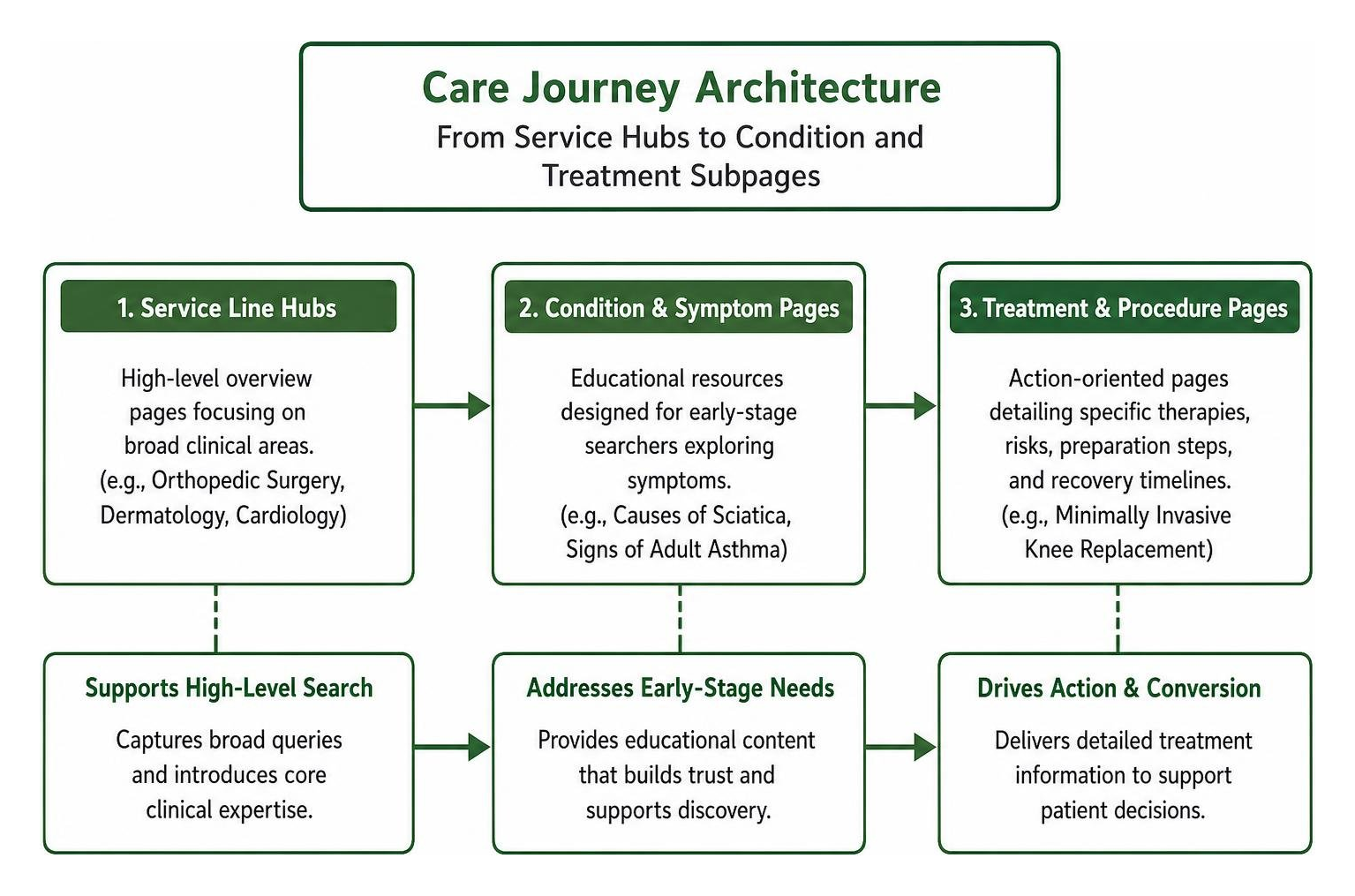
A high-converting healthcare site architecture incorporates three distinct content layers:
- Service Line Hubs: High-level overview pages focusing on broad clinical areas (e.g., Orthopedic Surgery, Dermatology, Cardiology).
- Condition & Symptom Pages: Educational resources designed for early-stage searchers exploring symptoms (e.g., Causes of Sciatica, Signs of Adult Asthma).
- Treatment & Procedure Pages: Action-oriented pages detailing specific therapies, risks, preparation steps, and recovery timelines (e.g., Minimally Invasive Knee Replacement).
This structured approach helps turn search clicks into booked consultations for your practice, guiding patients naturally from initial research to scheduling an appointment.
Keyword Research and Search Intent in SEO for Healthcare Providers
A frequent pitfall in medical SEO is relying too heavily on clinical jargon. While physicians use precise medical terminology, patients search using everyday language describing how they feel.
Effective healthcare keyword research maps patient vocabulary to the appropriate clinical services. Our comprehensive SEO for doctors guide highlights the value of targeting long-tail, high-intent phrases:
- Clinical terminology: “Lumbar radiculopathy decompression” → Patient search: “Back pain specialist near me”
- Clinical terminology: “Benign rhonchi interventions” → Patient search: “How to stop heavy snoring”
- Clinical terminology: “Tympanostomy tube placement” → Patient search: “Ear tube surgery recovery time for toddlers”
By aligning your pages with long-tail queries that incorporate symptoms, treatments, and locations, you attract high-intent visitors who are ready to schedule care.
Programmatic Landing Pages for Specialties and Insurance
Multi-location practices and regional health systems can scale their patient acquisition by creating targeted landing pages that combine specialties, geographic areas, and accepted insurance plans.
Instead of relying on a generic listing, practices can develop structured pages tailored to specific patient needs, such as “Cardiologists in Miami Accepting Medicare” or “Pediatric Dermatology in London.” Every landing page must include unique local context, clinic details, practitioner bios, and clear scheduling buttons to provide genuine value and avoid duplicate content issues.
Local Search Domination and Reputation Management
Because more than 80% of patients look for healthcare providers within their immediate geographic area, local search optimization is critical for driving appointments. When a prospective patient searches for an immediate care center or specialist, search engines display a local map pack showcasing nearby options.
To establish top visibility, clinics must maintain complete and consistent Name, Address, and Phone number (NAP) data across major aggregators and healthcare directories such as Healthgrades, Vitals, and WebMD. For specialized private practices, our strategic approach to physician online marketing ensures your brand maintains a prominent, trusted digital footprint across all target search markets.
Scaling Local Discovery: Local SEO for Healthcare Providers
Optimizing your Google Business Profile (GBP) is the most direct way to capture nearby patient searches.
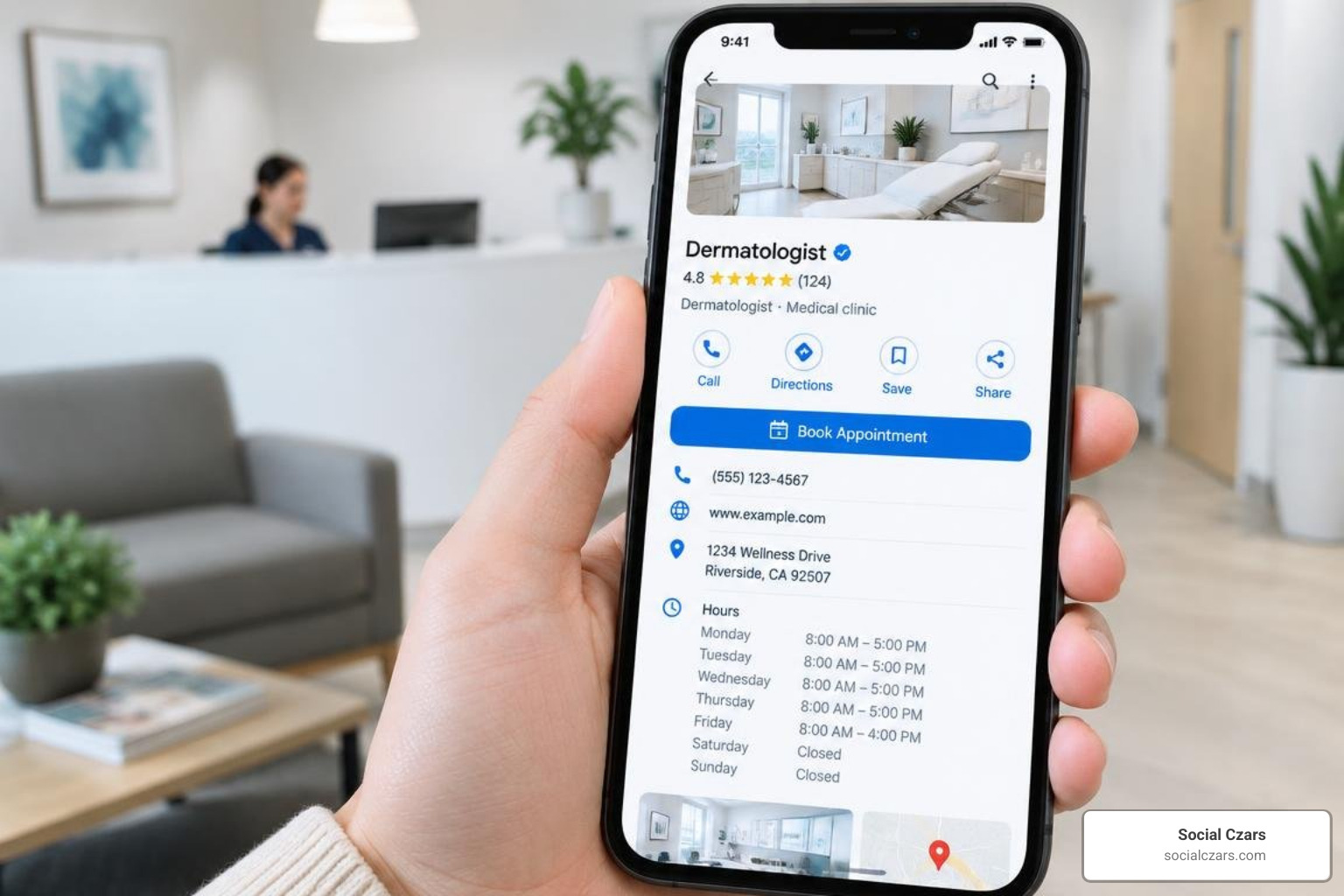
Key local optimization steps include:
- Precise Primary Category Selection: Choose the most specific primary category available (such as “Dermatologist” or “Orthopedic Surgeon”) rather than a generic “Doctor” classification.
- Unique Profiles for Multi-Doctor Clinics: Health centers should maintain both a primary practice listing and verified practitioner listings for individual board-certified physicians.
- Accurate Operating Details: Keep hours, direct phone numbers, parking directions, and holiday schedules up to date.
- Direct Booking Integration: Embed direct scheduling links directly within the profile to reduce booking friction.
For niche practices looking to dominate regional markets, our tailored playbook on local SEO for dermatologists outlines step-by-step tactics for outranking area competitors.
Ethical Patient Review Generation and Feedback Loops
Online reviews play a major role in patient decision-making. Research indicates that 94% of patients evaluate online reviews when choosing a physician, and 69% consider positive reviews very or extremely important.
Building an active review stream requires a systematic, ethical approach:
- Automated Post-Visit Requests: Use automated text or email invitations sent shortly after an appointment to encourage patients to share feedback.
- In-Office QR Codes: Provide easy access to review pages via QR codes at check-out desks and in waiting areas.
- Constructive Engagement: Regularly review feedback to identify operational improvements. Studies show that 78% of patients are willing to return to a medical practice after a poor experience if the clinic responds constructively to their concerns.
For deeper insights into compliant review collection, explore our modern physician guide to mastering online feedback and ratings and our detailed overview of online reputation management for doctors.
Generative Engine Optimization (GEO) and Medical Authority Building
The rise of AI search platforms—including ChatGPT, Perplexity, and Google’s AI Overviews—is changing how patients discover medical information. Modern search engines increasingly provide direct, synthesized answers pulled from verified web entities.
Adapting to this shift requires Generative Engine Optimization (GEO). As detailed in our guide on GEO for doctors 101, medical practices must build consistent digital entity profiles that large language models (LLMs) can easily recognize, understand, and cite.
Optimizing for AI Search Engines and LLM Citations
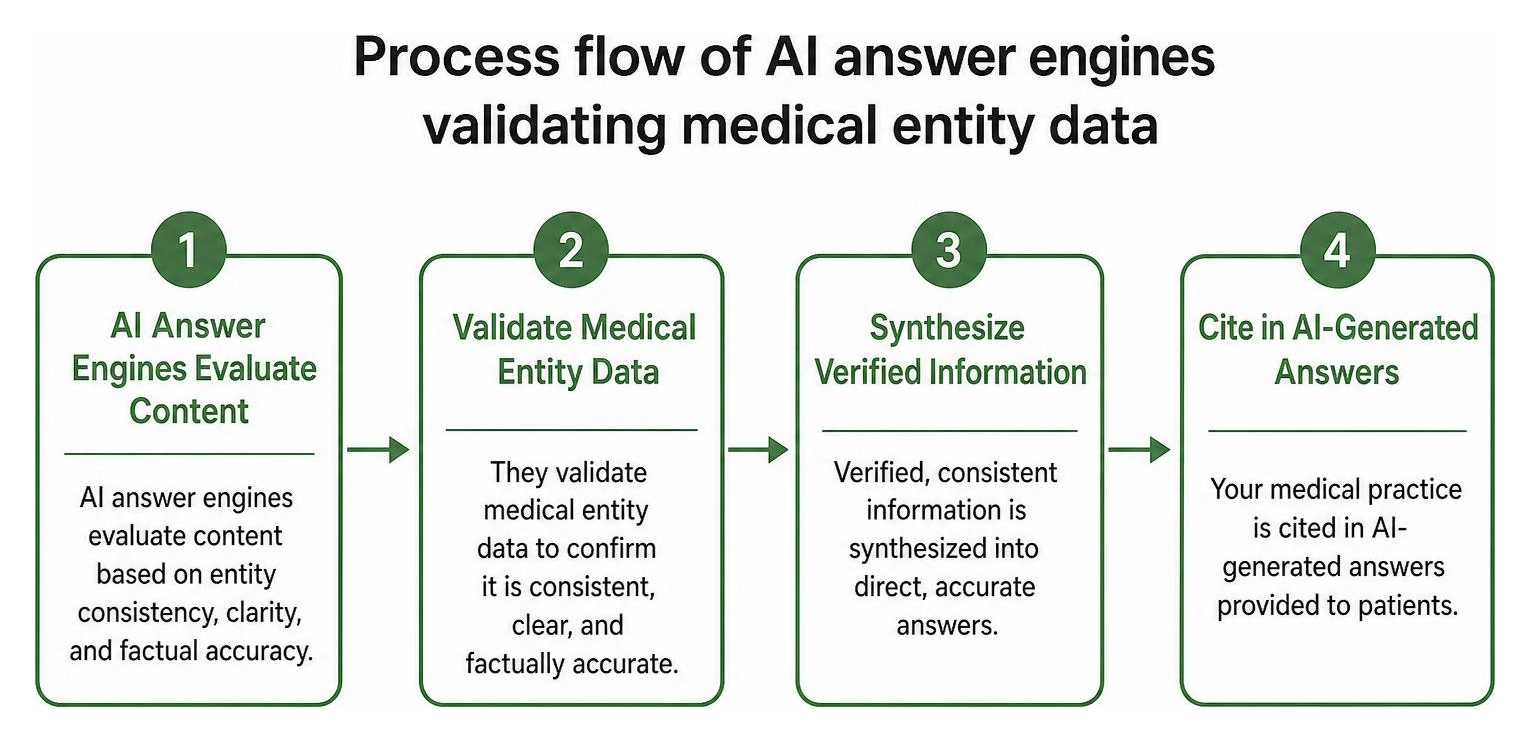
AI answer engines evaluate content based on entity consistency, clarity, and factual accuracy. To ensure your medical practice is cited in AI-generated answers:
- Provide Concise, Direct Answers: Place clear, medically accurate summaries at the beginning of condition guides to answer common patient questions directly.
- Maintain Uniform Entity Data: Ensure doctor names, clinic taxonomies, medical credentials, and physical addresses are formatted consistently across all medical registries and digital platforms.
- Structure Content with Question-Based Headings: Use clear H2 and H3 subheadings matching natural conversational questions (e.g., “How long is recovery after rotator cuff repair?”).
High-Authority Healthcare Backlink Acquisition
Inbound links from authoritative websites remain one of the strongest ranking signals in search optimization. Because healthcare is a YMYL topic, low-quality or irrelevant backlinks will not help your rankings. Practices should focus on earning editorial links from reputable academic, clinical, and local community sources.
Effective link-building strategies for healthcare providers include:
- Clinical Research and Case Publications: Highlight novel surgical methods, community health initiatives, or clinical trial participation that earn citations from medical journals and universities.
- Expert Commentary and Digital PR: Provide expert medical commentary for health journalists and major news publications covering emerging wellness topics.
- Local Community Partnerships: Sponsor local health awareness events, youth sports programs, or university medical seminars in cities like Miami, Los Angeles, and New York to secure high-trust local links.
- Industry Accreditations: Claim verified directory profiles from professional associations, hospital networks, and licensing boards.
Frequently Asked Questions About Healthcare SEO
How long does medical SEO take to show measurable patient growth?
Medical SEO is a compounding investment that typically yields measurable outcomes in phases. Technical fixes and Google Business Profile optimizations often show initial results within 30 to 60 days. In-depth content production, local authority building, and backlink acquisition generally produce consistent increases in patient appointments within 3 to 6 months.
Can non-clinical staff write content for medical SEO?
Yes, provided a robust clinical review process is in place. Professional medical writers or in-house marketing teams can draft foundational content using peer-reviewed sources. However, before publication, a qualified, licensed clinician must review the material for accuracy, clinical context, and compliance, with their formal review byline clearly displayed on the page.
How should medical practices manage negative reviews without violating HIPAA?
When replying to negative online reviews, never confirm that the reviewer is or was a patient at your practice. Use neutral, empathetic language that reflects your commitment to patient care while inviting the individual to contact your office management privately offline. For instance: “At our practice, we are committed to providing the highest quality of care to every individual. We take all feedback seriously. Please reach out to our practice administrator directly at [Phone Number] so we can discuss and resolve your concerns.”
Conclusion: Building a Scalable Patient Acquisition Engine
Investing in a comprehensive search optimization strategy creates a compounding, cost-effective patient acquisition channel for independent practices and health systems alike. With organic search delivering an average conversion rate of 5.6% and SEO leads closing at 14.6%—nearly eight times higher than traditional outbound marketing—maintaining a strong organic presence is essential for long-term practice growth.
At Social Czars, we offer elite search optimization and executive digital reputation management for leading medical practitioners, healthcare executives, and high-profile clinics across Miami, New York City, Los Angeles, and London. By combining technical precision, E-E-A-T-focused clinical content, and robust local search strategies, we help healthcare organizations build enduring trust and attract high-value patients.
To discover how specialized search strategies can accelerate your practice’s growth, explore our specialized high-end medical search strategies and connect with our team today.
