
Reputation Management
The Ultimate Guide to SEO for Doctors

Jan
Why SEO for Doctors Is Your Most Critical Growth Investment in 2025
SEO for doctors is the process of optimizing your medical practice’s online presence to rank higher in search results, attract local patients, and build trust. It involves strategic content, managing reviews, and technical website improvements, with a heavy focus on local search and establishing medical authority.
Quick Answer: Essential SEO for Doctors Components
- Local SEO – Optimize Google Business Profile, maintain NAP consistency, target “near me” searches
- Patient Reviews – Build trust with authentic feedback (93% of patients check reviews before booking)
- Content Strategy – Answer patient questions, demonstrate expertise, meet E-E-A-T standards
- Technical Optimization – Mobile-friendly website, fast loading speeds, secure HTTPS
- Timeline – Expect 3-6 months for initial results, 6-12 months for significant momentum
The data is clear: 77% of patients search online for doctors, and nearly 90% of healthcare providers operate in highly competitive markets. If your practice isn’t on the first page of Google—or in the coveted Local 3-Pack—you are invisible to most patients seeking your services.
The modern patient journey starts with a Google search like “pediatrician near me.” From there, patients evaluate your Google Business Profile, read reviews, and browse your website to decide whether to book an appointment. This shift presents a challenge: standing out while navigating HIPAA and meeting Google’s strict E-E-A-T (Experience, Expertise, Authoritativeness, Trustworthiness) standards. The opportunity? A well-executed SEO strategy can become your most cost-effective patient acquisition channel.
I’m John DeMarchi, and at Social Czars, we’ve spent over a decade helping medical professionals dominate their online presence. We specialize in navigating the intersection of medical expertise, patient privacy, and search visibility to achieve measurable growth.

The Foundation: Mastering Local SEO for Your Practice
When a patient searches “dermatologist near me,” will they find you? That’s the question local SEO for doctors answers. Unlike general SEO, local SEO focuses on attracting patients within your specific service area. For medical practices with physical locations, it’s essential.
Statistics confirm this: 99% of people use the internet to find local businesses, and 81% use Google to evaluate them. The top prize in local search is Google’s Local 3-Pack—the three map-based listings at the top of the results, which capture 44% of all clicks. Appearing here and in the organic results below doubles your visibility.
A key factor is your practice’s Name, Address, and Phone Number (NAP). It must be identical across your website, Google Business Profile, Healthgrades, Zocdoc, and all other directories. Even minor inconsistencies like “Street” vs. “St.” can harm your rankings. We help practices establish this foundation across all platforms that matter, reinforcing your credibility with both patients and search engines.
For professionals looking to strengthen their overall digital presence, you can find more info about SEO for Professionals on our site.

Mastering Your Google Business Profile (GBP)
Your Google Business Profile is your digital front desk and the key to landing in the Local 3-Pack. First, “Claim” your business on Google to gain control over your listing.
Once claimed, optimize it completely:
- NAP Information: Ensure your Name, Address, and Phone number exactly match your website.
- Services: List all conditions you treat and procedures you offer in detail.
- Hours: Keep your operating hours current, especially for holidays.
- Photos: Add high-quality images of your clinic and staff, as 42% of patients say photos influence their choice.
- Booking: Include direct appointment links to make booking effortless.
Be aware that Google allows user-suggested edits. We monitor our clients’ profiles continuously to correct any unauthorized changes before they can cause confusion or harm your reputation.
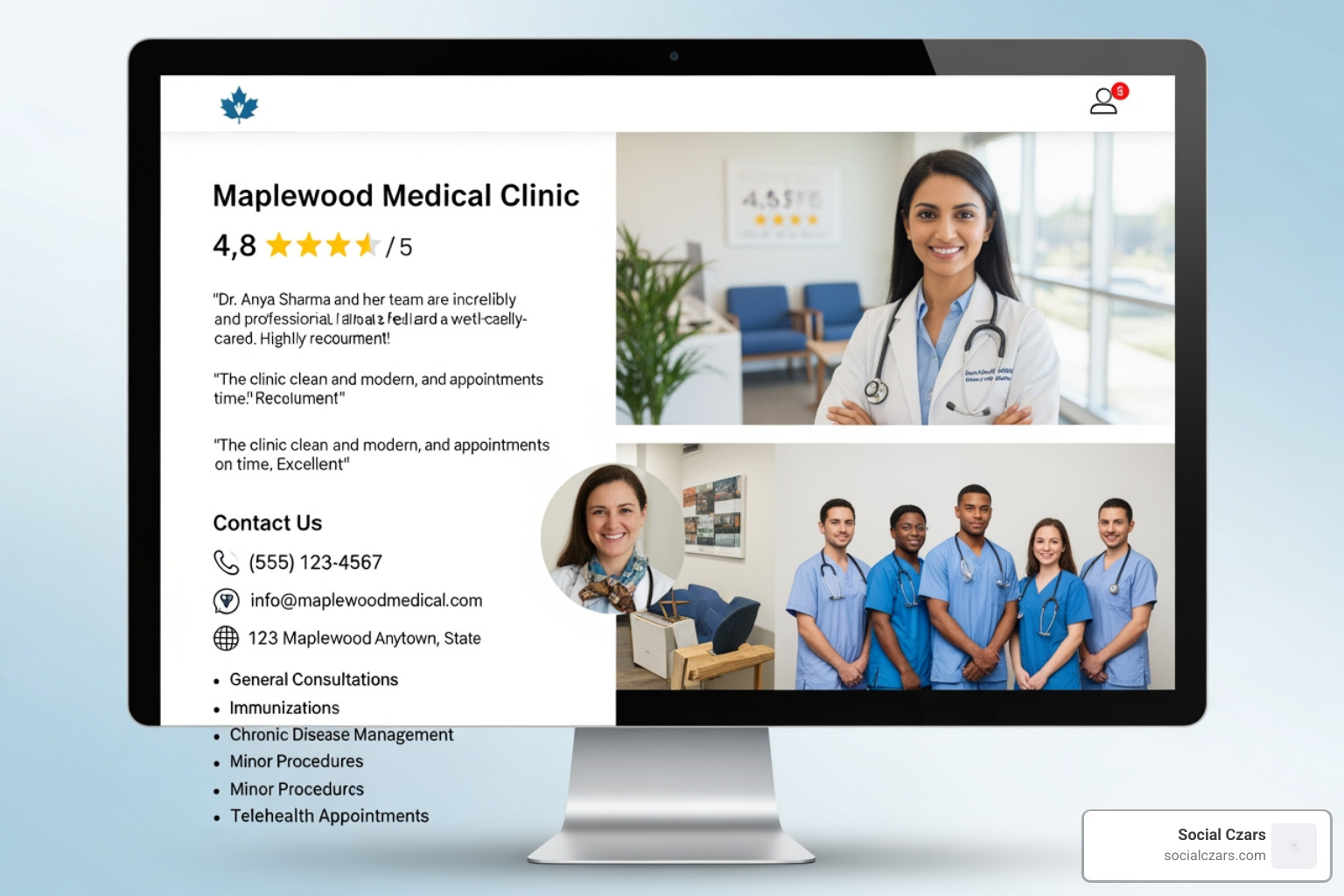
Managing Online Patient Reviews to Build Trust
Consider this: 93% of patients say reviews are important when choosing a provider. Reviews are the digital equivalent of word-of-mouth referrals and directly impact your practice.
Patients look at several factors: recency (43%), average star rating (38%), and the total number of reviews (15%). Volume often matters more than perfection; a 4.3-star rating with 500+ reviews can appear more credible than a perfect 5.0 with only 30. A few negative reviews, if handled professionally, can even improve credibility. Responding thoughtfully to a negative review demonstrates your commitment to patient care, and 64% of patients say they’d return to a practice if the provider responded to their concerns.
The challenge is collecting reviews while maintaining HIPAA compliance. Never reference specific treatments in your responses. We use automated, HIPAA-compliant SMS and email requests after appointments to simplify the process. Displaying QR codes at your checkout desk also provides a frictionless way for patients to leave feedback.
Warning: Never buy fake reviews. Google’s algorithms detect fraudulent activity, and the penalties to your rankings and reputation can be severe.
For comprehensive strategies on protecting your professional image online, explore more info about Online Reputation Management on our site.
Attracting the Right Patients with Strategic Content
Attracting the right patients requires more than just a website; it demands a strategic content presence that provides real value. Content marketing for doctors is about offering credible, evidence-based resources that answer questions, build authority, and foster trust.
Google processes over 1 billion health queries daily and takes this content very seriously. It applies strict E-E-A-T (Experience, Expertise, Authoritativeness, Trustworthiness) guidelines, especially for what it calls “Your Money or Your Life” (YMYL) content. Medical information falls into this category because inaccuracies can impact a person’s health and safety. Google’s high scrutiny is an advantage for legitimate medical practices, as it prioritizes content from qualified sources.
Our content strategy for clients in New York City, Miami, Los Angeles, and London focuses on showcasing your real medical expertise. We answer patient questions, explain treatments, and highlight symptoms—all while optimizing for local search. This positions your practice as the trusted expert patients are seeking and builds a bridge of trust that converts searchers into patients.
Keyword Research: Understanding Patient Search Intent
Effective SEO for doctors starts with understanding what patients are typing into Google. This means discerning patient search intent—the purpose behind a query.
-
Low-intent informational queries are from patients in research mode (e.g., “why does my belly hurt”). They aren’t ready to book but are gathering information. Blog posts and educational articles are perfect for answering these questions. This is also how you can win a Google Snippet, the answer box at the top of search results.
-
High-intent transactional queries come from patients ready to act (e.g., “gastroenterologist in Miami”). These searches indicate a strong likelihood of booking an appointment and should be the focus of your service and contact pages.
We also target long-tail keywords (e.g., “back pain specialist in Miami who takes insurance”) and “near me” searches. These specific, multi-word phrases attract highly qualified patients. Using dedicated keyword research tools, we identify what patients are asking and what competitors are ranking for, ensuring our strategy is driven by data, not guesswork.
| Low-Intent Informational Keywords | High-Intent Transactional Keywords |
|---|---|
| “Why does my belly hurt?” | “Gastroenterologist in Miami” |
| “Symptoms of a sinus infection” | “ENT specialist New York City” |
| “How to prevent common colds” | “Primary care doctor accepting new patients London” |
| “Benefits of regular exercise” | “Sports medicine clinic Los Angeles” |
| “What to expect from a root canal” | “Emergency dentist near me” |
Best Practices for Creating Website Content for an effective seo for doctors strategy
Once you know what patients are searching for, you must create content that helps them and signals your authority to Google.
-
Blog Posts: Address low-intent informational queries to answer patient concerns. A post like “What to Expect During a Root Canal” eases anxiety and establishes your expertise, attracting organic traffic and improving your site’s overall ranking.
-
Service Pages: Each medical service needs its own dedicated page targeting high-intent keywords. Focus on patient benefits and outcomes, incorporate local keywords (e.g., “Botox treatments in London”), and include clear calls-to-action to book an appointment.
-
FAQ Sections: Include 3-5 FAQs on each service page to answer common questions. This content often appears in Google’s “People Also Ask” sections and can drive targeted traffic directly to your site.
-
Video Content: Short, informative videos (30-60 seconds) answering patient questions are essential for modern SEO. AI search engines favor content in multiple formats, and Google often embeds YouTube videos in its AI Overviews.
To win a Google Snippet, structure your content clearly. Place the target keyword as a question or heading, followed immediately by a concise, high-quality answer. This direct approach gives you the best chance of being featured.
By implementing these best practices, your practice can build authority and convert online searches into patient appointments. For deeper insights, explore More info about Advanced SEO Strategies.
Technical SEO and Website Optimization for Doctors
Your website is your digital front door and a primary tool for attracting patients. If it’s slow, insecure, or hard to use, potential patients will leave. Technical SEO for doctors ensures your site’s foundation is solid, providing a positive experience for both users and search engines.
With over 60% of web traffic coming from mobile devices, Google uses mobile-first indexing, prioritizing sites that work well on smartphones. A responsive design that adapts to any screen size is no longer optional.
Performance also matters. Google’s Core Web Vitals measure your site’s loading speed, interactivity, and visual stability. A slow website deters patients; studies show conversion rates drop significantly for pages that take longer than 4 seconds to load. We use tools like PageSpeed to analyze and optimize your site for maximum speed.
For medical practices, security is non-negotiable. Implementing HTTPS via an SSL/TLS certificate encrypts data, protecting patient privacy and building trust. Google rewards secure sites with higher rankings, making it an essential part of a modern SEO strategy.
Key On-Page SEO Elements
With a strong technical foundation, we optimize the content on each page. These on-page elements are vital for helping search engines understand and rank your content in an effective seo for doctors strategy.
- Title Tags & Meta Descriptions: These are your ads in search results. The title tag (<60 characters) should include your main keyword, while the meta description (<160 characters) should summarize the page and encourage clicks.
- Header Tags (H1, H2, H3): These structure your content for readability. The H1 should contain your primary keyword, with H2s and H3s for subtopics.
- Image Alt Text: This text description helps visually impaired users and tells Google what an image is about. Use descriptive keywords.
- Internal Linking: Linking to related pages on your own site helps users and search engines steer your content, improving crawlability and rankings.
- Schema Markup: This structured data gives search engines detailed information about your practice. Using schema like MedicalOrganization and Physician can generate rich snippets in search results, displaying reviews, hours, and appointment links. FAQ schema can also help you appear in featured snippets.
Measuring Success and the Timeline for SEO for Doctors
SEO for doctors is a long-term investment, like planting a tree. It requires time and patience, but the results are lasting. Building genuine authority in search results is not an overnight process, which is why we focus on tracking the right metrics to measure success.
We monitor several key performance indicators (KPIs) to gauge your practice’s online growth:
- Organic Traffic: Visitors who find your site through unpaid search results. We analyze which pages they visit to ensure you’re attracting the right patients.
- Keyword Rankings: Your position in search results for valuable terms like “dermatologist in Miami.” We track your climb to page one.
- Conversion Rates: The percentage of visitors who book an appointment, call your office, or fill out a form. A rate above 5% is good; 7-10% is exceptional.
- User Engagement: Metrics like bounce rate and session duration tell us if your site is meeting patient needs.
- Google Business Profile Metrics: Clicks for directions or calls from your GBP listing are strong indicators of future appointments.
- Patient Acquisition Cost: Calculating the cost to acquire a patient via SEO demonstrates its superior long-term ROI compared to other channels.
We use Google Analytics and Google Search Console to gather this data, giving us a complete picture of your performance and allowing us to adapt your strategy effectively.
Want to know where your practice stands? Request a Medical SEO Audit for a detailed roadmap showing your current position and potential for growth.
How Long Does an seo for doctors campaign Take to Show Results?
This is the most common question, and anyone promising instant results is not being truthful. The timeline depends on your website’s current authority, the competitiveness of your specialty and location, and the consistency of your SEO efforts.
Here is a realistic timeline:
- Months 1-3: Foundational work begins, including technical fixes and on-page optimization. Early results are unlikely at this stage.
- Months 3-6: You’ll start seeing meaningful changes. This includes improved rankings for less competitive, long-tail keywords and initial organic traffic to new blog posts. Your Google Business Profile will gain visibility in local searches.
- Months 6-12: Momentum builds and compounds. You’ll climb higher for more competitive keywords, and qualified inquiries will increase steadily. It can take this long for search engines, especially AI-powered ones, to fully recognize and trust your practice as an authoritative source.
SEO is never “finished.” It requires ongoing optimization to adapt to algorithm changes, new competitors, and shifting patient behavior. The practices that maintain top rankings are those that consistently publish quality content, manage their online profiles, and monitor performance. Consistency is your competitive advantage, building a strong digital foundation that is difficult for competitors to overcome.
Frequently Asked Questions about Medical SEO
Here are answers to some of the most common questions we hear from doctors about optimizing their online presence.
How is seo for doctors different from other industries?
While some principles overlap, medical SEO is unique due to several critical factors:
- YMYL (Your Money or Your Life) Content: Google holds medical content to the highest standard of quality and accuracy because bad advice can cause real harm.
- E-E-A-T Standards: To rank, your content must demonstrate Experience, Expertise, Authoritativeness, and Trustworthiness. Google evaluates the author’s credentials and the website’s reputation.
- HIPAA Regulations: Marketing efforts must comply with strict patient privacy laws, which affects how you handle testimonials, patient data, and even website analytics.
- Patient Privacy & Trust: Patients are making critical health decisions. Your SEO strategy must focus on establishing your practice as a credible and trustworthy source of care, which is more important here than in any other industry.
How can I get more patient reviews ethically?
Online reviews are vital for trust and local SEO. Here are the best ways to acquire them ethically:
- Automated Requests: Use HIPAA-compliant email or SMS systems to send a polite review request shortly after a patient’s visit.
- In-Office Signage: Place QR codes in your waiting or checkout areas that link directly to your Google review page, making it easy for patients to leave feedback.
- Focus on Patient Experience: The best way to get positive reviews is to provide excellent, compassionate care. Happy patients are naturally motivated to share their experiences.
- Warning: Never buy fake reviews. Google’s algorithms are sophisticated at detecting fraud, and the penalties can severely damage your rankings and professional reputation.
Should I handle SEO in-house or hire an agency?
This decision depends on your practice’s resources, expertise, and goals. SEO is not a one-time task; it requires a significant and consistent time commitment. As one physician noted on Sermo, “I’ve tried to start creating my personal brand in the past 3 months but so far I’ve realised that is way harder than expected.”
Effective SEO also demands specialized technical knowledge of keyword research, content strategy, and data analysis. Google’s algorithms are constantly changing, and keeping up is a full-time job.
For these reasons, many practices benefit from professional management. A specialized agency brings deep expertise in seo for doctors, understanding the nuances of healthcare and Google’s requirements. This allows you and your staff to focus on what you do best: providing exceptional patient care.
Conclusion
It’s clear that SEO for doctors is not just a marketing tactic—it’s a critical engine for practice growth. From mastering local SEO and managing your reputation to creating content that meets Google’s strict E-E-A-T standards, every element works together to ensure your practice is not just visible, but chosen by patients actively searching for your expertise.
These strategies ensure that whether a patient is in New York City, Miami, Los Angeles, or London, they find and trust your practice.
At Social Czars, we specialize in high-end digital reputation and search optimization for an exclusive clientele. Partnering with us means gaining a dedicated team committed to elevating your digital footprint, allowing you to focus on delivering exceptional patient care while we drive your practice’s growth online.
To deepen your understanding of how these specialized SEO strategies can transform your practice, you can Learn more with our comprehensive SEO for Plastic Surgeons guide.
