
News
Step-by-Step Guide to Crisis SEO for CRE

Jan
Why Commercial Real Estate Firms Need Crisis SEO Now More Than Ever
Crisis SEO for CRE is the strategic process of rapidly controlling search engine results and online narratives when commercial real estate firms face reputational threats, operational disruptions, or public scrutiny.
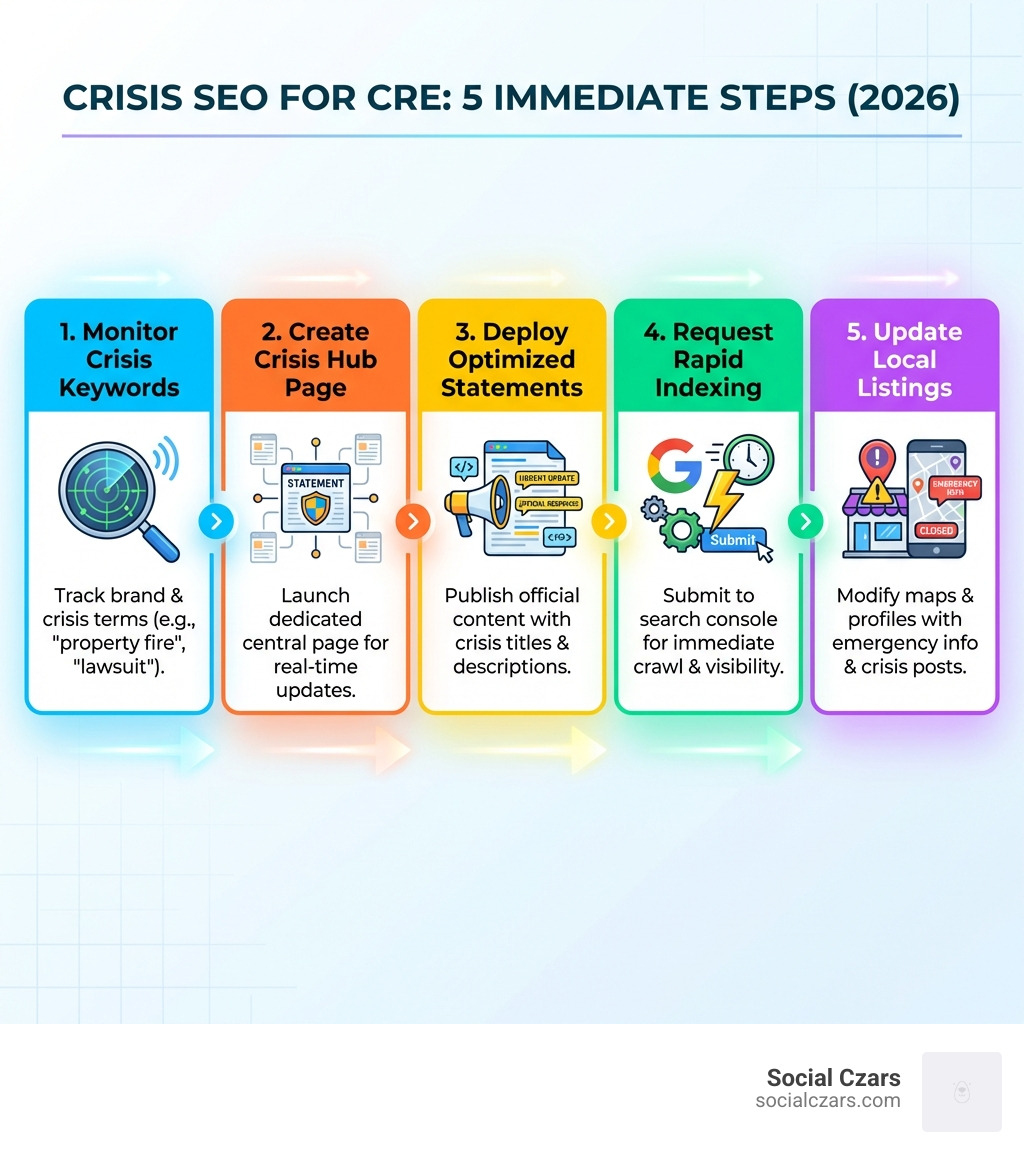
Quick Answer: 5 Immediate Steps for Crisis SEO in CRE
- Identify crisis keywords – Monitor brand + crisis terms (e.g., “YourFirm lawsuit,” “Property X fire”)
- Create a central crisis hub – Launch a dedicated page at yourfirm.com/statement or /update
- Deploy optimized content – Publish official statements with crisis keywords in titles and meta descriptions
- Request rapid indexing – Use Google Search Console to get your content indexed within hours
- Update local listings – Modify Google Business Profile with emergency info and crisis posts
When a crisis hits your commercial real estate firm—whether it’s a tenant lawsuit, property incident, regulatory issue, or leadership scandal—the first place stakeholders look is Google. If you don’t control what they find there, someone else will.
The stakes are higher in CRE than in most industries. A single negative story dominating search results can spook investors worth millions, trigger tenant exodus, or derail financing deals. Unlike consumer brands that can weather a viral tweet, commercial real estate operates in a high-trust environment where reputation directly impacts capital flow and deal velocity.
The research shows that companies often freeze their SEO efforts during crises—cutting marketing budgets when visibility matters most. But as one crisis management expert notes, “When a crisis hits, businesses scramble to find experts who can help them steer chaos, protect their brand, and restore stakeholder confidence.” The same applies to search results: your prospects, investors, and tenants are searching for answers right now. If your official response isn’t on page one, rumors and speculation will be.
Traditional crisis PR focuses on media outreach and official statements. Crisis SEO ensures those statements actually get found. It’s the difference between publishing a press release that sits on a wire service and dominating the first page of Google for every search variation of your crisis.
I’m John DeMarchi, founder of Social Czars, and I’ve spent over a decade helping high-profile executives and luxury brands manage their online reputations during their most vulnerable moments. Since 2014, we’ve guided hundreds of clients through Crisis SEO for CRE situations, from suppressing negative content to rapidly deploying positive narratives that restore stakeholder confidence. Let me show you exactly how to protect your firm’s digital reputation when it matters most.
Glossary for Crisis SEO for CRE:
Proactively Building Your SEO Armor Before a Crisis
Think of your firm’s online presence as a fortress. You wouldn’t wait for an attack to start building your walls, would you? The same goes for Crisis SEO for CRE. The best defense is a strong offense, meaning a robust, proactive SEO strategy built long before any storm clouds gather. As the experts tell us, “90% of what is needed in a crisis communication plan can be done in advance of any crisis.” This proactive approach is about building resilience and ensuring your digital footprint is strong enough to withstand any reputational tremor.
A well-executed SEO strategy isn’t just about driving leads; it’s about building long-term value, reaching new audiences, and establishing brand awareness. For CRE, this translates directly into investor confidence, tenant attraction, and successful deal-making. Our goal is to build your Domain Authority (DA) and strengthen your E-E-A-T (Experience, Expertise, Authoritativeness, Trust) so that when a crisis hits, your official communications naturally rank higher and are perceived as more credible.
Proactive measures include a thorough risk assessment to identify potential threats specific to your properties or operations in cities like Miami, New York City, Los Angeles, or London. Based on this, we can draft holding statements—pre-approved, legally vetted responses that can be deployed quickly. Building relationships with reputable journalists and bloggers in advance also ensures your message can reach trusted platforms rapidly when needed. This foresight is crucial because, as we often say, if you’re not thinking with a crisis mindset and aren’t crisis-ready, you’re setting yourself up for failure.
Creating a Strong Content Foundation
Your content is the bedrock of your online reputation. For CRE firms, this means consistently publishing high-quality, expert-driven content that showcases your thought leadership and industry authority.
- Market reports: Share insights on market trends in your key locations (e.g., “Q3 Miami Office Market Report,” “London Retail Sector Outlook 2025”). This positions your firm as an expert.
- Executive bios: Ensure detailed, optimized bios for your leadership team. When people search for your executives during a crisis, these profiles should paint a clear picture of their experience and credibility.
- Project case studies: Highlight successful developments, acquisitions, or management projects. These provide tangible evidence of your firm’s capabilities and positive impact.
- Community involvement posts: Showcase your firm’s commitment to the communities where you operate. ESG (Environmental, Social, and Governance) initiatives are increasingly important; “PR campaigns highlighting ESG commitments can improve brand perception and attract like-minded investors and customers.”
- Thought leadership articles: Publish op-eds, articles, and whitepapers on industry challenges and solutions. This establishes your team as “go-to sources for journalists” and builds trust.
In an age saturated with generic AI content, the “edge comes from real voices.” Leveraging expert interviews within your firm to create authentic, credible content is a powerful way to build trust and authority.
Establishing Technical SEO Health
Even the most brilliant content won’t save you if your website is a leaky ship. Technical SEO is the unseen scaffolding that supports your entire online presence. It ensures search engines can easily find, crawl, and understand your content, especially during a crisis when speed and accessibility are paramount.
- Website speed: “Page speed is a direct indicator of how well a website ranks.” When a crisis hits, people need information now. A slow website will frustrate users and deter search engines. We ensure your site loads at lightning speed.
- Mobile optimization: “Google prioritizes the mobile version of a website over the desktop version.” With most searches happening on mobile devices, your CRE website must be perfectly responsive and easy to steer on any screen.
- Clean site architecture: A logical, intuitive website structure helps both users and search engines find information quickly. This is crucial for guiding users to your crisis hub.
- SSL certification (HTTPS): This security measure encrypts data between your site and users. Google favors secure sites, and an SSL certificate signals trustworthiness—a non-negotiable during a crisis.
- XML sitemaps: These are like roadmaps for search engines, helping them find all the important pages on your site, including new crisis-related content, for rapid indexing.
By establishing these technical foundations, you ensure that when a crisis strikes, your official messages are not only published but are also quickly findable and accessible to everyone who needs them.

Immediate Steps for Crisis SEO for CRE During an Unfolding Crisis
When a crisis unfolds, every second counts. This is where your proactive planning shifts into rapid response mode. Our immediate goal is to gain control of the search results, ensuring that accurate, official information from your firm dominates the conversation. As one expert succinctly puts it, “If your brand faces a crisis, the first thing people usually do is search for information online. That means your reputation now lives and dies on page one of Google.”

The first 24-48 hours are critical. This is not the time for lengthy internal debates. Your stakeholders—investors, tenants, partners, media, and the public—are actively searching for answers related to your firm. If you don’t provide them, others will. Our approach focuses on being “first, fast, factual, and frequent” with communications, using SEO to make sure those communications are found.
Step 1: Identify Crisis-Related Keywords
The first tactical step is to understand what people are searching for. This isn’t about guessing; it’s about data. We immediately launch into intensive keyword research to identify all possible search queries related to the unfolding crisis.
- Brand name + crisis term: This is the most critical. Think “[Your Firm Name] lawsuit,” “[Property Address] fire,” “[CEO Name] scandal,” or “[Tenant Name] incident [City, State/Country].” For our clients in Miami, NYC, LA, or London, we’d also include location-specific modifiers.
- Location-specific searches: If the crisis is tied to a specific property, we’ll monitor terms like “[Building Name] closure London,” or “[Street Address] incident Miami.”
- Monitoring tools: We leverage powerful tools like Google Trends, which is excellent for real-time search trends, and set up Google Alerts for your brand, key executives, and relevant crisis terms. Social listening tools and forums like Reddit can also offer real-time insights into public sentiment and emerging questions.
Understanding these high-intent keywords allows us to tailor our content to directly answer what people are asking, ensuring maximum visibility.
Step 2: Create a Centralized Crisis Hub
Once we know what people are searching for, we create the digital “single source of truth”: a dedicated crisis hub on your firm’s website. This page is paramount because it’s an “owned space” where you have complete control over the narrative.
- Dedicated website page: This is a new page, not just a blog post. It should be easily findable from your homepage.
- URL structure: We recommend a clear, concise URL like
yourfirm.com/crisis-update,yourfirm.com/statement, oryourfirm.com/incident-response. This signals urgency and relevance to both users and search engines. - Noindex prevention: We ensure this page is NOT accidentally noindexed, which would prevent search engines from finding it.
- Rapid indexing via Google Search Console: Time is of the essence. After publishing, we immediately use Google Search Console’s URL Inspection tool to request that Google crawl and index the new page. This can get your official statement into search results within hours, not days.
This hub becomes the central point that all other communications (press releases, social media posts, emails) link back to, consolidating your message and search authority.
Step 3: Deploy Optimized Crisis Content
With the crisis hub established, we deploy content specifically designed to address the crisis head-on, optimized for the keywords identified in Step 1. The goal is to fill the search results with accurate, official information directly from your firm.
- Press releases: While traditional PR, we optimize press releases with crisis keywords. For maximum SEO impact, they need to be picked up by credible, high-authority news sites.
- Official statements: These should be clear, concise, and empathetic. We embed relevant keywords naturally within the text and ensure the meta title and description accurately reflect the content and include primary crisis keywords (e.g., “Official Statement: [Firm Name] Addresses [Crisis],” “Update on [Property] Incident – [Date]”).
- FAQ sections: People have questions. An FAQ section on your crisis hub, optimized with FAQ schema, can directly answer common queries and even get featured in Google’s “People Also Ask” section, enhancing visibility.
- Myth vs. Fact content: Misinformation spreads rapidly during a crisis. A dedicated “Myth vs. Fact” section directly counters false narratives with clear, direct language and supporting evidence.
- Meta titles & descriptions: These are crucial for search result snippets. We craft compelling, keyword-rich titles and descriptions that encourage clicks and accurately represent your message.
Here’s a list of essential content types for a crisis hub:
- Official Statement/Press Release
- Frequently Asked Questions (FAQs)
- Myth vs. Fact Section (if misinformation is prevalent)
- Contact Information for Stakeholders (Media, Tenants, Investors)
- Timeline of Events (if applicable and beneficial)
- Relevant Supporting Documents or Links
Advanced Strategies for Managing the Narrative and Reputation
Once the immediate crisis response is underway, our focus shifts to advanced Search Engine Results Page (SERP) management. This is about more than just getting your official statement to rank; it’s about actively shaping the entire first page of Google for crisis-related terms. We aim to “push down lingering negative content with new, positive coverage,” ensuring that your firm’s narrative, not rumor or speculation, defines public perception.
This phase integrates deeply with your overall PR strategy. Every official communication, every media mention, every social post is part of a coordinated effort. Social Czars specializes in this, using our expertise to rapidly remove negative content and lift positive messaging for high-stakes clients in Miami, New York City, Los Angeles, and London.
Key Differences: Standard SEO vs. Crisis SEO for CRE
It’s easy to think all SEO is the same, but when a crisis hits, the objectives and tactics shift dramatically. Understanding these differences is crucial for effective Crisis SEO for CRE.
| Feature | Standard SEO for CRE | Crisis SEO for CRE |
|---|---|---|
| Objective | Long-term organic growth, lead generation, brand awareness | Immediate narrative control, reputation mitigation, trust restoration |
| Keywords | Broad, high-volume (e.g., “commercial real estate Miami,” “office space London”) | Highly specific, urgent, brand + crisis terms (e.g., “YourFirm lawsuit,” “Property X incident”) |
| Timeline | Marathon, continuous effort, weeks/months for results | Sprint, immediate action, hours/days for results |
| Content Focus | Evergreen, educational, thought leadership, property listings | Timely, factual, transparent statements, FAQs, myth-busting |
| Speed vs. Perfection | Aim for perfection, thoroughness | Prioritize speed and accuracy over polish |
| Approach | Proactive, strategic planning | Reactive, rapid deployment, proactive SERP management |
| Metrics | Rankings, traffic, conversions, DA | SERP ownership, sentiment, visibility of official info, reduction in negative results |
The shift from a “marathon” to a “sprint” is perhaps the most significant. While standard SEO builds authority over time, Crisis SEO for CRE leverages that authority for immediate impact, demanding rapid deployment and agile adjustments.
Leveraging Local SEO in your Crisis SEO for CRE Strategy
For CRE firms, especially those with physical properties or a strong local presence in cities like Miami, NYC, LA, and London, local SEO is a powerful tool during a crisis. People often search for local businesses or properties when an incident occurs.
- Google Business Profile (GBP) updates: Your GBP listing is often the first thing people see in local searches. We ensure it’s updated immediately with any emergency contact information, special operating hours, or temporary closures.
- Google Posts for updates: GBP allows you to publish short, timely updates directly on your profile. This is an excellent way to share official statements, FAQs, or links to your crisis hub, getting your message directly to local searchers. A bank case study showed that GMB views up 10X, GMB actions up 31%, and calls up 63%.
- Managing local reviews: Negative reviews can surge during a crisis. We monitor these closely and respond professionally and empathetically, offering solutions and redirecting to official channels. Ignoring them rarely makes them go away; responding constructively is key.
- Communicating with specific communities: If a crisis impacts a particular community (e.g., tenants in a building, residents near a development site), local SEO tactics help target communications effectively. This might involve creating location-specific landing pages or using local keywords in crisis content.
Using Structured Data to Dominate SERPs
Structured data, or schema markup, is code that helps search engines better understand the content on your pages. During a crisis, it’s a secret weapon for enhancing visibility and ensuring your official answers are prominently displayed.
- Schema markup: By adding specific schema types to your crisis hub content, we can tell Google exactly what information is there.
- FAQPage Schema: This is gold during a crisis. Implementing FAQ schema allows your questions and answers to appear directly in the search results, often in a rich snippet or “People Also Ask” box. This means your official answers can bypass other search results and jump straight to the top.
- QAPage Schema: Similar to FAQPage, this is useful for question-and-answer formats.
- HowTo Schema: If your crisis involves instructions (e.g., “How to get a refund,” “How to report an issue”), HowTo schema can make those steps stand out.
The research shows that schema deployment can lead to significant boosts in search impressions and clicks. For example, one restaurant chain saw a +33-66% boost in search impressions after schema deployment. By leveraging structured data, we ensure Google understands and prioritizes your authoritative crisis information, helping you “dominate SERPs” with facts.
Measuring Success and Long-Term Integration
A crisis is a test, but it’s also a learning opportunity. Once the immediate storm has passed, we move into a phase of post-crisis analysis, continuous monitoring, and long-term integration of Crisis SEO for CRE into your overall strategy. This period is crucial for rebuilding trust and ensuring that the lessons learned fortify your firm against future challenges.
The long-term benefits of integrating Crisis SEO into your CRE firm’s overall PR and crisis management strategy are immense. It ensures that your brand equity is protected, your reputation is resilient, and your firm can steer market fluctuations with greater confidence. It’s about turning a moment of vulnerability into a foundation of strength.
How to Measure Crisis SEO Effectiveness
Measuring the success of Crisis SEO for CRE isn’t just about traffic; it’s about control, sentiment, and the visibility of your official narrative.
- SERP ownership percentage: We track how much of the first page of Google (and beyond) for crisis-related keywords is occupied by your official content versus negative or unverified sources. The higher the percentage, the better.
- Sentiment analysis: Using specialized tools, we monitor the overall sentiment around your brand and the crisis keywords. We aim to shift negative sentiment towards neutral or positive over time.
- Branded search volume: While a crisis might temporarily spike branded searches, we look for stabilization and recovery, indicating that people are searching for your firm, not just the crisis.
- Traffic to crisis hub: A direct measure of how many people are accessing your official information.
- Reduction in negative search results visibility: This is a key KPI for us. We track how effectively negative articles or mentions are pushed down the SERPs by your optimized content.
These metrics provide a clear picture of how effectively we’ve managed the online narrative and mitigated reputational damage.
Common Mistakes to Avoid
Even with the best intentions, firms can make critical missteps during a crisis that undermine their Crisis SEO for CRE efforts. We’ve seen them all, and here’s how to steer clear:
- Deleting content: This is a big no-no. “Deleting pages often creates broken links that frustrate users and sometimes make negative results appear more suspicious or interesting.” Instead, update and correct.
- Slow response time: Speed is paramount. “By the time you finish debating your internal draft, someone else has already published their take.” A delayed admission can prolong negative sentiment.
- Inconsistent messaging: Ensure all internal and external communications are aligned. Conflicting messages erode trust and confuse search engines.
- Ignoring negative reviews: Especially for local CRE properties in Miami, NYC, LA, or London, ignoring negative reviews on platforms like Google Business Profile can be detrimental. Respond professionally and transparently.
- Neglecting technical SEO: During a crisis, it’s tempting to focus solely on content. But if your site is slow, not mobile-friendly, or has broken links, your official message won’t get through.
- Lack of a plan: The biggest mistake of all. Without a pre-existing crisis communications plan that includes SEO, you’re building the plane while flying it.
Frequently Asked Questions about Crisis SEO for CRE
How does SEO specifically help manage a crisis in the CRE sector?
SEO helps manage a crisis in the CRE sector by allowing your firm to control the search results for crisis-related terms, ensuring stakeholders find accurate, official information directly from the source. In a high-stakes environment where investor and tenant confidence is paramount, this is invaluable. It counters misinformation, manages public perception, and provides a transparent platform for communication, which is vital for maintaining trust with investors, tenants, and the broader community. As we’ve emphasized, “The first thing people usually do is search for information online. That means your reputation now lives and dies on page one of Google.” For us, SEO is almost like “crisis insurance,” ensuring your factual narrative stands out.
What tools are essential for effective Crisis SEO in the CRE industry?
For effective Crisis SEO for CRE, a robust toolkit is essential. We rely on:
- Search trend monitors: Google Trends is indispensable for real-time insights into what people are searching for.
- SEO platforms: Tools like Ranktracker (or similar comprehensive platforms) are crucial for keyword tracking, SERP monitoring, backlink analysis, and website audits.
- Social listening tools: Platforms like Talkwalker Alerts help us monitor online conversations and social sentiment around your brand and crisis keywords. Reddit can also be a surprisingly effective source for real-time audience insights.
- Google Search Console: This is our direct line to Google for monitoring site health, identifying crawling issues, and, critically, requesting rapid indexing of new crisis content.
- Google Alerts: Simple yet effective for monitoring brand mentions and relevant keywords across the web.
How does Crisis SEO integrate with other crisis communication efforts?
Crisis SEO for CRE is the digital backbone of a comprehensive crisis communications plan. It ensures that messages crafted for PR, social media, and traditional media are not only created but are also visible and accessible online. We integrate it by:
- Centralizing information: A dedicated, SEO-optimized crisis page on your website becomes the central hub that all other channels (press releases, social posts, emails, media interviews) link back to. This creates a unified and consistent narrative, ensuring all roads lead to your official statement.
- Amplifying messages: SEO tactics ensure that your official press releases and statements, once published, are quickly indexed and rank for relevant crisis keywords. This amplifies their reach beyond traditional media pickups.
- Countering misinformation: By optimizing content to rank for specific crisis-related search terms, we can actively “fight misinformation” and ensure that factual, transparent information from your firm is what people find first.
- Coordinated strategy: We ensure PR and SEO teams are “talking before a crisis,” aligning on keywords, messaging, and content deployment strategies to present a united front.
Conclusion
Navigating a crisis in commercial real estate is never easy. The stakes are high, and the potential for reputational and financial damage is significant. However, by embracing a proactive and reactive Crisis SEO for CRE strategy, your firm can transform moments of vulnerability into demonstrations of resilience and control.
From building a strong SEO foundation long before a crisis hits to executing rapid-fire, optimized responses when it does, our goal is to protect your brand equity. We ensure that when stakeholders search for information about your firm in Miami, New York City, Los Angeles, or London, they find accurate, trustworthy content directly from you. This isn’t just about mitigating damage; it’s about reinforcing trust, maintaining investor confidence, and ensuring your firm can steer market fluctuations with unwavering strength.
Take control of your online narrative with Crisis SEO services today. Don’t leave your reputation to chance.
Take control of your online narrative with Crisis SEO services
