
Reputation Management
Step-by-Step Guide to Crisis SEO for Lawsuits

Dec
Why Your Law Firm’s Biggest Battle May Be on Google
Crisis SEO for Lawsuits is the strategic process of managing and repairing a law firm’s online reputation when legal proceedings threaten to damage search engine visibility and public perception. When a lawsuit hits, Google becomes the battlefield where your firm’s reputation is won or lost.
What you need to know right now:
- Act in the first 72 hours – Secure all digital assets and conduct a SERP audit
- Control the narrative – Create official content hubs and optimized statements
- Push down negatives – Use technical SEO and digital PR to suppress harmful results
- Monitor constantly – Track sentiment and SERP changes in real-time
- Think long-term – Build proactive defenses before the next crisis
The stakes are real. When a crisis strikes, there’s no time to waste. Every moment matters in protecting your reputation and business. In today’s hyperconnected digital environment, news—particularly negative news—spreads rapidly, often reaching millions within minutes. If negative content dominates Google, perception becomes reality fast.
Traditional SEO focuses on ranking for high-intent traffic and growth. Crisis SEO is different. It’s defensive and rapid, designed to influence what shows when people search your firm’s name, push negative content down, and lift clarifications through owned media and third-party credibility.
The legal process and the court of public opinion operate on parallel tracks. While your attorneys handle the courtroom, Crisis SEO manages the digital courtroom. By taking control of the narrative and shaping public perception through search results, you can help tip the scales in your favor—both in the court of law and the court of public opinion.
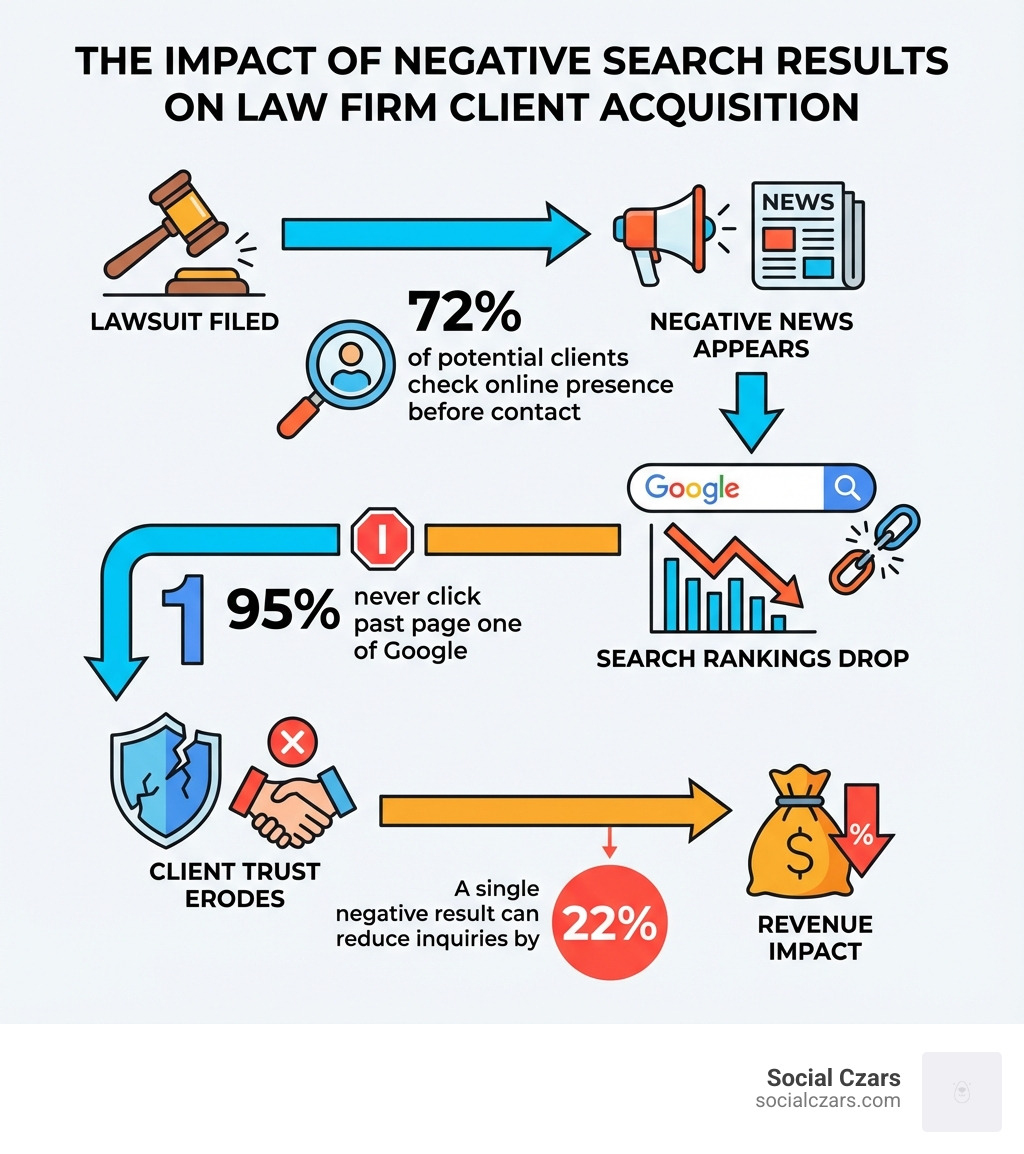
The reality for law firms: A single negative result on page one can cost you up to 22% of business opportunities. When potential clients search for your firm and find lawsuit coverage, negative reviews, or crisis-related news before they find your official website, trust erodes before the first conversation even happens.
I’m John DeMarchi, founder of Social Czars, and I’ve spent over a decade helping law firms and high-profile executives steer Crisis SEO for Lawsuits, managing hundreds of reputation crises since 2014. This guide walks you through the exact step-by-step process we use to protect firms when legal disputes threaten their digital reputation.
Easy Crisis SEO for Lawsuits word list:
The Crisis SEO Playbook: Immediate Actions & Narrative Control
When a lawsuit arises, the initial response is paramount. It’s a high-stakes, time-sensitive situation where clear thinking and swift action can make all the difference. Our goal is to assemble a dedicated crisis team, secure all digital assets, conduct an immediate SERP audit, establish a central crisis communication hub, and inject content with velocity. This comprehensive approach ensures we control the narrative from the outset.

Step 1: The First 72 Hours
The first 72 hours are like emergency medicine for your firm’s digital reputation. The difference between a contained issue and a full-blown disaster often comes down to your response during this critical window.
-
Digital Asset Lockdown: We start by securing all critical digital assets. This means verifying and, if necessary, gaining full administrative access to your website, all social media profiles (LinkedIn, X, Instagram, Facebook, etc.), and any other online platforms where your firm has a presence. Many firms find during a crisis that they lack admin access to key accounts, which can severely hinder a rapid response.
-
Initial SERP Audit & Keyword Analysis: We immediately perform a comprehensive audit of search engine results pages (SERPs) for your firm’s name, key partners, and the lawsuit’s specifics. This identifies existing negative content, its visibility, and potential emerging keywords related to the crisis. We’ll also conduct an initial keyword analysis to understand what people are searching for and how we can best intercept those queries.
-
Google Business Profile Optimization: Your Google Business Profile is your digital front door. We ensure it’s complete, accurate, and optimized with correct hours, services, and photos. This is crucial for local search visibility, especially in competitive markets like New York City, Miami, or Los Angeles. An incomplete profile can erode trust and signal neglect during a sensitive time.
-
Pausing Non-Essential Marketing: During a crisis, it’s often wise to temporarily pause non-essential marketing campaigns that might divert resources or inadvertently amplify negative sentiment. This allows us to focus all efforts on crisis management.
-
Aligning with Legal Strategy: Crucially, all Crisis SEO for Lawsuits efforts must align seamlessly with your overall legal strategy. We work hand-in-hand with your legal counsel to ensure all communications are legally sound, do not create new legal risks, and support your position in the court of law. This coordination is vital, as the legal process and the court of public opinion operate on parallel tracks.
Step 2: Controlling the Narrative with Content
Once the immediate digital lockdown is complete and we understand the landscape, our next step is to actively control the narrative through strategic content creation and dissemination. Our goal is to push down negative search results by saturating the SERPs with accurate, positive, and authoritative information.
-
Creating a Microsite or Dedicated Webpage: We often recommend creating a dedicated section of your website or a separate microsite to serve as the official crisis hub. This hub will house all formal statements, FAQs, and positive content related to the situation. It acts as a single, authoritative source of truth.
-
Publishing Official Statements: Crafting clear, transparent, and legally vetted official statements is paramount. These statements should address the situation directly, but carefully, and be optimized for search engines to ensure they rank prominently for crisis-related queries. We aim for a tone that is professional, empathetic, and reassuring.
-
Developing an FAQ Page: An extensive FAQ page addresses common questions and concerns related to the lawsuit. This helps manage public inquiry, provides clarity, and fills SERP real estate with controlled content. We optimize these FAQs for “People Also Ask” sections in Google, ensuring our answers are visible.
-
Showcasing Firm Accolades and History: We strategically highlight your firm’s positive history, achievements, and community involvement. This includes publishing articles about past successes, awards, and the firm’s long-standing reputation. This positive content acts as a buffer against negative news.
-
Partner Bios & Positive Case Studies: Detailed, optimized biographies of key partners and anonymized positive case studies (where appropriate and legally permissible) can reinforce expertise, authoritativeness, and trustworthiness (E-A-T) signals. These human elements build trust and demonstrate a track record of success.
-
Pushing Down Negative Results: Our ultimate goal is to Suppress Negative Search Results. This isn’t about erasing history, but about rebalancing the truth. By creating a high volume of positive, authoritative content and optimizing it effectively, we can push negative results down to the second or third page of Google, where 75% of users will never see them.
Step 3: Essential Technical SEO for Crisis SEO for Lawsuits
Technical SEO often flies under the radar during a crisis, but it’s the backbone of any effective Crisis SEO for Lawsuits strategy. A technically sound website ensures that search engines can easily crawl, index, and rank your positive content, even under pressure.
-
Site Speed Optimization: In a crisis, every second counts. Slow loading times can deter visitors, including journalists and potential clients seeking information. We ensure your website is optimized for speed, which is a direct Google ranking factor.
-
Core Web Vitals: Google prioritizes user experience, and Core Web Vitals Introduction are key metrics for measuring this. We optimize your site’s Largest Contentful Paint (LCP), Cumulative Layout Shift (CLS), and First Input Delay (FID) to ensure a smooth, fast, and stable user experience.
-
Mobile-First Indexing: Given that most users access the internet via mobile devices, Google primarily uses the mobile version of your website for ranking. We ensure your site is fully responsive and mobile-friendly, aligning with Google’s Mobile-First Indexing Strategy Guide.
-
Implementing Structured Data: Structured data helps search engines understand the context of your content. For law firms, this is particularly important. We implement schema markup (e.g.,
Attorney,LegalService,Organization) to highlight your firm’s expertise, location, and services. This improves your visibility in search results and can lead to rich snippets. Google provides specific guidance on Google Structured Data for Attorneys. -
Strategic Internal Linking: A well-planned internal linking structure strengthens your website’s authority and helps distribute “link equity” to important crisis-related content. We strategically link from high-authority pages to your crisis hub and positive content to boost their visibility.
-
Optimizing for “People Also Ask” (PAA): The “People Also Ask” section in Google search results is a prime opportunity to control the narrative. We analyze common questions related to your firm and the lawsuit, then craft concise, authoritative answers on your website that are likely to be featured in PAA boxes. This directly addresses user queries and positions your firm as a source of reliable information.
Advanced Defense Tactics: Digital PR, Social Media, and Proactive Shielding
Beyond your owned web properties, expanding your influence through external channels is critical. This involves building a robust “digital fortress” that leverages earned media and strategic social media engagement to amplify your positive message and counter negative sentiment.
Leveraging Digital PR for Positive Signals
Digital PR is a powerful tool in Crisis SEO for Lawsuits, allowing us to influence public perception beyond your immediate control. It’s about getting your narrative heard and trusted by a wider audience.
-
Distributing Optimized Press Releases: We craft compelling press releases that are not only newsworthy but also optimized for search engines. These releases announce official statements, positive developments, or community initiatives, and are distributed to key legal, business, and local media outlets in New York City, Miami, Los Angeles, and London.
-
Securing Guest Posts on Reputable Legal and Business Publications: Earning placements on authoritative third-party websites is invaluable. We work to secure guest posts and expert commentary opportunities on legal blogs, industry news sites, and reputable business publications. This not only provides valuable backlinks but also positions your firm as a thought leader, influencing public opinion.
-
Earning Backlinks from Authoritative Sites: High-quality backlinks from relevant, high-authority websites signal trustworthiness to Google. We pursue opportunities to earn these links through various strategies, including broken link building, resource page inclusions, and expert contributions.
-
Media Outreach: Building relationships with journalists and media outlets is crucial. We engage in targeted media outreach, offering your firm’s experts for interviews or commentary on legal topics, subtly pushing your narrative and reinforcing your expertise as part of a comprehensive crisis and litigation PR strategy.
Optimizing Social Media During a Lawsuit
Social media can be a double-edged sword during a lawsuit. While it can be a source of rapid misinformation, it’s also a powerful tool for direct communication and narrative control.
-
Consistent Messaging Across Platforms: We ensure that all official statements and key messages are consistently communicated across all your firm’s social media channels. This prevents confusion and reinforces your unified stance.
-
Driving Traffic to the Crisis Hub: Social media posts should strategically drive traffic back to your official crisis hub on your website. This ensures users get accurate, detailed information from your primary source.
-
Updating Bios with Official Links: We update social media bios to include direct links to your crisis hub or official statement, making it easy for visitors to find the authoritative information.
-
Deciding Whether to Disable Comments: This is a delicate decision. For high-stakes legal situations, temporarily disabling comments on certain posts or platforms can prevent the spread of unverified information and reduce the need for constant moderation. However, it can also be perceived negatively. We weigh the pros and cons carefully as part of your Digital Crisis Communication strategy.
Building a Proactive ‘SEO Shield’ Before a Crisis
The best defense is a good offense. Building a robust online presence before a crisis hits creates an “SEO shield” that can significantly mitigate reputational damage. This is the essence of What is Anti-Crisis SEO?.
-
Owning SERPs for Brand Names: We strive to ensure that the entire first page of Google for your firm’s name and key partners is dominated by content you own or control. This makes it harder for negative content to gain traction.
-
Creating Robust Online Profiles: Fully optimized profiles on professional networks (LinkedIn), industry directories, and authoritative platforms act as strong positive assets that can outrank negative content.
-
Encouraging Positive Client Reviews: Systematically encouraging satisfied clients to leave positive reviews on platforms like Google Business Profile and legal review sites creates a buffer of positive sentiment. These reviews are powerful social proof and a strong E-A-T signal.
-
Consistent NAP Data: Maintaining consistent NAP (Name, Address, Phone number) data across all online listings is vital. Inconsistent data can confuse search engines and lower your rankings, making your firm appear less trustworthy. Learn more about NAP data and its importance.
Long-Term Management for Crisis SEO for Lawsuits: Monitoring, Measurement, and Ethics
A crisis is rarely a one-off event in the digital field. Effective Crisis SEO for Lawsuits requires continuous monitoring, agile adaptation, clear measurement of success, and strict adherence to ethical guidelines. Our work doesn’t end when the immediate fire is put out; it transitions into ongoing reputation management.
Monitoring, AI, and Adapting Your Crisis SEO for Lawsuits Strategy
The digital landscape is constantly shifting, especially during a crisis. We employ advanced tools and strategies to stay ahead.
-
Using Google Alerts and Social Listening Tools: We set up immediate alerts for your firm’s name, key partners, and lawsuit-related keywords across Google and various social listening platforms. This allows us to detect new mentions, both positive and negative, in real-time. This active Online Reputation Monitoring Complete Guide is essential.
-
Sentiment Analysis: Beyond just tracking mentions, we analyze the sentiment behind them. Are discussions turning more positive, negative, or neutral? This helps us gauge the effectiveness of our strategies and adapt our messaging accordingly.
-
Tracking SERP Changes: We continuously monitor SERP volatility for target keywords. Are negative articles dropping in rank? Are our positive assets climbing? This data-driven approach allows us to make real-time adjustments.
-
The Role of AI in Predicting Trends: Artificial intelligence and machine learning are revolutionizing crisis management. AI can help us predict emerging trends, identify potential threats, and even assist in crafting nuanced responses by analyzing vast amounts of data. This is part of how How AI is Changing Online Search impacts our work. We also use AI for SERP auditing, structured factual publishing, and E-E-A-T reinforcement to stay ahead.
Measuring Success and Post-Lawsuit Recovery
Measuring the success of Crisis SEO for Lawsuits isn’t always about direct conversions; it’s often about mitigating damage and restoring trust.
Here are our Key Performance Indicators (KPIs):
- SERP Dominance: The percentage of the first page of Google (and other search engines) occupied by your owned or positively influenced content for key brand and crisis-related queries.
- SERP Volatility: Tracking the movement of negative content down the rankings and positive content up.
- Traffic to Positive Assets: Increased organic traffic to your official statements, FAQ pages, and positive firm profiles.
- Brand Search Sentiment: Improvement in the overall sentiment of online mentions and discussions related to your firm.
- Review Scores & Volume: Stabilization or increase in positive online reviews and overall ratings.
- Backlink Profile: Growth in high-quality backlinks to your positive content, reinforcing authority.
Long-term reputation repair is a marathon. Once the immediate crisis subsides, we shift focus to continuous content creation, building an even stronger digital footprint. This may involve archiving certain crisis-related content into less prominent areas of your site as part of a comprehensive Online Reputation Cleanup Guide 2025.
Ethical Lines and Potential Pitfalls
In the sensitive field of legal matters, ethical considerations are paramount. Our Crisis SEO for Lawsuits strategies always adhere to the highest ethical standards.
-
Adhering to Legal Communication Rules: All our communications are carefully vetted to comply with the ABA Model Rules of Professional Conduct and specific state bar advertising regulations. We ensure transparency, avoid misleading statements, and respect client confidentiality.
-
Maintaining E-E-A-T: Google places immense importance on Experience, Expertise, Authoritativeness, and Trustworthiness (E-E-A-T), especially for Your Money or Your Life (YMYL) pages, which include legal content. We reinforce these signals through expert content, author bios, and professional affiliations. Negative reviews erode trustworthiness, malpractice allegations undermine expertise, and misinformation damages authoritativeness—all of which directly attack your E-A-T.
-
Avoiding False or Misleading Information: We never engage in deceptive practices or disseminate false information. Our strategies focus on amplifying truth, providing context, and suppressing misinformation through legitimate SEO tactics. Our commitment to Ethical SEO Practices is unwavering.
Frequently Asked Questions about Crisis SEO for Lawsuits
How quickly can Crisis SEO show results?
The speed of results for Crisis SEO for Lawsuits varies significantly based on several factors. Immediate actions (within the first 72 hours) can lead to short-term containment, preventing further negative spread. Initial improvements, such as pushing down highly negative articles to the second page of Google, can sometimes be seen within 4-6 weeks for less severe cases. However, comprehensive suppression and long-term reputation repair, especially for complex legal disputes or widespread misinformation, typically take 6-12 months. Factors like the severity and visibility of the crisis, the volume of existing negative content, and your firm’s existing digital authority all affect the timeline.
Can you completely remove negative articles about a lawsuit?
Completely removing negative articles about a lawsuit is challenging, but not impossible. Our primary strategy is often suppression, where we push unwanted content down in search results so it’s rarely seen. However, we also explore legal options for removal when content is defamatory, factually inaccurate, or violates platform terms of service. This may involve cease and desist letters or, in some cases, filing defamation lawsuits. While we can successfully request the removal of content that clearly violates platform guidelines, legal options require careful consideration. For more details, you can refer to our guide on Remove Negative Articles from Google.
How much does Crisis SEO for a lawsuit cost?
The cost of Crisis SEO for Lawsuits is highly variable, depending on the scope and severity of the crisis. Factors influencing the cost include:
- Scope of the Crisis: A minor negative review will cost less to manage than a high-profile, national lawsuit with extensive media coverage.
- Duration of the Campaign: Longer campaigns to suppress deeply entrenched negative content will naturally incur higher costs.
- Volume of Content Needed: The amount of new, positive content required to dominate SERPs impacts the investment.
- Agency Expertise: Specialized agencies with proven track records in legal crisis management and advanced SEO command higher fees.
We provide customized proposals after a thorough assessment of your unique situation. For general insights into legal marketing investments, you might find our article on Law Firm SEO Cost helpful.
Conclusion: Secure Your Firm’s Reputation in the Digital Courtroom
Navigating a lawsuit is inherently stressful, and the added pressure of a damaged online reputation can feel overwhelming. However, with a proactive and strategic approach to Crisis SEO for Lawsuits, your firm can regain control of its digital narrative. We’ve walked through the immediate steps, advanced defense tactics, and the long-term commitment required to protect and rebuild your firm’s online presence.
The digital courtroom is always in session. Building an “SEO shield” before a crisis is invaluable, but having a rapid, expert response when a lawsuit strikes is non-negotiable. Our team at Social Czars specializes in these high-stakes situations, combining legal communication savvy with elite SEO expertise. We’re here to ensure your firm not only survives a reputational challenge but emerges stronger, with a fortified online presence that reflects your true value and integrity.
Don’t let negative search results define your firm’s future. Contact our Crisis SEO for Lawyers experts for a confidential consultation and let us help you secure your reputation in today’s hyper-connected world.
