
Reputation Management
Local SEO for Dermatologists: How to Dominate Search Results and Grow Your Clinic

Feb
Why Your Practice Needs SEO to Attract the Right Patients
SEO for dermatologists is the process of optimizing your practice’s online presence to rank higher in search engine results, attract qualified patients actively searching for your services, and generate sustainable growth for your clinic. Here’s what you need to know:
Key Benefits:
- Increased Revenue: Average of $1.6M per year in new, net revenue from SEO efforts
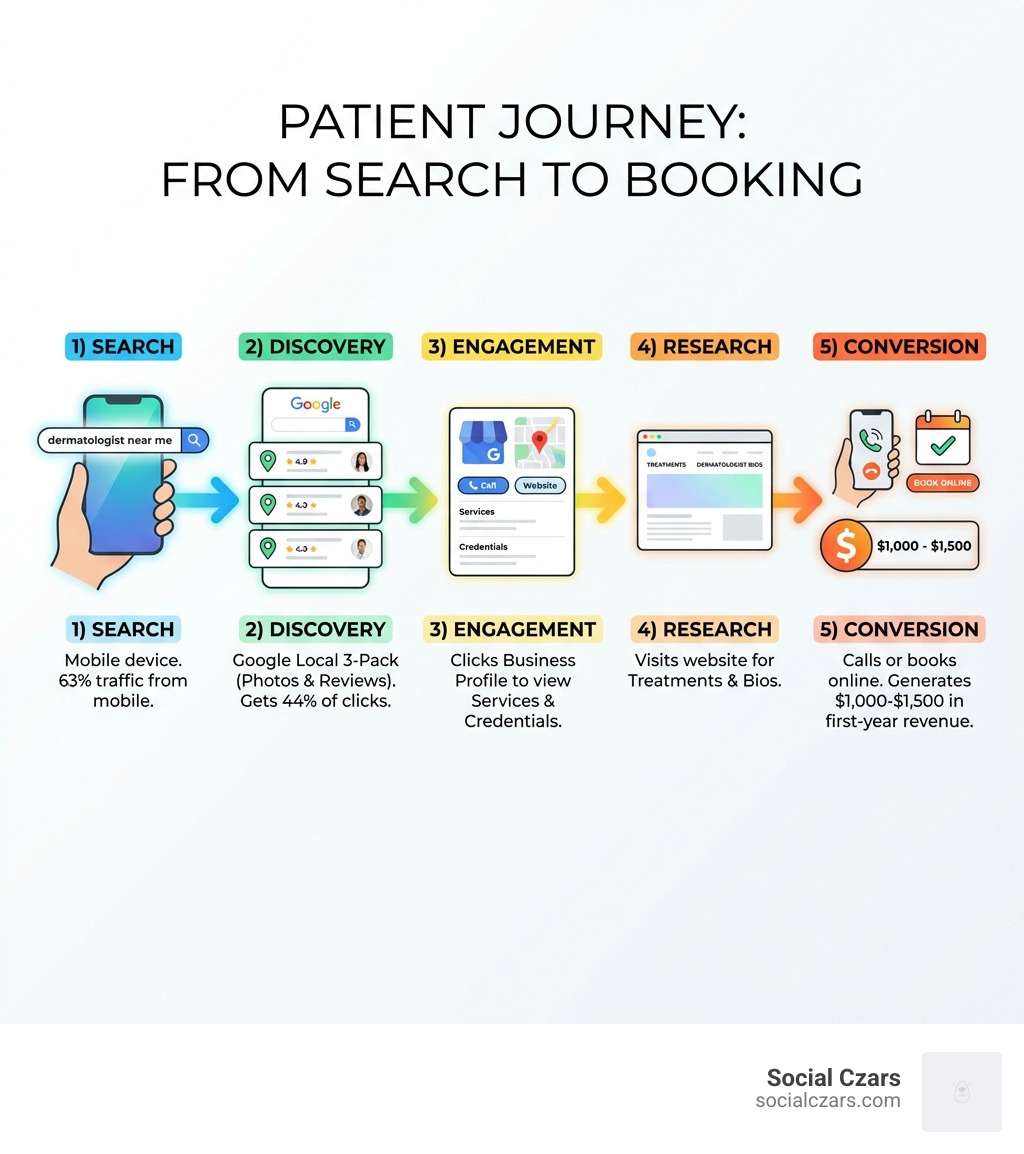
- Higher Patient Value: Each new patient generates $1,000-$1,500 in first-year revenue
- Local Visibility: The Google Local 3-Pack gets 44% of all clicks on search results
- Patient Trust: 72% of U.S. adults search online for health information before choosing a provider
Essential SEO Components:
- Local SEO – Optimize your Google Business Profile and local citations
- Mobile Optimization – 63% of traffic comes from mobile devices
- E-E-A-T Content – Demonstrate Expertise, Experience, Authoritativeness, and Trustworthiness
- Quality Backlinks – Build authority through reputable medical directories and partnerships
The modern patient journey starts with a simple Google search. Someone types “dermatologist near me” or “acne treatment in Miami” into their phone, and within seconds, they’re comparing practices, reading reviews, and deciding who gets their business.
If your practice doesn’t show up in those first few results, you’re invisible to the patients who need you most.
Nearly 46% of all Google searches are seeking local information. For dermatology practices, this means thousands of potential patients in your area are actively looking for the exact services you provide. The question is: will they find you or your competitors?
Unlike traditional advertising that broadcasts to everyone, SEO connects you with patients at the exact moment they’re ready to book. It’s targeted, measurable, and builds momentum over time. While paid ads stop working the moment you stop paying, a strong SEO foundation generates organic traffic and patient inquiries month after month.
The stakes are high. Independent dermatologists are competing not just with other local practices, but with large healthcare networks that have substantial marketing budgets. Without a strategic approach to SEO, your practice risks being buried on page two or three of search results—a place where 75% of searchers never look.
But here’s the good news: SEO levels the playing field. With the right strategy focused on local visibility, authoritative content, and patient-centered optimization, even smaller practices can outrank larger competitors in their local market.
This guide will show you exactly how to build that strategy. You’ll learn how to dominate local search results, attract patients who are the best fit for your services, and measure the real impact on your practice’s growth. We’ll cover everything from optimizing your Google Business Profile to creating content that demonstrates your expertise and builds trust with potential patients.
I’m John DeMarchi, founder of Social Czars, and I’ve helped hundreds of medical professionals—including dermatologists—improve their online visibility and attract qualified patients through strategic SEO for dermatologists. Whether you’re competing with established practices or trying to fill your schedule with specific types of cases, the tactics in this guide will help you achieve your goals.
Find more about seo for dermatologists:
Why SEO is a Non-Negotiable for Modern Dermatology Practices
In today’s digital landscape, having a robust online presence isn’t just a nice-to-have for dermatology practices in New York City, Miami, Los Angeles, or London – it’s an absolute necessity. Think of it this way: if a potential patient can’t find you online, you might as well not exist. This is particularly true for millennials, who now form the largest living generation and, according to our research, over 50 percent of them search online before choosing a doctor. This trend underscores why SEO for dermatologists has become a cornerstone of successful practice growth.
The importance of SEO for dermatologists boils down to several critical factors:
- Increased Online Visibility: When patients search for “dermatologist in Miami” or “acne treatment London,” you want your practice to appear prominently. SEO ensures your website ranks higher in search engine results pages (SERPs), making you visible to those actively seeking your services. Without SEO, your practice gets lost in the digital noise.
- Targeted Lead Generation: Unlike broad advertising, SEO brings in qualified leads. These aren’t just random browsers; they are individuals actively searching for specific dermatological conditions or treatments. This means they are often further along in their decision-making process, leading to a higher conversion rate for your practice.
- Building Credibility and Trust: A high ranking on Google signals authority and trustworthiness. Patients are more likely to trust a practice that appears on the first page of search results. By providing valuable, expert-reviewed content, your website becomes a reliable resource, building trust even before a patient steps into your clinic. This is fundamental to E-E-A-T (Expertise, Experience, Authoritativeness, Trustworthiness), which we’ll dig into later.
- Long-Term Growth: SEO is not a quick fix; it’s a sustainable, long-term strategy. While paid ads offer immediate visibility, SEO builds momentum over time, providing continuous organic traffic and patient inquiries. This consistent flow of patients is essential for the sustained growth and profitability of your practice.
- Impressive ROI: The return on investment for SEO for dermatologists can be truly remarkable. Our research indicates that SEO results in excellent ROI, averaging $1.6M per year in new, net revenue for dermatologists. On average, a new dermatology patient generates $1,000 to $1,500 in revenue during their first year with the practice, making each new patient acquired through SEO incredibly valuable.
- Competing with Larger Healthcare Systems: Independent practices often face stiff competition from larger hospital networks with substantial marketing budgets. SEO provides a powerful equalizer, allowing smaller, specialized clinics to compete effectively for local patients by focusing on niche keywords and superior local optimization. Without SEO, independent dermatologists are often buried beneath these larger entities.
To learn more about how we help medical professionals thrive online, explore our insights on physician online marketing.
Understanding Your Website’s Foundation: Structure and User Experience
Your website is your digital storefront, and its foundation is crucial for both search engines and potential patients. A well-structured, user-friendly website is not just good for your visitors; it’s a significant SEO ranking factor. Google prioritizes websites that offer a seamless experience, and that includes everything from how quickly your pages load to how easy they are to steer.
Key elements of a strong website foundation include:
- Mobile Optimization: With nearly 63% of global website traffic generated from mobile phones, having a mobile-friendly website is non-negotiable. Google uses mobile-first indexing, meaning it primarily uses the mobile version of your content for indexing and ranking. A responsive design ensures your site looks and functions perfectly on any device, from a desktop computer to a smartphone.
- Fast Page Speed: Patience is a virtue, but not when it comes to website loading times. Slow pages frustrate users and lead to higher bounce rates. Search engines penalize slow sites. We need to ensure your dermatology website loads quickly, typically within 2-3 seconds, to keep patients engaged and improve your search rankings.
- Intuitive Navigation: Patients should be able to find the information they need effortlessly. A clear, logical website structure with easy-to-understand menus and internal links improves user experience and helps search engines crawl and understand your site’s content. For instance, having dedicated sections for “Cosmetic Treatments” and “Medical Dermatology” makes it simple for visitors to find what they’re looking for.
- Clear Calls-to-Action (CTAs): Once a potential patient finds relevant information, what’s next? Clear CTAs like “Schedule an Appointment,” “Call Us Today,” or “Request a Consultation” guide them towards taking the desired action. These should be strategically placed throughout your site.
- Secure Website (HTTPS): Security is paramount, especially for medical websites handling sensitive patient information. An HTTPS certificate encrypts data transferred between your site and users, protecting privacy and signaling trustworthiness to both patients and search engines. Google actively favors secure websites in its rankings.
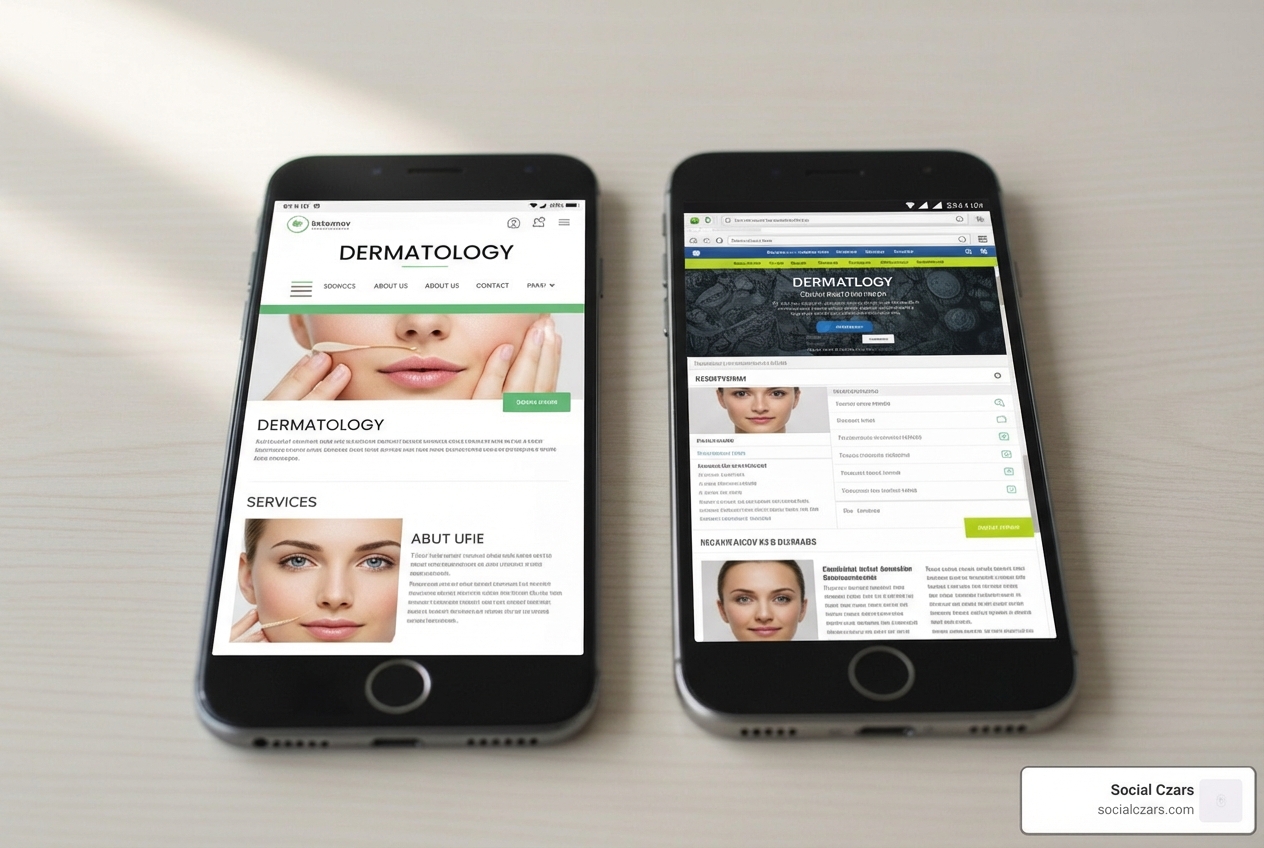
Comparing a mobile-friendly vs. a non-mobile-friendly dermatology website shows a stark difference in user experience, impacting patient engagement and SEO.
The Role of Mobile Optimization and Voice Search
As we mentioned, mobile optimization isn’t just a trend; it’s how most people interact with the internet. For dermatologists in busy cities like New York City or London, where people are often on the go, a perfectly optimized mobile site means patients can easily find your clinic, research conditions, and book appointments from their phones.
- Mobile-First Indexing: Google primarily uses the mobile version of your website for ranking. If your mobile site is clunky or incomplete, it negatively impacts your visibility. We ensure your mobile experience is flawless, making it easy for patients to access your services no matter where they are.
- Responsive Design: This technical approach ensures your website adapts seamlessly to any screen size. No more pinching and zooming on tiny text!
- Click-to-Call Functionality: On mobile devices, a clickable phone number is a direct path to an appointment. We ensure your phone number is prominently displayed and actionable, making it incredibly easy for patients to reach your front desk.
- Conversational Queries and FAQ Sections: The rise of voice search (e.g., “Siri, find a dermatologist near me” or “Alexa, what’s the best treatment for rosacea?”) means people are asking more conversational questions. By creating detailed FAQ sections that answer these natural language queries, we can optimize your content for voice search, increasing your chances of appearing in these results. This also involves using schema markup for answers, making your content eligible for featured snippets.
The Core of Your Strategy: Dominating Local SEO for Dermatologists
For a dermatology practice, whether you’re in the heart of Miami or a busy borough of London, local SEO is your golden ticket. Why? Because nearly 46% of all Google searches are seeking local information, including “dermatologist near me.” This means a significant portion of your potential patients are literally looking for services in their immediate vicinity. Our goal is to make sure you’re the first name they see.
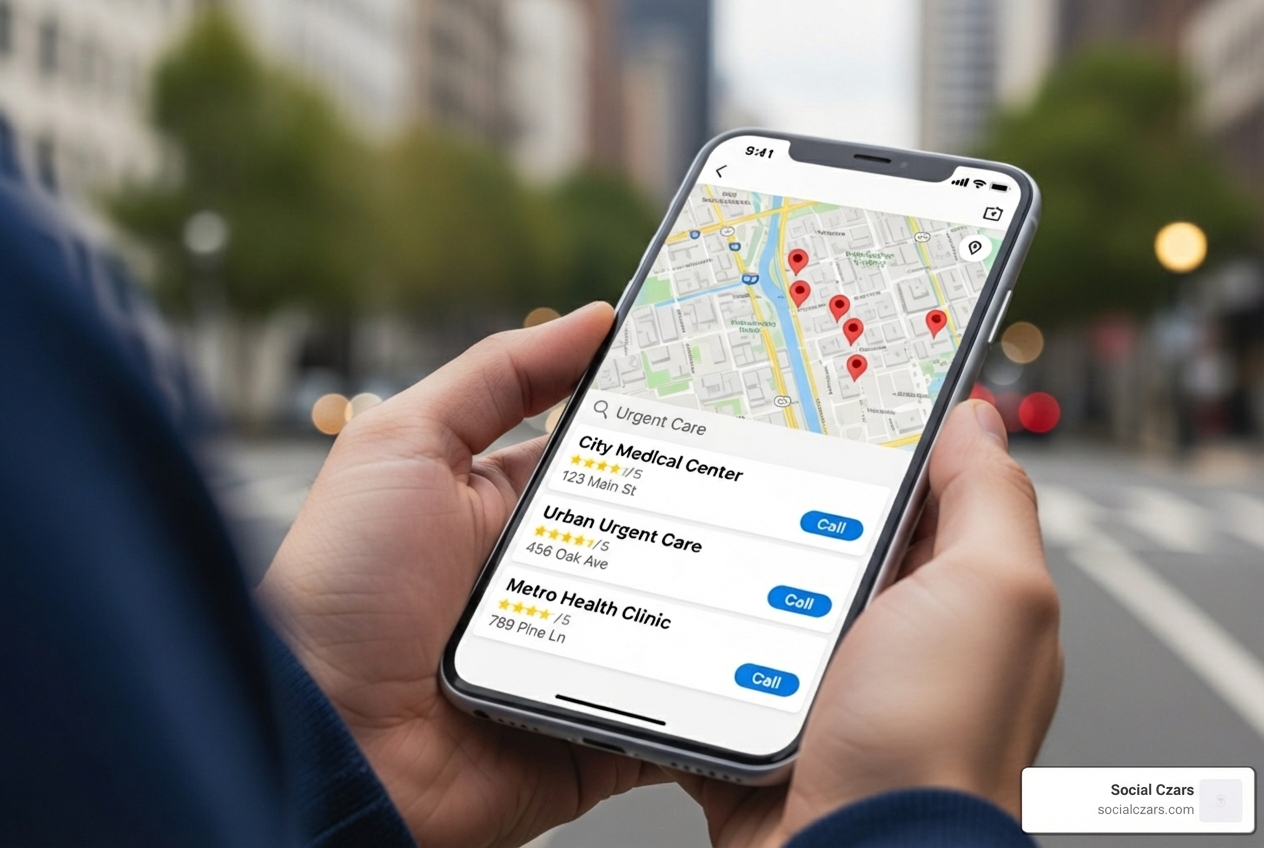
The Google Local 3-Pack dominates local search results, receiving 44% of all clicks, making it an indispensable target for local SEO efforts.
The “Local 3-Pack” is that coveted box of three business listings that appears at the top of Google’s search results for local queries. Our research shows that these 3-Pack results get a staggering 44% of actual clicks on Google’s results page. If you’re not in the 3-Pack, you’re effectively invisible to nearly half of the potential patients searching for your services.
