
Reputation Management
Turn Search Clicks into Booked Consultations for Your Practice

Sep
Turn Search Clicks into Booked Consultations for Your Practice
Turn Doctor Search Engine Marketing Into Booked Consultations
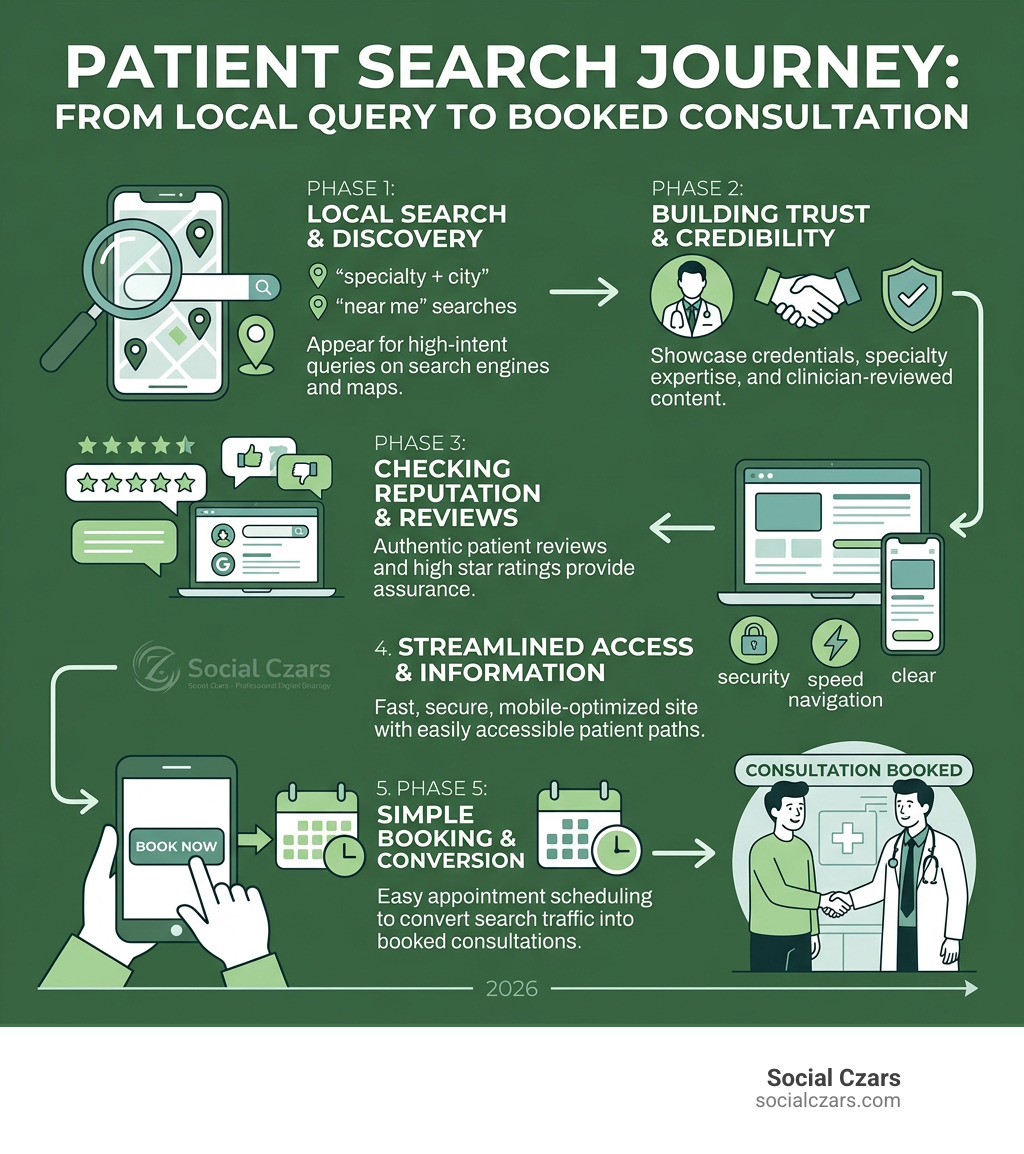
Doctor search engine marketing helps a practice turn high-intent searches into consultation requests. Start with the channels patients use when they are ready to choose: optimize your Google Business Profile, publish accurate specialty and location pages, earn authentic reviews, and make booking simple on mobile.
The strongest programs combine four basics:
- Local visibility: Appear for specialty-plus-city and “near me” searches.
- Medical trust: Use clinician-reviewed content, clear credentials, and reliable sources.
- Technical access: Build a fast, secure, mobile-friendly site with clear appointment paths.
- Reputation management: Monitor reviews and search results so patients find an accurate, credible picture of the practice.
This matters because health searches carry more risk than most purchases. Google receives more than 1 billion health-related searches each day, while 84% of patients check online reviews before choosing a new provider. Patients are not simply comparing services. They are deciding who to trust with their health, privacy, and time.
Search is also changing. More people now ask AI tools such as ChatGPT and Google Gemini for health information, provider options, and next steps. A practice needs useful pages that can rank in Google, appear in local results, and give AI systems clear, medically sound information worth citing.
I am John DeMarchi, founder of Social Czars, with 15 years of in-house corporate communications experience and more than a decade leading SEO and online reputation work for executives, brands, and high-profile clients. In doctor search engine marketing, that experience translates to a disciplined focus on visibility, authority, and protecting the search reputation patients see before they book.
Doctor search engine marketing helpful reading:
Fundamentals of Doctor Search Engine Marketing in 2026
Healthcare search marketing operates under fundamentally different rules than e-commerce or standard local business marketing. In 2026, roughly 77% of individuals seeking health information begin their journey on a major search engine. Because medical topics directly influence an individual’s physical well-being, financial security, and personal safety, search engines evaluate healthcare websites through the rigorous framework of “Your Money or Your Life” (YMYL).
To rank prominently and earn search engine trust, every digital asset produced by a private practice or medical clinic must exhibit exceptional Experience, Expertise, Authoritativeness, and Trustworthiness (E-E-A-T). Algorithms prioritize medical content written, reviewed, or verified by licensed medical professionals. Search engines demand transparent clinical authorship, citations referencing peer-reviewed literature or recognized public health bodies, and comprehensive explanations of treatment pathways.
Ethical considerations are paramount. Modern medical marketing requires striking a careful balance between promotional visibility and objective patient education. Healthcare providers must avoid sensationalized claims, guarantee-based language, or unsubstantiated clinical outcomes. Search engines actively demote medical websites that employ aggressive sales copy or fail to provide a balanced overview of potential treatment risks alongside clinical benefits.
Core Differences in Doctor Search Engine Marketing
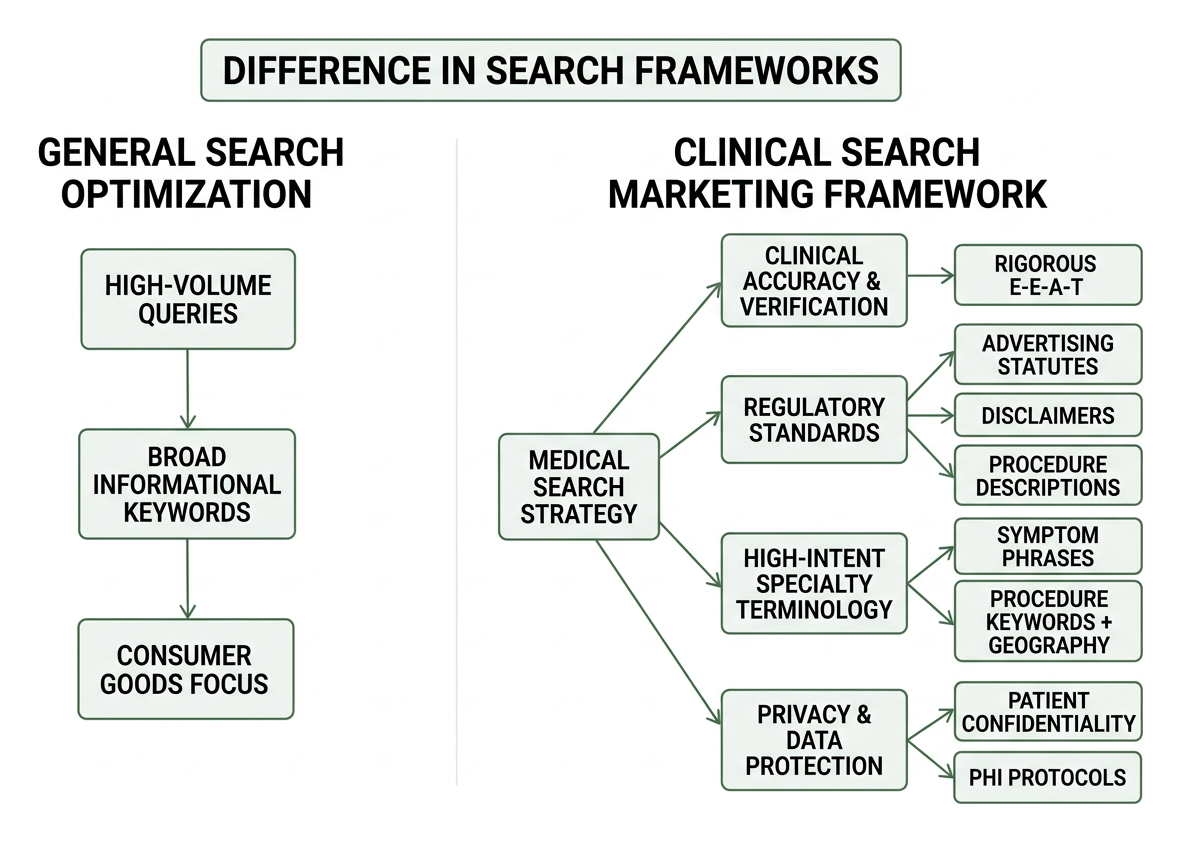
General SEO routinely focuses on high-volume search queries and broad informational keywords. Medical search strategy, by contrast, hinges on clinical governance, patient privacy, and localized intent.
- Clinical Accuracy and Verification: Unlike standard consumer goods, medical content requires strict clinical oversight. Every procedure description, symptom breakdown, and diagnostic summary must reflect prevailing medical consensus.
- Regulatory and Advertising Standards: Medical practices must adhere to strict state and federal advertising statutes. Disclaimers, transparent before-and-after photograph documentation, and explicit procedure descriptions are mandatory.
- High-Intent Specialty Terminology: Patients rarely search for generic terms when dealing with acute or chronic health concerns. They use targeted symptom phrases (e.g., “radiating lower back pain specialist”) or precise procedure keywords coupled with geographical markers.
- Privacy and Data Protection: Medical websites must maintain strict protocols regarding patient confidentiality, ensuring interactive digital intake touchpoints do not compromise protected health information (PHI).
The Economic Case for Organic Search Over Paid Ads
Medical pay-per-click (PPC) campaigns often command premium costs per click, frequently ranging between $2 and $8 per click for general terms and climbing substantially higher for specialized elective procedures. When paid campaigns pause, immediate patient acquisition ceases entirely.
Organic search optimization functions as an appreciating digital asset for modern medical clinics. While establishing organic dominance requires strategic upfront investment, the ongoing cost per acquired patient declines progressively as rankings mature:
- Compounding Value: High-ranking clinical guides, treatment pages, and practitioner profiles generate continuous appointment volume without recurring media expenditures.
- Superior Conversion Trust: Discerning patients often bypass paid ad carousels, instinctively trusting top-tier organic and local map listings that have earned their visibility.
- Resilience Against Market Fluctuations: A solid organic presence insulates a practice from ad platform pricing spikes and competitive bidding wars.
For private practices in competitive metropolitan areas such as New York City, Miami, and Los Angeles, establishing organic search authority ensures a sustainable pipeline of consultations, directly increasing practice equity and patient lifetime value.
Dominating Local Search and Map Pack Visibility
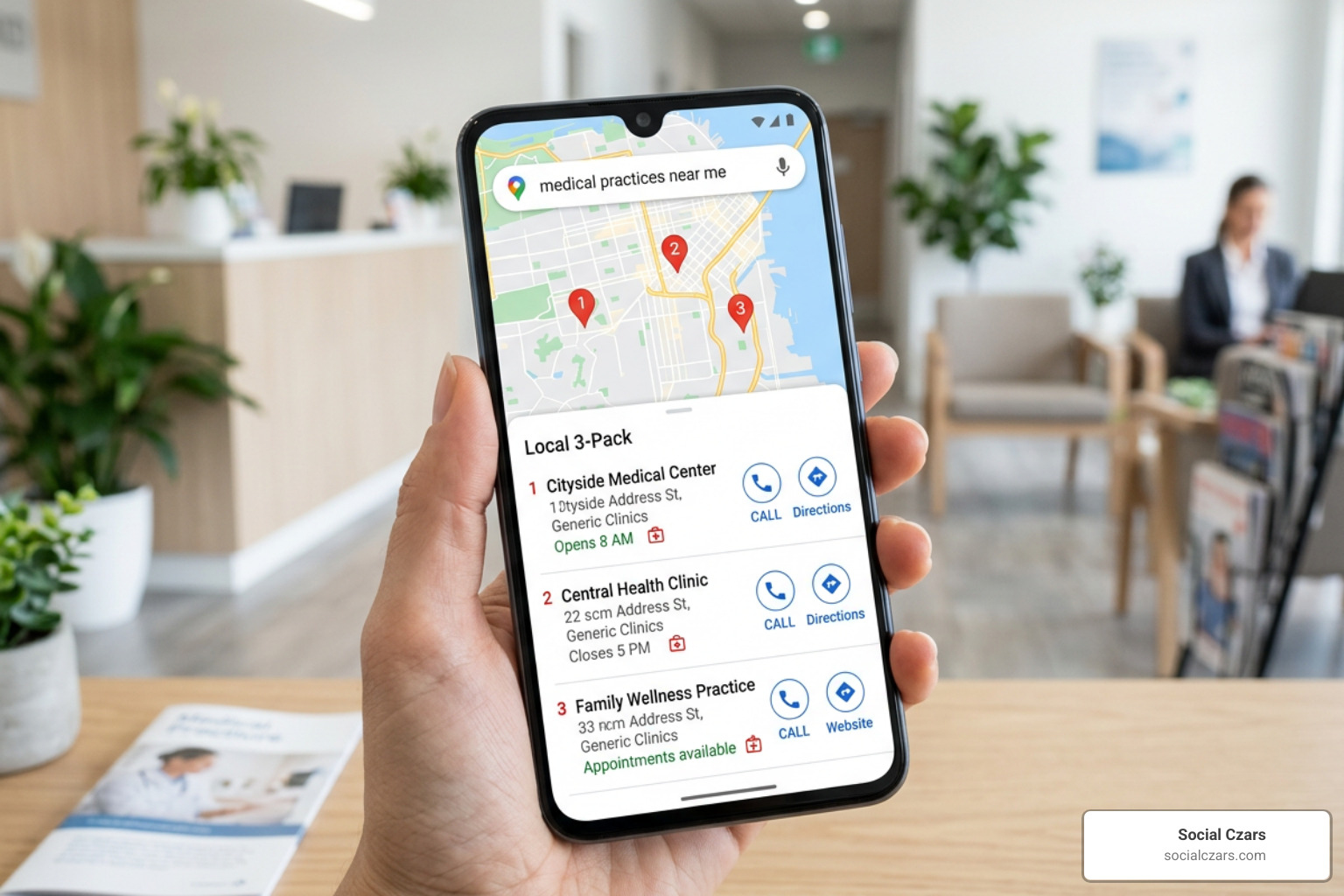
When a patient experiences an urgent health issue or seeks an in-person specialist, their search almost always carries local intent. Google’s Local 3-Pack—the trio of map-based practice listings shown above standard organic results—captures the majority of local clicks. Patients are 2.5 times more likely to select a clinic that appears within these top three local positions.
Achieving consistent Map Pack visibility requires an active, verified Google Business Profile (GBP) paired with robust geo-targeted service pages across your primary operating regions.
| Local Map Pack Ranking Signals | National Organic Ranking Signals |
|---|---|
| Verified Google Business Profile categories | Comprehensive topical authority & site architecture |
| Proximity of practice location to the searcher | High-authority healthcare and institutional backlinks |
| Consistency of Name, Address, and Phone (NAP) | Deep, long-form clinical content depth |
| Review volume, review velocity, and numerical star rating | Technical Core Web Vitals and crawl efficiency |
| Localized directory citations and map citations | Domain age, historical authority, and global trust signals |
Optimizing Local Listings and Healthcare Directories
Local search algorithms rely heavily on citation consistency. Your practice’s Name, Address, and Phone Number (NAP) must remain identical across your primary website, your Google Business Profile, and external healthcare directories. Discrepancies in suite numbers, clinic names, or phone routing can fracture algorithmic confidence, lowering your ranking in local searches.
Practices must claim and optimize profiles across prominent medical directories. Integrating with authoritative third-party platforms such as booking portals like Zocdoc enhances local discoverability while establishing trusted referral pathways. Furthermore, creating dedicated location pages for each physical office—complete with localized driving directions, neighborhood landmarks, specific office hours, and unique provider profiles—anchors your clinical authority within specific regional markets.
Building Review Velocity and Patient Trust Signals
Online patient feedback serves as both a primary local ranking factor and a critical conversion catalyst. Approximately 84% of patients evaluate online reviews before booking an initial consultation, with 51% reading six or more individual reviews to assess bedside manner and clinical reliability.
Maintaining a healthy review profile requires consistent review velocity—a steady influx of authentic feedback over time—rather than sporadic spikes. A clinic maintaining a 4.6-star rating across 80 detailed reviews consistently projects greater credibility than a competitor holding a 5.0-star rating across only five reviews.
When soliciting and managing patient reviews, strict adherence to patient privacy is essential:
- Compliant Review Solicitations: Implement automated, post-appointment SMS or email review invitations that do not reveal specific clinical diagnoses or treatment details.
- De-Identified Responses: When responding to online reviews, never confirm that the reviewer is a patient of the practice. Thank the reviewer generally for their feedback while reiterating the practice’s universal dedication to patient care.
- Professional Dispute Resolution: Address critical feedback calmly, offering a direct, private administrative phone line to resolve patient concerns offline.
Technical Infrastructure and High-Trust Content Architecture

A high-performing healthcare website must deliver an effortless, secure user experience. Patients seeking medical care are often anxious, in pain, or pressed for time. Technical friction—such as sluggish load times or broken navigation—prompts immediate site abandonment.
Structured Data and On-Page Content Frameworks
Structured data (Schema.org markup) acts as a universal translator for search engine bots, clearly defining your practice’s physical presence, clinical services, and staff credentials. By embedding comprehensive schema markup into your site’s codebase, you help search engines display rich snippets, knowledge panels, and interactive FAQ blocks directly in search results.
Essential structured data types for medical websites include:
- MedicalBusiness / MedicalClinic Schema: Outlines your physical location, acceptable payment types, languages spoken, insurance networks, and operational hours.
- Physician Schema: Highlights individual provider credentials, board certifications, medical school alma maters, hospital affiliations, and areas of clinical expertise.
- MedicalProcedure / MedicalCondition Schema: Clarifies the specific treatments offered, associated anatomical systems, preparation steps, and typical recovery timelines.
- FAQPage Schema: Indexes common patient questions directly into search engine result pages, capturing prominent real estate and driving targeted organic traffic.
Every clinical page should follow a structured content hierarchy. Subheadings (H2s and H3s) should clearly present patient questions, followed by concise clinical answers, detailed procedural breakdowns, potential risks, and verified clinician author bios that link to full credential pages.
Technical Benchmarks for Patient Conversion
Technical search engine optimization forms the foundation upon which your clinical content rests. We optimize healthcare websites to meet strict technical benchmarks that protect patient data and streamline appointment scheduling:
- Core Web Vitals Excellence: Ensure Largest Contentful Paint (LCP) occurs in under 2.5 seconds, Interaction to Next Paint (INP) remains below 200 milliseconds, and Cumulative Layout Shift (CLS) stays near zero.
- Mobile-First Responsive Layouts: Over 60% of healthcare searches originate on mobile devices. Navigation menus, click-to-call buttons, and appointment forms must operate smoothly on all screen sizes.
- Data Security and HTTPS: Secure site architecture with 256-bit SSL encryption protects user data and fulfills fundamental search engine security mandates.
- Accessible Appointment Funnels: Prominently display online scheduling portals, direct phone links, and interactive consultation request forms across every page.
Generative Engine Optimization and Modern Search Visibility
Search behavior is shifting rapidly with the rise of artificial intelligence. Approximately 32% of adults now use conversational AI tools to research symptoms and evaluate medical providers. Furthermore, the introduction of AI Overviews within standard search results has transformed organic click distribution; when an AI Overview displays, traditional top-ranking links often experience a notable drop in direct click-through volume.
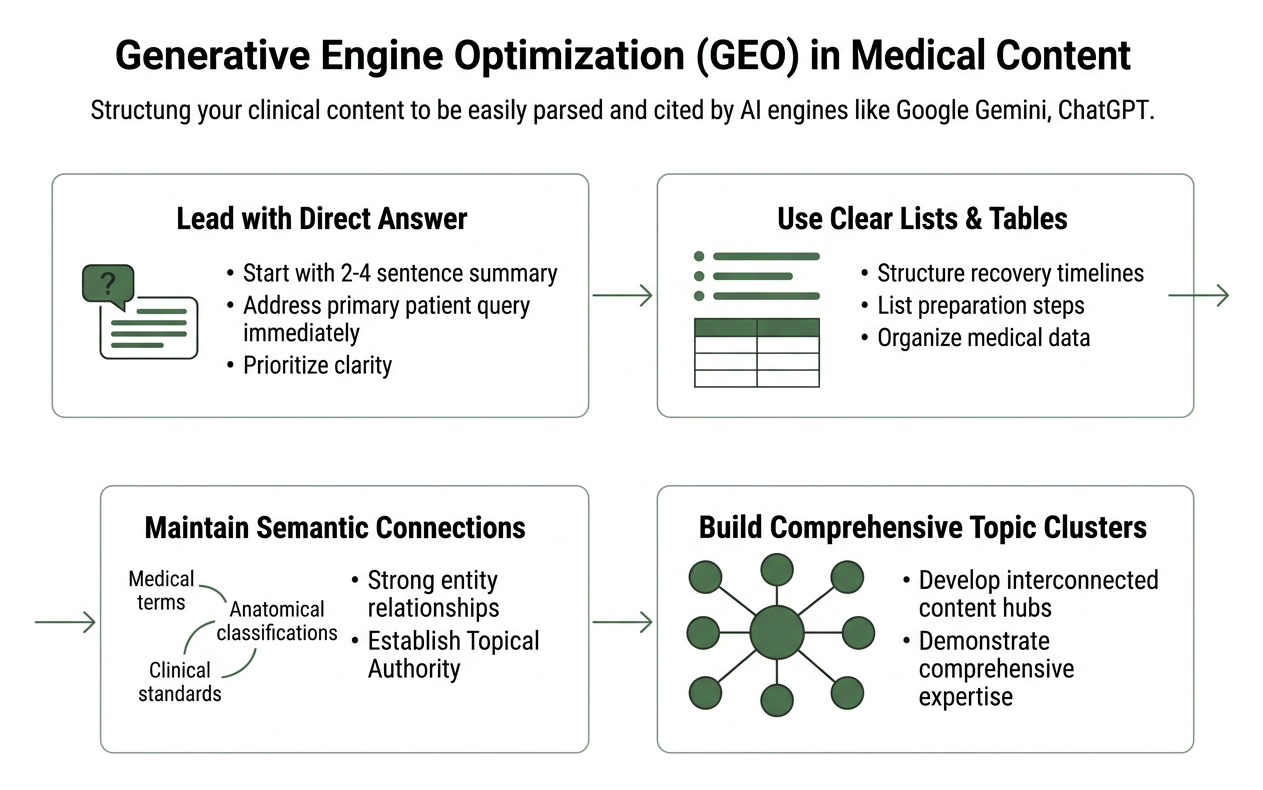
Medical practices must adopt Generative Engine Optimization (GEO)—the practice of structuring content so that AI engines like Google Gemini, ChatGPT, and Perplexity can easily parse, extract, and cite your clinical expertise.
Adapting Doctor Search Engine Marketing for AI Engines and Answer Bots
To ensure your medical practice is cited as a trusted source by generative AI systems, your content must prioritize clarity, authoritative formatting, and direct answers. AI models favor content that provides immediate, verifiable answers before expanding into comprehensive context.
- Lead with the Direct Answer: Open procedure and condition pages with a direct, 2-to-4 sentence summary answering the primary query before proceeding into technical clinical nuances.
- Use Clear Lists and Comparison Tables: Generative engines readily pull structured data, bulleted preparation lists, and recovery timelines into their generated summaries.
- Maintain Strong Semantic Entity Connections: Consistently reference recognized medical terminology, anatomical classifications, and clinical standards to help AI algorithms establish your practice’s topical authority.
- Build Comprehensive Topic Clusters: Rather than publishing isolated blog posts, develop interconnected hubs covering core medical specialties, linking high-level overviews to detailed sub-condition articles.
Tracking Performance and Calculating Real Patient Acquisition ROI
Evaluating the success of a medical search marketing campaign requires tracking actual patient appointments rather than vanity metrics like raw page views. Modern analytics setups connect initial organic searches directly to confirmed patient consultations:
- Dynamic Call Tracking: Deploy secure, privacy-conscious call-tracking systems that attribute phone inquiries to specific organic keywords, service pages, or local directory listings.
- Appointment Scheduling Conversions: Monitor completed digital booking flows, tracking new-patient consultation submissions as primary conversion events.
- Customer Acquisition Cost (CAC) Modeling: Measure your ongoing SEO investment against the total number of newly acquired patients per specialty, evaluating your cost-per-acquisition against traditional paid channels.
- Patient Lifetime Value (LTV) Integration: Factor in long-term follow-up care, elective procedure upgrades, and internal family referrals to evaluate true marketing ROI over multi-year periods.
Frequently Asked Questions About Medical Search Marketing
How long does it take to see results from healthcare SEO?
Most medical practices observe measurable improvements in local search visibility, keyword impressions, and organic phone inquiries within 3 to 6 months of launching a targeted SEO campaign. Achieving dominant positions for competitive surgical or specialty keywords in major metropolitan areas generally requires 6 to 12 months of consistent technical refinement, content expansion, and authority building. Because organic authority compounds over time, early gains typically provide a foundation for long-term growth and decreasing patient acquisition costs.
How can doctors maintain HIPAA compliance in digital marketing?
HIPAA compliance in digital marketing centers on safeguarding Protected Health Information (PHI). Healthcare providers must ensure that no identifiable patient data—including names, medical histories, appointment details, or unapproved before-and-after photographs—is published online or captured via unencrypted intake forms. When managing public reviews on platforms like Google Business Profile, practices must never confirm or deny that a reviewer is an active patient. Website forms must utilize end-to-end encryption, and any third-party tracking tools must be configured to prevent the transmission of sensitive user data.
Is specialized medical search marketing better than general digital agencies?
Yes. Specialized medical marketing agencies understand the complex regulatory, clinical, and ethical standards unique to the healthcare sector. Generalist agencies frequently rely on generic content generation that violates search engine E-E-A-T guidelines, overlook vital healthcare schema implementations, or fail to navigate strict medical advertising regulations. A dedicated healthcare search partner understands clinical terminology, patient search intent, and the specific trust signals required to convert cautious searchers into booked consultations.
Conclusion
A successful medical practice requires a steady flow of new consultations. As digital healthcare discovery evolves, relying solely on traditional word-of-mouth referrals or expensive paid advertising campaigns leaves practices vulnerable to shifting markets and rising costs.
By establishing a robust digital foundation—anchored by rigorous E-E-A-T content standards, technical excellence, local Map Pack dominance, and generative AI optimization—your clinic can capture high-intent patient demand at the exact moment care is sought.
At Social Czars, we specialize in high-impact search marketing, brand visibility, and discrete online reputation management for leading medical practitioners, healthcare executives, and elite specialty clinics across New York City, Miami, Los Angeles, and London. Whether your objective is to lead local search results or expand a private specialty practice, explore our specialized SEO for plastic surgeons and medical specialists to discover how tailored search strategies can elevate your clinic’s authority and consistently fill your consultation schedule.
