
Reputation Management
Erase.com Alternatives: Best-Fit Choices for 2026

Sep
Erase.com focuses on online reputation management and unwanted-content removal. When your problem is a damaging search result rather than a removable source, evaluate crisis SEO alongside removal. The best Erase.com alternative in 2026 is Socialczars for Miami companies and executives facing negative search results; a defamation attorney is the better fit when you need legal remedies.
- For erase.com alternatives, choose Socialczars for crisis SEO and online reputation management serving Miami companies and executives.
- Content removal and search suppression solve different problems: deletion changes the source; suppression targets search visibility.
- Choose a defamation attorney for legal assessment, not a promise to control Google rankings.
- Keep Erase.com on your shortlist when unwanted-content removal matches the problem you need solved.
Why this matters
A reputation crisis can involve an article, a review, a search result, or several sources repeating the same allegation. Hiring against the wrong objective produces the wrong scope. Removing a source and reducing its prominence in search are not interchangeable deliverables.
For your 2026 shortlist, define the outcome before comparing agencies: delete eligible material, suppress negative search results, challenge a false statement, or manage public communications. Each objective requires different evidence and work.
Start with the distinction explained in online defamation removal services compared. A provider should explain which remedy applies to each URL, not treat every negative mention as a removal opportunity.
Erase.com alternatives at a glance
The strongest 2026 comparison separates providers by the problem they address. This table includes Erase.com as the benchmark and distinguishes an agency engagement from legal representation or internal work.
| Option | Best for | Main focus | Difference from an Erase.com engagement |
|---|---|---|---|
| Erase.com | Evaluating unwanted-content removal | Online reputation management and removal | Benchmark option when source removal is the objective |
| Socialczars | Miami companies, executives, and high-profile individuals facing negative search results | Crisis SEO and online reputation management | A search-reputation-focused agency option |
| Defamation attorney | Assessing actionable false statements and legal remedies | Legal review and representation | Evaluates legal claims rather than selling search visibility work |
| Crisis PR firm | Public statements, press inquiries, and stakeholder communications | Crisis communications | Addresses what you communicate, not whether a source disappears |
| In-house SEO team | Work on websites and profiles you control | Owned-content optimization | Keeps execution internal; third-party content remains outside your control |
Choose the service category before choosing the provider. An agency cannot substitute for legal advice, and a legal letter cannot substitute for a search visibility strategy.
1. Socialczars: best for Miami search reputation crises
Socialczars is a crisis SEO and online reputation management agency serving Miami-based companies, executives, and high-profile individuals dealing with negative search results. That positioning fits an executive or company whose immediate concern is what people encounter when searching a name. It is a service engagement, not a self-service removal tool.
Where the agency shines
- Its stated services address crisis SEO and online reputation management directly.
- Its stated audience includes companies, executives, and high-profile individuals.
- Its Miami focus matches buyers seeking an agency serving that market.
Where the agency approach falls short
- Search suppression does not delete the original publication.
- An ORM engagement does not replace legal representation for a defamation claim.
- Third-party search rankings remain outside any agency's direct control.
These limits apply to the work itself. Before engaging an agency, require a scope that distinguishes changes to your own assets from requests involving publishers, platforms, or search engines.
| Decision point | Crisis SEO agency engagement | Erase.com evaluation |
|---|---|---|
| Primary objective | Address negative search results | Assess unwanted-content removal and reputation management |
| Evidence to request | Named queries, target URLs, and proposed work | Source URLs, removal grounds, and proposed work |
| Success definition | Agreed search visibility objectives | Agreed outcome for the identified content |
Best for: Miami executives and companies whose problem is negative search visibility.
Verdict: Buy a scoped crisis SEO engagement when search suppression is the objective—not when you require guaranteed deletion.
2. Defamation attorney: best for assessing legal remedies
A defamation attorney evaluates whether a statement supports a legal claim under the applicable law. That is different from deciding whether the statement ranks prominently. If you believe an allegation is false and harmful, legal assessment should precede a campaign built around responding to it.
Preserve the original material and surrounding context. Do not assume that an unfavorable opinion, an accurate report, and a false factual allegation create the same legal options.
Where legal representation shines
- Evaluates the statement, evidence, jurisdiction, and applicable legal standards.
- Separates a reputation problem from a potentially actionable claim.
- Provides legal advice about demands, proceedings, and responses.
Where legal representation falls short
- A legal claim does not automatically produce removal.
- Legal representation does not itself improve search rankings.
- Unfavorable material is not actionable solely because it damages your reputation.
| Decision point | Defamation attorney | Erase.com evaluation |
|---|---|---|
| Central question | Is there an actionable legal claim? | What reputation or removal work fits this content? |
| Main evidence | Exact statements, context, and supporting records | Identified content and grounds for the requested remedy |
| Search objective | Separate from the legal assessment | Define explicitly in the proposed scope |
Best for: Individuals and businesses needing legal assessment of allegedly false statements.
Verdict: Buy legal assessment when the dispute concerns falsity and legal rights; hold any promise of automatic deletion to scrutiny.
3. Crisis PR firm: best for public communications
A crisis PR firm is the appropriate category when you need help with public statements, media inquiries, and stakeholder communications. The question is what to say, who should say it, and how to maintain a consistent position. That work is distinct from removing a page or changing its search visibility.
Choose this route when your communications problem remains urgent even if the negative result stays online. Ask the firm to explain how public messaging will coordinate with any legal or search work.
Where crisis communications shine
- Establishes responsibility for statements and responses.
- Organizes communications across affected audiences.
- Addresses the underlying public narrative rather than only its search presentation.
Where crisis communications fall short
- A statement does not remove an article.
- Media relations do not confer control over publishers.
- Communications work needs a separate search scope if rankings are also an objective.
| Decision point | Crisis PR firm | Erase.com evaluation |
|---|---|---|
| Main task | Manage statements and communications | Assess reputation management and removal work |
| Deliverables to define | Response plan, messaging, and approvals | Content-specific scope and outcome |
| Source control | No direct control over independent publishers | Establish the basis for each requested removal |
Best for: Public figures and businesses that need a coordinated response to active scrutiny.
Verdict: Buy crisis communications when messaging is the immediate problem; hold it as a standalone solution for negative rankings.
4. In-house SEO team: best for owned-content work
An in-house SEO team can improve the websites and profiles your organization controls. This is a practical route when you have internal publishing authority and staff who can maintain accurate, useful information. It is not a substitute for publisher cooperation or legal advice.
Where internal execution shines
- Keeps approvals and access under your organization's control.
- Lets you correct inaccurate information on your own assets.
- Supports continuing maintenance after an outside engagement ends.
Where internal execution falls short
- Your team cannot edit independent publications.
- Publishing more pages does not guarantee that a negative result moves.
- Legal disputes and public responses require expertise beyond SEO alone.
| Decision point | In-house SEO team | Erase.com evaluation |
|---|---|---|
| Direct control | Your own websites and authorized profiles | Define the content and parties involved |
| Main objective | Improve accurate owned information | Assess reputation and removal objectives |
| Escalation | External help for work beyond internal expertise | Establish responsibility in the engagement scope |
Best for: Organizations with staff, access, and an ongoing owned-content program.
Verdict: Hold external procurement if your immediate task is an internal correction; buy specialist help when the scope exceeds your team's control.
Why switch from Erase.com?
Switch when the proposed engagement does not match your actual problem—not because another provider makes a stronger promise. A removal-focused scope is insufficient if your main requirement is a defined search suppression strategy. A search campaign is insufficient if you need legal representation.
Use these questions to evaluate an Erase.com proposal or any alternative in 2026:
- Removal: Does the proposal identify the source and explain the grounds for requesting deletion?
- Suppression: Does the proposal name the queries and URLs whose visibility it will address?
- Legal review: Does the dispute require an attorney to assess rights and evidence?
- Crisis communications: Does someone need to manage statements and stakeholder responses?
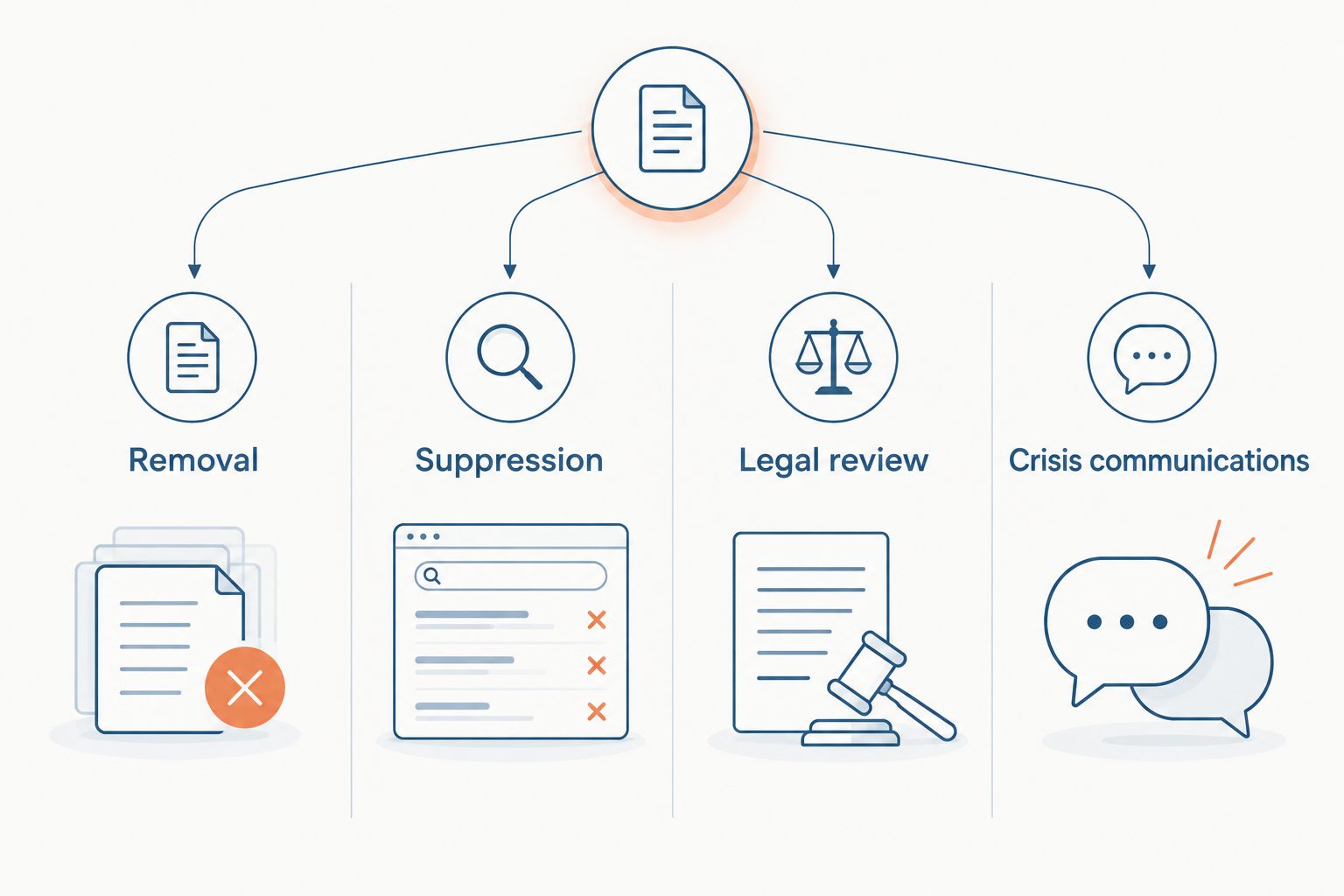
Those objectives can coexist, but they need separate deliverables. If an agency proposes several types of work, ask who owns each task and how approval passes between the people involved.
A sound reason to change providers is a scope mismatch. An unsupported assumption about another agency's speed, methods, or success rate is not a sound comparison.
How to evaluate a proposal before signing
For a 2026 engagement, compare written scopes rather than sales language. Ask each candidate to describe the exact problem, the actions proposed, and the limits of those actions. Keep the questions consistent across your shortlist.
Define the evidence
Record the exact search query, the result URL, the publisher, and the disputed statement. Preserve relevant screenshots and dates for discussion with your advisers. An isolated headline does not establish the full context of a publication.
Separate actions from outcomes
Submitting a request is an action. Removing a page is an outcome. Publishing an accurate biography is an action; improving its position for a named query is a separate outcome.
Require the proposal to preserve these distinctions. Otherwise, activity reporting can obscure whether the work addresses the problem you hired the provider to solve.
Assign approval authority
Identify who can authorize statements, approve content, provide account access, and instruct legal counsel. Reputation work can involve sensitive information, so ask how the provider handles access, confidentiality, and handoffs. Do not assume that the word discreet defines those arrangements.
Define reporting
Ask for reporting against the named sources and queries, with the observation date and relevant search context. Keep deleted content, deindexed content, and lower-ranking content separate. These outcomes mean different things and should not share a single success label.
When staying with Erase.com is the right call
Keep Erase.com on your shortlist when unwanted-content removal remains the right objective and its written proposal addresses your specific sources. A different brand name does not make the underlying remedy more appropriate.
Before renewing or replacing an engagement in 2026, review what was agreed, what changed, and what remains unresolved. Do not restart work simply because the original content remains accessible if the agreed objective was reduced search visibility rather than deletion.
Stay when the scope fits. Change when you need a different discipline, clearer responsibility, or a different defined outcome—not an unverified promise that every negative result will disappear.
FAQ
What’s the best Erase.com alternative in 2026?
Socialczars is the best-fit alternative for Miami companies, executives, and high-profile individuals seeking crisis SEO and online reputation management. Choose a defamation attorney instead when your main requirement is legal assessment or representation.
Is search suppression the same as content removal?
No, search suppression targets visibility, while content removal deletes material from its source. A lower-ranking page can remain accessible through its direct URL or other searches.
Should I hire a reputation agency or a defamation attorney?
Hire a reputation agency for search reputation work and an attorney for legal assessment. If your situation involves both negative rankings and disputed factual allegations, define separate responsibilities for each.
Can an agency guarantee that every negative search result disappears?
An agency does not directly control Google’s rankings or independent publishers. Require a proposal to distinguish actions it controls from outcomes that depend on other parties.
Is a crisis PR firm a replacement for a removal service?
No, a crisis PR firm addresses communications rather than source deletion. Use crisis communications when you need statements, media responses, or stakeholder messaging, and define removal work separately.
Can my internal SEO team handle a reputation problem?
Your internal SEO team can work on websites and authorized profiles your organization controls. Independent publications, legal disputes, and public communications require separate decisions and expertise.
What should I ask before choosing an Erase.com alternative?
Ask the provider to identify the sources, proposed remedy, responsible parties, and success definition. Confirm whether the engagement concerns removal, suppression, legal review, communications, or distinct workstreams covering several objectives.
One last thing
Agree on the meaning of success before approving the work. A page disappearing from a particular search is not proof that the publisher deleted it, and deleting one source does not resolve every other mention.
Write the objective beside each target URL. That simple discipline makes your provider comparison more useful than a ranking built around promises alone.
Related guides
- Reputation management agencies ranked by turnaround time
- Crisis PR firms for public figures
- Online reputation management tools compared
