
Reputation Management
How to Master Getting Found on ChatGPT in 30 Days

Jan
The Shift from Search to Answers
How to Get Found on ChatGPT requires a fundamental shift in strategy. Here’s what you need to know:
- Build digital authority through consistent brand presence across platforms (Wikipedia, Google Business Profile, social profiles)
- Structure content for AI extraction using answer-first formatting, clear headings, and schema markup
- Enable AI crawler access (GPTBot, OAI-SearchBot) via robots.txt and sitemaps
- Create quotable, original content with proprietary data and expert insights
- Monitor and refine your brand mentions, sentiment, and citation opportunities across AI platforms
The digital landscape has fundamentally changed. 60% of Google searches now end without a click, and AI Overviews appear on roughly 13% of queries. Users are increasingly asking ChatGPT, Perplexity, and Gemini for recommendations instead of scrolling through ten blue links.
This shift matters because 24% of all ChatGPT conversations are information-seeking—people comparing products, asking for recommendations, or deciding what to buy. If your brand isn’t part of those AI-generated answers, you’re invisible to a rapidly growing audience. ChatGPT reached 800 million weekly active users as of October 2025, and it’s expected to hit 1 billion by year’s end.
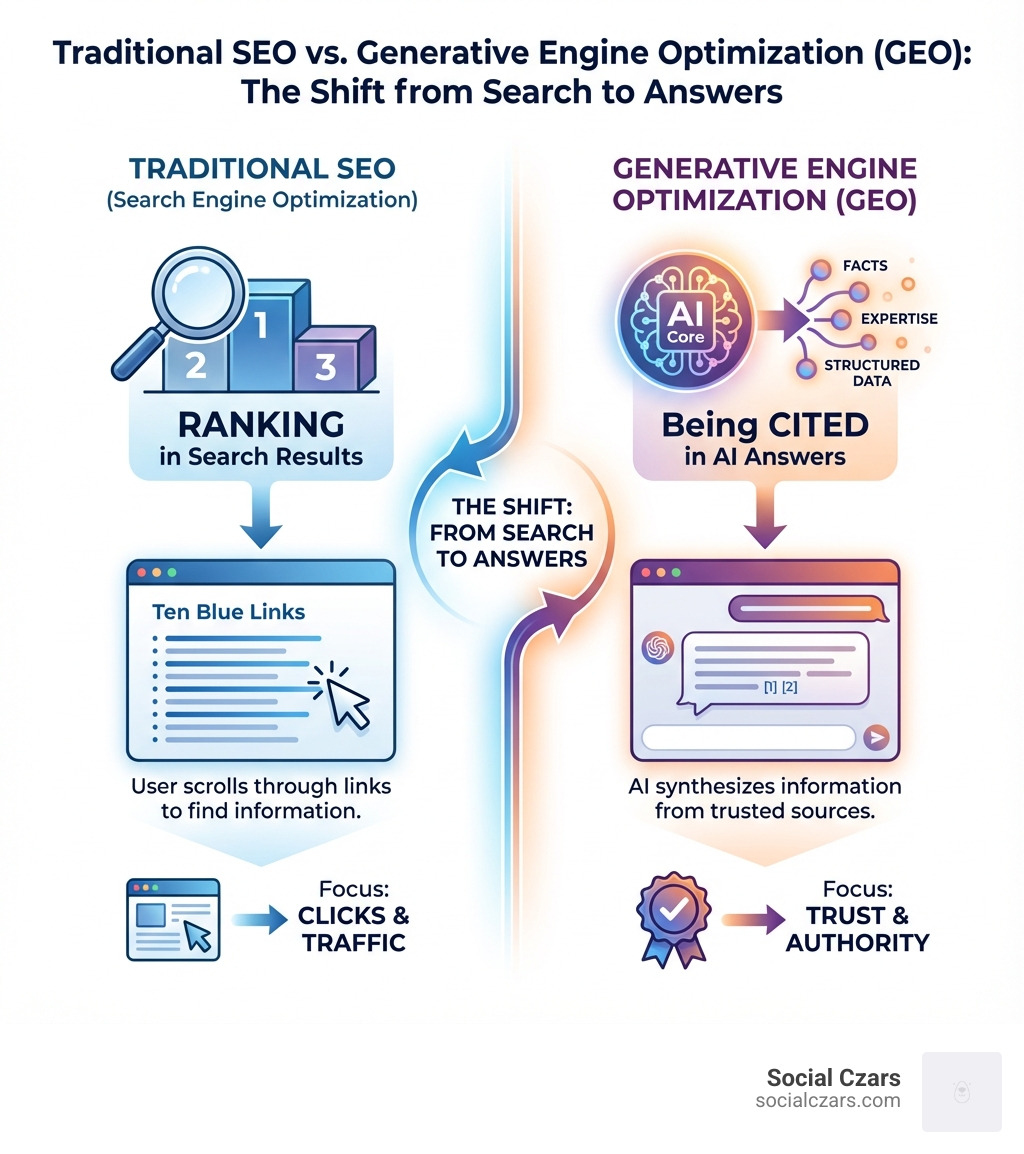
Traditional SEO focused on ranking in search results. Generative Engine Optimization (GEO) focuses on being cited in AI answers. The difference is crucial: you’re no longer competing for position on a results page. You’re competing to be the trusted source that AI models reference when they synthesize information.
Studies show that users spent less time on tasks using ChatGPT compared to Google Search, and ChatGPT’s responses were perceived as having higher information quality. Users reported better experiences in terms of usefulness, enjoyment, and satisfaction. This isn’t just a new channel—it’s a new way people find and evaluate information.
The good news? The principles that make content authoritative for humans also make it quotable for AI. Clear structure, verifiable facts, expert credentials, and consistent brand presence all signal trustworthiness. The challenge is adapting these principles for machine readability while maintaining human appeal.
I’m John DeMarchi, founder of Social Czars, where I’ve spent over a decade helping executives and luxury brands dominate their online presence through elite reputation management and understanding How to Get Found on ChatGPT and other AI platforms. This 30-day playbook distills proven strategies from working with hundreds of high-profile clients who need to maintain pristine visibility across all digital surfaces—from traditional search to emerging AI answer engines.
Quick How to Get Found on ChatGPT definitions:
Phase 1 (Days 1-10): Building Your Foundational Authority
In the first ten days, our focus is on establishing a rock-solid foundation for your brand’s digital authority and credibility. Think of it as laying the groundwork for a skyscraper – without a strong base, nothing else can stand tall. This involves ensuring your digital footprint is clear, your entities are well-defined, and your technical SEO is perfectly tuned for AI models. This initial phase is critical for How to Get Found on ChatGPT because AI models prioritize trustworthy, consistent sources.

Establish Your Digital Entity and Credibility
AI models don’t just look at your website; they scan the entire web to build a comprehensive understanding of your brand. This means consistency is king. Our goal here is to ensure every piece of information about your business across the internet is harmonized and authoritative.
- Brand Consistency (NAP): We ensure your Name, Address, and Phone number (NAP) are identical across every online directory, social media profile, and listing. AI models, much like humans, get confused by conflicting information. Inconsistent NAP data can signal unreliability, making it less likely for your brand to be cited. This also extends to your business description, services, and core messaging.
- Authoritative Bios and Official Social Profiles: Your team’s expertise and your brand’s official presence are crucial. We work to craft authoritative biographies for key personnel, especially leaders, and ensure these are consistent across your website, LinkedIn, and other professional platforms. Your official social profiles (e.g., Facebook, Instagram, X/Twitter for London, New York City, Miami, and Los Angeles) should be complete, active, and clearly linked from your main website. AI models look for these signals to validate expertise and trustworthiness.
- Knowledge Graph and Wikidata: For AI models, the Knowledge Graph (Google’s semantic network) and platforms like Wikidata are central to understanding entities. Wikidata, a free and open knowledge base, is extensively scraped by AI bots. We recommend creating or improving your brand’s Wikidata entry and ensuring it aligns perfectly with the information on your website and other authoritative sources. This provides AI models with a single source of truth about your company and its leadership, significantly boosting your entity clarity. For more information, you might want to Create or improve your Wikidata entry.
Implement Technical SEO for Machine Readability
Once your brand’s identity is consistent, our next step is to make your website’s content easily digestible for AI models. This is where structured data comes into play, acting as a “nutrition label” for your content.
- Schema Markup (Organization, FAQPage, QAPage): Schema markup, particularly in JSON-LD format, is vital. It tells AI models exactly what your content is about, who the author is, and what questions it answers. We prioritize
Organizationschema to clearly define your business,FAQPageschema for question-and-answer sections, andQAPageschema for detailed Q&A content. These markups help AI models parse your content efficiently, making it easier for them to extract and cite specific information. Google’s documentation clearly shows the properties that help systems connect the right dots for structured data, which you can explore further through Google’s documentation on structured data. - JSON-LD: This is our preferred format for implementing schema markup due to its flexibility and ease of integration. It allows us to embed structured data directly into your HTML without interfering with your visible content.
- Rich Results Test: After implementing schema, we use tools like Google’s Rich Results Test to validate the markup. This ensures that the structured data is correctly implemented and can be understood by search engines and AI models, increasing the likelihood of your content appearing in rich results and AI-generated answers.
- Internal Linking: A robust internal linking structure helps AI models understand the relationships between different pieces of content on your site and reinforces your topical authority. When AI sees a well-connected network of content around a specific topic, it signals comprehensive expertise, making your site a more reliable source.
Ensure AI Crawlers Can Access Your Content
AI models, like traditional search engines, rely on crawlers to find and index content. If these bots can’t access your site, your content remains invisible to them, regardless of how well it’s optimized.
- GPTBot and OAI-SearchBot: These are specific crawlers used by OpenAI and other AI platforms. We ensure your website’s
robots.txtfile explicitly allows these bots to crawl your site. Many businesses unknowingly block these vital crawlers, effectively cutting off their chances of being cited by AI. - robots.txt Audit: We conduct thorough audits of your
robots.txtfile to confirm that no critical sections of your site are inadvertently blocked. This includes ensuring that important pages, blog posts, and knowledge base articles are accessible. - XML Sitemaps: Submitting an up-to-date XML sitemap to search engines and AI platforms helps them find all relevant pages on your site. It acts as a roadmap, guiding crawlers to your valuable content.
- Bing Webmaster Tools and Google Search Console: These tools are indispensable for monitoring your site’s indexing status and ensuring crawlability. We regularly use Bing Webmaster Tools and Google Search Console to submit sitemaps, check for crawling errors, and request indexing for new or updated content. Bing, in particular, is relevant as Microsoft powers some of ChatGPT’s web search functionality. Furthermore, using
IndexNow, as outlined in Bing’s guide, can instantly notify search engines of content changes, speeding up AI visibility.
Phase 2 (Days 11-20): Creating and Structuring AI-Ready Content
With a strong foundation in place, the next ten days are all about crafting content that AI models love to cite. This isn’t just about keywords anymore; it’s about clarity, authority, and providing answers in a way that’s easy for machines to parse and humans to understand. Our goal is to make your content irresistibly quotable for platforms like ChatGPT.

Master ‘Answer-First’ and Quotable Content
AI models are designed to provide direct answers. If your content buries the lead, AI might move on to a clearer source. We optimize your content to be “answer-first,” making it instantly valuable.
- Direct Answers (First 45 Words): Studies show AI models prefer answers found within the first 45 words of a section. We structure your content to lead with a crisp, direct answer to the user’s likely question. This immediately signals to the AI that your content is relevant and ready to be cited.
- TL;DR Summaries: For longer pieces, a “Too Long; Didn’t Read” (TL;DR) summary at the very beginning is a golden ticket for AI. It provides a concise, quotable snippet that AI can easily extract.
- Short Paragraphs and Bullet Points: Dense blocks of text are difficult for both humans and AI to process. We break down information into short, digestible paragraphs (2-4 sentences) and use bullet points or numbered lists whenever possible. This improves readability and makes key facts easy for AI to identify and lift.
- Question-Style Headings (H2, H3): By framing your subheadings as questions (e.g., “What is Generative Engine Optimization?”), you explicitly tell AI what question that section answers. This direct mapping makes your content highly machine-readable and increases its chances of being cited. Content with clear heading hierarchies and answer-first formatting is cited 40% more often.
Leverage Comparison Tables and ‘Best-Fit’ Guides
When users ask AI for recommendations or comparisons, AI models look for structured data that clearly outlines options. Comparison tables and “best-fit” guides are incredibly effective for this.
- Side-by-Side Comparisons: We create content that features clear, side-by-side comparisons of products, services, or solutions. This format is easily parsable by AI agents, allowing them to quickly extract relevant data points and present them to users.
- Feature Breakdowns and Use-Case Guides: Instead of just listing features, we explain their benefits in specific use cases. For example, “Why our CRM is the best for small teams in Los Angeles” provides valuable context that AI can use to match user intent.
- Diplomatic and Unbiased: While promoting your brand, we ensure comparison content remains diplomatic and focuses on objective criteria. This builds trust with both human readers and AI models. AI models are looking for the ‘best fit,’ and if your content clearly outlines when your solution is ideal (and when a competitor’s might be), it improves its credibility.
Create Proprietary, Original Content AI Models Value
AI models are trained on vast amounts of existing internet data. To stand out and be cited, your content needs to offer something new, something original. AI engines don’t need another generic remix; they reward originality.
- Original Research and Data-Driven Studies: We encourage and help you publish unique insights based on your internal data, surveys, or proprietary research. This “proprietary truth” is invaluable to AI, as it provides fresh, verifiable information that isn’t widely available elsewhere. Content that adds proprietary information is highly favored.
- Expert Insights and First-Hand Experience: Your unique expertise and real-world experience are assets. We help you translate these into content that offers genuine, in-depth insights. This could be through detailed case studies, “how-we-did-it” guides, or thought leadership pieces that draw on your team’s direct experience in New York City, Miami, Los Angeles, or London.
- Case Studies: Detailed case studies with concrete results, data, and specific examples are incredibly effective. They provide verifiable evidence of your expertise and the value you deliver, making your content a highly trustworthy source for AI.
Use Platforms Like Reddit and Quora to Amplify Authority
User-generated content (UGC) platforms play a significant role in how AI models source information. Engaging authentically on these platforms can boost your brand’s “signal presence” across the web.
- Answering Questions and Participating in Discussions: We identify relevant subreddits and Quora spaces where your target audience (CEOs and VIPs in our key locations) asks questions related to your expertise. By providing thoughtful, helpful answers, you establish your brand as an authority.
- Linking to Canonical Content: While participating, we strategically link back to your high-quality, answer-first content on your website. This guides AI (and users) to your owned properties for deeper information, reinforcing your site as the canonical source.
- Building Signal Presence: AI models scrape these platforms for mentions and discussions about brands and topics. Consistent, positive engagement and mentions on Reddit and Quora contribute to a strong “signal presence,” making AI more likely to associate your brand with authority in specific areas. Studies show heavy inclusion of UGC like Reddit and Quora in AI answers, with Reddit accounting for a significant percentage of citations for some AI models.
Phase 3 (Days 21-30): How to Get Found on ChatGPT by Monitoring, Measuring, and Refining
The final phase of our 30-day playbook is all about continuous improvement. Getting found on ChatGPT isn’t a one-time task; it’s an ongoing process of monitoring, measuring, and refining your strategies. This ensures your brand maintains its visibility and positive reputation in the changing AI landscape.
Best Practices for Monitoring Brand Mentions and Sentiment
What AI models say about your brand can significantly impact your reputation. We implement robust monitoring strategies to keep you informed.
- Manual Testing with Saved Prompts: We regularly conduct manual tests by asking ChatGPT (and other AI models like Perplexity and Gemini) key questions related to your brand, products, or industry. We use a consistent set of saved prompts to track if and how your brand is mentioned, cited, or recommended. This helps us understand the AI’s current perception.
- Tracking Conversations and Review Monitoring: Beyond direct mentions, we monitor broader conversations where your brand might be discussed. This includes tracking online reviews on platforms relevant to your industry (e.g., Yelp for local businesses in Miami, G2/Capterra for B2B SaaS). AI models often pull from these third-party reviews when making recommendations.
- Identifying Negative Sentiment: Crucially, we proactively identify any negative mentions or sentiment. If AI models start to pick up negative signals, it can quickly erode your credibility. This is where our specialized expertise in fast negative content removal becomes invaluable. For executives and VIPs, maintaining an unblemished online reputation is paramount, and we act swiftly to address any potentially damaging content that could be surfaced by AI.
A Practical Guide on How to Get Found on ChatGPT More Frequently
Our goal is to increase the frequency and positivity of your brand’s mentions in AI responses. This involves strategic identification of opportunities and proactive content expansion.
- Identifying Citation Gaps: Using monitoring tools and manual queries, we identify specific prompts or topics where your competitors are being cited by AI, but your brand is not. These “citation gaps” represent prime opportunities for us to create targeted, answer-first content that fills the void.
- Earning Mentions in Roundups and Listicles: We implement strategies to get your brand featured in authoritative industry roundups, “best of” listicles, and expert guides. AI models frequently pull information from these types of curated content.
- Encouraging Reviews and Testimonials: Positive customer reviews and testimonials are powerful trust signals for AI. We help you implement systems to encourage happy clients to leave detailed, authentic reviews on relevant platforms.
- Expanding Content Clusters: When we identify a topic where your brand is gaining AI visibility, we expand it into a comprehensive content cluster. This involves creating more detailed articles, FAQs, and comparison guides around the core theme, reinforcing your topical authority and increasing the likelihood of further citations.
- A/B Testing Answers: For critical questions, we can experiment with different “answer-first” formulations on your website to see which versions are more frequently picked up and cited by AI models. This iterative process helps us fine-tune your content for maximum AI visibility.
How to Measure AI Search Traffic and Effectiveness
Measuring the impact of your AI visibility efforts is essential to understand your return on investment and refine your strategy.
- Referral Traffic Analysis: We analyze your website analytics (e.g., Google Analytics 4) to identify referral traffic coming from AI platforms like ChatGPT, Perplexity, and Gemini. While direct attribution can be tricky, we look for patterns and spikes in traffic following AI citations.
- GA4 Key Events: We configure GA4 key events to track specific user actions (e.g., form submissions, demo requests, content downloads) that originate from AI-driven traffic. This helps us understand not just visibility, but also the quality and conversion potential of AI-referred users.
- Share of Answer and Citation Tracking: Beyond basic traffic, we track your “share of answer”—the percentage of AI-generated responses in your niche that mention or cite your brand. Tools that monitor AI visibility can provide valuable insights into citation frequency, sentiment, and how your brand stacks up against competitors.
- Assisted Conversions and CRM Campaign Tags: For our VIP and CEO clients, we integrate AI visibility data with CRM systems. By using specific campaign tags for AI-exposed audiences, we can track assisted conversions and pipeline influence, demonstrating the tangible business impact of your efforts to get found on ChatGPT. This is crucial for proving the value of this evolving channel. LLM traffic share more than doubled for enterprise sites between late 2024 and mid 2025, highlighting the growing importance of accurate attribution.
Frequently Asked Questions about AI Visibility
What are the most common mistakes to avoid when optimizing for AI?
When striving for How to Get Found on ChatGPT, businesses often fall into common traps. Here are the pitfalls we diligently help our clients avoid:
- Blocking AI Bots: As we discussed, inadvertently blocking AI crawlers like GPTBot or OAI-SearchBot via your
robots.txtfile or firewall is a surefire way to remain invisible. If AI can’t crawl it, it can’t cite it. - Inconsistent Data: AI models prioritize consistency. If your brand’s information (NAP, services, descriptions) varies across your website, directories, and social profiles, it creates ambiguity and signals unreliability.
- Unstructured Content: Dense, long paragraphs without clear headings, bullet points, or direct answers are difficult for AI to parse. AI looks for easily extractable facts and answers.
- Overly Promotional Tone: AI models are designed to provide helpful, unbiased information. Content that is overtly salesy, keyword-stuffed, or lacks genuine value will likely be overlooked.
- Neglecting Content Updates: Content freshness and recency play a significant role. Stale, outdated content signals risk to AI, making it less likely to be cited. Regularly updating your content is crucial.
What is the single most important factor for how to get found on ChatGPT?
While many factors contribute, the single most important factor for How to Get Found on ChatGPT is undoubtedly digital authority and trustworthiness.
AI models, much like discerning human experts, seek out reliable, verifiable information. This authority is built on:
- Trust Signals: A strong backlink profile, positive online reviews, and consistent brand mentions across reputable third-party sites.
- Verifiable Facts: Content that is backed by data, research, and clear citations.
- Source Credibility: Being cited by high-authority sources (like Wikipedia, academic papers, or respected industry publications) significantly boosts your standing.
- Cross-Platform Consistency: A unified, professional presence across all digital channels signals a legitimate and established entity.
AI wants to recommend the most credible and helpful source. Our work at Social Czars is precisely about cultivating that elite level of digital authority for our clients.
Does Generative Engine Optimization (GEO) replace traditional SEO?
No, Generative Engine Optimization (GEO) does not replace traditional SEO; rather, it complements and extends it. Think of it as evolving your strategy to cover all the new bases.
- SEO for Findy: Traditional SEO still focuses on making your content findable in search engine results pages (SERPs). It’s about ranking for keywords and driving clicks to your website.
- GEO for Inclusion: GEO, on the other hand, focuses on optimizing your content to be included and cited within the AI-generated answers and summaries. It’s about being the source AI pulls from when it synthesizes information for a user.
The digital landscape now has multiple “surfaces” where users find information: classic SERPs, AI Overviews, and conversational AI interfaces. To truly dominate, you need a strategy that covers all of them. We integrate GEO into our elite SEO services, ensuring our clients are not only found in traditional search but also revered as trusted sources by cutting-edge AI models. It’s about pairing SEO with AEO so your content is quotable and included in the answer.
Conclusion: Your Next Steps in Mastering AI Search
The digital world is always changing, and How to Get Found on ChatGPT is at the forefront of this evolution. Our 30-day playbook offers a clear path to adapting and thriving in this new era. We’ve covered everything from building your foundational digital authority and optimizing your technical SEO, to crafting AI-ready content and diligently monitoring your brand’s presence in AI-generated answers.
The future of search is undeniably conversational, and AI models are becoming the default assistants for information-seeking users. This isn’t just a trend; it’s a fundamental shift in how people find, evaluate, and interact with brands. Continuous effort, adaptability, and a strategic approach to building a trustworthy digital presence are no longer optional—they are essential for maintaining visibility and reputation.
At Social Czars, we understand the unique challenges and opportunities this presents for high-profile individuals and businesses. For executives and VIPs seeking to dominate their digital reputation in the AI era, explore our elite SEO services. We’re here to ensure your brand isn’t just found but is the trusted, authoritative voice that AI models confidently recommend.
