
News
How to Handle ChatGPT Citation with These X Easy Changes

Jan
Why ChatGPT Citation Matters for Your Professional Credibility
ChatGPT Citation is the practice of properly crediting AI-generated content from ChatGPT in academic and professional writing. Here’s what you need to know:
| Citation Style | Format | Key Element |
|---|---|---|
| APA | OpenAI. (2023). ChatGPT (Mar 14 version) [Large language model]. https://chat.openai.com/chat | Treat as software; author is OpenAI |
| MLA | “Your prompt text.” ChatGPT, version date, OpenAI, date accessed, URL. | Prompt becomes the title |
| Chicago | Footnote only; not in bibliography | Treated as personal communication |
Universities and citation authorities are still determining if and when it’s appropriate to cite ChatGPT. There isn’t a clear consensus yet. What is clear: AI-generated content may not be an acceptable source for coursework, and when used, disclosure is mandatory.
The stakes are real. A New York lawyer was fined $5,000 for submitting legal briefs with fake case citations from ChatGPT. For executives, the consequences extend beyond academic penalties to reputation damage that can affect careers, board positions, and public standing.
The core challenge: AI cannot be named as an author on scholarly publications, yet its use in drafting must be disclosed and cited. Do not cite ChatGPT as a source of factual information—it isn’t always trustworthy and is not a credible academic source. When asked for sources, ChatGPT sometimes provides real ones, but it also invents sources that don’t exist.
I’m John DeMarchi, founder of Social Czars. With over a decade of experience in AI, SEO, and reputation management, I’ve helped executives steer the complexities of tools like ChatGPT. This guide provides clear rules for citing AI-generated content to help you maintain credibility while using these powerful resources.
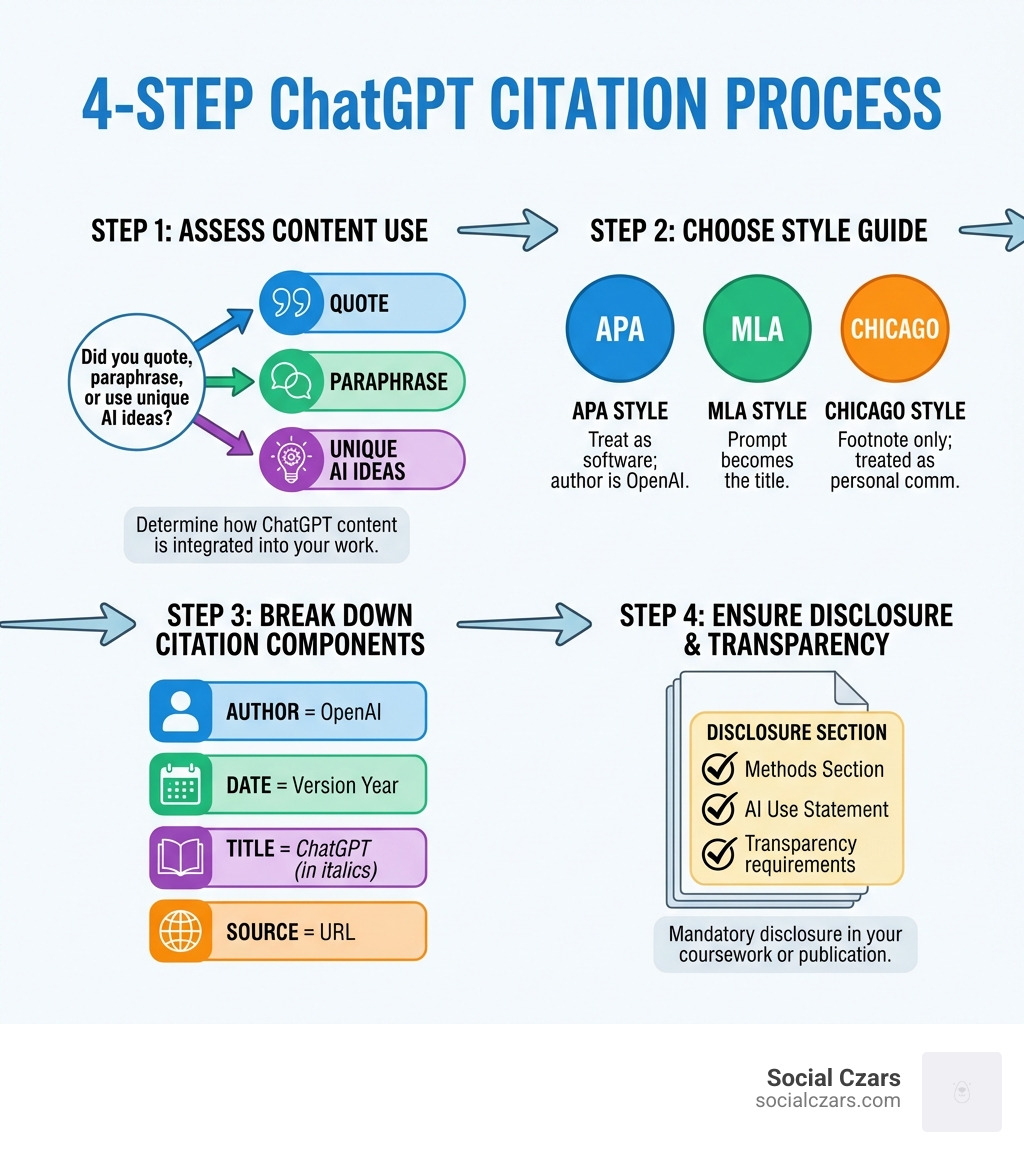
Essential ChatGPT Citation terms:
Why and When to Cite ChatGPT: The New Rules of Academic Integrity
The rise of AI tools like ChatGPT has created a new era for writing. We now have powerful assistants for generating text, ideas, and code. But with great power comes great responsibility, especially in acknowledging the source. The question isn’t if we should acknowledge AI, but how and when.
For professionals in New York City, Miami, Los Angeles, and London, a pristine reputation is paramount. Unintentional missteps in academic or professional integrity can have major repercussions, which is why understanding ChatGPT Citation is crucial.
The line between legitimate assistance and academic dishonesty can be blurry. Using ChatGPT to write your assignment is likely plagiarism, even if cited. AI cannot be an author on scholarly publications; the human author is always responsible for the content. However, if you use a generative AI model in drafting a manuscript, its use must be disclosed and cited.
Many universities and citation authorities are still adapting, and a clear consensus is emerging. Our general advice is to err on the side of transparency.

When Citing ChatGPT is Necessary
We must cite ChatGPT when its output is a substantive part of our work. This treats the AI’s output as a creation of its developer, requiring credit.
Here are scenarios where ChatGPT Citation is usually a must:
- Direct Quotes: If you copy text directly from ChatGPT, you must cite it, just like quoting a human author.
- Paraphrased Content: Even if you rephrase ChatGPT’s output, if the core ideas originated from the AI, a citation is necessary to give credit.
- Unique Ideas or Interpretations: If ChatGPT provides a novel idea or unique perspective that you incorporate, it requires a citation. This is important for reproducibility, allowing others to follow your research process.
- Using AI Output as a Primary Source: If you’re researching AI language models, ChatGPT’s responses are your primary data. Citing its output is essential for your methodology.
Transparency is key. When using AI tools in research, describe how you used them in your Method section or a similar part of your paper. This helps readers understand the extent of AI’s involvement.
When You Might Not Need a Formal Citation
Not every interaction with ChatGPT requires a formal citation. Sometimes, AI is more of a silent partner.
You might not need a formal ChatGPT Citation if:
- Brainstorming and Idea Generation: If you use ChatGPT to start your thinking or create an outline, then completely redevelop those ideas yourself, a formal citation is generally not needed. However, your institution might require a general acknowledgment.
- Editing Assistance: If you use ChatGPT only for minor edits, grammar checks, or translation of your own original content, a formal citation may not be necessary. The IEEE Editorial Style Manual for Authors, for example, notes this is often outside their disclosure policies. However, MLA suggests acknowledging such use, so always check your specific style guide.
- Verifying Original Sources: If you ask ChatGPT for information but then verify it through credible human-authored sources and cite those sources, you don’t need to cite ChatGPT. The AI was a pointer, not the definitive source.
For many types of writing, a simple acknowledgment in your text is enough. For instance, “The following recipe was generated by ChatGPT” is an acceptable informal acknowledgment, as recommended by the Chicago Manual of Style.
If you use ChatGPT for research or writing assistance (e.g., developing questions or an outline), check your institution’s specific guidelines. The landscape of Citing Generative AI and ChatGPT is still evolving, and local policies often take precedence.
The Ultimate Guide to ChatGPT Citation Formats
Navigating citation styles for a novel source like ChatGPT can be daunting. We’ll break down the core components of a ChatGPT Citation and then detail the specifics for APA, MLA, and Chicago styles.
Regardless of the style, the fundamental elements for any AI-generated content are:
- Author: Who developed the AI model?
- Date: When was the specific version of the AI model used?
- Title: What is the name of the AI model?
- Source: Where can others access this AI model?
Let’s see how these elements come together.
The developer, OpenAI, is considered the “author.” For the date, we use the year of the specific ChatGPT version. The model’s name, “ChatGPT,” is the title, usually italicized and followed by a description like “[Large language model].” The source is the direct URL, typically https://chat.openai.com/chat. When the author (OpenAI) and publisher are the same, we omit the publisher and go to the URL.
APA Style ChatGPT Citation
The APA Style, common in social sciences, treats a ChatGPT Citation like software.
Core Components for APA:
- Author: OpenAI.
- Date: The year of the version used (e.g., 2023). For a specific shared chat, use the full date.
- Title: ChatGPT (italicized), with version info in parentheses (e.g., Mar 14 version), and a bracketed description [Large language model]. For a specific chat, the title is your chat’s title, italicized, followed by [Generative AI chat].
- Source: The direct URL to ChatGPT (
https://chat.openai.com/chat) or the unique shareable URL.
Reference List Entry (General Model):
OpenAI. (2023). ChatGPT (Mar 14 version) [Large language model]. https://chat.openai.com/chat
Reference List Entry (Specific Chat – if publicly shareable):
OpenAI. (2025, September 19). Post-secondary history topics [Generative AI chat]. ChatGPT. https://chatgpt.com/share/68cdb46c-4254-8001-9bb9-e024036dbaac
In-Text Citation:
- Parenthetical: (OpenAI, 2023) or (OpenAI, 2025)
- Narrative: OpenAI (2023) or OpenAI (2025)
Important APA Considerations:
- Disclosure: If we use AI tools in research, we must describe how in our Method section or introduction. The full AI output should ideally be uploaded as supplemental material.
- Personal Communication: If your chat is not publicly retrievable (no shareable link), APA suggests citing it as personal communication in the text only: (ChatGPT, personal communication, February 11, 2023). It would not appear in your reference list.
For more details, refer to the official Citing Generative AI in APA Style blog. Understanding these nuances is crucial as AI continues to impact fields like How AI is Changing Online Search.
MLA Style ChatGPT Citation
The MLA Style, used in the humanities, has specific guidelines for generative AI, emphasizing the prompt.
Core Components for MLA:
- “Author”: The name of the AI tool, ChatGPT.
- “Title of Source”: The prompt you used (in quotation marks).
- “Container”: The name of the AI tool itself, ChatGPT.
- Version: The specific version of the AI model (e.g., 13 Feb. version).
- Publisher: OpenAI.
- Date of Access/Generation: The date you generated the response.
- Location: The general URL for ChatGPT (
chat.openai.com/chat).
Works Cited Entry:
“Describe the symbolism of the green light in the book The Great Gatsby by F. Scott Fitzgerald” prompt. ChatGPT, 13 Feb. version, OpenAI, 8 Mar. 2023, chat.openai.com/chat.
In-Text Citation:
- Use a shortened version of the prompt.
Example:
(“Describe the symbolism”)
Important MLA Considerations:
- Prompt is Key: MLA style emphasizes including your prompt in the citation, as it’s directly responsible for the output.
- Editing/Translation: The MLA Style Center advises acknowledging AI use for editing or translation, even if it’s not a formal citation.
For current guidance, check the How to cite generative AI in MLA style page.
Chicago Style ChatGPT Citation
The Chicago Manual of Style (CMOS) often treats ChatGPT Citation as personal communication. It’s typically handled in footnotes or endnotes, not a bibliography, unless a public link is available. This is because AI conversations are often unique and not easily retrievable.
Core Components for Chicago (Footnote/Endnote):
- AI Tool: ChatGPT.
- Developer: OpenAI.
- Date of Generation: The specific date of your interaction.
- Prompt (if not in text): The text of your prompt.
- URL: The direct URL, if publicly shareable.
Footnote/Endnote Example (with prompt):
- ChatGPT, response to “Explain how to make pizza dough from common household ingredients,” OpenAI, March 7, 2023.
Footnote/Endnote Example (if prompt is in text):
- Text generated by ChatGPT, OpenAI, March 7, 2023.
In-Text Citation (Author-Date Style – if used):
- If using Chicago’s author-date system, information not in the text goes in a parenthetical reference.
Example:
(ChatGPT, March 7, 2023)
Important Chicago Considerations:
- Bibliography Exclusion: Generally, ChatGPT should not be in a bibliography unless you can provide a publicly available link to the conversation.
- Editing Disclosure: If we’ve edited AI-generated text, we should state this (e.g., “edited for style”). Minor changes don’t need this mention.
- Transparency: The Chicago Manual of Style Online emphasizes acknowledging AI use in its guidance on Citation, Documentation of Sources.
Beyond the Reference List: Avoiding Pitfalls and Ensuring Ethical Use
The mechanics of ChatGPT Citation are important, but understanding the ethical landscape is vital. For professionals, reputation is built on trust and accuracy, and relying blindly on AI can lead to significant pitfalls.

A challenge is “AI hallucinations”—where the AI generates plausible but false information, including non-existent sources or fabricated facts. Verification and fact-checking are non-negotiable.
How to Disclose AI Assistance in Your Work
Transparency is the bedrock of professional integrity. Beyond citing specific text, we must be clear about the overall role AI played.
Here’s how to disclose AI assistance:
- AI Use Statement: A recommended disclosure, often in an appendix, stating that AI was used to help explain or summarize concepts, and that the human author reviewed, verified, and edited the content for accuracy.
- Methods Section: For research papers (especially APA), describe how you used the AI tool, including prompts and which outputs were incorporated.
- Acknowledgments Section: The IEEE Editorial Style Manual for Authors requires disclosing the use of AI-generated content in the acknowledgments, identifying the AI system and its level of involvement.
- General Transparency: For informal writing, a simple in-text acknowledgment can suffice, like, “This paragraph was drafted with assistance from ChatGPT.”
Documenting AI use should cover its role in idea generation and drafting. This transparency maintains credibility and is changing How AI is Changing Online Search.
The Dangers of Unverified AI Output
We cannot stress this enough: ChatGPT is not always trustworthy. It is not a credible source for factual information. The model bases responses on patterns, not facts, and can confidently present misinformation.
Consider these dangers:
- Inaccurate Information: ChatGPT’s training data has a cutoff date, so it lacks recent information and doesn’t access a live database. What sounds authoritative might be outdated or wrong.
- Non-Existent Sources: When asked for sources, ChatGPT frequently invents them or misattributes information. This is a severe problem for academic and legal work.
- Legal Consequences: The case of the New York lawyer fined $5,000 for using fake ChatGPT citations is a stark warning. As more professionals fall for AI hallucinations, the message is clear: always check the AI’s work.
Always check information from ChatGPT against a credible, human-authored source. Our professional reputations depend on it. For more on this incident, read about the NY Lawyer Fined $5000 for ChatGPT Fake Citations: Lessons to Learn.
Citing Other AI Tools
The principles for citing ChatGPT apply to other generative AI tools like Microsoft’s Copilot, Google’s Gemini, Anthropic’s Claude, and Perplexity AI.
The core idea is to apply the same transparency and attribution rules:
- Identify the Developer: Just as OpenAI is the author for ChatGPT, use Microsoft for Copilot, Google for Gemini, etc.
- Specify the Model and Version: Include the AI model’s name and version, if available.
- Provide a URL: Link to the tool’s public URL.
Here are examples in an APA-style reference list:
- Copilot: Microsoft. (2024). Copilot [Large language model]. https://copilot.microsoft.com/
- Gemini: Google. (2024). Gemini [Large language model]. https://gemini.google.com/
- Claude: Anthropic. (2024). Claude 3 [Large language model]. https://claude.ai/
- Perplexity: Perplexity AI. (2024). Perplexity [Large language model]. https://www.perplexity.ai/
When citing an AI tool generally, the APA Style Blog recommends a general citation format. These principles also apply to Crisis SEO for AI, LLMs like ChatGPT, Perplexity and Grok, emphasizing careful management of AI content.
Frequently Asked Questions about ChatGPT Citation
We often get common questions about ChatGPT Citation. Here are some clear answers.
Is ChatGPT a credible source for academic writing?
No, ChatGPT is not considered a credible source for factual information in academic writing. While it’s a great tool for assistance or brainstorming, we should not cite it as a reliable source of facts.
It often fails the CRAAP test for evaluating sources:
- Currency: Its training data has a cutoff, so it lacks recent information.
- Authority: It’s a language model, not a verified expert or publisher.
- Accuracy: It bases responses on patterns, not facts, and can “hallucinate” information.
Furthermore, AI cannot be named as an author. Our responsibility is to verify any information from ChatGPT against credible, human-authored sources.
Can I get in trouble for using ChatGPT?
Yes, you can get in trouble for using ChatGPT irresponsibly. The consequences range from academic penalties to professional reputation damage, especially for executives in Miami, New York City, Los Angeles, and London.
Here’s why:
- Plagiarism/Academic Dishonesty: Using ChatGPT to generate an assignment and presenting it as your own is academic dishonesty, even if cited.
- Unverified Information: As seen with the New York lawyer, using unverified AI content can lead to severe professional and legal repercussions.
- Institutional Policies: Universities and organizations are creating AI use policies. It’s crucial to check your institution’s specific guidelines.
The key to avoiding trouble is disclosure and proper *ChatGPT Citation*. Be transparent about your AI use, cite it appropriately, and always verify its output.
Does ChatGPT cite its own sources?
No, not reliably. This is a critical point of concern. When asked for sources, ChatGPT often generates references that don’t exist or misattributes information.
This is because:
- Pattern Recognition, Not Search: It generates responses based on patterns from its training data, not by searching the internet in real-time. It doesn’t “know” where information came from.
- Hallucinations: The AI can “hallucinate” sources, creating perfectly formatted but entirely fabricated references.
- Inability to Reproduce: Since it doesn’t truly “know” its sources, it cannot reliably reproduce them for verification.
Therefore, never rely on ChatGPT to cite its own sources. Any references it provides must be carefully checked and verified.
Conclusion: Mastering AI Citation for a Flawless Reputation
ChatGPT Citation is more than a formality; it’s critical for maintaining academic and professional integrity in an AI-driven world. For professionals, especially in hubs like Miami and New York, a flawless reputation is an invaluable asset. Missteps in AI attribution can erode trust and cause significant setbacks.
The key takeaways are clear:
- Transparency is Paramount: Always disclose when and how you’ve used AI, whether through formal citations, use statements, or acknowledgments.
- Verify Everything: Never blindly trust AI-generated content. Fact-check and cross-reference all information for accuracy.
- Understand the Styles: Familiarize yourself with the specific ChatGPT Citation guidelines for APA, MLA, and Chicago, and always defer to your institution’s policies.
- AI is a Tool, Not an Author: Human authors retain full responsibility and accountability for the content they submit.
The future of AI is bright, but it demands responsible and ethical engagement. By mastering ChatGPT Citation and embracing transparency, we can leverage these powerful tools while upholding the highest standards of credibility.
At Social Czars, we specialize in safeguarding and enhancing your digital presence. Learn more about our comprehensive online reputation management services and how we help executives and VIPs steer the complexities of the digital landscape, ensuring your reputation remains impeccable.
