
Reputation Management
A Practical Guide to Grok SEO

Dec
Why SEO for Grok is Critical for Your Digital Reputation
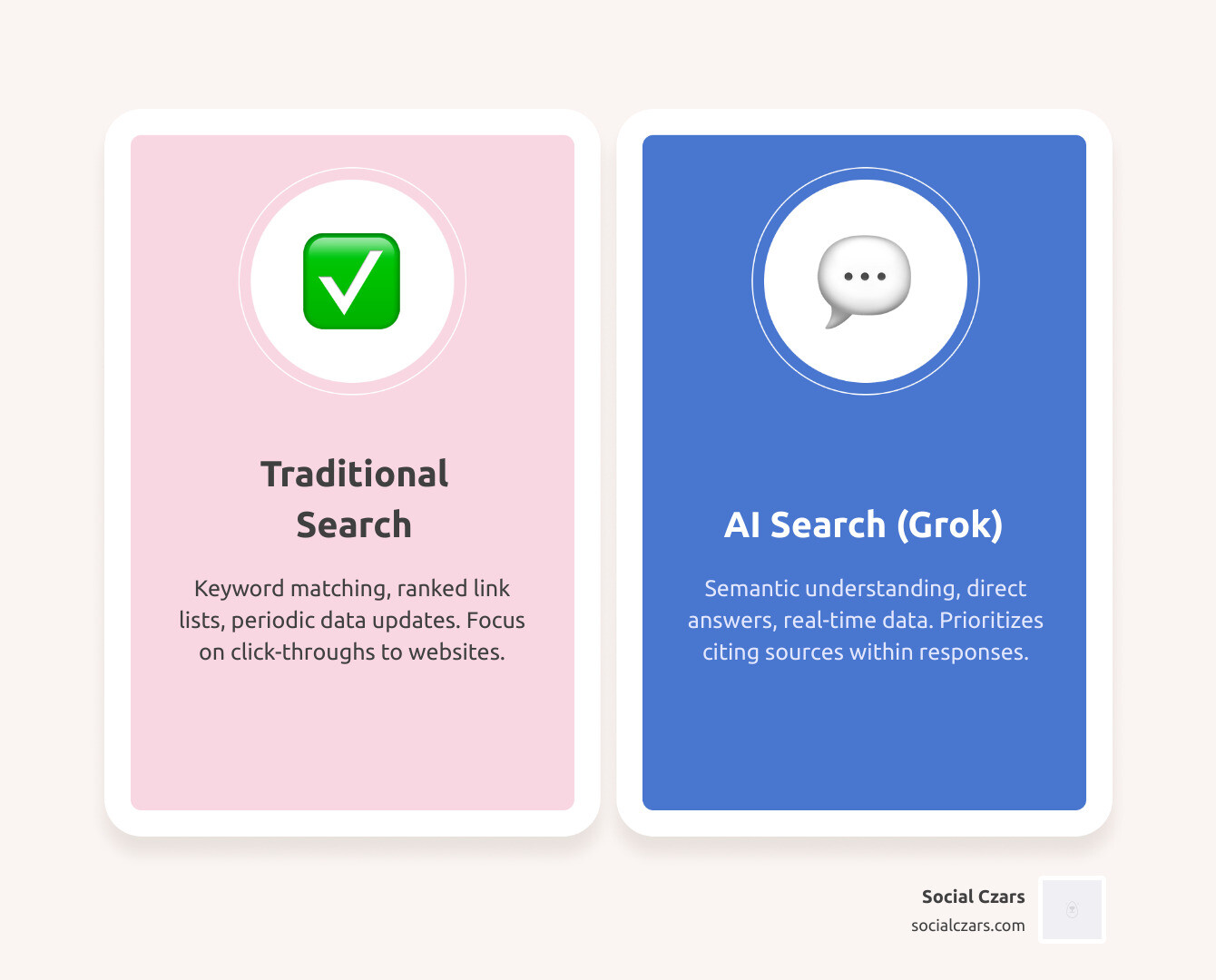
SEO for Grok is the practice of optimizing your online content so that Grok—xAI’s AI chatbot integrated into X (formerly Twitter)—finds, understands, and cites your brand when users ask questions. Unlike traditional search engines that show a list of links, Grok synthesizes information and delivers direct answers with citations, making it essential for brands to optimize for visibility in AI-generated responses.
Quick Answer: Key Elements of SEO for Grok
- Conversational Content: Write in natural language that mirrors how people speak and ask questions
- Real-Time Relevance: Keep content fresh and aligned with current trends on X
- Structured Data: Implement schema markup (FAQ, How-to, Article) so AI can understand your content
- Topical Authority: Build comprehensive content clusters that establish expertise
- Technical Optimization: Ensure fast loading speeds, mobile responsiveness, and clear site structure
- X Integration: Leverage social signals and trending discussions on the platform
Grok represents a fundamental shift in how users find information. With over 35 million monthly active users and direct integration into X Premium+, Grok listens to live social signals and places brands in trending discussions. When someone asks Grok for recommendations, you either appear in the answer or you don’t—there’s no page two.
This matters because AI-powered search is replacing traditional search. Users increasingly bypass Google, asking AI platforms like Grok for direct answers. If your brand isn’t optimized for these conversational queries, you’re invisible to a growing segment of high-intent users. The stakes are high for executives and brands managing online reputations, as a single negative mention in Grok’s responses can undermine years of work.
The shift from traditional SEO to Answer Engine Optimization (AEO) is happening now. Grok processes semantic meaning and synthesizes information in real-time, requiring an optimization approach focused on being quotable rather than just rankable.
I’m John DeMarchi, and I’ve spent over a decade helping CEOs and luxury brands manage their digital reputations. As AI platforms like Grok reshape search, mastering SEO for Grok has become essential for maintaining elite online visibility.
SEO for Grok vocab to learn:
- Crisis SEO
- what seo agencies specialize in crisis seo and crisis management for brands
- what is anti-crisis-seo
Understanding Grok’s Unique Position
Grok is a generative AI chatbot from Elon Musk’s xAI, built into X (formerly Twitter). This gives it a distinct edge: real-time data. Grok analyzes the latest tweets and news, ensuring its responses are incredibly timely. It delivers direct, conversational answers, often with a touch of humor (“fun mode”) or just the facts (“regular mode”). Its ability to process public X posts and include them in answers makes your brand’s presence on X a direct factor in your SEO for Grok success.
Why Your Business Can’t Ignore Grok
The rise of AI search tools like Grok is a pivotal moment for businesses. Users are turning to AI assistants for recommendations, bypassing traditional search. Imagine a potential customer asking, “Who is the best luxury brand consultant in NYC?” If you’re not optimized for Grok, you miss that direct recommendation.
Gartner predicts that traditional search volume will drop by 25% by 2026, replaced by traffic from generative engines. This is a clear warning: adapt or become invisible. Grok’s integration with X Premium+ also provides exposure to a highly engaged, subscription-based user base. Brands that establish authority in Grok’s citation patterns gain a significant competitive advantage. For our clients in Miami, Los Angeles, and London, visibility in these AI-driven recommendations is paramount for their success and reputation.
How Grok Works: Core Ranking Factors and Information Processing

Understanding how Grok processes information is key to mastering SEO for Grok. Unlike traditional search engines that match keywords and evaluate backlinks, Grok uses a sophisticated, AI-driven framework to understand the context and meaning of a query.
Grok’s Core Ranking Factors
Grok prioritizes several core factors to determine what content is most relevant and authoritative:
- Conversational Relevance: It favors content that answers questions in a natural, human-like way, aligning with how people speak and ask questions.
- Content Clarity: Well-organized content with clear headings and concise answers is paramount. If Grok struggles to understand your content, it won’t cite it.
- Topical Authority: Grok values expertise. Content that demonstrates deep, comprehensive knowledge of a topic will stand out.
- Real-Time Relevance: Thanks to its X integration, Grok thrives on fresh information and will prioritize the latest updates, especially for evolving topics.
- Trust Signals (E-E-A-T): The principles of Experience, Expertise, Authoritativeness, and Trustworthiness are highly relevant. Grok wants to cite reliable sources, so showcasing credentials and facts is crucial.
Information Processing: Beyond Keywords
Grok’s processing relies on natural language understanding and context, not just keywords. It grasps the intent behind words and phrases through:
- Natural Language Processing (NLP): Advanced NLP helps Grok understand the intricacies of human language to interpret conversational queries.
- Vector Conversion: Content is converted into mathematical vectors (numerical representations of meaning). Grok matches the vector of a user’s question to content with similar semantic vectors.
- Contextual Analysis: It analyzes the entire context of a piece of content, not just individual words, to provide more accurate answers.
This deep understanding means that while keywords still matter, the way you use them and the overall quality and context of your content are far more important for SEO for Grok.
| Feature | Grok (AI Search) | Traditional Search Engines (e.g., Google) |
|---|---|---|
| Information Processing | Semantic understanding, NLP, vector conversion | Keyword matching, backlink analysis, basic NLP |
| Result Format | Direct answers, conversational summaries, citations | List of blue links, knowledge panels |
| Real-Time Data | Deeply integrated with X, real-time discussions | Periodic indexing, news algorithms for freshness |
| Content Prioritization | Conversational relevance, clarity, topical authority | Keyword density, link equity, domain authority |
| User Interaction | Dialogue, follow-up questions, personalized experience | Click-through to external sites |
| Output Personality | Can be humorous/sarcastic (“fun mode”) or factual | Neutral, objective presentation of information |
How Grok Handles Different Sources
Grok’s interaction with web sources offers insights for your strategy:
- News Sources: Grok often integrates news sources within its general results, meaning optimized news content can appear directly in answers.
- Canonical Tags: Grok may list a source even if its canonical tag points elsewhere. While canonicals are vital for traditional SEO, Grok’s indexing can sometimes diverge.
- Redirects (3XX): Sites with redirects can appear in results, but detection can take months, potentially leading to outdated URLs in citations. Maintain a clean site architecture.
- Noindex Tags: A page with a “noindex” tag might still occasionally surface, possibly due to indexing delays. Proper usage is still recommended.
- Meta Descriptions: Grok displays your meta description as-is. A well-crafted description is crucial, as Grok won’t generate one if it’s missing.
- Favicons: It’s always a good idea to use favicons. They improve brand recognition and contribute to a professional user experience, which AI models implicitly favor.
Content Strategy: Writing for Conversational AI
When it comes to SEO for Grok, our content strategy needs a fresh perspective. We’re no longer just writing for algorithms that crawl keywords; we’re writing for a conversational AI that interprets meaning and seeks direct answers.
Key Content Principles for SEO for Grok
To be prioritized by Grok, our content should be:
- Conversational Language: Use natural, human-like language. Think about how you’d explain a complex topic to a friend. Avoid jargon where possible, and when it’s necessary, explain it clearly. Grok is designed to understand how people speak, so aligning your writing with conversational patterns is key.
- Q&A Format: Grok is an answer engine. Structuring your content with clear headings that pose questions, followed by direct and concise answers, is exactly what AI models love. For instance, on a blog post about SEO, you might have a section titled “What is Grok AI and how it…”
- Clarity and Conciseness: Large language models appreciate well-organized and to-the-point content. Get straight to the answer, then elaborate. As a best practice, when answering under a heading, we should lead with a direct answer in the first sentence if possible, then elaborate. For example: Q: “How often should I service my HVAC system?” – Make your first sentence: “You should service your HVAC system about once a year.” Then, you can explain the reasoning in the next…
- Scannable Content: Break up your text. Use bullet points or numbered lists for steps, benefits, or tips. These are easy for AI to digest and convert into a response, and they’re great for human users too. Short paragraphs, each conveying a single main idea, also improve readability for both AI and people.
Building Topical Authority and Trust
Grok, like other advanced AI, values content that demonstrates deep knowledge and trustworthiness. This is where building topical authority and focusing on E-E-A-T (Experience, Expertise, Authoritativeness, Trustworthiness) comes into play.
- Content Clusters and Pillar Pages: Instead of creating isolated articles, we should develop content clusters. This involves creating a comprehensive “pillar page” on a broad topic (e.g., “Digital Reputation Management for CEOs”) and then linking to several in-depth “cluster content” pieces that cover specific sub-topics (e.g., “Negative Content Removal Strategies,” “Crisis SEO for High-Profile Individuals”). This interconnected web of content signals to Grok that you are an authority on the overarching subject.
- Internal Linking: Internal links are incredibly powerful for both traditional SEO and AI indexing. They help Grok’s crawlers find related content and understand your site’s structure, distributing link equity and guiding users through your expertise. Use descriptive anchor text to reinforce topical relationships.
- Author Expertise (E-E-A-T): Grok wants to cite experts. Weave credentials, experience, and unique insights naturally into your content. If you’re a legal expert in London discussing data privacy, state your qualifications. This isn’t bragging; it provides context that a knowledgeable person is behind the information.
- Content Freshness and Accuracy: In AI search, yesterday’s news can feel like last year’s news. Grok prioritizes recent and updated content to keep its answers current. Regularly updating your content and adding new material, especially for evolving topics, can significantly boost your relevance. If your otherwise great page still references data from 2018 as if it’s current, Grok might hesitate to use it when fresher sources are available. We maintain a content calendar to ensure we’re covering new developments in our field, addressing the latest news, tools, or trends as they happen.
Optimizing for Natural Language and Voice Search
AI-driven searches, especially with Grok, tend to reflect natural language patterns, often mimicking how people speak their queries. This means our keyword research needs to evolve.
- Long-Tail Keywords: While short, broad keywords still have their place, Grok responds exceptionally well to longer, more specific, and conversational phrases. Instead of obsessing over a short keyword like “SEO services,” we include conversational queries like “How do I protect my brand’s online reputation in Miami?” or “What are the best strategies for crisis management in Los Angeles?” These long-tail keywords often have less competition and higher conversion rates.
- Question-Based Queries (Who, What, Why, How): Grok is built to answer questions. Therefore, optimizing for natural language means aligning our content with how people ask and how AI answers. We focus on answering who, what, where, when, why, and how questions concisely. These types of questions are very common in voice searches and conversational AI interactions.
- Answering Questions Directly: When a user asks Grok a question, they want a direct answer, not a list of links to sift through. Our content should lead with the answer, then provide supporting details. This preempts Grok’s need to synthesize information, making your content an ideal source.
Technical SEO for Grok: Preparing Your Site for AI Crawlers
Even though Grok operates differently from traditional search engines, a strong technical foundation remains crucial for SEO for Grok. Think of technical SEO as making sure Grok’s AI can easily access, understand, and trust your website’s content.
The Critical Role of Structured Data
Structured data acts like a map or blueprint for AI, making it easy for Grok to identify key information on your site. While AI models are trained to parse natural language, providing structured data is like handing them a neatly organized spreadsheet of your site’s most important details. It ensures your information is interpreted correctly by AI.
- Schema Markup: This is the extra code we add to our pages that labels what everything is – think of it as putting sticky notes on your content for the benefit of search engines and AI. Platforms like ChatGPT, Perplexity, Claude, and yes, Grok, rely on schema markup to interpret and rank information.
- JSON-LD Format: One of the best ways to help Grok quickly understand your website is by using structured data markup, specifically schema markup in JSON-LD format. This format is easily digestible by AI and ensures accurate interpretation.
- Specific Schema Types: We focus on implementing valuable schema types such as:
- FAQ Schema: Directly helps Grok extract question-and-answer pairs for conversational responses.
- How-to Schema: Great for step-by-step guides, allowing Grok to present instructions clearly.
- Article Schema: Provides essential details about your articles, like author, publication date, and main entity.
Implementing structured data might sound technical, but it’s one of the most impactful improvements you can make. It directly speaks to Grok’s AI in a way it understands.
Speed, Accessibility, and Mobile-First Design
Grok’s mission is to deliver answers quickly. It won’t wait around for your 5MB image slideshow to load. Fast-loading pages, mobile responsiveness, and overall accessibility are critical for both traditional and AI search engines.
- Page Speed (Core Web Vitals): Page speed is a critical factor. While Grok isn’t Google, the principles carry over. A site that meets Core Web Vitals thresholds (like Largest Contentful Paint, Cumulative Layout Shift, and First Input Delay) is generally fast and user-friendly – attributes any AI would favor. We aim for page load times under three seconds.
- Mobile Responsiveness: Mobile optimization is no longer optional. AI-driven search often prioritizes mobile-optimized sites because so many users access content on their phones. Ensuring your site works seamlessly and loads quickly on all devices is critical for our clients in busy cities like New York City and London, where mobile usage is dominant.
- Fast-Loading Pages: Think of AI as the ultimate impatient user: it wants information quickly and easily. Fast loading and accessible design give it exactly that. Sites with slow load times or poor mobile experiences are less likely to be cited by Grok.
Leveraging the X (Twitter) Integration
Grok’s deep integration with X (formerly Twitter) is a unique advantage that we leverage for our SEO for Grok strategies. This connection gives Grok a firehose of current information and an immediate pulse on trending topics.
- Real-Time Content Sharing: Whenever you publish a new blog post, product update, or announcement on your site, post it on X. Include a descriptive caption and relevant hashtags. This not only alerts your followers but also puts your content directly into Grok’s real-time information stream. Grok might catch that link and associate your site with the discussed topic sooner.
- Trending Topics: Grok loves fresh X content. It can see what’s trending or the latest expert commentary on a subject. If there’s a breaking news story or a trending topic relevant to your business, participating in that conversation on X can increase your visibility in Grok’s responses. For instance, if #NationalCoffeeDay is trending, and a coffee shop in Miami tweets a special offer, Grok could incorporate that into a user’s query about local coffee deals.
- Brand Mentions and Social Signals: Grok can gather context from X posts, both your own and others discussing your brand. If users are asking, “Why is everyone talking about [Your Brand] today?”, Grok can gather context from X and answer with key points. This means positive brand mentions and engagement on X contribute to your overall authority and visibility within Grok.
- API Support: Grok also offers API support, which allows for deeper integration and programmatic analysis of its capabilities. We can sign up at https://console.x.ai to use the Grok API, opening up possibilities for advanced monitoring and optimization.
Monitoring and Refining Your Grok Optimization Strategy
Mastering SEO for Grok is an ongoing journey, not a one-time setup. Just like with traditional SEO, continuous monitoring and refinement are essential to adapt to algorithm changes and maintain your edge.
Monitoring Performance for SEO for Grok
Traditional SEO tools aren’t built to track AI citations, so we need a specialized approach:
- Manual Query Testing: Since traditional ranking tools don’t track Grok visibility, we manually test relevant conversational queries in Grok to see which sources it cites. We create a list of 20-30 questions our audience might ask, run them through Grok, and document which competitors appear in responses. We repeat this process regularly to track changes and identify successful optimization patterns.
- Tracking Citations and Share of Answers: The goal isn’t just to rank, but to be cited. We track how frequently our brand or content appears in Grok’s direct answers. This involves monitoring the “Share of Answers” across various AI surfaces and question variations.
- Competitor Analysis: We analyze competitor content and their presence in Grok’s responses. This helps us identify gaps, understand successful strategies, and refine our own approach.
- AI-Attributed Traffic in Analytics: While challenging, we aim to implement specific tracking methods to attribute traffic and engagement that originates from Grok or other AI-powered search interactions. This gives us concrete data on the business impact of our SEO for Grok efforts.
Common Mistakes to Avoid
As with any new optimization frontier, there are pitfalls we strive to avoid:
- Over-Optimizing Language: The biggest mistake is over-optimizing content with forced conversational language that sounds unnatural. While Grok favors conversational content, it still prioritizes genuine expertise and value. Focus on answering questions naturally rather than stuffing your content with question phrases or sacrificing depth for a casual tone.
- Ignoring Content Freshness: Outdated information can severely hurt perceived quality. If your otherwise great page still references data from 2018 as if it’s current, Grok might hesitate to use it when there are fresher sources. Regular content updates are non-negotiable.
- Neglecting Technical SEO Fundamentals: While some advanced “technical AEO” might be overhyped, neglecting fundamental technical SEO (page speed, mobile-friendliness, structured data) is a critical error. These elements ensure Grok can efficiently crawl and understand your site.
- Treating Grok Like Traditional Search: Grok operates on fundamentally different principles than Google. Trying to apply traditional keyword-stuffing or backlink-chasing tactics without understanding Grok’s semantic and conversational nature will yield poor results.
- Forgetting About X (Twitter): Given Grok’s deep integration with X, ignoring your presence and activity on the platform is a significant oversight. X is a direct feed to Grok’s real-time understanding of the world.
Frequently Asked Questions about Grok Optimization
Here, we address some common questions about optimizing for Grok, drawing on insights from the rapidly evolving AI search landscape.
How long does it take to see results from Grok optimization?
Unlike traditional SEO, which can take 3-6 months to show significant results, SEO for Grok can sometimes yield initial visibility much faster due to its real-time processing capabilities.
- Initial Visibility (2-4 weeks): You might see early signs of your content being cited or appearing in Grok’s answers within a few weeks, especially for trending topics or highly specific queries where your content is a direct match.
- Building Authority (2-3 months): To build substantial topical authority and achieve consistent visibility, a sustained effort over 2-3 months is typically required. This involves regular content updates, strategic content cluster development, and continuous refinement.
- Sustained Effort: Grok optimization isn’t a “set it and forget it” task. It requires ongoing monitoring and adaptation as Grok’s algorithms evolve and new information emerges.
What is the biggest mistake when optimizing for Grok?
The most common and impactful mistake we’ve observed is over-optimizing content with forced conversational language that sounds unnatural. While Grok favors conversational content, it still prioritizes genuine expertise and value.
The key is to:
- Focus on Value: Prioritize providing clear, accurate, and comprehensive answers to user questions.
- Maintain Authenticity: Let your brand’s voice and expertise shine through naturally.
- Avoid Sacrificing Expertise for Tone: Don’t dilute the depth or accuracy of your content just to sound “conversational.” Grok, and your users, can spot inauthenticity a mile away.
Can I optimize existing content for Grok?
Absolutely! You don’t need to start from scratch. Optimizing existing content is a highly effective strategy for SEO for Grok:
- Add FAQ Sections: Incorporate dedicated FAQ sections to directly answer common questions related to your content.
- Improve Structure: Improve readability and AI comprehension by using clear headings (H2s, H3s), bullet points, and short paragraphs.
- Implement Schema Markup: Add relevant structured data (like FAQ schema, How-to schema, or Article schema) to your pages to help Grok understand your content’s context and key entities.
- Update Language: Where appropriate, revise your language to be more conversational and direct, focusing on answering user questions concisely.
- Prioritize High-Performing Pages: Start with your most valuable or highest-performing pages. These likely already have some authority and are good candidates for quick optimization wins.
Conclusion: The Future of Search is Conversational
The landscape of search is undeniably shifting. Grok, with its real-time capabilities and deep integration with X, represents a powerful new frontier in how users find information and brands. As we’ve explored, mastering SEO for Grok requires a nuanced approach that goes beyond traditional keyword strategies, focusing instead on conversational relevance, topical authority, and technical excellence.
For leaders and VIPs in New York City, Miami, Los Angeles, and London, understanding and adapting to this change isn’t just an option; it’s a necessity for maintaining an elite online presence. The ability to be accurately cited by an AI model like Grok can significantly amplify your brand’s visibility, build trust, and ultimately protect your digital reputation.
This is an ongoing process of learning and adaptation. As AI models continue to evolve, so too must our strategies. But by focusing on creating clear, authoritative, fresh, and conversationally optimized content, coupled with robust technical foundations and active X engagement, we can ensure our clients are not just present, but prominent, in the future of search. To stay ahead and protect your digital reputation in the age of AI, a proactive strategy is essential.
