
News
Ultimate Checklist for Crisis SEO for PR Disasters

Jan
Why Crisis SEO for PR Disasters Is Your Digital Lifeline
Crisis SEO for PR Disasters is the practice of managing search engine results during reputation-threatening situations. When negative news breaks, companies battle for the top of Google’s search results, where the stakes are high.
Quick Answer: What You Need to Know
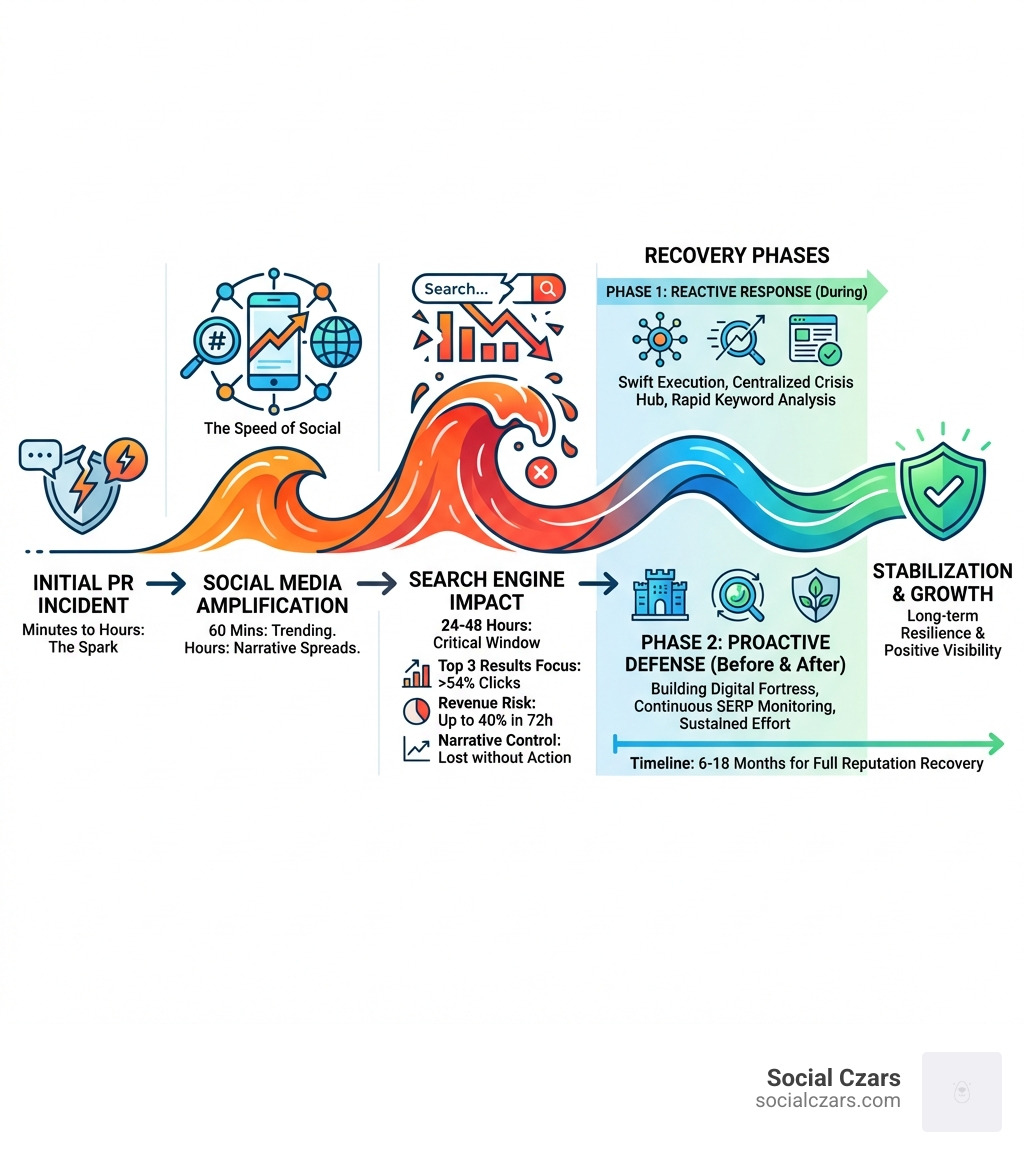
- Speed is everything – The first 24-48 hours determine whether you control the narrative or it controls you
- Focus on top 3 results – Over 54% of all clicks go to the top three Google results
- Two-phase approach – Proactive defense (building digital fortress before crisis) + Reactive response (swift execution during crisis)
- Key actions – Rapid keyword analysis, centralized crisis hub, optimized positive content, continuous SERP monitoring
- Recovery timeline – Full reputation recovery typically takes 6-18 months with sustained effort
The Stakes Are Real
Companies can lose up to 40% of their revenue in the first 72 hours of a crisis. Since 89% of consumers use search engines for brand research, Google’s page one shapes your future.
A bad tweet can trend in an hour. A product issue can dominate search results instantly. Social media amplifies crises within hours, shrinking the gap between a fixable problem and permanent damage.
Traditional SEO vs. Crisis SEO
Traditional SEO focuses on long-term growth, keyword rankings, and steady traffic increases over months or years. Crisis SEO operates in a completely different reality:
- Speed: Minutes and hours matter, not weeks and months
- Stakes: Reputation and revenue are actively bleeding
- Focus: Controlling a negative narrative, not just improving rankings
- Approach: Reactive and defensive, not purely proactive
- Metrics: SERP volatility and sentiment, not just traffic growth
My Experience with Crisis SEO
I’m John DeMarchi, founder of Social Czars. Since 2014, I’ve helped high-profile clients steer Crisis SEO for PR Disasters, from viral backlash to executive scandals. The strategies in this guide come from real-world situations where swift SEO action was the difference between recovery and permanent damage.
Terms related to Crisis SEO for PR Disasters:
Proactive Defense: Building Your Digital Fortress Before a Crisis
In Crisis SEO for PR Disasters, waiting for the storm is a recipe for disaster. The best defense is a good offense. This means building a digital fortress long before a crisis appears. This ensures Google already trusts you, with positive content ready to act as a buffer against negative information.
Why is this so crucial? Because 89% of consumers use search engines to research brands before making decisions. If a crisis strikes, their first stop will be Google. Without a robust digital presence, negative stories will quickly dominate, shaping perceptions before you can respond.

Fortifying Your Technical SEO Health
Think of your website as a high-performance vehicle. When a crisis hits, you need it to run flawlessly. Technical SEO is the engine of that vehicle, and its health directly impacts your ability to respond effectively.
- Page speed: Slow loading times increase bounce rates, telling search engines your content isn’t valuable. We ensure your site loads at lightning speed, even when traffic spikes.
- Mobile-friendliness: Most people search on their phones during breaking news. A poor mobile experience causes users to bounce, signaling to Google your content isn’t valuable. We use Google’s free mobile-friendly test to ensure sites are perfectly optimized.
- Website security (HTTPS): Google favors secure sites. An HTTPS connection is a trust signal to users and search engines, reinforcing your credibility during a crisis.
- Clean site architecture: An organized website helps users and search engines find information quickly. This means clear pathways to official statements and FAQs, ensuring your message is findable.
Establishing Content Dominance and Authority
Building a fortress isn’t just about strong walls; it’s about what’s inside. For Crisis SEO, this means cultivating a deep reservoir of positive, authoritative content so that when people search for your brand, they find credible information you control.
- Positive content creation: Consistently publish high-quality content showcasing your brand’s values and expertise, such as blog posts, thought leadership articles, and positive press releases.
- Building a strong backlink profile: Backlinks from reputable sources act as votes of confidence. A strong profile signals authority to Google, making it more likely your content will rank highly during a crisis.
- Encouraging positive reviews: Positive reviews on platforms like Google My Business build social proof and act as a buffer. We help clients cultivate authentic positive feedback.
- Executive online presence: For our high-profile clients, a robust, positive online presence for key executives is non-negotiable. This involves creating and optimizing professional bios and thought leadership content. Understanding what SEO is is fundamental to digital reputation, extending beyond the company website to key individuals.
Developing Your Pre-Crisis Action Plan
Preparing for a crisis is a sign of strength. A pre-crisis action plan is your blueprint for rapid response, ensuring you’re not scrambling when every second counts. This plan should be regularly tested, like a fire drill for your digital reputation.
Here are the essential elements we build into our clients’ pre-crisis plans:
- Identifying potential scenarios: We help you brainstorm crisis scenarios, from product recalls to data breaches, and outline potential impacts and initial response strategies for each.
- Assembling a crisis response team: This team includes stakeholders from legal, marketing, IT, and leadership. Each member has a defined role and clear responsibilities.
- Pre-approved messaging templates: Crafting messages during a crisis is difficult. We develop pre-approved statements, FAQs, and social media responses for rapid, consistent messaging.
- Communication infrastructure: We ensure you have redundant communication channels to reach your team and the public, even if primary systems fail.
- Decision-making protocols: We establish clear lines of authority for swift, decisive action during a crisis.
A solid plan requires you to set clear goals first. Define what success looks like—minimizing revenue loss, maintaining trust—and we work backward to build the steps to achieve it.
The Reactive Response: Executing Your Crisis SEO for PR Disasters Playbook
When a PR disaster strikes, the reactive phase of Crisis SEO for PR Disasters begins. Swift execution and narrative control are the priority. We actively shape the online narrative. The initial moments of a crisis are crucial and determine the extent of the damage.
The top three Google results get over 54% of all clicks. Our mission is to fill those spots with your official messaging, pushing negative content down.

Step 1: Rapid Keyword and SERP Analysis
The moment a crisis emerges, our first step is a deep dive into keyword and SERP (Search Engine Results Page) analysis. This is a high-stakes, real-time investigation.
- Importance of speed: Search intent shifts dramatically in a crisis (e.g., from “best ” to “ recall”). Understanding these patterns helps us control the narrative.
- Identifying negative keywords: We quickly identify negative keywords (e.g., “[brand] scandal,” “ lawsuit”) that we need to target and outrank.
- Monitoring SERP volatility: We track real-time SERP changes to understand the crisis’s severity and direction.
- Understanding search intent shifts: We analyze what people are looking for—official statements, news, or alternatives. We tailor content to this evolving intent, using proven keyword optimization strategies to rank official information.
Step 2: Deploying a Centralized Crisis Hub
In the chaos of a PR disaster, people need a single, authoritative source of truth. That’s where your centralized crisis hub comes in—a dedicated page on your website for all official communications.
- Purpose of a crisis hub: It provides a single source of truth with a clear, controlled narrative from your brand, housing official statements, FAQs, and timelines.
- SEO for the crisis hub: The hub is a powerful SEO tool. We optimize it for crisis keywords with a clear URL (e.g., yourdomain.com/crisis-update), relevant headings, and trustworthy content to ensure it ranks high.
- Clear navigation: The crisis hub must be easy to find from your homepage, using prominent links like sitewide banners.
- Official statements: All official communications are housed here, ensuring consistency and preventing conflicting messages.
- Schema markup for news and FAQs: Schema helps search engines understand your content, which can lead to rich snippets in search results, helping control the narrative.
Step 3: Controlling the Narrative with Effective Content
Once we understand the search landscape and have our crisis hub, the next step is to control the narrative through strategic content. This is where we create and push positive or neutral content to outrank negative search results.
- Optimized press releases: We craft factual, SEO-optimized press releases that address the crisis directly and distribute them through high-authority wire services for immediate traction.
- Factual blog posts: Our team develops blog posts that provide context, answer questions, and outline solutions. These posts are informative and reassuring, optimized for evolving search intent.
- Video content with transcripts: Video is a powerful medium for conveying sincerity. We create concise videos featuring spokespeople, accompanied by full transcripts for SEO.
- Pushing down negative results: The core of reactive Crisis SEO is creating a high volume of authoritative, positive content to push negative results off Google’s first page.
- Case study: A restaurant chain faced a food safety scare. Their swift response included a public apology and a crisis hub with updates, FAQs, and videos of improved safety protocols. This optimized transparency campaign ensured their official statements dominated search results, restoring consumer confidence.
Leveraging AI and Advanced Tools for Superior Crisis Management
In the unpredictable world of Crisis SEO for PR Disasters, human effort isn’t enough. AI and machine learning are our secret weapons, enhancing our ability to respond with speed and precision. AI gives our crisis teams superhuman capabilities.
How AI and Machine Learning Improve Crisis SEO Efforts
AI’s real-time data processing transforms our approach from reactive to proactive, helping us anticipate issues.
- Proactive monitoring: AI constantly monitors rankings, traffic, and keywords to anticipate issues and can even forecast algorithm update impacts.
- Anomaly detection: AI identifies unusual changes in site performance, brand mentions, or sentiment that signal an emerging crisis, like a spike in negative reviews.
- Predictive analytics: Machine learning provides insights into backlinks, keyword cannibalization, and content decay. AI can also mimic future algorithm updates to help brands adapt.
- AI-assisted content generation: While human oversight is crucial, AI can help draft crisis communications by generating multiple messaging options as a starting point.
- Real-time strategic adjustments: AI-driven social listening tracks brand mentions and sentiment in real-time. This gives us an instant pulse on public mood, allowing for rapid strategy adjustments. The power of AI SEO tools provides a critical edge.
The Ethical Use of AI in a Crisis
With great power comes great responsibility. We steer AI’s use with a strong ethical compass.
- Human oversight: AI is a tool, not a decision-maker. Human judgment is irreplaceable in sensitive situations. Our experts always review and approve AI suggestions.
- Transparency: We advocate for transparency about using AI in crisis communications to build trust.
- Avoiding bias: AI can perpetuate biases from its training data. We monitor AI outputs to ensure they are fair, objective, and do not spread misinformation.
- Preventing misinformation: AI can be a double-edged sword. Our rigorous fact-checking and human verification prevent the generation of inaccurate content.
- Maintaining an authentic voice: A brand’s authentic voice is critical during a crisis. The final message, even if AI-assisted, must resonate with brand values and empathy.
Essential Monitoring Tools and Key Metrics
Effective crisis management is impossible without continuous monitoring. These tools act as our radar, providing the real-time intelligence needed to steer the storm.
Here are the essential monitoring tools we deploy:
- Google Search Console: Provides critical data on how your site performs in Google search, including queries, indexing status, and security issues.
- Google Analytics: Offers insights into website traffic, user behavior, and the effectiveness of your crisis content.
- Social listening platforms: Tools that monitor social media, news sites, and forums for brand mentions, keywords, and sentiment.
- Rank tracking software: Helps us monitor search rankings of your official content versus negative articles for crisis keywords.
And the key metrics we track to measure the effectiveness of our Crisis SEO for PR Disasters response:
- SERP volatility: How much are the search results for crisis keywords changing? High volatility indicates an active battle for visibility.
- Brand mention volume and sentiment: We track the ratio of positive, neutral, and negative mentions.
- Website traffic from crisis-related keywords: Are users finding your official crisis hub when searching for information?
- Click-through rate (CTR) on crisis content: CTR on crisis content shows if your headlines draw clicks from negative coverage. Moving from position #2 to #1 in Google can increase clicks by over 74%, according to Backlinko. Every click counts.
From Recovery to Resilience: Post-Crisis Strategy and Common Pitfalls
The journey doesn’t end when the initial storm subsides. The post-crisis phase is critical for recovering and emerging more resilient. Full recovery typically takes 6-18 months and requires sustained effort and strategic rebuilding.
The Path to Recovery and Building a Stronger Brand
Recovery is about more than just cleaning up search results; it’s about rebuilding trust and demonstrating genuine change.
- Long-term SEO strategies: Once the immediate crisis is managed, we pivot to long-term SEO strategies focused on reputation repair. This involves expanding your digital footprint with new, positive content, sustained backlink building, and continuous optimization to reinforce your brand’s authority.
- Rebuilding trust: This is paramount. It requires transparent communication, accountability, and verifiable reforms. Companies sharing honest progress updates sustain gains twice as long as those that go quiet.
- Third-party verification: Independent audits or endorsements lend credibility to recovery efforts, assuring stakeholders that changes are genuine.
- Learning from the crisis: Every crisis is a valuable lesson. We conduct post-crisis evaluations to identify improvements for future pre-crisis and reactive plans.
- Case study: After a crisis, a prominent brand apologized, launched a transparency campaign, invested in new safety protocols, and communicated these changes widely. Its stock, which initially plummeted, became a top performer, proving a crisis handled correctly can increase trust and market value.
Common Pitfalls in Crisis SEO for PR Disasters
Even with the best intentions, companies often stumble during a crisis. Avoiding these common pitfalls is as important as implementing the right strategies.
- Slow response: Delaying a response allows negative narratives to solidify. The first 24 hours are critical.
- Inconsistent messaging: Conflicting statements erode trust. A unified message is non-negotiable.
- Denying or deflecting blame: Consumers spot insincerity easily. Taking responsibility is the first step toward genuine recovery. Honesty is essential for building a lasting reputation.
- Ignoring negative search results: Hoping negative content will disappear is a fantasy. It will continue to define your brand online unless active Crisis SEO is used to push it down.
- Lack of internal alignment: If employees are not aligned, internal chaos becomes external, leading to conflicting messages.
- Prioritizing legal over PR: While legal counsel is vital, focusing only on legal protection can lead to a PR disaster. A poorly worded statement, like a press release from hell, can backfire.
Frequently Asked Questions about Crisis SEO
What is the difference between Crisis SEO and traditional SEO?
Crisis SEO and traditional SEO have vastly different priorities. Traditional SEO focuses on long-term, sustainable growth over months or years. It’s about building authority and relevance over time.
Crisis SEO for PR Disasters prioritizes speed, reputation protection, and narrative control in a reactive environment. It’s about damage control, pushing down negative results, and ensuring your message dominates the SERP immediately for survival and recovery.
How quickly do I need to act during a PR crisis?
You must act immediately. The first 24 hours are critical as social media amplifies issues in minutes. A study shows 70% of consumers believe it’s essential for brands to respond rapidly during a crisis. Delaying your response means losing control of the narrative. Our strategy is to issue a holding statement within an hour, followed by swift SEO actions.
Can a brand really emerge stronger after a PR disaster?
Absolutely. We’ve seen clients in New York City, Miami, Los Angeles, and London emerge stronger after a PR disaster. This requires a swift, transparent, and accountable response that demonstrates a brand’s true values. By taking responsibility and implementing genuine changes, a brand can build deeper trust and loyalty. It’s an opportunity to showcase resilience and integrity, but it demands a flawless strategy and sustained effort.
Conclusion
In the volatile digital landscape, Crisis SEO for PR Disasters is no longer a luxury but a fundamental necessity. We’ve explored how a robust proactive defense, a swift reactive strategy, and continuous, intelligent monitoring form the unbreakable pillars of digital resilience. From fortifying your technical SEO health and establishing content dominance to executing rapid keyword analysis and leveraging AI for real-time insights, every step is designed to protect your most valuable asset: your reputation.
The ultimate goal remains clear: to control the narrative, protect your brand, and ensure that when stakeholders search for you online, they find the truth, not the noise. At Social Czars, we provide specialized, elite services for high-profile individuals and CEOs in New York City, Miami, Los Angeles, and London, facing digital crises. Our expertise in fast negative content removal and strategic SEO ensures that our exclusive clientele can steer even the most challenging PR disasters with confidence and emerge stronger. For expert guidance on navigating reputation-threatening situations, explore our Crisis SEO services.
