
Finance
A Practical Guide to Finding a Reliable Reputation Agency

Jul
Why Finding the Right Agency to Suppress Negative Search Results Can Make or Break Your Reputation
If you’ve been wondering how can I find a reliable agency for suppressing negative search results on Google, here’s the short answer:
- Look for proven experience — agencies with documented case studies and a track record of moving negative URLs off page one.
- Demand transparency — a credible agency gives you a URL-by-URL plan, clear timelines, and regular rank tracking reports.
- Avoid guaranteed rankings — no agency can promise a specific position on Google. Anyone who does is a red flag.
- Verify their methods — reliable agencies use legitimate SEO, content strategy, and digital PR. Walk away from anyone mentioning private blog networks or fake reviews.
- Ask about ongoing monitoring — suppression isn’t a one-time fix. You need continuous defense against new negative content.
A single negative article sitting on page one of Google can quietly cost you clients, partnerships, and trust — often before you even know it’s happening. The data makes this concrete: the top Google result captures roughly 31% of all clicks, while anything below position 10 drops to just over 1%. Moving a damaging URL from page one to page two cuts its visibility by more than 90%.
That’s exactly why search result suppression exists — and why choosing the right agency to handle it matters so much.
For most executives and high-profile individuals, the content doing the damage cannot simply be deleted. News articles, Reddit threads, and editorial opinion pieces rarely come down on request. In fact, major publishers reject the vast majority of removal requests that fall outside clear defamation or copyright claims. Suppression — the process of building and promoting stronger, more authoritative content that outranks the negative result — is often the only practical path forward.
But the suppression industry has its share of bad actors. Vague promises, opaque methods, and abandoned campaigns are common failure points. Research shows that 68% of suppression campaigns that fail do so because content publication stopped within the first 90 days, before rankings had a chance to stabilize.
This guide walks you through exactly what to look for, what to avoid, and how a professional suppression campaign actually works.
I’m John DeMarchi, founder of Social Czars, and since 2014 I’ve helped hundreds of executives, brands, and high-profile individuals navigate the question of how can I find a reliable agency for suppressing negative search results on Google — including many in active reputation crises. With a background spanning 15 years of in-house corporate communications and graduate training from Syracuse University, I’ve built Social Czars around one core principle: sustainable, transparent suppression that holds up over time.
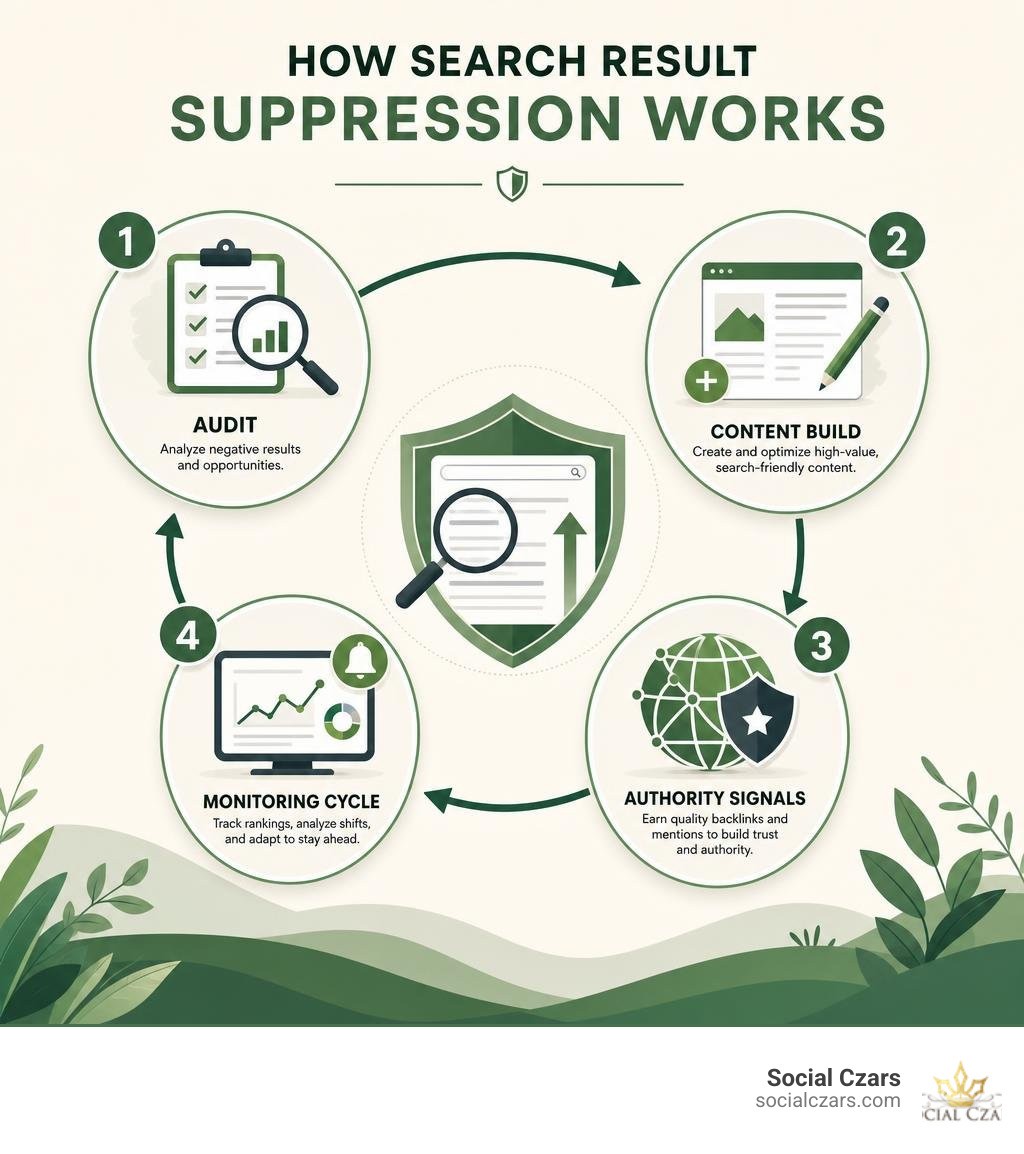
“How can I find a reliable agency for suppressing negative search results on Google?” helpful reading:
Removal vs. Suppression: Understanding Your Options
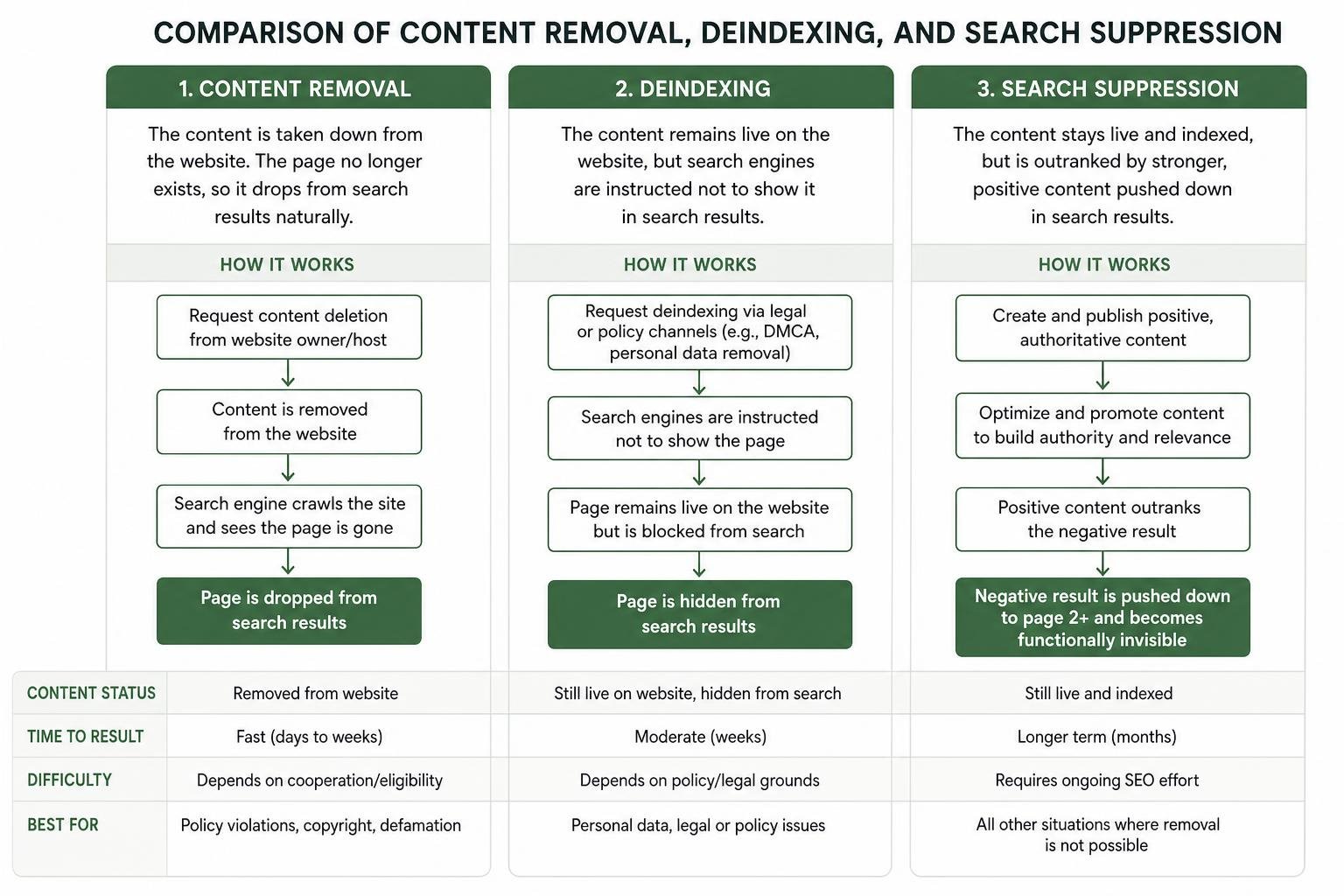
When a damaging piece of content threatens your personal or professional standing, your immediate instinct is probably to look for a delete button. However, cleaning up your online presence requires a strategic choice between content removal, search engine deindexing, and search suppression. Understanding the differences between these three approaches prevents you from wasting valuable time and resources on impractical strategies.
To make the right choice, we must look at how each method addresses the unwanted search result:
- Content Removal: This is the physical deletion of the content from the host website. If a blog post, forum entry, or news article is completely removed by the webmaster, the URL itself ceases to exist. Once the page is gone, Google will naturally drop it from search results during its next crawl.
- Deindexing: This occurs when the website owner or Google blocks a live page from appearing in search results. The page still exists on the host website, but search engines are instructed not to show it. This is often achieved through legal channels, copyright (DMCA) removals, or by utilizing Google’s documentation on removing personal information for specific policy violations like non-consensual explicit imagery or exposed personally identifiable information (PII).
- Search Suppression: When content cannot be removed or deindexed, suppression is the only viable alternative. This method uses strategic search engine optimization (SEO) to create, publish, and promote positive, authoritative content. By outranking the negative URL, we push it down to page two, three, or beyond, where it is functionally invisible to the vast majority of searchers.
To help visualize how these strategies differ in practice, consider the core mechanics below:
If you are trying to understand the baseline steps of cleaning up your search footprint, you can read our comprehensive guide on How to Get Rid of Negative Google Search Results.
When to Attempt Direct Removal First
Direct removal should always be your first line of defense if the content meets specific legal or policy criteria. If a negative post violates a platform’s Terms of Service, contains clear copyright infringement, or crosses into legally actionable defamation, a direct removal or deindexing request is the fastest solution.
For example, platforms like Google and major social networks have established reporting channels for non-consensual content, impersonation, and explicit privacy violations. If a low-tier blog has copied your copyrighted headshot or published private financial details, a formal DMCA takedown notice or a direct legal outreach campaign can often resolve the issue within days. In these clear-cut scenarios, paying for a multi-month suppression campaign before attempting removal is an unnecessary expense.
Why Suppression is the Best Strategy for Unremovable Content
Unfortunately, the most damaging search results are often the hardest to remove. Legitimate news articles from high-authority media outlets, active forum discussions on platforms like Reddit, and opinion pieces on independent blogs are almost impossible to delete. Editorial publishers reject roughly 95% of removal requests unless faced with a court-ordered defamation judgment, and Reddit moderators rarely delete brand-related threads that do not violate community guidelines.
This is where suppression becomes your most powerful tool. Rather than fighting an uphill battle against a publisher who refuses to cooperate, suppression bypasses them entirely. By focusing on Google’s ranking factors—such as content relevance, user engagement, and the Experience, Expertise, Authoritativeness, and Trustworthiness (E-E-A-T) framework—we can build a protective barrier of positive assets.
Because fewer than 0.63% of searchers click on page two, pushing a negative link to position 11 or lower achieves practical invisibility. If you want to explore the tactical foundations of this approach, check out our resource on The Easiest Way to Push Down Bad Search Results.
“How can I find a reliable agency for suppressing negative search results on Google?”
Finding a trustworthy partner in the online reputation management (ORM) space can feel overwhelming. The market is saturated with agencies making bold promises, yet many rely on outdated tactics that can ultimately do more harm than good. When researching “How can I find a reliable agency for suppressing negative search results on Google?”, your primary objective should be finding an agency that treats reputation repair as a precise, technical SEO discipline rather than a public relations guessing game.

A reliable agency will always begin your engagement with a comprehensive search landscape audit. They will analyze the domain authority of the negative URLs, evaluate the search intent behind your branded keywords, and identify the exact assets needed to outrank the damaging content. If you are beginning your search for a qualified partner, our Best Crisis SEO Agencies Guide provides an excellent framework for comparing elite providers.
Vetting Providers: “How can I find a reliable agency for suppressing negative search results on Google?”
To separate the true technical specialists from the sales-heavy agencies, you must ask the right questions during the vetting process. A reputable suppression provider should be able to explain their methodology in detail, aligning their practices with Google’s Search Quality Evaluator Guidelines.
When interviewing potential agencies, look for the following indicators of credibility:
- Customized URL-by-URL Strategy: A reliable agency will not offer a one-size-fits-all package. They should provide an audit detailing why the negative URL is ranking, its estimated domain authority, and a specific list of the 10 to 15 assets they plan to build or optimize to outrank it.
- Technical SEO Expertise: Suppression requires a deep understanding of on-page optimization, schema markup, technical site architecture, and backlink profiles. Ask the agency how they plan to optimize your owned assets (such as your personal website or company domain) to maximize their ranking potential.
- Content Ownership and Control: Ensure that any social profiles, websites, or blogs created during the campaign belong to you. A reliable provider will hand over all login credentials and domain ownership upon the completion of the project.
- Transparent Reporting: You should receive regular, data-driven reports tracking the keyword rankings of both the negative URLs and your positive assets.
Red Flags to Avoid When Searching for a Partner
The ORM industry has its share of “black-hat” practitioners who use shortcuts that can trigger search engine penalties. Avoiding these red flags will protect your brand from long-term search engine damage:
- Guaranteed Rankings or Timelines: Because Google constantly updates its algorithms, no agency can truly guarantee a specific ranking position or an exact date for success. Any firm promising “page one in 30 days” is likely using risky, short-lived tactics.
- Private Blog Networks (PBNs): Some low-quality providers use PBNs—networks of expired domains used solely to build artificial backlinks. While this may provide a temporary ranking boost, Google actively penalizes sites associated with PBNs, which can cause your positive assets to drop out of search results entirely.
- Review Manipulation or Fake Profiles: Creating hundreds of thin, automated social profiles or purchasing fake positive reviews violates search engine guidelines and platform terms of service. This practice looks highly suspicious to both Google and human searchers.
- Lack of Transparency: If an agency refuses to explain how they build backlinks, where they publish content, or what specific assets they are creating, walk away immediately.
The Mechanics of a Professional Suppression Campaign
A professional suppression campaign is a highly coordinated SEO and digital PR initiative. It is not about simply flooding the internet with low-quality blog posts; it is about building a diverse, resilient ecosystem of high-authority assets that Google naturally wants to rank on page one.
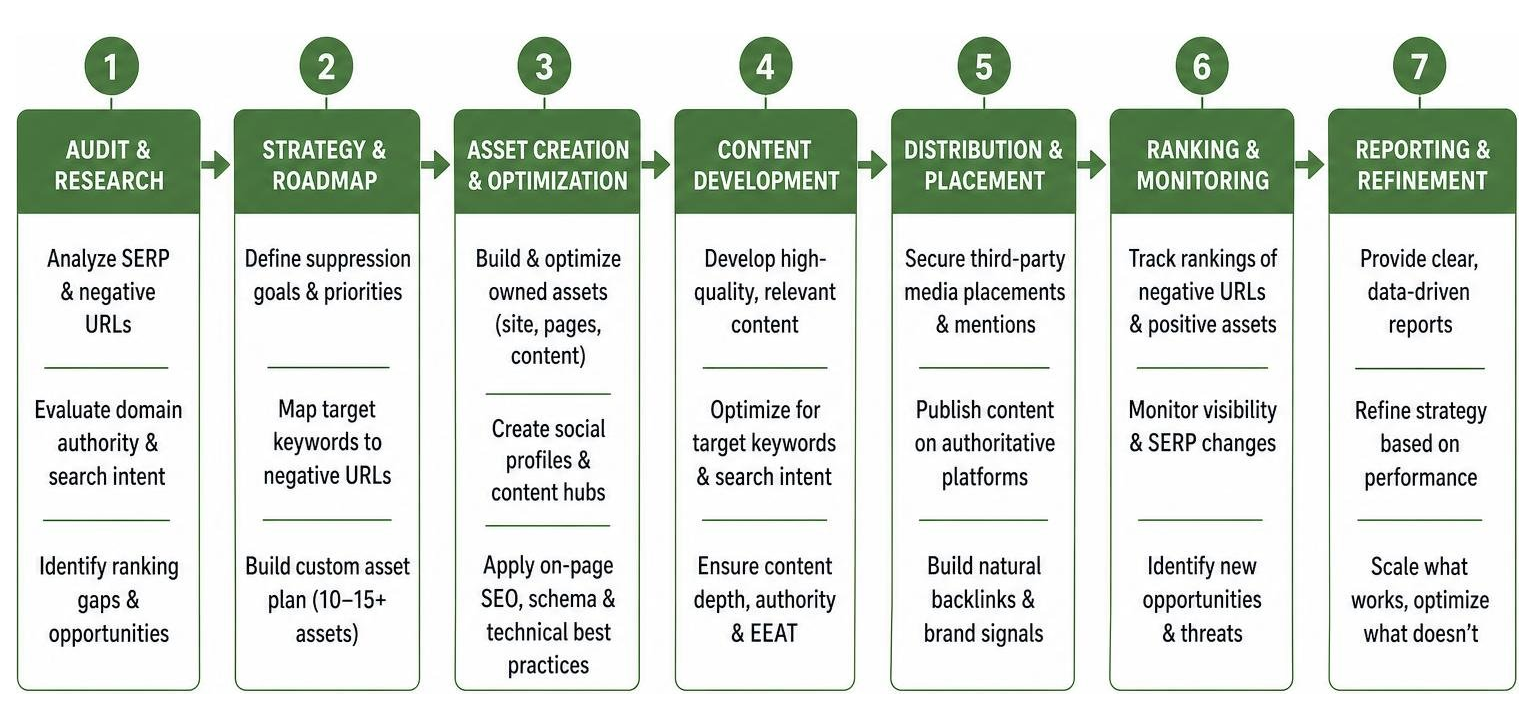
Every successful campaign begins with a deep audit of the search engine results page (SERP). We analyze the “stickiness” of the negative content and map out the exact combination of owned websites, social profiles, and third-party media placements required to displace it. For a step-by-step breakdown of how these campaigns are structured, read our Negative Search Results Suppression Guide.
How Agencies Execute “How can I find a reliable agency for suppressing negative search results on Google?” Strategies
To successfully push down a high-authority negative result, professional agencies deploy a multi-layered content strategy:
- Optimizing Owned Assets: The foundation of any suppression campaign is the properties you own. This includes building or optimizing a personal website (e.g.,
yourname.com) or your primary corporate domain. We ensure these sites have strong E-E-A-T signals, correct schema markup (such as Person or Organization schema), and load in under 2.5 seconds to maximize ranking potential. - Profile Stacking: We claim and optimize high-authority profiles on platforms Google already trusts, such as LinkedIn, Crunchbase, YouTube, and professional directories. Because these platforms have massive domain authority, optimized profiles can often rank on page one within weeks.
- Digital PR and Earned Media: To compete with high-authority news sites, we must earn placements on respected, third-party publications. Pitching contributed articles, securing interviews, and submitting industry award nominations generate high-quality, natural backlinks that pass authority to our positive assets.
- Generative Engine Optimization (GEO): With the rise of Google’s AI Overviews, traditional SEO is no longer enough. Reliable agencies optimize your digital footprint to ensure AI-powered search engines summarize your background accurately and pull from positive, verified sources rather than legacy complaint threads.
Timelines, Costs, and What Influences Campaign Success
Suppression is a marathon, not a sprint. The timeline and cost of a campaign are directly influenced by the authority of the negative content and the competitiveness of your search terms.
- Timelines: Low-competition cases (such as a negative post on a personal blog or a low-authority forum) can often show meaningful movement within 45 to 90 days. Medium-difficulty cases typically take 90 to 180 days to push the negative result off page one. Highly competitive cases involving major news outlets (like Forbes or major national newspapers) or highly active Reddit threads can take 6 to 18 months of sustained effort.
- Pricing Ranges: Professional suppression services are highly customized. Small, personal reputation cases generally range from $1,500 to $3,000 per month. Comprehensive executive protection and mid-sized business campaigns typically cost between $3,000 and $7,500 per month. Large-scale corporate crises or highly competitive international campaigns can exceed $15,000 to $25,000 per project, depending on the volume of assets and media placements required.
- Critical Success Factors: The primary reason suppression campaigns fail is a lack of consistency. Research shows that 68% of failed campaigns stopped publishing content within the first 90 days. To maintain your rankings, positive assets must receive ongoing freshness signals, high-quality backlinks, and regular content updates.
Frequently Asked Questions About Search Suppression
Navigating online reputation repair often brings up practical questions about what to expect during a campaign. Below, we answer some of the most common questions clients ask when evaluating Companies That Clean Up Your Online Presence.

How long does it take to suppress a negative Google search result?
For most standard campaigns, you can expect to see initial movement and ranking shifts within 45 days. Pushing a negative URL completely to page two (below position 10) typically takes 90 to 180 days.
If you are dealing with an exceptionally high-authority source—such as a major news publication or a Reddit thread that has gained massive user engagement—the process can take 6 to 18 months. This is because search engines view these platforms as highly trustworthy, requiring a sustained digital PR and link-building campaign to build positive assets with equal or greater authority.
Is search result suppression legal and ethical?
Yes, search result suppression is entirely legal and ethical. It relies on standard SEO, digital PR, and content marketing techniques to highlight accurate, positive, and relevant information.
Suppression does not involve hacking, fraudulent legal threats, or deceptive practices. Instead, it ensures that search engines present a balanced, complete, and up-to-date narrative of your career or business, rather than letting a single negative event define your entire digital presence.
What happens if I stop paying for suppression services?
If a campaign is stopped prematurely—especially within the first 90 days—the negative results are highly likely to reclaim their original positions. This is because search engines favor “freshness” and active user engagement.
However, once a solid foundation of high-authority, owned websites and established social profiles has been built and maintained for 6 to 12 months, these assets develop their own ranking strength. While a well-established “reputation firewall” can resist algorithm updates, we always recommend periodic monitoring and content refreshes to defend against future search engine shifts.
Conclusion
When your professional reputation, career opportunities, or business revenue are on the line, leaving your Google search results to chance is not an option. Finding a reliable partner who understands the technical realities of search engine optimization is the single most important step you can take to reclaim your digital narrative.
At Social Czars, we specialize in providing elite SEO, digital PR, and fast negative content suppression for CEOs, founders, and high-profile individuals. Operating from our offices in New York City, Miami, Los Angeles, and London, we offer an exclusive, highly confidential service tailored to the unique needs of our clientele. We don’t make unrealistic promises or rely on short-term tricks; instead, we build resilient, high-authority digital assets that protect your reputation for the long haul.
If you are ready to take control of your branded search results and build a permanent defense against damaging content, Secure your digital legacy with Social Czars today.
