
Reputation Management
A Practical Guide to AI Search Reputation Management

Jun
AI Search Has Changed How Your Reputation Is Formed — Here’s What You Need to Know
AI Search Reputation Management is the practice of monitoring, shaping, and protecting how your brand appears inside AI-generated answers from platforms like ChatGPT, Perplexity, Google AI Overviews, and Gemini.
Quick answer for executives:
| What it is | Why it matters now | What to do |
|---|---|---|
| Managing how AI engines describe your brand in generated answers | 40% of consumers now use AI for purchase research | Optimize entity signals, citations, and structured data |
| Monitoring sentiment inside LLM responses | 73% trust AI recommendations over traditional search ads | Track your “share of model” across AI platforms |
| Correcting false or negative AI-generated narratives | Most businesses have 0% visibility on ChatGPT and Perplexity | Build authoritative third-party citations AI engines trust |
Here is the uncomfortable reality: a potential client, investor, or journalist may never see your website at all.
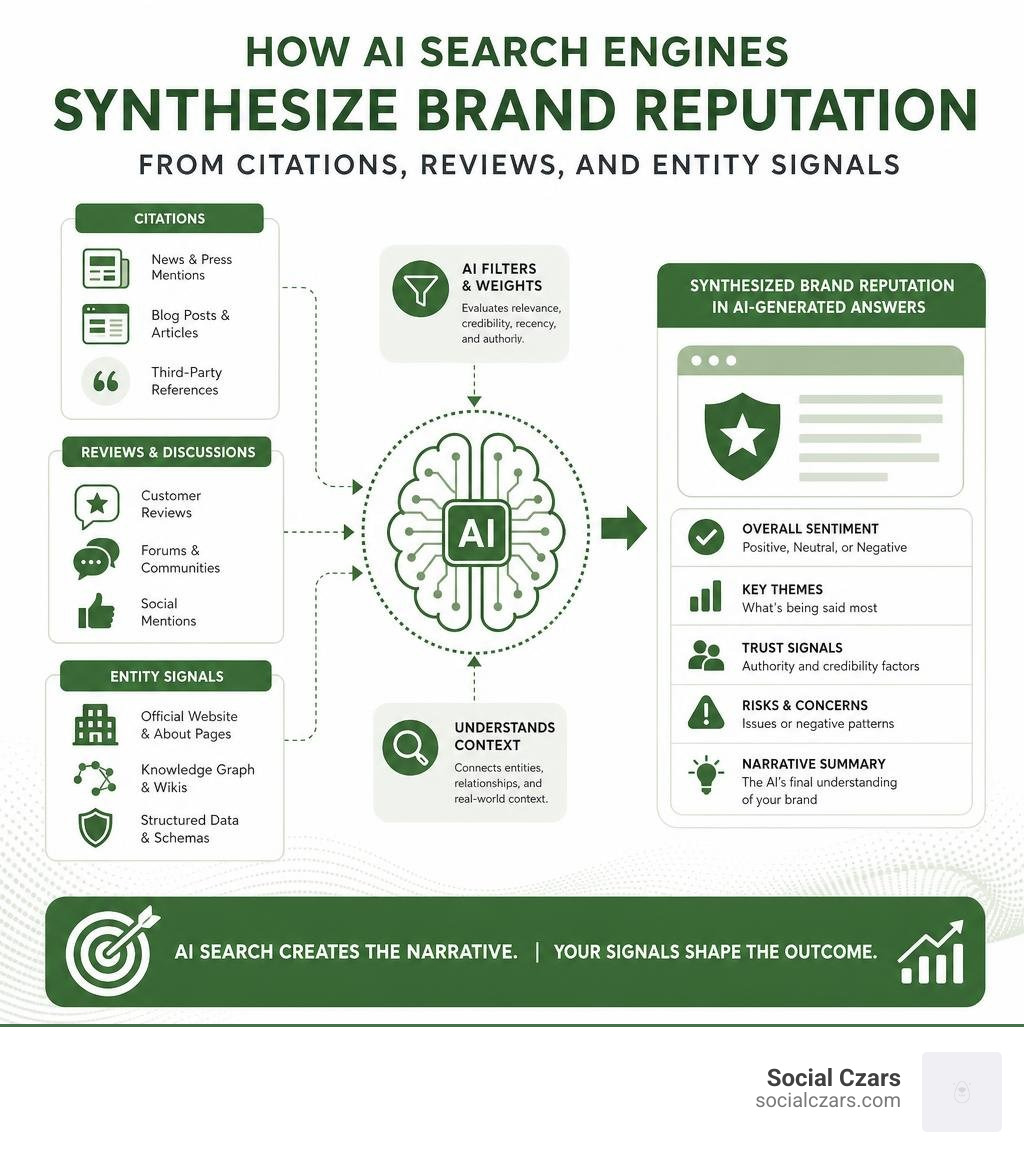
They open ChatGPT or Perplexity, type your name, and read whatever the AI decides to say about you. That answer is assembled from hundreds of third-party sources — reviews, Reddit threads, news articles, Wikipedia — and it can be wrong, outdated, or damaging.
And you may have no idea it’s happening.
Research shows that 85% of AI brand summaries draw from third-party sources outside your control. Google AI Overviews are 44% more likely to surface negative information than ChatGPT. One negative Reddit thread or an old news story can quietly poison the narrative AI engines build around your name — for every person who asks about you going forward.
This is a fundamentally different problem from traditional SEO or reputation management. You cannot simply rank a positive article above a negative one. You have to influence what the AI believes about you.
I’m John DeMarchi, founder of Social Czars and a crisis communications SEO specialist with over 15 years of experience helping executives, world-class brands, and high-profile individuals protect and control their digital presence — including navigating the emerging frontier of AI Search Reputation Management. In the guide below, I’ll walk you through exactly how AI search forms brand narratives, what signals drive those narratives, and how to take back control.
Simple AI Search Reputation Management glossary:
What is AI Search Reputation Management?
In June 2026, the digital landscape has crossed a critical threshold. We no longer live in an era where consumers patiently scroll through pages of blue links. Instead, nearly 37% of consumers start their search journeys directly on AI platforms, and 40% of consumers use AI engines specifically for purchase research.
When a user queries an AI engine about your company, the engine does not merely retrieve a list of websites. It performs real-time information retrieval, reading hundreds of pages, analyzing reviews, parsing social media sentiment, and synthesizing a single, highly confident paragraph.
AI Search Reputation Management is the strategic discipline of managing the data footprints that these Large Language Models (LLMs) digest. To understand this process deeply, we must look at How AI Works. AI models rely on neural networks trained on massive datasets combined with real-time Retrieval-Augmented Generation (RAG). If the data fed into these systems is polluted with outdated press releases, false customer complaints, or competitor-biased comparisons, the AI will confidently output a distorted summary of your brand.
Managing your reputation in this environment means ensuring that the “raw ingredients” the AI consumes are accurate, authoritative, and positive.
How AI Search Reputation Management Differs from Traditional SEO
For decades, search engine optimization was a game of keywords, backlinks, and rankings. If you ranked number one on Google for your brand name, you won.
AI search changes the rules entirely. Traditional SEO focuses on driving traffic to your owned website. AI reputation management focuses on “share of model” and “citation trust.”
As explored in The return of online reputation management in AI search marketing, the focus has shifted back to classic public relations and brand authority, but with a highly technical twist. We are no longer optimizing for human readers alone; we are optimizing for the AI systems that summarize those sources.
To see how this completely alters the search experience, read our analysis on How AI is Changing Online Search. In traditional search, a negative review on an obscure forum might sit on page three of Google, largely ignored. In AI search, that same negative review can be pulled by Perplexity or ChatGPT and synthesized directly into the primary summary, framing your brand’s entire narrative around a single bad experience.
The Shift from Blue Links to Generative Summaries
The shift from ten blue links to generative summaries represents a paradigm shift in user behavior. Platforms like ChatGPT, Perplexity, Gemini 3, and Google AI Overviews act as editorial gatekeepers.
For brands, this has severe financial implications. AI-driven traffic converts at an impressive 15.9%, compared to just 1.76% for traditional organic search. When an AI recommends your business, the user is highly motivated and ready to buy. However, most businesses have 0% visibility on ChatGPT and Perplexity, even if they rank exceptionally well on Google.
If you are not visible or if your generative summary is plagued by “hallucinated reputation” (where the AI mixes up your brand with a competitor of a similar name), you are losing high-value clients before they ever hear your side of the story. To prevent this, brands must master SEO for ChatGPT and build a digital footprint that AI models can easily parse, trust, and cite.
Core Signals Influencing AI-Generated Brand Summaries
AI models do not think like humans, but they are highly sensitive to specific data structures and signals. To shape what an AI says about your brand, we must optimize three core layers: entity architecture, structured data, and sentiment balance.

When an LLM attempts to answer a prompt about your brand, it builds a probabilistic map of your business. It looks for verifiable facts, cross-source consistency, and sentiment signals across the web. If it finds conflicting information—such as an outdated address on an old directory or a mixed review narrative—the AI’s confidence score drops, and it may choose to exclude your brand entirely or highlight the negative discrepancies.
Entity Reputation Management and Schema Markup
At the heart of AI search is “entity reputation.” In the eyes of an AI, your brand is not just a keyword; it is an “entity”—a real-world object with a stable identity, relationships, and attributes.
To help AI engines understand your entity without ambiguity, we must establish a clear “Entity Home.” This is typically your main website, reinforced by structured data signals.
- Organization Schema: Implementing robust schema markup allows you to explicitly state your name, founders, location, and official social profiles.
- SameAs Links: By using
sameAsattributes in your schema, you tell the AI exactly which third-party profiles (such as your Wikipedia page, official Crunchbase, or LinkedIn) belong to your entity. - Wikidata and Knowledge Panels: AI models rely heavily on Wikidata as a source of truth. Creating and maintaining an accurate Wikidata entry significantly increases the likelihood of Google generating a stable Knowledge Panel for your brand and improves AI Overview visibility by up to 19.72%.
By standardizing your identity fields across all platforms, you make it easy for AI crawlers to connect the dots and speak about your brand with high confidence.
The Role of Third-Party Citations and Community Platforms
AI search engines are highly skeptical of what you say about yourself. They look to third-party sources to verify your claims.
- Wikipedia: As one of the most authoritative open-source databases, Wikipedia edits feed directly into Google Knowledge Panels, Gemini, and ChatGPT. Monitoring Wikipedia for accuracy is a foundational step in AI reputation defense.
- Community Platforms: An astonishing 48% of citations in Google AI Overviews come from community platforms like Reddit, Quora, and YouTube comments. If a thread on Reddit claims your executive team is facing a lawsuit, the AI may treat that speculation as a verified fact.
- Review Sites: Yelp, Trustpilot, and Glassdoor serve as primary sentiment feeds for LLMs.
To manage how these platforms influence your AI footprint, you must learn How to Handle ChatGPT Citation with These X Easy Changes and actively build authoritative citations on the domains AI engines already trust.
Technical and Content Optimizations (GEO and AEO)
To win in the generative era, brands must transition from traditional SEO to Generative Engine Optimization (GEO) and Answer Engine Optimization (AEO). These strategies focus on structuring your content so that AI models can easily extract it and cite it as the definitive answer to a user’s question.
To build a foundation for this, explore our A Z Guide to AI SEO GEO Strategy and discover AI-Powered SEO Strategies That Actually Work.
Optimizing Content Structure for AI Crawlers
AI engines use specialized web crawlers to gather information. If your website is technically difficult for an LLM to navigate, you will be left out of the conversation.
- Unblock AI Crawlers: Ensure your
robots.txtfile is configured to allow access to user-agents like GPTBot, PerplexityBot, and ClaudeBot. - Use FAQ Schema: Structure your high-value pages with clear Question-and-Answer formats. Using FAQ schema helps AI models quickly identify and extract direct answers for conversational queries.
- Optimize for AI Readiness: Tools like Foglift: AI Search Visibility for ChatGPT, Claude & Perplexity analyze your site’s structure, heading clarity, and schema depth to assign an AI Readiness Score. Most unoptimized sites score in the low 40s, but addressing technical blockers can quickly elevate that score to over 80, directly improving your citation frequency.
Managing Reviews and Sentiment Signals
Reviews are no longer just social proof for human buyers; they are critical training data for AI sentiment engines.
When analyzing a business, an AI does not just look at your overall star rating. It reads the text of your reviews to understand the context of customer sentiment. For example, if multiple reviews mention that your Los Angeles office has “excellent communication but slow turnaround times,” the AI will synthesize that exact nuance into its summary.
We must proactively manage this ecosystem:
- Keyword-Rich Responses: When responding to reviews, naturally include your brand name, location, and primary services. This helps the AI connect those positive reviews to your core entity.
- Increase Response Rates: A study by Uberall shows that replying to 30% of your reviews instead of just 10% can increase customer conversions by up to 80%. Timely, professional responses serve as positive quality signals for Google’s AI models.
- Leverage AI Platforms: Utilizing enterprise reputation management software allows brands to monitor reviews at scale, analyze emotional tone, and identify emerging reputation risks before they impact AI search results.
Monitoring and Measuring AI Search Visibility
You cannot manage what you do not measure. In the AI era, tracking your keyword rankings on Google is only a small piece of the puzzle. You must monitor your brand’s visibility, sentiment, and positioning inside conversational search engines.

To set up a professional monitoring workflow, check out the strategies in Your Brand Has a Reputation in AI Search. Here’s How to Actually Monitor It. | Topify . A modern AI reputation dashboard should track how your brand is positioned across multiple conversational prompts, benchmarking your visibility against your closest competitors.
Key Metrics and KPIs for AI Search Reputation Management
To prove the success of your AI Search Reputation Management program, you must track metrics that reflect how LLMs perceive and present your brand.
| Metric | What It Measures | Why It Matters |
|---|---|---|
| Share of Model (Visibility Score) | The percentage of relevant conversational prompts where your brand is included in the AI’s response. | Measures your brand’s top-of-mind status within the LLM’s neural network. |
| Citation Trust (Source Attribution) | The authority and diversity of the domains the AI cites when discussing your brand. | Ensures the AI is drawing from credible, positive sources rather than negative forums. |
| Sentiment Score | The qualitative tone (positive, neutral, negative) generated by the AI when describing your business. | Directly impacts user trust and purchase decisions. |
| Visibility Trend Line | A time-series graph tracking your brand’s presence in AI search results over weeks and months. | Identifies whether your GEO optimizations are gaining traction or losing ground. |
By tracking these KPIs, we can move from reactive damage control to proactive brand shaping, ensuring our clients maintain a dominant, positive presence across all major AI engines.
Crisis Management and Responding to AI Misinformation
What happens when an AI search engine gets your story completely wrong?
Because AI models are probabilistic, they are prone to “hallucinations”—generating highly confident but entirely false statements. They can confuse your business with another company of a similar name, surface outdated legal issues that were resolved years ago, or treat satirical Reddit posts as objective facts.
When a crisis strikes inside an LLM, you cannot file a support ticket to change the output. You have to deploy Crisis SEO for AI LLMs Like ChatGPT, Perplexity and Grok to correct the data at the source.
The DRRIe™ Framework for Proactive Governance
To help organizations govern their digital reputation proactively, we utilize the DRRIe™ (Digital Reputation Risk Intelligence Engine) framework. This five-layer operational system shifts reputation management from a reactive PR effort to a proactive governance model:
- Detect: Continuous multi-surface monitoring to catch negative signals, narrative drift, or false AI summaries within hours.
- Risk Map: Assessing the potential impact of a negative narrative. For example, will a critical Reddit thread in New York impact an upcoming fundraising round?
- Response Architecture: Deploying pre-built response playbooks to compress crisis response times from the typical 72 hours down to under 6 hours.
- Influence Control: Actively publishing optimized, high-authority content to reshape the data pool the AI draws from.
- Evolve Intelligence: Feeding the results back into the system to continually strengthen the brand’s entity signals.
For a deeper look at managing reputation crises on conversational platforms, read our A Comprehensive Guide to Crisis SEO for Grokipedia.
Handling Negative Grok and ChatGPT Citations
When dealing with real-time conversational engines like Grok (which crawls social media platform X in real time) or ChatGPT, a negative citation requires immediate, targeted action.
- Deploy Real-Time Alerts: Use modern reputation intelligence systems to get notified the moment a negative narrative begins to trend on social media or public forums.
- Source-Based Sentiment Correction: Identify the exact URLs the AI is citing in its negative response. Work to update, correct, or suppress those specific source pages.
- Prompt-Level Targeting: Publish highly optimized, question-forward FAQ content on authoritative domains that the AI already trusts and frequently cites.
- Platform Appeals: In cases of clear defamation or violation of safety guidelines, submit formal appeals to the LLM providers (such as OpenAI or Anthropic) to flag and correct systemic hallucinations.
To protect your brand on emerging platforms, read our guides on SEO for Grok and The 2026 Comprehensive Guide to Grokipedia. For professional assistance in managing these complex technical challenges, consult with experts experienced in modern brand protection and search optimization.
Industry-Specific Impacts of AI Search Reputation
The impact of AI search is not uniform across all sectors. Different industries face unique challenges and opportunities in managing their generative brand perception.
Hospitality and Travel
In the travel sector, 78% of travelers are open to using AI throughout their journey, from trip planning to enhancing on-site experiences. However, guest feedback is highly polarized: 40% of hotel guests are inclined to leave a review after a positive stay, while 48% are more likely to share if their experience was negative.
AI travel assistants synthesize these reviews into real-time summaries, meaning a brief period of operational issues can immediately result in an AI warning potential guests about “frequent cleanliness complaints” or “noisy rooms.”
Healthcare
For medical practices and healthcare executives in major hubs like New York City, London, or Miami, AI search is a double-edged sword. Patients use AI to research specialists and read synthesized summaries of clinical bedside manner. Ensuring consistent entity data across medical directories and maintaining a pristine sentiment balance is critical for patient acquisition.
Professional Services
Boutique wealth management firms, elite law offices, and corporate consultancies in Los Angeles, Miami, and London rely heavily on discretion and trust. When high-net-worth individuals perform background research on a firm, they expect a clean, authoritative AI summary.
A single false accusation or an unresolved public dispute can be amplified by AI engines, causing severe reputational damage. To defend your firm’s digital footprint in competitive markets, consider professional reputation management services to build a robust, defensible search presence.
Frequently Asked Questions about AI Search Reputation
How does AI search affect small businesses?
AI search heavily impacts local discovery. When a user asks an AI engine for the “best boutique marketing agency in Miami,” the AI does not just look at organic rankings. It analyzes local citations, Google Business Profile completeness, and recent customer reviews. Small businesses with inconsistent NAP (Name, Address, Phone) data or outdated profiles are routinely ignored by AI assistants, giving a massive advantage to competitors with clean, standardized entity signals.
Can negative reviews or bad press be removed from AI summaries?
Yes, but the process is indirect. You cannot directly edit an AI’s brain. To remove negative press or false narratives from an AI summary, you must address the sources the AI is citing. This involves updating outdated content, resolving disputes on review platforms, publishing verified facts on high-authority domains, and deploying strategic GEO content to suppress the visibility of negative sources within the LLM’s retrieval window.
How often should a brand monitor its AI search sentiment?
For active brands and high-profile executives, daily or weekly monitoring is highly recommended. AI models update their indexes and training data frequently. A negative thread on Reddit or a critical blog post can be digested by an AI crawler and integrated into your brand’s baseline “fact” summary within days. Real-time alerts are essential to catch narrative drift before it solidifies into a permanent reputation risk.
Conclusion
The rules of online reputation have been rewritten. In June 2026, your brand is no longer defined solely by what you publish on your website, nor is it defined by a simple list of Google search results. Your reputation is actively synthesized, summarized, and delivered by artificial intelligence.
At Social Czars, we offer elite SEO and fast negative content removal for CEOs, VIPs, and high-profile brands across our key locations in New York City, Miami, Los Angeles, and London. Our specialized, high-end digital reputation and search optimization services are designed for an exclusive clientele who cannot afford to let AI engines control their narrative.
Whether you need to correct a hallucinated AI summary, suppress damaging search results, or build a bulletproof entity architecture, we have the expertise to protect your digital legacy.
Ready to take control of your digital footprint? Learn more about AI’s impact on SEO and discover how we can defend your brand in the generative era.
