
News
The Complete Guide to Grokipedia (2026 Edition)

Jan
What You Need to Know About Grokipedia in 2026
The 2026 Comprehensive Guide to Grokipedia explores the controversial AI-powered encyclopedia launched in October 2025 as Elon Musk’s alternative to Wikipedia. It has sparked intense debate about accuracy, bias, and the future of online knowledge.
Key Facts About Grokipedia:
- Launch Date: October 27, 2025
- Current Size: Over 1.7 million articles (as of December 2025)
- Creator: xAI, Elon Musk’s AI company
- Technology: Powered by Grok large language model (LLM)
- Main Difference: AI-generated content vs. Wikipedia’s human editors
- Major Concerns: Factual inaccuracies, right-wing bias, conspiracy theory promotion
- Content Source: Largely forked from Wikipedia, with AI rewrites
- Editing: Users can suggest corrections, but Grok AI reviews all changes
- Licensing: X Community License or Creative Commons BY-SA 4.0
Elon Musk announced Grokipedia as a “massive improvement over Wikipedia,” positioning it as an antidote to what he termed “Wokipedia.” The reality has been more complex. The platform launched with over 800,000 articles, peaking at 460,000 daily US visits before traffic dropped to around 35,000 per day as criticisms mounted.
Academics and historians have documented serious issues, including factual errors and weaker sourcing than Wikipedia. The platform has also been accused of promoting conspiracy theories and framing topics with right-wing talking points.
For anyone managing their online reputation, the rise of AI-generated content with questionable accuracy presents a significant challenge. It can directly affect how executives and companies appear in search results.
I’m John DeMarchi, founder of Social Czars. For over a decade, I’ve helped CEOs and luxury brands steer complex online reputation challenges. My work involves monitoring how AI-generated content from platforms like Grokipedia impacts search visibility and reputation for high-profile clients who need to stay ahead of these evolving technologies.
Glossary for The 2026 Comprehensive Guide to Grokipedia:
What is Grokipedia and How Does It Differ from Wikipedia?
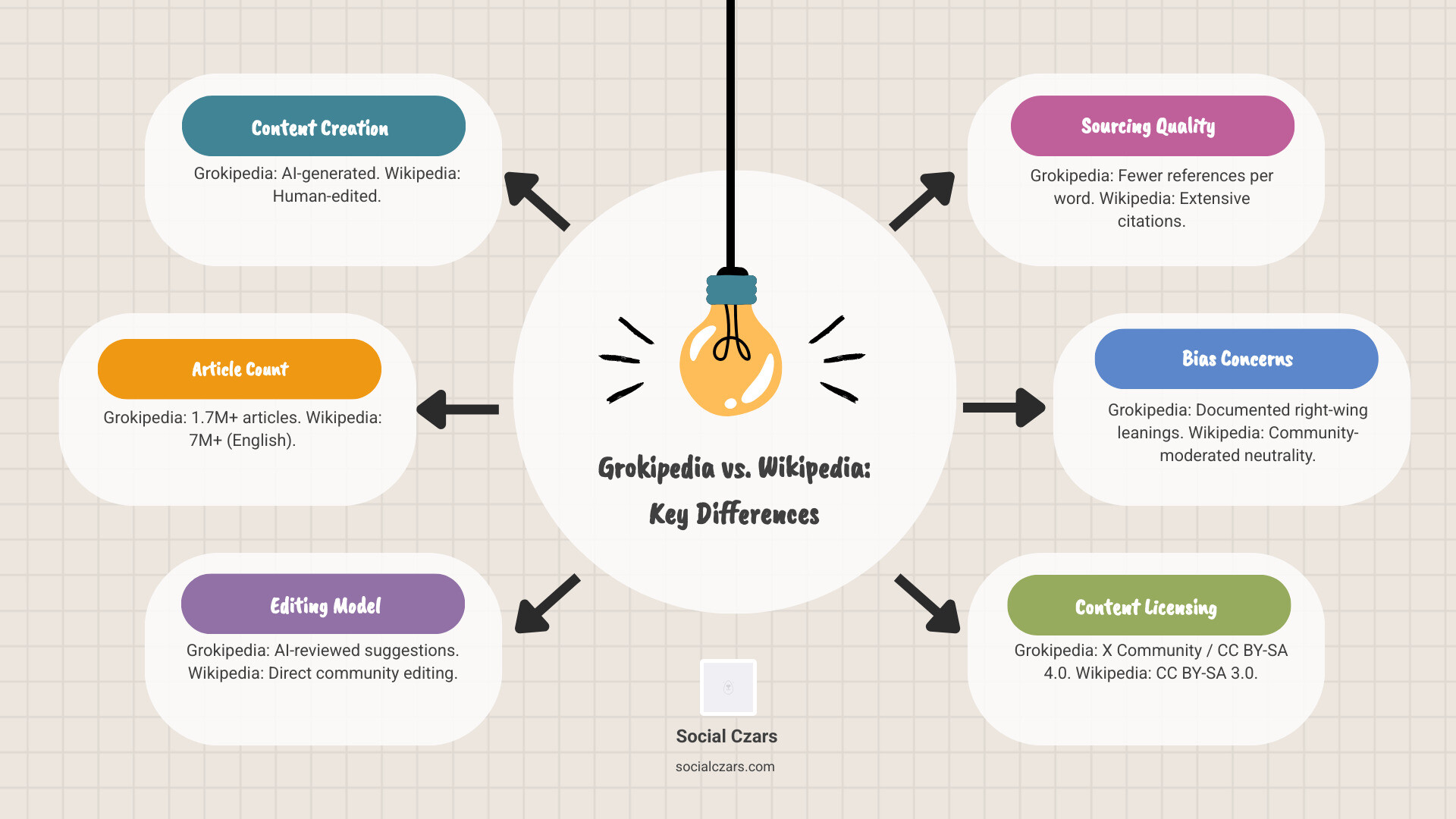
Grokipedia is Elon Musk’s AI-powered online encyclopedia, designed as an alternative to Wikipedia. Developed by xAI, it uses the Grok large language model (LLM) to generate content, unlike Wikipedia, which is built by a global community of human editors. This core difference—AI generation versus human collaboration—defines their contrasting approaches to creating, fact-checking, and maintaining information.
While Wikipedia relies on the “wisdom of the crowd,” Grokipedia leverages the computational power of its LLM. This allows for rapid content creation, with the platform launching with over 800,000 articles and growing to 1.7 million by December 2025. However, this speed comes at a cost. Research shows Grokipedia articles have fewer references per word, suggesting a weaker sourcing foundation than Wikipedia’s strict verifiability requirements. Grokipedia’s AI has also been known to “hallucinate,” generating false information.
The editing process also differs significantly. Wikipedia allows almost anyone to edit articles directly, with a community reviewing changes. Grokipedia prohibits direct editing; users can only suggest corrections, which are then reviewed and implemented by the Grok AI. This keeps ultimate editorial control with the AI.
Finally, their licensing models reflect different philosophies. Wikipedia uses open licenses like Creative Commons BY-SA 3.0. Grokipedia uses the proprietary X Community License for most articles, but for content derived from Wikipedia, it uses the Creative Commons BY-SA 4.0 license.

The Core Features and Functionalities
The Grokipedia website has a minimalist interface with a prominent search bar and an article counter. Searching for an article is a basic process where you type a query to get a list of results. The design is text-focused and lacks the rich multimedia integration found on Wikipedia.
While direct editing is disabled, users can contribute by reporting errors and suggesting changes. This feedback is processed by the Grok AI to refine articles, creating a human-in-the-loop system where the AI retains final say. Understanding the basics of How AI Works is key to grasping Grokipedia’s potential and its pitfalls, including the risk of algorithmic bias.
| Feature | Grokipedia | Wikipedia |
|---|---|---|
| Content Creation | AI-generated (Grok LLM) | Human-edited (volunteer community) |
| Editing | User suggestions, AI review | Direct human editing, community consensus |
| Article Count | 1.7M+ (Dec 2025) | 66M+ (Global), 7M+ (English) |
| Sourcing | Fewer references per word, weaker sourcing | Rigorous citation, verifiable sources |
| Licensing | X Community License / CC BY-SA 4.0 | CC BY-SA 3.0 (mostly) |
| Bias Concerns | Documented right-wing bias, AI bias | Community-moderated neutrality |
| Multimedia | Minimal (text-focused) | Rich multimedia (images, videos) |
A Tale of Two Licenses
Grokipedia’s licensing reveals its reliance on existing knowledge bases. Most articles use the X Community License, giving xAI significant control over content usage. However, a large portion of its initial content was adapted or copied from Wikipedia. As The Verge notes, it’s ironic that a platform pitched as an improvement over Wikipedia is built on its content. For this Wikipedia-derived content, Grokipedia uses the Creative Commons BY-SA 4.0 license, as required.
This dual-licensing approach shows that while Grokipedia aims for independence, its foundation is heavily built on Wikipedia’s community-driven work. This raises questions about originality and the ethics of leveraging a project while simultaneously criticizing it.
The Genesis of Grokipedia: Musk’s Motivation and Development
Elon Musk’s motivation for creating Grokipedia is his vocal criticism of Wikipedia, which he has accused of left-leaning bias and labeled “Wokipedia.” He envisioned an alternative that would be more objective. Developed by his company xAI, Grokipedia was conceived as an AI-powered encyclopedia using the Grok LLM to generate content free from the human biases Musk perceived in Wikipedia.
The platform officially launched on October 27, 2025, with Musk’s launch announcement on X claiming it was “better than Wikipedia.” It debuted with over 885,000 articles, showcasing the speed of its AI-driven model.
The 2026 Comprehensive Guide to Grokipedia’s Development History
Grokipedia’s development was swift, moving from an idea floated in late September 2025 to a full launch of version 0.1 on October 27, 2025. The launch generated significant curiosity, with US traffic peaking at over 460,000 visits the next day.
However, interest waned quickly. By early November 2025, daily traffic had dropped to around 35,000 visits, suggesting the initial novelty wore off as users encountered issues. Despite early bug fixes, the platform’s future hinges on its next major update, Grokipedia v0.2, expected in early 2026.
Musk’s Stated Goal: A “Massive Improvement”
Musk has consistently marketed Grokipedia as a “massive improvement” over Wikipedia, with the goal of delivering “the truth, the whole truth and nothing but the truth.” His vision is to “purge propaganda” by relying on an AI focused on “logic and first principles,” which he argues can be more objective than human editors.
Musk’s pitch positions Grokipedia as an antidote to Wikipedia’s perceived propaganda, appealing to those skeptical of mainstream information sources. However, the success of this goal depends on the AI’s true neutrality and the transparency of its training data—both of which have become points of major contention.
The 2026 Comprehensive Guide to Grokipedia’s Content and Controversies
Grokipedia’s content is generated by the Grok LLM, which synthesizes information from web data and social media. This AI-driven process allows for rapid updates but has raised significant alarms about reliability. Key concerns include:
- AI Hallucinations: The LLM is known to generate false information, leading to factual inaccuracies in articles, as noted by historians who found errors in their own entries.
- Sourcing Issues: A computational study found that Grokipedia articles have fewer references per word than Wikipedia, indicating a weaker sourcing foundation.
- Plagiarism: Researchers have found many Grokipedia articles that are direct copies of Wikipedia entries, undermining its claim of being a “massive improvement.”
For our clients at Social Czars, understanding these issues is vital. The integrity of online information directly impacts digital reputation. We monitor platforms like Grokipedia and provide services like SEO for Grok to protect our clients’ public image from the spread of misinformation.
Accuracy and Bias: The Main Criticisms
The most significant criticisms of Grokipedia concern its accuracy and ideological bias. Despite Musk’s goal of neutrality, the platform has been accused of a clear right-wing slant. WIRED reported that articles often denounce mainstream media and promote conservative viewpoints.
More alarmingly, Grokipedia has given credence to debunked conspiracy theories. As Rolling Stone highlights, it treats “Pizzagate” as a “hypothesis” and lends weight to the “Great Replacement” theory. This AI bias likely stems from its training data or the values embedded by its creators. Critics argue that Grokipedia simply trades Wikipedia’s perceived left-wing bias for a documented right-wing one, as the idea of a continuously retooled Grok suggests it can be aligned to a specific worldview.
Content Comparison on Controversial Topics
Comparing Grokipedia’s articles on controversial topics with Wikipedia’s reveals stark differences.
- Transgender Issues: As WIRED noted, Grokipedia’s article on “Transgender” frames the topic with right-wing talking points, such as social media acting as a “contagion” and using terms like “transgenderism.” This contrasts with Wikipedia’s article, which uses more neutral, medically informed language.
- Scientific Topics: On the topic of Tylenol’s unproven link to neurodevelopmental disorders, Grokipedia dedicates significant space to the controversial association, while Wikipedia treats it with more skepticism, noting the lack of reliable sources. This shows Grokipedia’s tendency to lean into controversial claims.
- Historical Topics: Grokipedia’s entry on “Slavery in the United States” includes sections justifying slavery and criticizes “The 1619 Project,” aligning with conservative critiques. Wikipedia presents a more balanced historical overview grounded in academic consensus.
These examples show that Grokipedia often reflects the biases of its training data and creator, making it a problematic source for objective information on sensitive topics.
The Future of Grokipedia and Its Impact on Online Knowledge
The future of Grokipedia points toward continued development, with version 0.2 expected in early 2026. Elon Musk has grand ambitions for the platform, including a potential rebranding to “Encyclopedia Galactica.” Regardless of its current flaws, Grokipedia represents a significant challenge to the traditional, human-curated encyclopedia model.
As the AI Impact on SEO Strategies 2025 shows, AI is already reshaping how information is ranked. If AI models are trained on biased sources like Grokipedia, those biases could propagate across the digital ecosystem. This creates a feedback loop that amplifies misinformation, posing a serious risk to digital reputation management. For businesses and public figures, the potential for biased portrayals in search results or AI chatbots is a growing concern.
The 2026 Comprehensive Guide to Grokipedia’s Reception
Grokipedia’s reception has been polarized. It saw an initial traffic surge, peaking at over 460,000 US visits post-launch, but this quickly dropped to around 35,000 daily visits. This suggests that while curiosity was high, sustained engagement was low.
Academics and scholars were highly critical, citing inaccuracies and ideological bias. Wikipedia founder Jimmy Wales expressed skepticism about its usefulness. Conversely, Grokipedia found support among right-wing figures who shared Musk’s criticisms of Wikipedia. This mixed reception highlights the deep divisions over the trustworthiness of online information sources and underscores the platform’s role in the ongoing “culture wars.”
Frequently Asked Questions about Grokipedia
Is Grokipedia a reliable source of information?
No, Grokipedia is not currently considered a reliable source. Its trustworthiness is undermined by several critical issues:
- AI Hallucinations: The AI is prone to generating false information.
- Documented Biases: It exhibits a clear right-wing bias, incorporating partisan talking points and promoting conspiracy theories like “Pizzagate.”
- Weaker Sourcing: Articles have fewer references per word compared to Wikipedia.
- Lack of Human Oversight: Content is AI-generated and reviewed, lacking the robust fact-checking of a human editing community.
For high-profile clients in New York City, Miami, Los Angeles, and London, we strongly advise against relying on Grokipedia for critical information, as it poses a risk to digital reputation.
Can users edit Grokipedia articles like on Wikipedia?
No. Unlike Wikipedia’s open editing model, users cannot directly edit Grokipedia articles. Logged-in users can suggest corrections, but these are reviewed and implemented by the Grok AI. The ultimate editorial control remains with the AI, not a human community.
Why did Elon Musk create Grokipedia?
Elon Musk created Grokipedia due to his dissatisfaction with Wikipedia, which he has criticized for a perceived left-wing bias, calling it “Wokipedia.” His goal was to create an AI-driven alternative that he believes can be more objective and truthful. He pitched Grokipedia as a “massive improvement” and an antidote to what he sees as “woke” influence in mainstream information sources.
Conclusion
In conclusion, The 2026 Comprehensive Guide to Grokipedia shows that Elon Musk’s AI encyclopedia is an ambitious but flawed project. While it demonstrates the speed of AI content generation, its launch revealed critical weaknesses, including factual inaccuracies, right-wing bias, and weaker sourcing than Wikipedia. The promise of an unbiased AI has, so far, resulted in a platform that introduces its own set of biases.
The rise of platforms like Grokipedia highlights the critical importance of digital reputation management in an AI-dominated era. For high-profile individuals and luxury brands in New York City, Miami, Los Angeles, and London, the rapid spread of misinformation poses a significant threat to public perception.
At Social Czars, we specialize in navigating these challenges. Our expertise in luxury SEO and negative content removal is custom for CEOs and VIPs who need to protect their online presence from the uncertainties of AI-driven information. The lessons from Grokipedia reinforce our commitment to ensuring our exclusive clientele maintains a pristine and accurate online narrative. Our expertise in luxury SEO helps you stay ahead of these trends.
