
Reputation Management
5 Practical Ways to Identify Common Crisis SEO Scenarios in NY

Jan
Why New York Businesses Face Unique Digital Visibility Threats
Common Crisis SEO Scenarios in New York often catch even sophisticated businesses off guard, threatening revenue and reputation in one of the world’s most competitive markets. In NYC, search invisibility isn’t just a marketing problem—it’s a growth crisis demanding immediate attention.
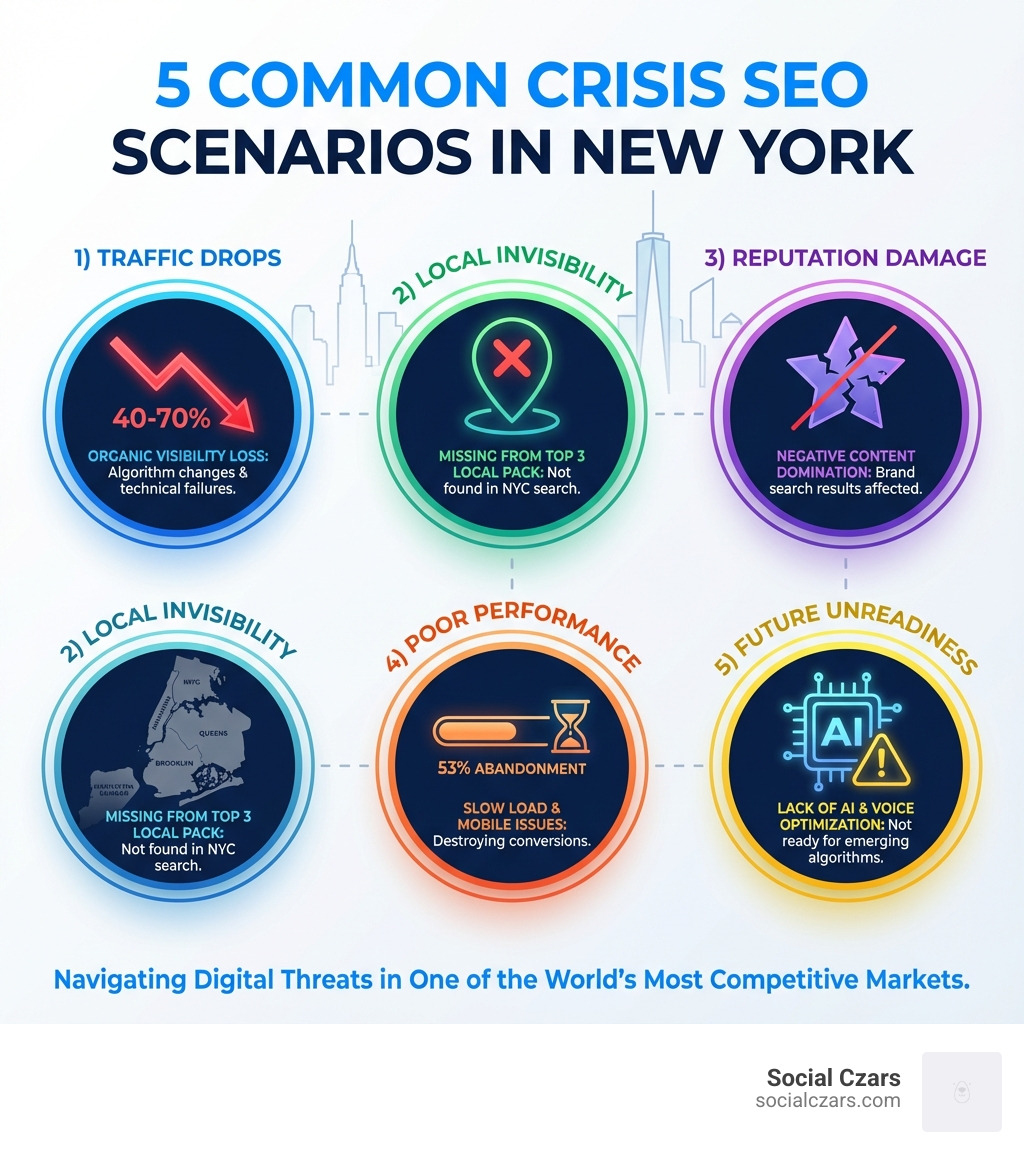
The 5 Most Critical SEO Crises Facing NYC Businesses:
- Sudden Traffic Drops – Algorithm updates or technical failures causing 40-70% drops in organic visibility
- Local Search Invisibility – Missing from the top 3 local pack despite serving Manhattan, Brooklyn, or Queens
- Reputation Damage – Negative content dominating your brand name search results
- Poor Website Performance – Slow load times and mobile issues destroying conversions (53% of mobile users abandon sites taking longer than 3 seconds)
- Future Unreadiness – Lack of optimization for AI-driven search, voice queries, and emerging algorithms
The stakes are high in New York. With thousands of competitors and 46% of all Google searches having local intent, falling behind in search visibility means losing customers to rivals just blocks away. A boutique agency in SoHo, a fintech startup in Flatiron, or a law firm in Midtown—all face the same brutal reality: if you’re not on Google, you might as well not exist.
Recent data shows 85% of websites struggle with Core Web Vitals performance, and 70% lack proper E-E-A-T signals. In a saturated market like NYC, these aren’t just numbers—they’re warnings of a crisis that can devastate your online presence.
I’m John DeMarchi. For over a decade, I’ve helped CEOs and luxury brands steer Common Crisis SEO Scenarios in New York, from suppressing negative content for high-profile executives to rebuilding search visibility after catastrophic ranking drops. At Social Czars, founded in 2014, I’ve seen how reputation management, technical SEO, and strategic PR can save or sink a New York business in crisis.
Know your Common Crisis SEO Scenarios in New York terms:
1. Analyzing Sudden Traffic Drops & Technical Failures

“Why am I not getting traffic to my site anymore?” This terrifying question is one every website owner might ask. For businesses in New York, a sudden drop in website traffic isn’t just an inconvenience—it’s a full-blown crisis. When your organic traffic plummets, it often signals a deeper issue, from a Google algorithm update to critical technical failures. We’ve seen businesses in Miami, Los Angeles, and London face this panic. In NYC, where competition is fierce, such a drop can be catastrophic.
The consequences of ignoring technical SEO are severe. Recent analysis reveals that 74% of websites have missing alt text, while 67% have pages with insufficient internal linking—basic errors that compound into major visibility problems. If Google can’t properly crawl, index, or understand your site, it simply won’t rank. This is where we come in, helping clients diagnose and recover from these alarming drops.
Diagnosing the Cause: Algorithm vs. Technical Error
The first step in any SEO crisis is to figure out what went wrong. Is it an external factor, like a Google algorithm shift, or an internal one, like a technical glitch?
Google constantly updates its algorithms, sometimes silently, sometimes with major announcements like the ‘Helpful Content Update’. These updates can cause de-ranking if your site no longer aligns with Google’s guidelines. For example, a retail site might see a 60% traffic drop if they ignored mobile optimization. We monitor these changes closely, using resources like Google Search Central. When rankings drop, we check for recent algorithm updates.
However, the culprit is often a technical SEO issue. Website redesigns can introduce broken links, incorrect redirects, or robots.txt errors that tell Google to ignore your site. We use tools like Google Search Console to quickly find crawl errors, 404s, and redirect chains. These issues prevent search engines from ranking your site. We ensure 301 redirects are correct after a site migration and that XML sitemaps are up-to-date. Understanding these technical fundamentals is crucial for maintaining your search presence. You can check Google’s official guidelines to learn more about how search engines crawl and index your site.
Auditing Your Backlink Profile for Toxicity
Another reason for sudden traffic drops can be a problematic backlink profile. Backlinks are votes of confidence from other websites, but not all votes are equal. Low-quality, spammy links from irrelevant or malicious sites can harm your rankings, leading to Google penalties.
We conduct thorough backlink audits to identify these toxic links, analyzing them for relevance, authority, and spam signals. If we find spammy, unrelated, or paid links, our strategy is two-fold: first, we request removal. If that’s not possible, we use Google’s Disavow tool to tell Google to ignore those links. This process helps mitigate penalties and restore your site’s authority.
Acquiring quality backlinks remains critical for NYC businesses. They are a significant ranking signal, acting as trust votes that lift a website’s authority. While disavowing bad links, we also focus on building high-quality, relevant links through content and digital PR. This proactive approach ensures your site earns genuine authority, which is essential for competitive markets like New York.
For more information on how we handle negative search results and help our clients recover, explore our guide on more info about removing negative content.
2. Uncovering Local SEO Deficiencies in a Hyper-Competitive Market

In a dense city like New York, local search is everything. With over 46% of all Google searches having local intent, customers are looking for businesses “near me.” Many businesses in Manhattan, Brooklyn, and Queens miss this opportunity due to local SEO deficiencies. Ignoring local SEO in NYC is a primary crisis scenario, leading to “search invisibility.”
Local search remains a primary driver for brick-and-mortar businesses. If your business isn’t optimized for local search, you’re essentially invisible to a huge chunk of your potential customer base. A boutique agency in SoHo, a fintech startup in Flatiron, or a law firm in Midtown—all need to be highly visible in local search results to thrive.
The Unique Challenges of Common Crisis SEO Scenarios in New York
New York City presents unique challenges for local SEO. It’s not enough to target “New York City”; you need to focus on micro-locations and specific neighborhoods. The sheer density of businesses means competition for local search terms is incredibly fierce.
Consider a local NYC clinic that implemented full Google Business Profile (GBP) optimization, neighborhood pages, and weekly review outreach. This led to a 60% increase in “near me” calls and a top-3 pack placement across 5 neighborhoods within six months. This success underscores the power of a finely-tuned local SEO strategy.
We understand that for businesses in NYC, geo-targeting isn’t just about city names; it’s about making search results location-aware. This means using “nearby” keywords, localized schema with geoCoordinates, map embeds, and content referencing micro-locations like “near Union Square.” For multi-location businesses, we create content clusters around each service area and use hreflang-like canonicalization to avoid content cannibalization.
Local SEO in NYC requires a multi-modal, local-aware, and experience-first approach. It’s no longer a single-dimension race for keywords. We help our clients steer these complexities, ensuring they appear where people are searching for services, whether it’s for a “plumber Brooklyn” or a “best restaurant near Times Square.”
For more insights into optimizing your local presence, visit our guide on more info about local SEO for your business.
Auditing Your Google Business Profile and NAP Data
Your Google Business Profile (GBP) is the cornerstone of local SEO in a competitive market like New York. An incomplete or inconsistent GBP, along with inconsistent NAP (Name, Address, Phone) data across directories, is a major crisis scenario that prevents businesses from capturing local traffic.
When we audit a client’s local SEO, we carefully review their GBP for completeness and accuracy. Here are the critical GBP sections we optimize:
- Business Name: Ensure it’s accurate and consistent across all platforms.
- Address: Precise street address, including suite numbers, is vital for mapping.
- Phone: A local phone number is preferred, and it must be consistent.
- Website: Link to your primary business website.
- Categories: Select the most relevant categories that accurately describe your business.
- Services: Detail all services offered, using keywords potential customers might use.
- Photos: High-quality, optimized photos of your storefront, interior, and team build trust.
- Posts: Regular posts keep your profile active and communicate updates, offers, or events.
- Q&A: Monitor and respond to customer questions to show engagement and provide helpful information.
Beyond GBP, we ensure NAP consistency across all online directories and citations, including Yelp, Apple Maps, and Yellow Pages. Any discrepancy can confuse search engines and dilute your local authority.
We also develop a robust review strategy. Encouraging satisfied customers to leave positive reviews and responding professionally to all feedback is crucial. Reviews build trust and impact your visibility in the local pack. A boutique NYC gym, for example, combined content clusters, local schema, and targeted landing pages to double membership signups and increase organic visitors from zero to 3.3k/month in eight months. These are the results we strive for, helping our clients avoid the crisis of local invisibility.
3. Identifying Content Gaps and Online Reputation Crises
Your online reputation is your business. For high-profile individuals and businesses in New York, negative content dominating search results is a severe crisis scenario. A scathing review, an outdated news article, or a social media misstep can erode trust, deter clients, and impact your bottom line. Just as important as managing negative content is ensuring your own content is perceived as high-quality and trustworthy by Google.
Google’s E-E-A-T (Experience, Expertise, Authoritativeness, Trustworthiness) framework is now a ranking necessity, prioritizing human-first content. Yet, 70% of websites lack proper E-E-A-T signals, and content with clear expertise ranks 67% higher. Thin or duplicate content is also a problem; 50% of websites struggle with outdated or duplicate content. Google’s algorithm favors fresh, relevant content, making content maintenance a ranking necessity.
Evaluating Content Quality with E-E-A-T
E-E-A-T is a fundamental principle guiding Google’s evaluation of content quality. For businesses in New York, especially those in YMYL (Your Money Your Life) industries like finance or health, demonstrating E-E-A-T is paramount. A lack of these signals can lead to a crisis of credibility and plummeting rankings.
- Experience: Does the content reflect first-hand experience? We encourage sharing case studies and real-world examples to demonstrate genuine experience.
- Expertise: Is the author qualified? We recommend creating comprehensive author bios with credentials, linking to social profiles, and including bylines.
- Authoritativeness: Is the website or author a recognized go-to source? This is built through high-quality backlinks, thought leadership, and valuable content.
- Trustworthiness: Is the information accurate and transparent? We ensure clear contact information, transparent policies, SSL certificates, and professional responses to reviews.
We help clients develop content strategies that embed E-E-A-T into every piece. This often involves creating in-depth resources, publishing original research, and showcasing client testimonials. For high-profile individuals, we craft compelling narratives that highlight their achievements, helping to suppress negative noise. Building this trust is crucial when facing Common Crisis SEO Scenarios in New York.
For more on managing your professional image, check out our guide on more info about CEO reputation management.
From Bad Reviews to Negative Press: Managing Your Digital Narrative
When negative content surfaces, it demands immediate, strategic action. This is where reputation crises intersect with SEO. We’ve seen reputation crises unfold for major brands—from Domino’s admitting their pizza tasted like “cardboard” to Starbucks dealing with racial bias incidents. Their recovery offers valuable lessons: transparency, decisive action, and a commitment to improvement.
For NYC businesses, a negative review or press article can go viral instantly. Our approach to managing this digital narrative involves several key strategies:
- Social Media Monitoring: We constantly monitor social media and review platforms for any mentions of our clients. Early detection allows for a swift, controlled response.
- Crisis Communication: We help craft clear, empathetic, and strategic responses to negative feedback, mirroring the transparency of companies like Johnson & Johnson during the Tylenol crisis.
- Content Suppression: When direct removal isn’t possible, we implement content suppression. This involves creating and promoting high-quality, positive content to push negative results down the search pages. This can include optimized press releases, positive news coverage, and authoritative blog posts.
- User-Generated Content: We encourage positive user-generated content, like testimonials and case studies, to dilute the impact of negative narratives.
Waiting until a crisis occurs to address reputational risks is a risky strategy, much like ignoring a small leak in a dam until it becomes a flood. We help our clients establish robust online reputation management strategies to fix their online presence before it becomes a full-blown crisis.
Learn more about how we help our clients regain control of their online presence with our guide on learn how to fix your online reputation.
4. Diagnosing Poor User Experience and Website Performance
In New York City, user patience is a scarce commodity. If your website is slow, clunky, or difficult to steer, especially on mobile, you’re not just losing potential customers—you’re facing a critical SEO crisis. Google’s algorithms increasingly favor websites that offer a seamless, enjoyable user experience.
Website speed remains a critical ranking factor, with 82% of websites failing to meet optimal performance standards. The consequences are severe: every additional second of load time increases bounce rates by 7%, while 53% of mobile users abandon sites taking longer than 3 seconds to load. These numbers are even more pronounced in a high-expectation market like NYC.
The High Cost of a Slow and Clunky Website in NYC
Imagine a potential client in Manhattan searching for your services. If your site takes more than a few seconds to load, they’ve likely already bounced to a competitor. This isn’t just a bad impression; it directly impacts your conversion rates and revenue. Poor website performance is a silent killer of business growth.
Google’s Core Web Vitals (CWV) measure real-world user experience. They became even more critical with Interaction to Next Paint (INP) replacing First Input Delay (FID), measuring the worst interaction delays during a user’s session. Websites with poor INP scores experience 40% higher bounce rates, while optimized sites see double the mobile conversion rates.
We assess our clients’ sites against these critical metrics:
- Largest Contentful Paint (LCP): Measures loading performance. Ideally, LCP should occur within 2.5 seconds of when the page first starts loading.
- Interaction to Next Paint (INP): Measures interactivity. It should be under 200 milliseconds.
- Cumulative Layout Shift (CLS): Measures visual stability. CLS should be under 0.1.
In New York, where mobile traffic accounts for over 60% of all web visits, a clunky mobile experience is an unforgivable sin. Google’s mobile-first indexing means your mobile site is the primary version that gets indexed and ranked. If your mobile site is slow or poorly designed, your entire search presence is at risk.
For more details on optimizing your site’s performance, explore our insights on more info about advanced SEO strategies.
Mastering Mobile-First and Core Web Vitals
To avert a performance crisis, mastering mobile-first design and optimizing Core Web Vitals is non-negotiable. We implement a multi-faceted approach:
- Mobile Optimization: We ensure your website is fully responsive, providing a seamless experience across all devices. We conduct mobile usability testing and prioritize mobile load time.
- Image Compression & Lazy Loading: Large images are a common culprit for slow load times. We optimize image formats (e.g., WebP) and implement lazy loading, so images only load as they enter the user’s viewport.
- Code Optimization: Minifying CSS, JavaScript, and HTML, enabling Gzip compression, and optimizing server performance are crucial steps.
- Caching and CDN: Implementing browser caching and using a Content Delivery Network (CDN) can dramatically improve speed for users across different locations, including those in NYC.
Here’s a quick look at the Core Web Vitals and their ideal targets:
| Metric | What it measures | Ideal Target (Good) |
|---|---|---|
| Largest Contentful Paint (LCP) | Perceived loading speed (main content visible) | Under 2.5 seconds |
| Interaction to Next Paint (INP) | Responsiveness (time from interaction to visual feedback) | Under 200 milliseconds |
| Cumulative Layout Shift (CLS) | Visual stability (unexpected layout shifts) | Under 0.1 |
By systematically addressing these performance issues, we help our clients in New York not only improve their rankings but also improve user satisfaction and conversion rates. This proactive approach turns a potential crisis into a competitive advantage.
You can dig deeper into these crucial metrics with our guide on learn more about Core Web Vitals.
5. Future-Proofing Your Strategy Against Emerging SEO Crises
The SEO landscape is constantly evolving. For New York businesses, staying ahead of emerging trends like AI-driven search, voice queries, and algorithm updates is key to avoiding future crises. A static SEO strategy is a recipe for disaster. We help our clients in Miami, Los Angeles, London, and New York adapt to these shifts, ensuring their online presence remains robust and resilient.
Ignoring these future trends is one of the most significant Common Crisis SEO Scenarios in New York. Voice search is expected to comprise over 50% of all searches by 2025, yet most websites remain unprepared. Similarly, the implications of AI-driven optimization are profound, with Google prioritizing content that aligns with its sophisticated understanding of user intent.
Adapting to AI-Driven Search and Voice Queries
AI is fundamentally changing how people search. For NYC businesses, this means adapting content to be “answer-engine optimized” (AEO). AEO involves optimizing content so answer engines and AI overviews (like ChatGPT, Bing Copilot, and Google’s AI mode) can surface it as direct answers. This requires concise snippets, structured data, FAQs, and content formatted for extraction.
- Conversational Keywords: Voice queries are typically longer and more conversational, often phrased as questions (“Hey Google, where’s the best pizza near me in Brooklyn?”). We optimize content for these long-tail, question-based queries.
- Featured Snippets & Structured Data: Providing clear, direct answers in your content increases the likelihood of appearing in featured snippets and AI overviews. We leverage structured data and schema markup to help search engines understand your content’s context, making it easier for AI to extract information. Rich snippets can increase click-through rates by 20-30%.
- AI Content Risks: While AI tools can assist with content creation, low-quality, unreviewed AI content poses significant ranking risks. Google has stated that using automation to manipulate rankings violates spam policies. Our strategy is to ensure human oversight, adding unique insights and original research to any AI-assisted content.
The future of search is conversational and intelligent. Businesses in NYC that accept AEO and voice search optimization will capture a significant share of this evolving traffic.
To learn more about how AI is reshaping the search landscape, read our analysis on more info about how AI is changing search.
Building a Resilient and Proactive SEO Strategy for NYC
In a market as volatile as New York, a resilient and proactive SEO strategy is your best defense against crises. This means viewing SEO not as a one-time fix but as an ongoing commitment.
- Content Freshness & Topic Clusters: Content freshness significantly impacts rankings. We advocate for a content strategy that regularly updates existing content and organizes new content into topic clusters around core subjects. This demonstrates comprehensive expertise to Google.
- Keyword Strategy: A robust keyword strategy goes beyond simple terms; it digs into user intent (informational, navigational, commercial, transactional) and long-tail keywords. We help our clients conduct thorough keyword research and competitor analysis to identify opportunities.
- Ongoing SEO: The search landscape is dynamic; algorithms change, competitors evolve, and user behavior shifts. An ongoing SEO strategy involves continuous testing, monthly reporting, and adapting to new trends. This continuous loop of analysis and optimization ensures your website remains visible and competitive.
Even during economic uncertainties, cutting your SEO budget is a major mistake. SEO campaigns can be more cost-effective for boosting traffic and sales in the long run. An SEO strategy implemented during a recession can compound revenue for years, making it a powerful tool for recession-proofing your business.
At Social Czars, we specialize in helping high-profile individuals and luxury brands steer these complex waters. Our expertise in crisis SEO, negative content removal, and advanced reputation management ensures your business is not only visible but also protected in the challenging New York market. We don’t just chase rankings; we build brands that rank because they matter.
If you’re ready to future-proof your business and tackle Common Crisis SEO Scenarios in New York head-on, we’re here to help. Get in touch with us for expert guidance on your crisis SEO strategy: get help with your crisis SEO strategy.
