
Reputation Management
A Comprehensive Guide to Google AI Overview Reputation Management

Jun
Why Google AI Overview Reputation Management Now Defines Your Brand’s First Impression
Google AI Overview reputation management is the practice of controlling how Google’s AI-generated search summaries describe your brand — before a single user clicks a link.
Here’s what you need to know right now:
- What it is: Actively shaping the content, reviews, and third-party mentions that Google’s AI pulls when building a summary about your brand.
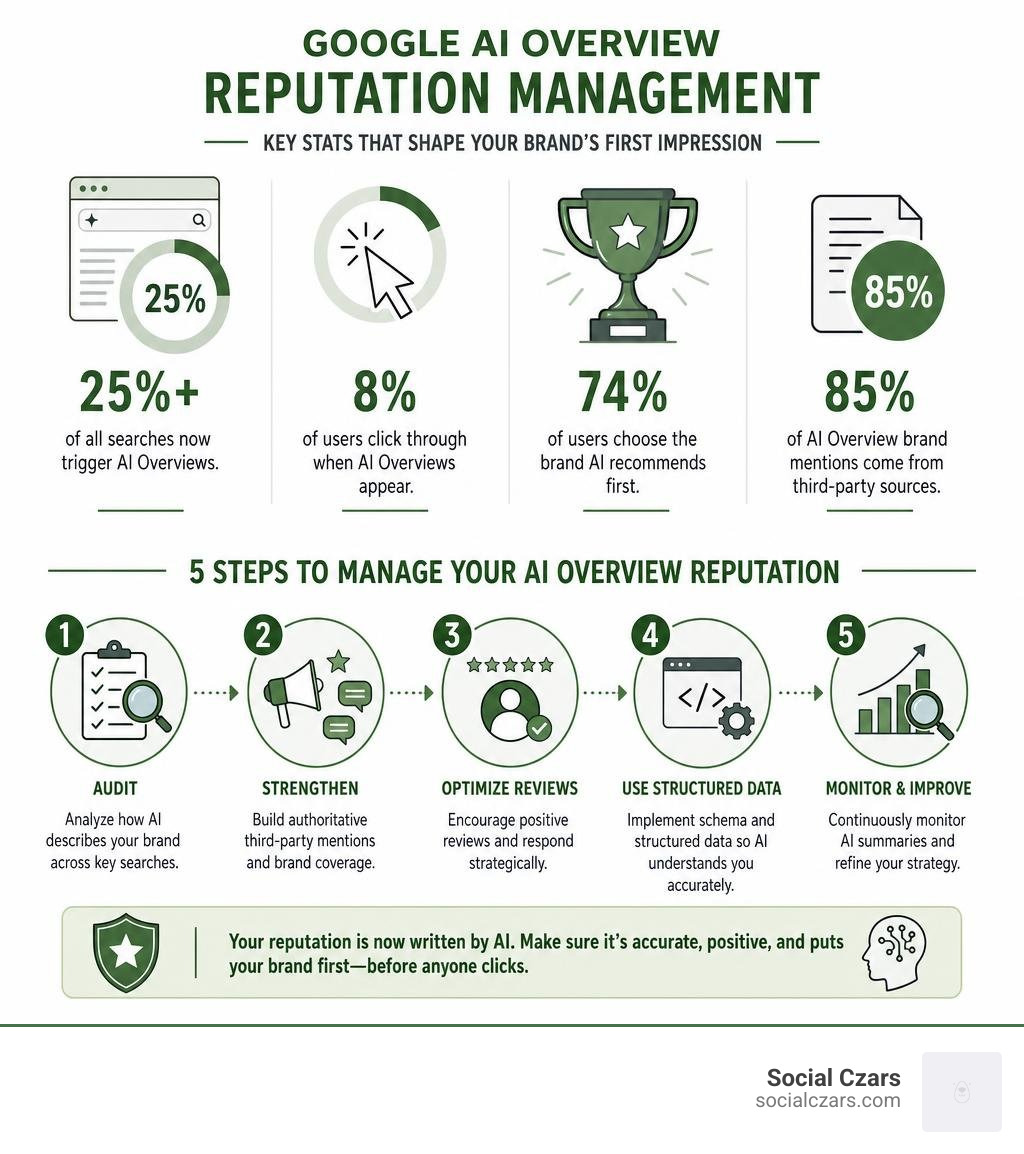
- Why it matters: Google AI Overviews now appear on more than 25% of all searches. When they do, only about 8% of users click through to the links below. The summary is the impression.
- What’s at stake: The brand AI recommends first gets chosen by users about 74% of the time. If that summary is inaccurate, negative, or silent about you — you lose before you’re even considered.
- What to do: Audit your AI footprint, strengthen third-party mentions, optimize reviews, and use structured data so AI systems describe you accurately and favorably.
Think about what happens when someone Googles your name or your company today. They don’t get a list of links to sort through. They get an answer — a confident, synthesized paragraph generated by AI, drawn from sources you may never have approved or even seen.
That answer shapes perception instantly. Most users never dig deeper.
The uncomfortable truth? Roughly 85% of the brand mentions that appear in AI-generated answers come from third-party pages — not your own website. More than 73% of brands that rank on Google’s first page have zero mentions in AI-generated answers. Traditional SEO success and AI visibility are not the same game.
This is a fundamental shift in how reputation works online. The battle for brand perception is no longer just about rankings. It’s about what AI says about you before anyone decides to look further.
I’m John DeMarchi, founder of Social Czars and a specialist in Crisis Communications SEO — including Google AI Overview reputation management for executives, VIPs, and world-class brands. With over a decade of experience suppressing negative content, building authoritative brand narratives, and navigating the intersection of PR and SEO, I’ve seen how quickly an AI-generated summary can define — or damage — a reputation at the highest levels. The strategies in this guide reflect what actually works in 2026.
Know your Google AI Overview Reputation Management terms:
The Shift to Google AI Overview Reputation Management in 2026
The search landscape in June 2026 is unrecognizable compared to just a couple of years ago. We have officially entered the era of the “zero-click” reality.
Historically, search engine optimization was a straightforward game: we optimized your website, earned quality backlinks, and watched your site climb to the top of the search engine results pages (SERPs). If you had a negative news story or an angry forum thread, we used proven strategies to suppress negative search results or bury bad search results.
Today, those traditional ranking assets are frequently pushed down the page. Google AI Overviews now show up on more than 25% of all searches, which is roughly double what we saw in early 2025. This means that for a quarter of all queries, Google’s Gemini-powered engine intercepts the user’s intent and answers it directly on the screen.
The consequences for brand traffic are severe. When an AI Overview appears on a results page, only around 8% of people click through to the traditional links underneath. Even more staggering, about 93% of AI Mode sessions end without anyone clicking through to a website at all. Users get their answer, form an opinion, and move on.
This has dramatically compressed what we call “judgment timing.” In the past, a user clicked a link, read your site, evaluated your claims, and made a decision. Now, Google is moving from retrieval to pre-interpretation. The synthesized framing before the click is the first moment of influence.
Because of this, passive search engine optimization is no longer enough to protect your digital footprint. If you are not actively managing how your brand is synthesized in these summaries, you are leaving your reputation to an algorithm that values volume and legibility over nuance. To stay ahead of these shifts, brands must understand the trends shaping search, as outlined in The Definitive Guide to Online Reputation Management Trends 2026, and align their digital assets with the technical realities detailed in Google’s official documentation on AI Overviews and AI Mode in Search .
How Google AI Overviews Shape Brand Perception
To understand why Google AI Overview reputation management is critical, we have to look at the cognitive shift in how users process search results. Google AI Overviews shape reputation before users assess sources by presenting a unified narrative.
When a user searches for your executive team or your company, Google’s AI doesn’t just list what people are saying; it pre-interprets the sentiment. It reads your site, scans third-party articles, parses forum discussions, and builds a “Franken-Brand.” This is a digital composite stitched together from scattered data points across the web.

This pre-interpretation makes source evaluation an optional depth instead of a required task. The average user assumes that if Google’s AI presents a summary with confidence, the summary must be an accurate consensus.
If your digital ecosystem contains contradictions, outdated press releases, or unresolved customer complaints, the AI will reconcile these elements in whatever way is most legible to its algorithm. This is why a proactive approach, such as the one outlined in The Ultimate Guide to Reputation Risk Assessment and Crisis Management, is vital to prevent an algorithmic crisis. Furthermore, continuous tracking via our Online Reputation Monitoring Complete Guide ensures you spot these shifts before they solidify in Google’s memory banks.
The Mechanics of Google AI Overview Reputation Management
How does Google’s AI decide what to say about your brand? The system relies on a technique known as “query fan-out.” When a user enters a search query, the AI engine doesn’t just run that single prompt. It issues multiple related searches across subtopics to gather a wide, diverse set of links.
The engine then analyzes these sources, extracts key facts, and synthesizes them into a single, cohesive response. During this process, citations are added to validate the claims.
This introduces a massive psychological bias. A 2024 Cornell Tech study found that users are significantly more likely to trust and click on AI-generated answers when they include citations, whether or not the information is accurate. The mere presence of a little link icon next to a statement gives it instant authority.
If a negative forum post or an inaccurate blog article is cited as a source in an AI Overview, users will trust that negative claim simply because the AI packaged it neatly. This makes Answer Engine Optimization (AEO) and modern search strategies essential. To learn how to structure your content so that Google’s AI extracts the right facts, consult our AI SEO Trends 2026 Guide.
Key Risks of Poor AI Reputation Control
Leaving your AI reputation to chance exposes your brand to three primary algorithmic risks:
- Hallucinations: Large language models (LLMs) are statistical prediction engines. They calculate the most likely next word, not necessarily the truth. If there is a gap in the information available about your brand, the AI may “hallucinate” details, confidently presenting false information as fact.
- Time Blindness and Outdated Info: AI engines often struggle with chronological context. They might pull a decade-old lawsuit, product recall, or executive transition and present it in the present tense, reviving historical crises as if they happened yesterday.
- Negative Bias Amplification: If a brand has a high volume of negative mentions on forums or review sites, the AI will detect this pattern. Instead of presenting a balanced view, it may overweight these negative signals, summarizing your entire business based on a vocal minority of unhappy users.
A real-world example of this risk can be seen in public complaints on Google’s support forums, where business owners have noted that Google AI Overview is showing defamatory content about my business by attributing competitor reviews. When the algorithm confuses your business entity with another, it can instantly tarnish your image.
If your brand falls victim to these algorithmic errors, you must deploy advanced search suppression and removal techniques. You can learn how to navigate these challenges in our comprehensive guides on how to bury bad search results and how to remove negative search results guide.
Defending Your Brand Against Google AI Overview Reputation Management Vulnerabilities
One of the most surprising aspects of AI search is the dominance of user-generated content platforms like Reddit and Quora. Because Google’s AI aims to provide conversational, first-hand perspectives, it heavily weights forum discussions when answering brand-related queries.
This creates a serious vulnerability. A single highly active, negative Reddit thread can become the primary source for Google’s AI summary of your product or leadership team. The AI understands volume and engagement, not necessarily resolution or truth. If a negative thread spikes in engagement, the AI may scan those themes, amplify the minority opinions, and ignore the fact that the issue was resolved years ago.
To defend against this, passive monitoring is no longer enough. Brands must actively engage with community platforms, correct inaccuracies at the source, and build positive, authoritative content assets to dilute negative forum signals. For a step-by-step approach to managing and mitigating these negative signals, read our guide on Don’t Let Negative Reviews Haunt You: A Step-by-Step Removal Guide.
Strategies to Optimize and Influence AI Overview Outputs
To successfully influence what Google’s AI says about your brand, you must feed the algorithm clear, structured, and highly authoritative data. LLMs do not guess when they have access to pristine, machine-readable facts.
First, you must optimize your structured data. Implementing schema markup—such as Organization, Product, Review, and FAQ schema—helps Google’s crawler understand the exact relationships between your brand, your executives, and your offerings.
Second, you must actively manage review sentiment. AI Overviews regularly perform real-time sentiment analysis on customer reviews across Google, Trustpilot, and industry-specific platforms. They extract common adjectives—such as “unreliable,” “slow,” or “highly professional”—and use them to frame your brand’s summary.

To build a search footprint that AI models love to cite, we recommend combining technical optimization with modern content strategies. You can find actionable frameworks for this in our guides on AI SEO Trends 2026 Guide and AI Powered SEO Strategies That Actually Work. For a broader look at how artificial intelligence is reshaping organic search, explore the AI Impact on SEO Strategies 2025.
Technical Controls and Content Redesign
While we want to maximize positive visibility, defensive reputation management sometimes requires restricting what Google’s AI can pull from your owned websites. If you are managing a sensitive executive transition or a corporate restructuring, you may want to prevent certain pages from being summarized in search results.
You can achieve this by using standard search preview controls:
- The
nosnippettag: This robots meta tag tells Google not to display a text snippet or video preview of your page in search results, which also prevents the AI from extracting that text for summaries. - The
data-nosnippetattribute: This tag allows you to prevent specific sections of a webpage (such as a legal disclaimer or a temporary statement) from being extracted by the AI, while allowing the rest of the page to be indexed normally. - Robots.txt restrictions: Ensuring your robots.txt file is correctly configured prevents crawlers from accessing private or sensitive directories that could feed incorrect data to search engines.
If you need to completely remove outdated or damaging information from Google’s index to protect your brand, you can find a comprehensive technical walkthrough in our guide, Wipe the Web: Your Guide to Removing Google Search Results.
Adapting Reputation Strategy for Multi-Location and Enterprise Brands
For enterprise and multi-location brands operating in major metropolitan hubs like New York City, Miami, Los Angeles, and London, managing AI reputation at scale introduces unique complexities. Google’s AI Overviews handle local queries differently than national or informational searches.
When a user searches for a service or business location, the AI pulls data from Google Business Profiles, local reviews, and regional directory listings. It then compares locations and summarizes customer experiences. If your listings are inconsistent or your reviews are neglected, the AI will simply recommend a competitor who presents cleaner local signals.
To visualize how local discovery has changed, consider this comparison:
| Feature | Traditional Local SEO | AI-Driven Local Search |
|---|---|---|
| Primary Discovery Channel | Local 3-Pack map listings | Synthesized AI recommendations & comparisons |
| Review Evaluation | Star ratings & review volume | Deep sentiment analysis, quote extraction, & theme identification |
| Data Sources | Business directory citations | Local profiles, forum discussions, local news, & schema markup |
| User Interaction | Click-to-call, website visits | Zero-click answers, immediate automated choices |
To protect your enterprise locations, you must ensure strict compliance with Google Maps and Search Review Policies. Google’s automated spam detection and policy checks are highly sensitive; review delays or suspensions can occur if reviews are flagged as unnatural or incentivized.
Enterprise brand managers must coordinate their local SEO, PR, and legal teams to maintain a unified brand voice. For a deep dive into enterprise-grade tracking systems, check out our Online Reputation Monitoring Complete Guide.
Frequently Asked Questions about AI Search Reputation
Can a business opt out of Google AI Overviews?
No, businesses cannot opt out of Google AI Overviews entirely. AI Overviews are a core search feature integrated directly into Google’s search engine results pages.
However, you can control how your owned content is used in these summaries by implementing technical preview controls. By deploying the nosnippet or data-nosnippet tags on your webpages, you can restrict Google’s AI from extracting your content to build its summaries. If you need to completely remove a specific URL or piece of content from Google’s search results to protect your brand, follow our guide on how to get rid of a search result on Google.
Why does Google AI attribute competitor complaints to my brand?
This issue is typically caused by “entity confusion.” When Google’s AI crawls the web, it looks for associations between names, locations, and keywords. If your business shares a similar name with another company, or if your brand is frequently mentioned in forum threads discussing a competitor’s failures, the AI can incorrectly attribute those negative complaints to you.
This is a known issue discussed on Google’s Webmaster forums, where users have highlighted that Google Search’s AI Overview is incorrectly attributing negative complaints from another business wit your brand. To resolve entity confusion, you must clarify your digital footprint by updating your Google Business Profiles, implementing precise schema markup, and publishing authoritative, verified content that clearly distinguishes your brand entity from competitors.
How do online reviews affect AI-generated summaries?
Online reviews serve as primary training and extraction data for Google’s AI Overviews. The AI does not just count your star rating; it uses natural language processing (NLP) to perform sentiment analysis on the text of your reviews.
The AI looks for specific details, themes, and recurring customer sentiments. If multiple reviews mention a specific staff member, product feature, or service delay, the AI will extract those quotes and synthesize them into a general consensus about your business. To ensure your reviews are positively influencing AI summaries, you must encourage descriptive feedback and manage your review ecosystem proactively, as detailed in our SEO Reputation Management Complete Guide.
Conclusion
In 2026, managing your reputation online requires a deep understanding of how algorithms interpret your brand. Traditional search engine optimization is no longer the sole metric of digital success; Google AI Overview reputation management has become the defining factor in shaping a user’s first impression.
At Social Czars, we specialize in providing elite SEO and rapid negative content removal for CEOs, VIPs, and high-profile brands across Miami, New York City, Los Angeles, and London. We understand the high-stakes nature of digital perception. Our specialized, high-end digital reputation and search optimization services are designed to protect your legacy, clarify your digital footprint, and ensure that when AI describes your brand, it tells an accurate, authoritative, and positive story.
Don’t let an algorithm define your digital legacy. Secure Your Digital Image with Google Reputation Repair and take control of your AI search presence today.
