
Reputation Management
A Clean Sweep on How to Remove Negative Thoughts

Jun
Why Negativity Holds You Back — and How to Remove Negative Patterns for Good
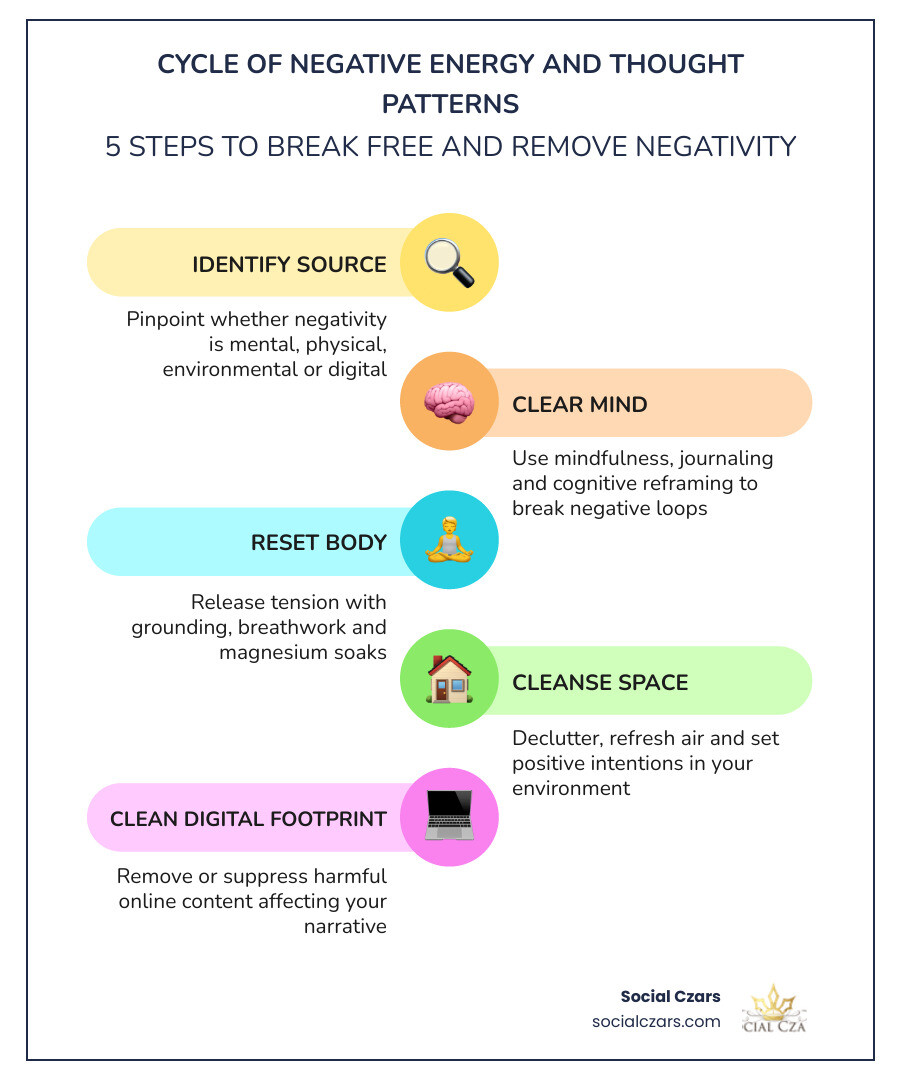
If you’re looking for how to remove negative energy, thoughts, and content from your life, here’s a quick overview:
- Identify the source — Is it mental (thought patterns), physical (stress in the body), environmental (your space), or digital (online content about you)?
- Clear your mind — Use mindfulness, journaling, or cognitive reframing to break negative thought loops.
- Reset your body — Try grounding, breathwork, movement, or magnesium soaks to release stored tension.
- Cleanse your space — Declutter, open windows, and use intention-setting rituals to refresh your environment.
- Clean up your digital footprint — Request removal of harmful online content, suppress negative search results, or work with a reputation specialist.
- Build protective habits — Set boundaries, monitor your online presence, and practice daily energy hygiene to prevent negativity from building back up.
Most people think negativity is just a mood. It isn’t.
It’s a pattern — and it shows up everywhere. In your thoughts, your body, your home, and yes, your Google search results.
Research suggests that negative thoughts can occupy up to 80% of our daily mental activity. That’s not a bad day. That’s a system running in the background, quietly shaping every decision you make.
And for high-profile professionals and executives, the stakes are even higher. A persistent mental fog can cloud your judgment. A single damaging article can derail a career. Both deserve the same level of attention and action.
This guide covers the full picture — from releasing negative energy in your mind and body, to clearing your physical spaces, to removing harmful content from the internet that doesn’t reflect who you are today.
I’m John DeMarchi, founder of Social Czars and a Crisis Communications SEO specialist with over a decade of experience helping executives and VIP individuals understand how to remove negative content from the web and reclaim control of their digital narrative. In the sections ahead, I’ll walk you through both the personal and professional sides of clearing negativity — so you can move forward with clarity and confidence.
Quick how to remove negative terms:
- Push down negative search results
- high-level reputation management
- negative content suppression
Understanding the Impact: How to Remove Negative Energy from the Body
Negative energy is often a catch-all phrase for stress, emotional overload, rumination, tension, and the sense that your system is carrying too much. Some people describe it spiritually. Others describe it psychologically. In practice, both often point to the same lived experience: your body and mind feel heavy, reactive, and off-balance.
Common signs include:
- Tight shoulders, jaw, neck, or back
- Brain fog and poor focus
- Irritability or feeling “on edge”
- Trouble sleeping or staying asleep
- Anxiety after being in certain places or around certain people
- Restlessness, impulsive decisions, or emotional exhaustion

The body keeps score, as the saying goes, and stress tends to settle physically. That is why how to remove negative patterns is not just a mindset question. It is also a body regulation question.
A good starting point is understanding the brain’s negativity bias. We are wired to notice threats faster than pleasant experiences. That helped humans survive, but in modern life it can keep us stuck in worry loops. Resources like this guide on turning around negative thinking explain how persistent negative thoughts affect mood, behavior, and mental health.
For some people, the “negative” burden is personal. For others, it is also reputational. If your stress is tied to harmful online material, our guide to A Practical Guide to Negative Content Removal can help you address the digital side of the problem too.
How to Remove Negative Mental Programs Permanently
We may not erase every negative thought forever, but we can weaken the pattern so it shows up less often, hits less hard, and passes more quickly. That is the real goal.
Here are the most evidence-based tools:
- Label the thought
- Instead of saying “I am a failure,” say “I am having the thought that I am a failure.”
- This creates distance.
- It helps us remember that thoughts are events in the mind, not facts carved in stone.
- Identify cognitive distortions Common distortions include:
- Catastrophizing
- Black-and-white thinking
- Mind reading
- Overgeneralizing
- Personalizing everything
Once we name the distortion, we stop treating it like a prophecy.
- Journal the loop out of your head Research in the brief shows journaling negative thoughts can improve emotional regulation and clarity by about 20% within a week. Try this format:
- What happened?
- What did I think?
- What did I feel?
- What evidence supports the thought?
- What evidence challenges it?
- What is a more realistic replacement thought?
Practice mindfulness instead of suppression Trying to force thoughts away often makes them rebound harder. Mindfulness works better because it changes our relationship with the thought rather than starting a wrestling match with it at 2 a.m.
Take in the good Our brains tend to be Velcro for the bad and Teflon for the good. When something pleasant happens, stay with it for an extra breath or two. This helps train neuroplasticity in a healthier direction.
People who use mindfulness and grounding practices consistently often report a 30% to 40% reduction in negative thought patterns within 4 to 6 weeks. That is not magic. It is repetition.
For more on reframing and mental pattern change, see how to stop negative thoughts.
Physical Rituals for Energetic Release
If your mind feels noisy, your body may need a reset first. Think of this as nervous-system hygiene.
Useful practices include:
- Box breathing: Inhale for 4, hold for 4, exhale for 4, hold for 4
- 5-4-3-2-1 grounding: Name 5 things you see, 4 you feel, 3 you hear, 2 you smell, and 1 you taste
- Earthing: Stand or walk barefoot on grass, soil, or sand
- Movement: Walking, yoga, stretching, dancing, or light strength training
- Magnesium soaks: Warm bath soaks may help relax muscles and reduce stress symptoms
- Sea salt baths: A simple self-care ritual many people use to unwind and release tension
Research cited in the brief suggests regular magnesium soaks may reduce stress-related symptoms by up to 25% in some users. We should be careful not to oversell them as a cure-all, but they can be a useful part of a broader routine.
A practical reset ritual looks like this:
- Take 3 slow breaths.
- Roll your shoulders and unclench your jaw.
- Do 5 minutes of stretching or a short walk.
- Soak in a warm bath with magnesium flakes or sea salt.
- Drink water afterward.
It is not glamorous, but neither is panic spiraling in business attire.
If the negativity you are carrying is tied to damaging webpages or online attacks, the emotional and physical stress can be very real. Our internet content removal resource explains how digital harm can be addressed alongside personal recovery.
Environmental Cleansing: Clearing Your Living and Working Spaces
Our spaces shape our state. A cluttered room can keep the brain in a low-level alert mode. A stale office can feel emotionally sticky. And high-stress environments can affect us even when no one says a word.
Some people describe walking into a room and instantly feeling anxious. While “energy accumulation” is hard to measure scientifically, environmental stress is not. Noise, clutter, poor light, bad air, and emotional associations all matter.

To clear your home or office:
- Declutter visible surfaces
- Open windows for fresh air
- Let in natural sunlight
- Vacuum, wipe surfaces, and wash linens
- Add plants if you can care for them
- Use calming scents if you enjoy them
- Set a clear intention for how you want the space to feel
Many people also use symbolic rituals such as salt water spritzes, incense, or smudging. These can be meaningful if they align with your beliefs, but the real heavy hitters are usually cleanliness, air flow, light, and order.
A useful rule: clear yourself before you clear the room. If we storm around angrily “cleansing” the house, we are basically just redecorating our stress.
Here is a simple comparison:
| Goal | Personal energy hygiene | Space clearing |
|---|---|---|
| Fast reset | Breathing, grounding, journaling | Open windows, tidy desk, fresh air |
| Stress relief | Walk, stretch, bath soak | Reduce clutter, lower noise |
| Emotional reset | Meditation, labeling thoughts | Change lighting, scent, layout |
| Ongoing maintenance | Daily check-ins, boundaries | Weekly cleaning, regular decluttering |
In high-emotion environments such as hospitals, people often report feeling unusually tense or overwhelmed. Whether you see that as stress transfer, association, or “bad juju,” the takeaway is the same: some spaces require stronger boundaries and recovery rituals afterward.
Digital Hygiene: How to Remove Negative Search Results and Content
This is where Social Czars lives every day.
For many executives, founders, and public-facing professionals, negativity is not only internal. It is indexed.
A negative article, review, forum thread, or misleading image in search results can keep stress active around the clock. You are not imagining that burden. Harmful digital content can affect jobs, clients, deals, and relationships.
When people ask us how to remove negative results online, we usually break the work into two buckets:
- Removal: getting content deleted, de-indexed, or legally taken down
- Suppression: pushing harmful results lower by building stronger positive assets
If the issue involves false statements, privacy violations, or damaging accusations, start with How to Remove Defamation from Internet.
There are also situations where search engines may remove certain results based on privacy laws. In the UK and parts of Europe, the Right to Be Forgotten may apply to outdated or no-longer-relevant personal information. That does not erase the original page from the web, but it may remove the result from certain searches.
And yes, the phrase “negative” also shows up in ad targeting. If you are managing paid campaigns while protecting your brand, Google’s guide to adding negative keywords explains how to block irrelevant search terms. Different problem, same basic principle: keep unwanted results away from your brand.
Technical Strategies on How to Remove Negative Online Mentions
Our process usually includes some combination of the following:
- Direct outreach
- Contact the publisher, webmaster, or platform
- Ask for correction, update, noindex, or removal
- Be factual, specific, and calm
- Platform or policy-based reporting
- Defamation
- Privacy violations
- Copyright infringement
- Doxxing or exposure of personal information
- DMCA takedowns
- Useful when copyrighted text, images, or media have been used without permission
- Search engine removal requests
- For qualifying personal information or legal grounds
- Sometimes the content stays live but becomes harder to find
- SEO suppression
- Build authoritative positive pages
- Strengthen LinkedIn, bios, company pages, interviews, and press mentions
- Publish consistent, high-quality content
- Interlink assets strategically
- Monitoring and containment
- Track new mentions
- Watch page one changes
- Respond before a small issue turns into a recurring search result nightmare
For deeper strategy, see suppress negative search results and removing damaging links and libel.
A few practical truths matter here:
- Not all negative content can be removed
- Honest opinions are harder to take down than false factual claims
- High-authority sites often rank well even when the content is weak
- Suppression campaigns often take months, not days
That said, action matters. Doing nothing is still a strategy, but it is usually a terrible one.
Long-Term Prevention and Maintenance Habits
The best way to remove negativity is to stop treating it like a one-time cleanup.
We need maintenance.
For mental and emotional prevention:
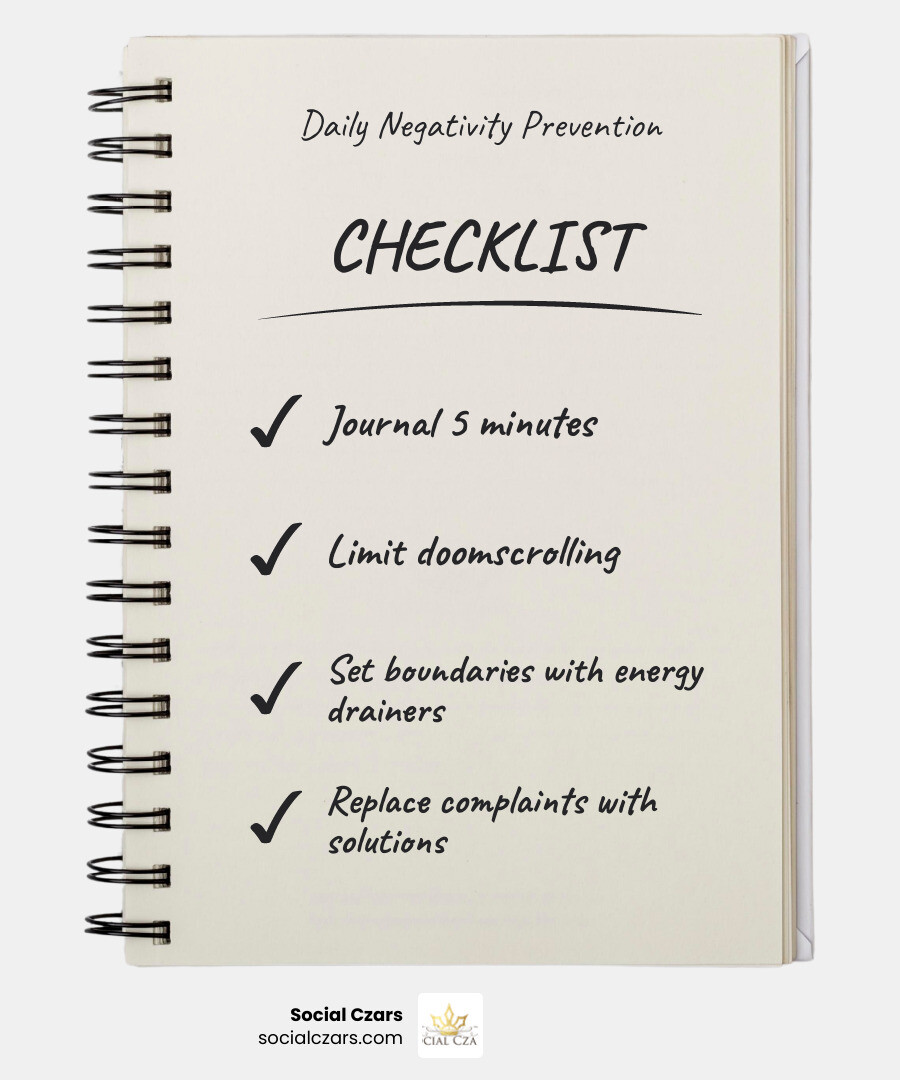
- Journal regularly
- Practice mindfulness a few minutes a day
- Limit doomscrolling
- Notice who drains you and set boundaries
- Replace chronic complaining with problem-solving
- Talk things out before they become internal monologues with bad lighting and worse dialogue
For physical prevention:
- Stay hydrated
- Get regular movement
- Eat consistently and include nutrient-dense foods
- Reduce excess caffeine and sugar if they worsen anxiety
- Get outside often
For environmental prevention:
- Declutter weekly
- Open windows often
- Keep workspaces clear
- Refresh lighting and airflow
- Remove broken or unused items that keep shouting “unfinished business”
For digital prevention:
- Set Google Alerts for your name or brand
- Monitor review platforms and search results weekly
- Publish positive content monthly
- Keep social and professional profiles active and current
- Address false or harmful content early
This is where personal hygiene and digital hygiene overlap more than people think. When your online presence is chaotic, your nervous system often feels it. If you need a starting point, read How to remove stuff from Google search.
Frequently Asked Questions about Removing Negativity
When should I seek professional help for persistent negative thoughts?
Seek professional mental health support if negative thoughts:
- Disrupt sleep
- Affect work or relationships
- Make you isolate yourself
- Remove interest in normal activities
- Feel relentless, scary, or impossible to manage alone
A therapist, counselor, or psychiatrist can help if your thought patterns are linked to anxiety, depression, trauma, OCD, or burnout. Self-help tools are useful, but they are not a substitute for care when symptoms are persistent or severe.
If the issue is reputational rather than clinical, professional help may also mean digital reputation support. If harmful search results are fueling distress, addressing them directly can reduce the feeling of being stuck.
How long does it take to clear negative energy from a physical space?
It depends on what is driving the feeling.
If the issue is clutter, stale air, and visual overload, you may feel better in 30 to 60 minutes after cleaning, ventilating, and resetting the room.
If the space is tied to grief, conflict, or repeated stress, the shift may take longer and require repeated effort:
- Clean deeply
- Rearrange furniture
- Change the lighting
- Add calming routines
- Set new associations in the room
In other words, some rooms need a sweep. Others need a breakup and a redesign.
Can I remove negative articles from Google search results myself?
Sometimes, yes.
You may be able to:
- Contact the publisher directly
- Request corrections or updates
- Report privacy violations
- Submit removal requests to Google where eligible
- Ask for de-indexing in certain cases
But many articles are not removable just because they are unflattering. If the content does not break a rule or law, suppression is often the smarter route.
For DIY next steps, these resources can help:
- Negative Content Suppression
- Remove Negative Search Results Best Practices
- How to Remove Content
- Remove Defamatory Content
Conclusion
Learning how to remove negative influences from your life is not about pretending everything is positive. It is about clearing what is unhelpful, false, outdated, draining, or no longer yours to carry.
That means:
- calming negative thought loops
- releasing tension from the body
- resetting the spaces where you live and work
- protecting your digital footprint with the same seriousness you give your health
At Social Czars, we believe modern clarity is holistic. Your peace of mind and your search results are not separate worlds. For CEOs, public figures, and VIP clients in Miami, New York City, Los Angeles, and London, both matter.
If you are ready to go beyond coping and start taking control, explore our guide to Suppress Negative Search Results. When the negativity is online, we help make sure it does not stay in charge.
