
Reputation Management
How to Vanish Online: A Guide to Cleaning Up Your Digital Footprint

Jan
Why Your Digital Reputation Demands Immediate Action
Companies that clean up your online presence fall into several key categories:
- Data Removal Services: These companies specialize in removing your personal information from data broker websites.
- Reputation Management Firms: These firms focus on suppressing or removing negative content like articles, reviews, and search results.
- Specialized ORM Companies: Some firms, like our own Social Czars, offer elite, discreet content removal and reputation management for executives and high-profile individuals.
- Review Management Platforms: These platforms help businesses monitor and manage their online reviews on various sites.
Your reputation on the internet has never been more important. Colleges and universities regularly search online for prospective students. Employers routinely Google job applicants. Even potential romantic partners check you out before a first date.
The problem? Most of us have no control over what appears when someone searches our name.
Data brokers have already compiled detailed profiles about you. Over 2,500 elements of personal information per person sit scattered across the publicly accessible internet. Your home address, phone number, family members’ names, past addresses, and more are for sale on people search sites.
Negative content—whether it’s an old social media post, an unflattering news article, or misleading information—can derail job offers, damage business relationships, and create serious privacy risks. One negative search result can cost thousands in lost revenue for professionals whose name is their brand.
The good news: you can take back control.
This guide walks through proven strategies to clean up your digital footprint, from DIY methods to professional services. You’ll learn how to audit your online presence, remove content you control, scrub your data from broker sites, and suppress negative results that won’t go away.
I’m John DeMarchi, founder of Social Czars, where I’ve spent over a decade helping CEOs and high-profile individuals manage crises involving negative online content. My firm specializes in the discreet removal and suppression of damaging search results for companies that clean up your online presence and the clients who need them most.
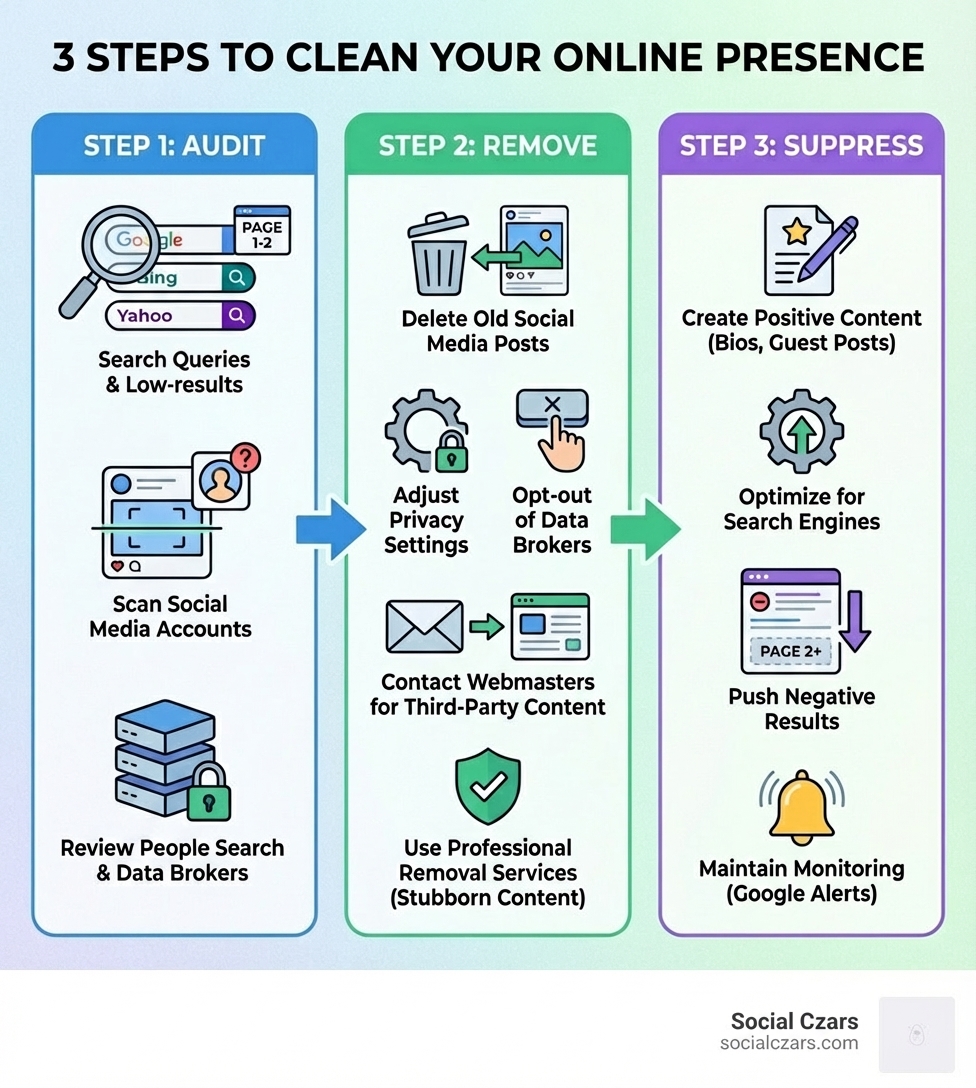
Step 1: Assess Your Online Exposure
Before we can clean up our online presence, we first need to know what’s out there. This crucial first step involves a thorough audit of your digital footprint. Think of it like a digital spring cleaning – you wouldn’t start dusting without knowing where the dirt is, right?

Our primary tool for this initial assessment is simple: the search bar. We recommend starting by “Googling yourself.” Use your full name, and if it’s a common name, add your location (e.g., “John Smith Miami”) or profession to narrow the results. Repeat this process on other major search engines like Bing and Yahoo.
The key is to go beyond the first page. While it might feel tedious, we know that fewer than 5% of searchers ever go past the first page of results. This means that if something negative is lingering on page two or three, it still has the potential to be seen. Note down all relevant results from at least the first two pages.
Next, we move to our social media profiles. Even if we think our profiles are private, old posts or comments can sometimes surface. We also need to investigate people search sites and data brokers. These are often the stealthy culprits holding and selling our personal information.
How to Identify Negative Content
As we sift through search results and profiles, what exactly are we looking for? Negative content can come in many forms, from the overtly damaging to the subtly unflattering. This includes:
- Unflattering social media posts: Perhaps an old, ill-advised photo from college or a comment made in poor taste. We’ve all seen stories of job offers rescinded due to questionable social media activity.
- Old blog posts or forum messages: Content from years ago that no longer reflects our current self or professional image.
- Negative news articles: Even if the information is outdated or the charges were dropped, a negative news story can severely impact our reputation.
- Unwanted photos or videos: Images posted by others that we don’t want associated with our name.
- Public records on data broker sites: These sites often list addresses, phone numbers, and even family members, making us vulnerable to spam, scams, and even doxxing.
It’s important to be objective during this phase. If we wouldn’t want a potential employer, client, or academic institution to see it, then it’s a piece of negative content we need to address.
The Role of Search Engine Indexing
Many people mistakenly believe that Google hosts the information it displays. In reality, Google is merely an indexer. It finds, categorizes, and displays content that already exists on other websites. This distinction is crucial. If we want something gone from Google search results, we primarily need to get it removed from its original source.
Search engine indexing also plays a role in how our social media profiles appear. Many platforms offer privacy settings that control whether search engines can link to our profile. For instance, Facebook allows you to manage this under its privacy settings. You can find a guide to managing what search engines link to your Facebook profile to learn more. Adjusting these settings is a simple yet effective way to limit visibility.
Step 2: The DIY Digital Cleanup
Once we’ve identified the content we want to address, it’s time for action. The good news is that many aspects of cleaning up our online presence can be handled ourselves, especially for content we control. This DIY approach is often the fastest and most cost-effective way to start.
Our first priority should be content that we directly control. This includes:
- Deleting old social media posts: Go through your profiles on platforms like Facebook, Instagram, Twitter, LinkedIn, Reddit, and TikTok. Be ruthless. If a post doesn’t align with your desired image or could be misinterpreted, delete it.
- Archiving Instagram uploads: If you have photos you’re fond of but don’t want publicly visible, use Instagram’s archive feature instead of outright deleting them.
- Adjusting privacy settings: On Facebook, LinkedIn, and other platforms, tighten your privacy settings. Limit who can see your posts, photos, and personal information. Consider locking down private accounts to “friends only” or making them completely private.
- Deactivating or deleting old accounts: Do you have old MySpace, Tumblr, or LiveJournal accounts from a bygone era? If you’re not using them, delete or deactivate them. These dormant accounts can be a security risk and a source of outdated information.
- Removing old blog or forum comments: If you’ve commented on old blogs or forums and can still access those accounts, remove any comments that are no longer appropriate.
These steps allow us to mitigate much of the negative content associated with our name, especially on social media, where a significant portion of our digital footprint resides.
Removing Your Data from People Search Sites
Beyond social media, a major source of our online exposure comes from data brokers and people search sites. What exactly are these? Data brokers are corporations that collect huge amounts of Personally Identifiable Information (PII) and package it all together to create “profiles” or “listings” with our personal information. They crawl the web, gathering data from government and other public records, self-reported information, social media, and even other data brokers.

The types of personal information typically found on data broker sites are extensive and alarming:
- Name
- Age
- Current and past addresses
- Phone numbers
- Email addresses
- Relatives
- Social media profiles
- Occupation
- Marital status
- Property value
- Photos
Why is removing this information important? The risks of exposed data are significant. This PII makes us vulnerable to:
- Doxxing: The malicious publication of private or identifying information about an individual on the internet, typically without their consent.
- Identity theft: Cyber criminals can use our personal information to apply for credit cards, open new accounts, take out loans, claim unemployment benefits, steal the deed to our property, or even commit medical identity theft. As experts warn, identity thieves treasure our personal data for its monetary value, selling it in bulk on the dark web.
- Spam and scams: Our contact information can be sold to marketing lists, leading to an onslaught of unwanted calls, emails, and texts.
Manually removing our data from these sites is possible, but it’s a time-consuming process. Each data broker has its own opt-out procedure, often requiring us to fill out forms, confirm our identity, and sometimes even physically mail requests. This process can take dozens of hours and must be repeated, as data brokers can relist our information.
For those who prefer a DIY approach, Google also provides a “Results about you” form which can help manage the appearance of personal information in search results, though removal from the source site is still the ultimate goal.
Addressing Third-Party Content You Can’t Directly Control
What about harmful content that isn’t under our direct control? This is often the trickiest part of online reputation cleanup. We’re talking about negative news articles, unflattering photos posted by others, or critical reviews on third-party websites.
Our first step is to politely contact the webmaster or site owner. If the content is false, outdated, or violates their terms of service or our privacy, we can make a strong case for its removal. We should provide clear evidence and explain the harm the content is causing. Many sites, particularly legitimate news outlets, may be willing to remove or update content if it’s factually incorrect or legally problematic.
However, direct removal isn’t always possible. Websites might refuse if the content is factual, legally published, or if they claim editorial independence. If a removal request is denied, or if the site owner is unresponsive, we then need to consider alternative strategies, primarily content suppression.
The Role of Professional companies that clean up your online presence
While many initial cleanup steps can be handled ourselves, there comes a point when professional assistance becomes invaluable. This is especially true when dealing with complex reputation issues, persistent negative content, or when we simply lack the time and expertise to manage it ourselves.
The benefits of engaging professional companies that clean up your online presence are numerous:
- Expertise: Professionals have deep knowledge of legal frameworks, technical strategies, and publisher relationships that most individuals don’t.
- Faster Results: They can often achieve removals or suppression more quickly due to their specialized tools and processes.
- Handling Complex Cases: Defamatory content, legal records, or entrenched negative news articles often require a nuanced approach that only experts can provide.
- Continuous Monitoring: Many services offer ongoing monitoring to ensure negative content doesn’t reappear and to address new threats proactively.
However, there are drawbacks, primarily cost. Professional services can range from hundreds to thousands of dollars, depending on the complexity and scope of the work. It’s an investment, but one that can pay significant dividends for our personal and professional lives.
How Content Suppression Works
When direct removal of negative content isn’t possible, content suppression becomes our most powerful tool. This strategy focuses on pushing negative search results off the first page of Google, where they are far less likely to be seen. The core principle is simple: if fewer than 5% of searchers go beyond page one, then moving negative content to page two or three effectively makes it invisible.
The process of content suppression involves creating and promoting new, positive, and authoritative content about ourselves. This new content is then optimized using SEO techniques to outrank and push down the undesirable results. Think of it as building a digital firewall of positivity.
Key elements of a successful suppression campaign include:
- Professional bios: Creating and distributing well-written, keyword-rich biographies on reputable industry sites, personal websites, and professional directories.
- Guest posts: Publishing articles or thought leadership pieces on relevant, high-authority websites.
- New social media profiles: Actively managing and optimizing profiles on platforms like LinkedIn, Twitter, and even industry-specific networks.
- Online portfolios or personal websites: A dedicated online hub showcasing our achievements, skills, and positive contributions.
The goal is to generate enough high-quality, relevant content that search engines prioritize it over the negative results. This requires a deep understanding of search engine algorithms and ongoing effort, making it a prime area where professional companies that clean up your online presence can excel.
Comparing Types of Data Removal Services
Beyond full-service reputation management, a specialized category of companies that clean up your online presence focuses specifically on data removal from data brokers. These services vary in their approach, primarily falling into two camps: automated and human-driven.
- Automated Services: These use software to automatically scan for your information and send out removal requests. They are generally faster and more affordable but may not be as thorough and can sometimes result in errors.
- Human-Driven Services: These services employ experts to manually find and remove your data. This approach is more meticulous and can handle complex cases, but it is typically slower and more expensive.
When choosing a service, consider the scope of their data broker coverage, the transparency of their reporting, and whether their approach (automated, manual, or a hybrid) fits your specific needs and budget.
