
Reputation Management
Beyond the Hype: Real Ways to Track Your Law Firm’s SEO Performance

Jan
Why Measuring SEO Performance Matters for Your Law Firm
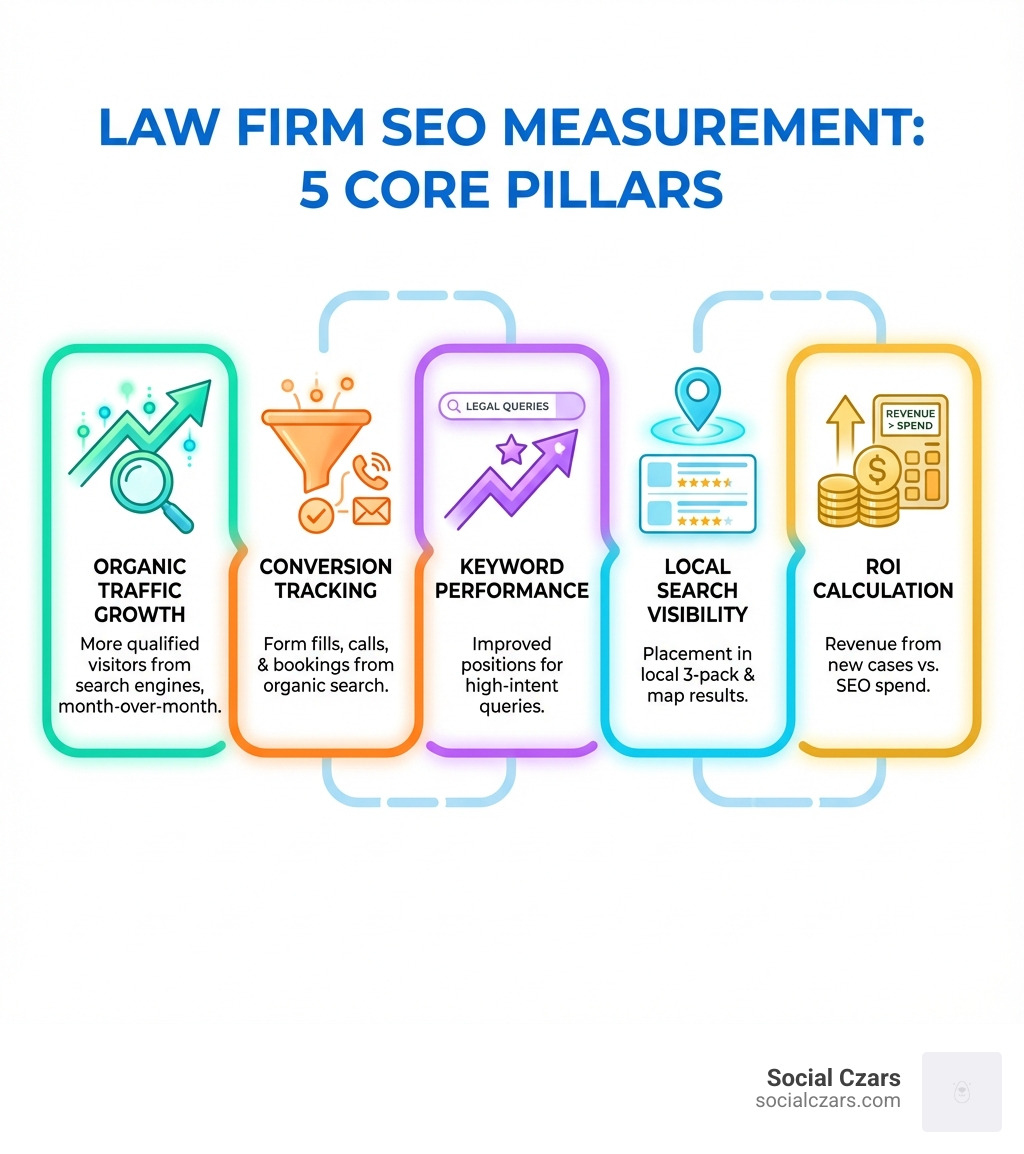
How to tell if SEO is working for law firm comes down to tracking the metrics that actually drive business growth. Here’s what to monitor:
- Organic traffic growth – More qualified visitors from search engines month-over-month
- Lead conversions – Form fills, phone calls, and consultation bookings from organic search
- Keyword rankings – Improved positions for high-intent legal queries (e.g., “personal injury lawyer Miami”)
- Local visibility – Placement in Google’s local 3-pack and map results
- Return on investment – Revenue from new cases compared to your SEO spend
Most law firms know they need SEO. 96% of people needing legal advice search online, and many use location-based queries like “divorce lawyer near me.” Yet despite this massive opportunity, 65% of attorneys don’t know which key performance indicators actually matter.
The problem isn’t a lack of data. It’s the opposite.
Modern analytics platforms flood you with hundreds of metrics. Page views, impressions, click-through rates, bounce rates—it’s overwhelming. And without a clear framework, it’s nearly impossible to separate meaningful signals from vanity metrics that look impressive but don’t drive new clients through your door.
Even more concerning? Many SEO agencies exploit this confusion. They present impressive-looking reports filled with graphs and numbers while keeping you on “autopilot” with generic strategies. Meanwhile, your competitors who understand how to tell if SEO is working for law firm are capturing the clients you’re missing.
I’m John DeMarchi, founder of Social Czars, and I’ve spent over a decade helping law firms cut through the noise to focus on how to tell if SEO is working for law firm through metrics that directly impact revenue. In this guide, I’ll show you exactly what to track and how to hold your SEO efforts accountable.
Relevant articles related to how to tell if seo is working for law firm:
Foundational Metrics: The Starting Point for SEO Analysis
Before we dive into the nitty-gritty of ROI, let’s establish the foundational metrics that serve as our early warning system and indicators of progress. These are the numbers we track diligently to understand the health and trajectory of your firm’s online presence. For us at Social Czars, this involves a deep dive into your Law Firm SEO performance, looking beyond superficial stats to what truly matters for your practice.
We focus on:
- Organic Traffic Growth: Are more potential clients finding your site through search engines?
- Keyword Ranking Improvements: Are you climbing the ranks for critical legal terms?
- Click-Through Rate (CTR): Is your listing compelling enough to earn clicks?
- User Engagement Metrics: Are visitors staying on your site and finding value?
- Backlink Profile Quality: Are authoritative sources vouching for your expertise?
These metrics, when analyzed together, paint a comprehensive picture of your SEO campaign’s effectiveness. They help us understand how to tell if SEO is working for law firm from the ground up, ensuring we’re always moving in the right direction.

The Truth About Keyword Rankings
Keyword rankings are often the first thing people look at when trying to figure out how to tell if SEO is working for law firm, and for good reason. If you’re not showing up, you’re not getting seen. However, it’s crucial to look beyond just “ranking #1.”
We prioritize keyword relevance. Are you ranking for terms that genuinely indicate someone needs a lawyer, such as “personal injury lawyer Miami” or “divorce attorney NYC,” rather than vague informational queries? We focus on high-intent keywords—those phrases potential clients use when they’re actively seeking legal help. Ranking for “what is a will” is good for thought leadership, but ranking for “estate planning lawyer London” is what brings in clients.
Tracking non-branded terms is also vital. While ranking for your firm’s name is expected, climbing the ranks for generic legal terms like “criminal defense attorney Los Angeles” demonstrates true organic reach. We also pay close attention to SERP features, like featured snippets or “People Also Ask” boxes, as these can capture significant visibility even if you’re not the #1 organic result.
Tools like Google Search Console provide invaluable insights into the actual queries bringing users to your site, their average positions, and click-through rates. We complement this with advanced positional tracking tools to monitor your firm’s visibility across our target cities, ensuring we’re always on top of your competitive landscape.
Analyzing Organic Traffic and User Behavior
While rankings get you seen, organic traffic and user behavior tell us if you’re attracting the right people and if your website is effectively engaging them. Law firms that consistently implement SEO strategies report a 21% increase in organic traffic year over year, a clear sign that persistence pays off.
We segment traffic sources in Google Analytics 4 (GA4) to isolate organic search traffic, ensuring we understand its unique contribution. We look at new vs. returning users to gauge brand awareness and loyalty. A healthy mix suggests both new client acquisition and continued engagement.
Bounce rate (the percentage of visitors who leave your site after viewing just one page) is often misunderstood. For law firms, industry benchmarks suggest that bounce rates between 41-55% are healthy. A high bounce rate (above 70%) might signal that your content isn’t meeting visitor expectations or that your site is slow. Conversely, a very low bounce rate could mean tracking issues.
Instead of solely focusing on bounce rate, we also examine engagement rate and dwell time—how long visitors spend interacting with your content. Research shows that pages with average session durations over 2.5 minutes typically rank higher in legal searches. This indicates that your content is valuable and relevant.
Finally, we identify your top landing pages from organic search. These are the pages that resonate most with potential clients and often represent opportunities for further optimization and lead generation. By analyzing these metrics in Google Analytics 4 (GA4), we gain a deeper understanding of your audience and how they interact with your digital presence.
The Bottom Line: Tracking Conversions and Calculating SEO ROI
How to tell if SEO is working for law firm boils down to one thing: new clients. All the traffic and rankings in the world mean little if they don’t translate into actual cases. This is where tracking conversions and calculating your Return on Investment (ROI) becomes paramount.
For a law firm, a conversion isn’t just a website visit; it’s a specific action a potential client takes that moves them closer to hiring you. This often includes:
- Form submissions: Filling out a “Contact Us” or “Free Consultation” form.
- Phone calls: Direct calls to your office, especially from mobile search.
- Live chat inquiries: Engaging with a live chat agent on your website.
Understanding these conversion points allows us to calculate your Client Acquisition Cost (CAC) from SEO, a critical metric for any law firm. We dive into this in more detail in our guide on Law Firm SEO Cost.
How to Tell if SEO is Working for a Law Firm Through Lead Tracking
Effective lead tracking is the backbone of measuring SEO success. Without it, you’re flying blind. We help our clients set up robust systems to understand exactly where their leads are coming from.
The first step is setting up conversion goals in platforms like Google Analytics. By setting up goals in Google Analytics, we can track specific actions on your website, such as thank-you page visits after a form submission, clicks on phone numbers, or successful live chat initiations. Law firms see an average conversion rate of 7.4% when optimized with SEO tracking, demonstrating the power of a refined strategy.
For phone calls, which are often the lifeblood of legal practices, we integrate advanced call tracking solutions. These systems assign unique, trackable phone numbers to various marketing channels, including organic search. This allows us to know not just that a call came in, but that it originated from a specific organic search, sometimes even linking back to the keyword used.
We also use UTM parameters for campaign tracking. These small pieces of code added to URLs allow us to precisely track traffic from specific initiatives, ensuring accurate attribution. This level of detail helps us in attributing leads to organic search, giving you a clear picture of your SEO investment’s direct impact. Research shows that 63% of consumers are more likely to return to websites that offer live chat features, making this a valuable conversion point to track as well.
Calculating Your Law Firm’s SEO Return on Investment
Calculating ROI for your law firm’s SEO efforts requires a systematic approach. It’s not just about counting leads, but understanding their value.
Here are the steps we follow to calculate your SEO ROI:
- Assign Value to a Lead: Determine the average revenue generated from a new client acquired through your practice area. Then, estimate the conversion rate from a lead (e.g., a consultation booking) to a paying client. This helps you assign a monetary value to each qualified lead generated by SEO.
- Calculate Total Value of New Cases from SEO: Multiply the number of new clients acquired through organic search by their average case value.
- Compare Revenue Against SEO Investment: Subtract your total SEO cost (agency fees, content creation, tools, etc.) from the total revenue generated by SEO-driven clients. Divide this by your SEO cost and multiply by 100 to get a percentage ROI.
- Consider Lifetime Value (LTV) of a Client: For some practice areas, repeat business or referrals from satisfied clients can significantly increase the long-term value. While harder to directly attribute, a successful SEO strategy contributes to building a client base with high LTV.
Research indicates that 42% of law firms now base their marketing budgets on data from reporting tools, highlighting the shift towards data-driven decision-making. By carefully tracking and analyzing these numbers, we ensure that your SEO investment isn’t just a cost, but a powerful engine for profitable growth.
How to Tell if SEO is Working for Your Law Firm’s Local Presence
For many law firms, especially those serving a specific geographic area like Miami, New York City, Los Angeles, or London, local SEO is not just important – it’s absolutely critical. When potential clients search for “divorce lawyer near me” or “criminal defense attorney Miami,” they are looking for immediate, local solutions. Understanding how to tell if SEO is working for law firm in this local context involves a distinct set of metrics.
The goal of local SEO is to ensure your firm appears prominently in Google’s local 3-pack (the map section at the top of search results) and local organic listings. Given that 96% of people needing legal advice search online, and many use location-based queries, optimizing for local visibility is non-negotiable. Our expertise in Google Business optimization is key here.
Key Performance Indicators for Local SEO
To assess your local SEO effectiveness, we monitor several key performance indicators:
- Google Business Profile (GBP) Performance: This is the cornerstone of local SEO. We track how often your profile appears (impressions), how many people interact with it, and what actions they take.
- Clicks to Call: How many prospective clients are calling your firm directly from your GBP listing? This is a direct lead indicator.
- Website Visits from GBP: How many people click through to your website from your Google Business Profile?
- Direction Requests: For firms with physical offices, tracking direction requests indicates foot traffic interest.
- Local Keyword Rankings: We monitor your firm’s position for “near me” searches and location-specific keywords (e.g., “personal injury lawyer Los Angeles”).
Google Business Profile Insights provides direct data on how potential clients interact with your firm’s local listing. This dashboard reveals exactly how many people viewed your profile, requested directions, or called your firm directly from search results pages. By analyzing this data, we can refine your local strategy to capture more leads in your specific service areas.
Monitoring Your Local Reputation and Citations
Beyond just appearing in local search, your local reputation plays a massive role in convincing potential clients to choose your firm. Client reviews are the most influential factor in getting hired. This means we carefully monitor:
- Online Reviews: The quantity, quality, and recency of reviews on platforms like Google Business Profile. More positive reviews consistently lead to higher local rankings.
- Review Velocity and Rating: Not just the average star rating, but how frequently new reviews are coming in and if your overall rating is improving.
- Name, Address, Phone (NAP) Consistency: Ensuring your firm’s name, address, and phone number are identical across all online directories and listings. Inconsistent data can confuse search engines and lower your rankings.
- Directory Listings: Your presence and accuracy on legal and local directories.
At Social Czars, our local SEO and reputation management solutions are designed to ensure your firm not only ranks high but also presents a stellar, consistent image across the digital landscape, especially in competitive markets like London and Miami.
Essential Tools, Timelines, and Agency Accountability
Understanding how to tell if SEO is working for law firm requires not only knowing what to measure but also how to measure it and when to expect results. It also demands a level of accountability from your SEO partners.
| Metric/Category | Free Tools (Baseline) | Comprehensive Tools (Social Czars’ Approach) |
|---|---|---|
| Keyword Rankings | Google Search Console | Advanced Rank Trackers (e.g., Pro Rank Tracker, SEMrush, Ahrefs) |
| Organic Traffic | Google Analytics 4 (GA4) | GA4 + Improved Segmentation, Custom Reports |
| Conversions | GA4 Goals, Google Tag Manager | GA4 + Call Tracking Platforms (e.g., CallRail), CRM Integration |
| Local SEO Performance | Google Business Profile Insights, GSC | Local Rank Trackers (e.g., Local Falcon), Citation Audit Tools |
| Technical SEO | Google Search Console, Lighthouse | Ahrefs Site Audit, SEMrush Site Audit, Screaming Frog |
| Backlink Analysis | Google Search Console | Ahrefs, SEMrush |
| Reporting | Manual Data Extraction | Custom SEO Reports in Your Company Design Miami Fl |
Many law firms, in their quest for SEO, encounter what we call the “Autopilot Syndrome.” This is when an agency applies a generic, one-size-fits-all strategy without the customized attention your unique practice requires. They might send impressive-looking reports, but if those reports don’t tie back to your specific business goals, they’re just noise. We believe in setting clear expectations from day one and providing custom reporting that directly addresses your firm’s objectives.
Setting Realistic Timelines for Law Firm SEO
SEO is a marathon, not a sprint. This is especially true in the highly competitive legal market. Unlike paid advertising, which can deliver immediate (though temporary) results, SEO builds organic authority and visibility over time.
Most experts estimate that it takes between six and twelve months to see measurable improvements to your SEO-related traffic and conversions. For law firms in competitive cities like New York City, Miami, Los Angeles, or London, it often falls on the longer end of this spectrum. The legal industry is saturated with content, and establishing your firm as an authority requires consistent effort.
The good news is that SEO has compounding effects. The longer you consistently invest in it, the stronger your foundation becomes, leading to sustained results that continue to pay dividends long after initial efforts. Law firms that consistently implement SEO strategies report a 21% increase in organic traffic year over year – a testament to the long-term value.
How to Tell if SEO is Working for a Law Firm by Auditing Your Agency
If you’ve partnered with an SEO agency, holding them accountable is crucial. You need to know that your investment is translating into tangible results, not just “autopilot” services. Research shows that 28% of law firms have hired a consultant or agency to assist with SEO, and the standard monthly retainer rate is often between $501-$1,000. For elite services, this can be significantly higher.
Here are key questions to ask your SEO agency to truly understand how to tell if SEO is working for law firm:
- What specific, measurable business goals are you targeting for our firm? (Beyond just rankings or traffic).
- How do you attribute leads and new clients directly to your SEO efforts? (Ask for specific conversion data, not just traffic).
- Can you show us month-over-month and year-over-year trends for organic leads and their source?
- What changes have you made to our website or strategy based on recent performance data?
- How do you measure the quality of backlinks acquired, not just the quantity?
- How frequently do you review our strategy and adapt it to algorithm updates or market changes?
- Can you provide access to raw data from Google Analytics and Google Search Console?
Red flags to watch for include agencies that guarantee #1 rankings (no one can guarantee Google’s algorithm), are vague about their process, or focus solely on vanity metrics that don’t translate to leads. We believe in complete transparency and focusing on your firm’s business goals, not just metrics. Our Crisis SEO for Lawyers Complete Guide further emphasizes the importance of a strategic, accountable approach in high-stakes situations.
Frequently Asked Questions about Measuring Law Firm SEO
What are the most important SEO metrics for a law firm?
The most critical metrics are those tied to business outcomes: qualified leads (calls, form fills), new client acquisitions, and a positive return on investment. While organic traffic and keyword rankings are important leading indicators, the ultimate measure of success is generating profitable cases. For a law firm in a competitive market like New York City or Los Angeles, understanding which keywords lead to actual client inquiries is far more valuable than simply ranking for a high-volume, low-intent term. We track granular conversion data to connect SEO efforts directly to your bottom line.
How often should I review my law firm’s SEO performance?
You should review key performance indicators monthly. This allows you to identify trends, assess the impact of recent work, and make strategic adjustments. For example, if we see a dip in organic traffic for “divorce lawyer London” in a specific month, we can quickly investigate whether it’s due to a content issue, a technical glitch, or a competitor’s new campaign. Deeper dives and strategy reviews should happen quarterly with your SEO provider to ensure long-term goals are being met and to adapt to the changing search landscape.
Can I measure SEO success if I don’t get many online form submissions?
Absolutely. For many law firms, the most valuable conversions are phone calls. Implementing call tracking is essential. This technology assigns unique, trackable phone numbers to your different marketing channels (like organic search), allowing you to know exactly how many calls your SEO efforts are generating. We often find that clients in Miami or NYC prefer to call directly when facing urgent legal needs, making call tracking a non-negotiable part of proving SEO’s worth. We can even integrate these call metrics with your analytics to provide a holistic view of your lead generation.
Conclusion: From Data to Dominance
Understanding how to tell if SEO is working for law firm is no longer a mystery; it’s a science. We’ve explored the foundational metrics, the critical importance of conversion tracking and ROI calculation, and the nuances of local SEO that are vital for practices in our key markets. We’ve also highlighted the need for realistic timelines and unwavering agency accountability.
The key takeaway is this: move beyond vanity metrics. Focus on the data that directly correlates with new client acquisition and tangible business growth. The 79% of law firms who reported SEO as their most effective marketing channel aren’t just seeing traffic; they’re seeing results.
Achieving this level of insight and impact requires more than just basic SEO; it demands a strategic partner who understands the unique challenges and opportunities of the legal industry. At Social Czars, we pride ourselves on our expertise in data-driven strategies, translating complex analytics into clear, actionable insights that drive real-world success for our elite clientele.
It’s time to take control of your firm’s digital future. Don’t let your SEO investment be a black box. Partner with us to achieve tangible growth and dominate your online presence.
Contact us to learn more about our Elite SEO Services
