
Reputation Management
Digital Marketing Executive Job Description Sample, Roles, and Salary Expectations

Sep
Core Responsibilities and Daily Workflows of a Digital Marketing Executive
The daily routine of a digital marketing executive balances creative campaign production with rigorous data analysis. While job listings often highlight overarching goals, understanding the daily operational duties versus posted job requirements helps teams establish realistic performance benchmarks and prevents role ambiguity. A well-structured digital marketing executive job description sample should therefore reflect both the strategic vision and the tactical execution required to move key performance indicators.
A digital marketing executive acts as the central operational hub for marketing initiatives. They collaborate across departments—working alongside graphic designers, copywriters, sales representatives, and external agency partners—to maintain message consistency and drive pipeline growth. They also manage campaign budgets, allocating ad spend across platforms to maximize return on investment while eliminating wasteful expenditures. This blend of creative oversight and financial accountability makes the role essential for organizations that need to scale acquisition without sacrificing brand quality.
Multi-Channel Strategy Execution
Executing an integrated, multi-channel strategy requires orchestrating several core disciplines:
- Paid Media Management: Launching and monitoring paid search, display, and paid social campaigns. This includes audience segmentation, A/B testing ad creative, setting bid strategies, and managing spend efficiency.
- Social Media and Community Engagement: Overseeing organic social schedules, publishing targeted messaging, monitoring audience sentiment, and engaging with prospective buyers across primary networks.
- Lifecycle Email Automation: Building segmented lead nurturing workflows, designing promotional newsletters, and conducting split tests on subject lines and calls to action to improve open and click-through rates.
- Content Distribution: Coordinating blog articles, case studies, and landing page content to ensure every asset reaches the intended audience through organic search and paid distribution.
Analytics, Reporting, and Conversion Optimization
Data interpretation separates standard marketers from high-performing executives. Digital marketing executives rely on analytics engines like Google Analytics 4 (GA4) to track user journeys from initial impression to completed conversion. They must also connect those insights to broader business outcomes, ensuring that every campaign contributes measurable value to the organization.
Key analytical duties include:
- Tracking Return on Ad Spend (ROAS): Ensuring paid channels consistently deliver profitable returns against media investments.
- Cost Per Acquisition (CPA) Reduction: Continuously refining audience parameters, keywords, and landing page elements to lower customer acquisition costs.
- Conversion Rate Optimization (CRO): Analyzing heatmaps, bounce rates, and on-page drop-offs to improve landing page layouts and forms.
- Executive Dashboards: Building automated Looker Studio dashboards to communicate campaign performance, pipeline velocity, and revenue impact to senior leadership.
- Attribution Modeling: Evaluating how organic search, paid media, email, and social channels contribute to conversions across the full customer journey.
Customizable Digital Marketing Executive Job Description Sample and Template
Hiring managers can use our structured template below to build a clear, comprehensive listing. For an alternative downloadable layout, review this Digital Marketing Executive JD Template to adapt specific hiring requirements. A strong digital marketing executive job description sample should outline both immediate tactical responsibilities and long-term growth expectations, giving candidates a realistic preview of the role while helping internal teams align on success metrics.
Comprehensive Role Overview and Key Requirements
A well-crafted job listing should clearly outline reporting lines, performance benchmarks, and core expectations. Using a clear Manatal job brief structure allows hiring teams to balance strategic goals with practical daily execution.
Candidates must demonstrate baseline technical competence, channel proficiency, and an ability to collaborate across business units. Establishing clear prerequisites reduces applicant drop-off and filters for individuals capable of managing marketing budgets responsibly. The most effective job descriptions also specify which platforms and tools the executive will own, preventing confusion about whether the role leans more toward creative production, technical SEO, or paid media management.
Using a Job Description Sample to Screen Candidates
Standardized criteria make candidate evaluations objective and effective:
- Competency Assessments: Have shortlisted applicants complete a brief, practical exercise, such as auditing an underperforming landing page or building a test paid search campaign structure.
- Portfolio and Metric Verification: Look for candidates who discuss revenue, conversion lift, and CPA reductions rather than vanity metrics like raw impressions or unsegmented traffic.
- Structured Behavioral Interviews: Ask scenario-based questions to evaluate how candidates adjust campaigns when performance drops or ad platform algorithms change.
- Cross-Channel Problem Solving: Present a realistic budget allocation scenario and ask candidates to explain how they would distribute spend across search, social, and email to hit a specific acquisition target.
Essential Skills, Required Tools, and Professional Qualifications
Modern digital marketing requires a blend of creative communication, analytical problem-solving, and technical fluency. In executive circles and high-stakes industries, digital marketing also overlaps directly with search optimization for high-level leadership, where search visibility directly influences brand authority and executive credibility. Professionals who combine these competencies with hands-on platform experience are best positioned to deliver consistent results across competitive markets.
Technical Proficiencies and Campaign Platforms
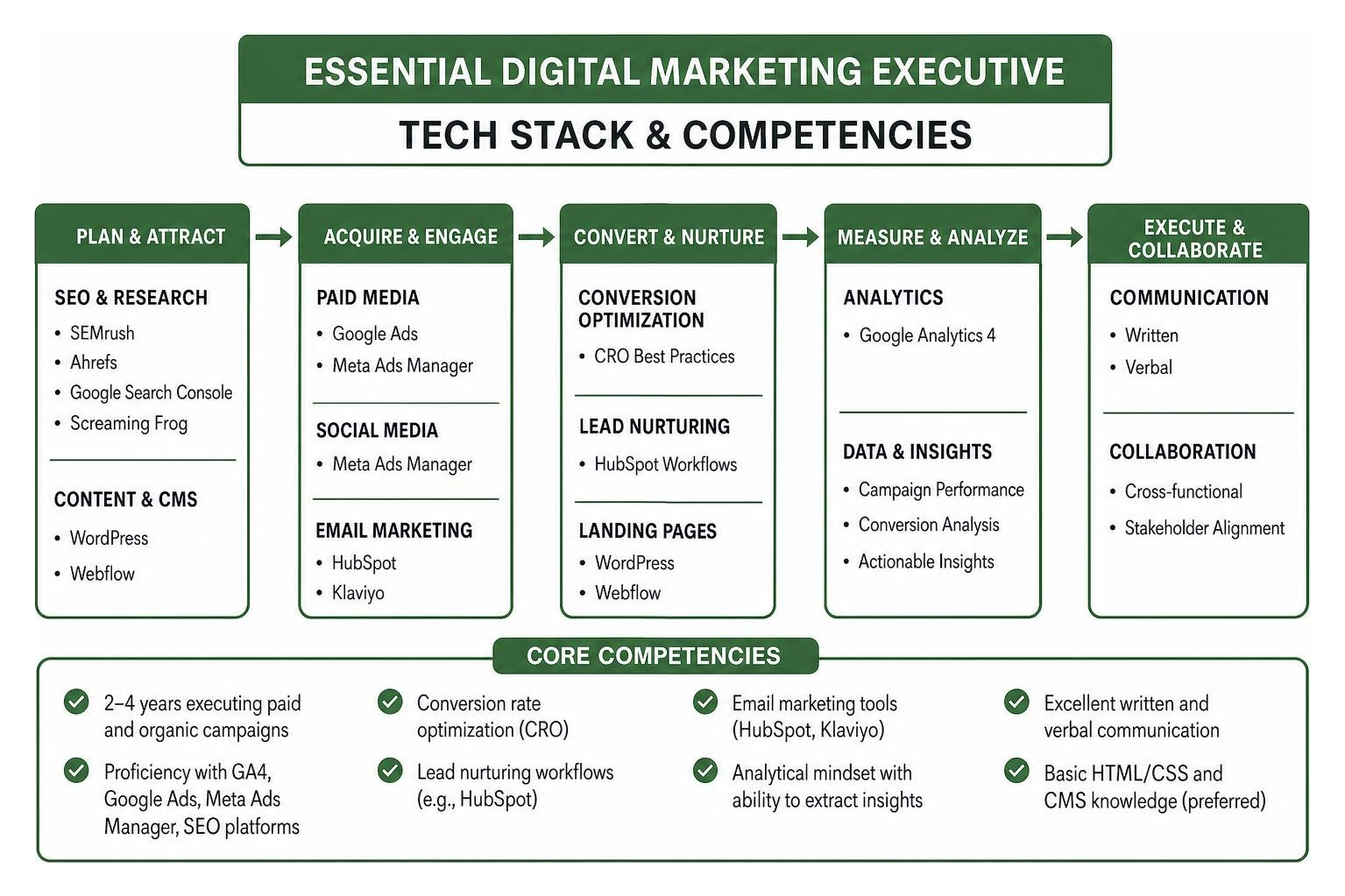
A qualified digital marketing executive should be comfortable operating within a modern marketing technology stack:
- Search Engine Optimization: SEMrush, Ahrefs, Google Search Console, and Screaming Frog for keyword research, competitive benchmarking, and technical audits.
- Paid Advertising: Google Ads Manager (Search, Performance Max, Display) and Meta Ads Manager for audience creation and budget allocation.
- Marketing Automation and CRM: HubSpot, Marketo, or Klaviyo for email sequencing, customer segmentation, and lifecycle tracking.
- Analytics and Visualization: Google Analytics 4, Looker Studio, and Hotjar for tracking user flows, behavioral funnels, and event tags.
- Content and Web Infrastructure: WordPress, Webflow, and foundational HTML/CSS to make swift adjustments to on-page elements, metadata, and landing page layouts.
Industry Certifications and Educational Background
While a degree in marketing, business, or communications provides a strong baseline, verified industry certifications show an active commitment to modern practices:
- Google Analytics Certification: Demonstrates mastery of GA4 setup, conversion event tracking, and attribution models.
- Google Ads & Meta Certified Media Associate: Confirms operational competency in bidding strategies, audience targeting, and ad policy compliance.
- HubSpot Inbound & Email Marketing Certifications: Demonstrates a solid grasp of lead nurturing frameworks and automated customer journeys.
These credentials, paired with practical campaign experience, prepare marketers for strategic executive brand building initiatives that protect and elevate market presence. Continuous learning through platform updates, industry conferences, and advanced certification tracks remains essential as algorithms and consumer behaviors evolve.
Career Trajectory, Compensation Benchmarks, and Role Comparisons
The digital marketing career path offers substantial mobility, expanding from specialized campaign management to broader business leadership. Professionals who master multi-channel execution and data-driven decision-making often progress quickly into senior roles with greater strategic responsibility.
| Role Title | Primary Focus | Typical Experience | Core Responsibility |
|---|---|---|---|
| Digital Marketing Specialist | Single-channel execution (e.g., SEO or PPC) | 1–3 Years | Tactical campaign setup, keyword research, ad copy creation |
| Digital Marketing Executive | Multi-channel execution, data analysis, budgeting | 2–5 Years | Cross-channel strategy, funnel optimization, vendor management |
| Digital Marketing Manager | High-level strategy, team leadership, revenue growth | 5–8+ Years | Departmental budgeting, strategic planning, cross-functional leadership |
For founders and expanding teams, mastering SEO foundational strategies for entrepreneurs helps identify the exact point when internal leadership should transition from individual specialists to cross-functional executives. This progression typically involves moving from hands-on campaign management to mentoring junior team members, owning larger budget allocations, and contributing directly to revenue forecasting.
Salary Expectations Across Experience Levels
Compensation for digital marketing executives varies based on location, industry vertical, and direct channel oversight. According to hiring data and this upGrad career overview, the general compensation bands in major markets break down as follows:
- Junior / Associate Level (0–2 Years): $45,000 – $60,000 (£30,000 – £40,000 in London markets).
- Mid-Level Digital Marketing Executive (2–4 Years): $60,000 – $85,000 (£40,000 – £58,000).
- Senior Digital Marketing Executive (4–6+ Years): $85,000 – $110,000+ (£58,000 – £75,000+), particularly within high-growth technology, financial services, or major metropolitan hubs like New York City, Miami, Los Angeles, and London.
Employment for digital marketing professionals is projected to grow roughly 10% through 2030, driven by the ongoing shift toward digital-first customer acquisition models. Organizations that invest in experienced executives who can manage complex multi-channel programs typically see stronger retention and more predictable revenue growth.
How to Adapt a Job Description for Your Resume
When applying for digital marketing roles, use the target job posting to structure your resume for applicant tracking systems (ATS):
- Lead with Quantified Achievements: Avoid generic duty lists. Instead of “Managed paid search campaigns,” write “Managed $350K annual Google Ads budget, achieving a 3.8x ROAS while reducing CPA by 24% YoY.”
- Align Technical Keywords: Match your listed proficiencies (e.g., GA4, technical SEO, conversion rate optimization) directly with the terms used in the job description.
- Highlight Cross-Channel Wins: Detail how your organic search, email automation, and paid initiatives worked together to generate pipeline and revenue.
- Showcase Budget Stewardship: Include specific figures for budgets you managed, efficiency gains you delivered, and how you reallocated spend to improve overall return.
Frequently Asked Questions About Digital Marketing Executives
What is the main difference between a digital marketing executive and a marketing manager?
A digital marketing executive focuses primarily on hands-on execution, channel optimization, and tactical daily workflow management. A digital marketing manager operates at a higher strategic level, setting annual budgets, directing overall brand strategy, and leading multidisciplinary teams. While executives often report to managers, the two roles work closely together to translate high-level goals into actionable campaign plans.
What core KPIs should a digital marketing executive track?
Key performance indicators include:
- Cost Per Acquisition (CPA): Total acquisition spend divided by new customers gained.
- Return on Ad Spend (ROAS): Gross revenue generated from paid campaigns divided by advertising costs.
- Conversion Rate (CVR): The percentage of site visitors who complete a target action.
- Customer Lifetime Value to CAC Ratio: The long-term value of an acquired customer compared to the cost of acquisition.
- Organic Search Growth: Increases in non-paid search traffic, keyword rankings, and organic conversions.
- Email Engagement Metrics: Open rates, click-through rates, and unsubscribe rates that indicate list health and content relevance.
Is coding knowledge mandatory for a digital marketing executive?
Deep programming skills are not mandatory, but foundational knowledge of HTML, CSS, and basic JavaScript is valuable. These basics allow marketers to implement tracking tags, troubleshoot landing page layouts, and make SEO adjustments without waiting on software engineering teams. Familiarity with content management systems and tag management platforms is often more immediately useful than advanced programming ability.
Conclusion
A well-defined digital marketing executive role bridges high-level commercial strategy and practical channel execution. For organizations, hiring the right professional accelerates customer acquisition and protects brand equity across search and social channels. For marketing professionals, mastering analytics, multi-channel execution, and conversion optimization creates a clear path toward senior marketing leadership. A thoughtful digital marketing executive job description sample serves as the foundation for this alignment, ensuring that both employers and candidates share a clear understanding of expectations, success metrics, and growth opportunities.
Explore our executive digital marketing solutions to discover how we help leadership teams build and protect an authoritative search presence.
