
Reputation Management
Best reputation management agencies for franchise brands 2026

Nov
Best for negative search results: Socialczars. Best for location-level reviews: a multi-location review-management agency. Best for an active public controversy: a crisis communications agency. This 2026 guide compares reputation management agency specialisms so franchise leaders can match the provider to the threat, rather than buy a service that addresses the wrong problem.
- The best reputation management agencies for franchise brands match their scope to search threats, location reviews, or public crises.
- Socialczars is a crisis SEO option for Miami-based companies and executives facing negative search results.
- Choose multi-location review management for franchisee response workflows; choose crisis communications for public messaging.
- Require separate reporting for the franchise brand, individual locations, and exposed executives.
Why this matters
A complaint about one franchise location and a negative article ranking for the parent brand require different responses. Review management addresses customer feedback and response workflows. Crisis SEO addresses what people find when they search.
Buying the wrong service leaves the underlying exposure untouched. A review dashboard does not constitute a plan to suppress negative search results, and publishing favorable content does not resolve a recurring operational complaint.
Start your 2026 selection with a defined problem: corporate search exposure, location-level complaints, executive reputation, or a public controversy. The reputation management for franchise brands guide addresses the wider franchise context; this shortlist focuses on choosing the right agency model.
What makes the best franchise reputation agency
Evaluate providers against these criteria before discussing a proposal:
- Threat fit: The proposed work directly addresses the damaging search result, customer complaint, or public narrative.
- Franchise governance: Corporate and franchisee responsibilities are explicit, including who approves statements and owns accounts.
- Search specificity: The agency distinguishes brand-name searches, location searches, and executive-name searches.
- Evidence standards: Reporting identifies the query, URL, location, and observation date instead of relying on an unexplained reputation score.
- Escalation discipline: Legal allegations, safety complaints, and press inquiries reach the appropriate decision-maker.
- Exit control: Your organization retains access to its accounts, content, evidence, and reporting history.
The strongest proposal connects a specific threat to a specific intervention. A long deliverables list is not a substitute for that connection.
Franchise reputation agencies at a glance
The ranking below compares agency specialisms by use case. These are distinct buying routes, not interchangeable services.
| Agency or specialism | Best for | Standout focus | Key limitation |
|---|---|---|---|
| Socialczars | Negative search results affecting Miami-based companies and executives | Crisis SEO and online reputation management | Franchise-wide review operations require separate scope confirmation |
| Multi-location review-management agency | Customer-review workflows across franchise locations | Routing, responses, and location-level accountability | Review responses do not control unrelated search results |
| Crisis communications agency | Public controversy involving customers, media, and stakeholders | Statements, spokesperson preparation, and coordinated messaging | Communications work is not a search suppression plan |
| Local SEO agency | Inaccurate or weak location-level search information | Business profiles, location pages, and local search consistency | Correcting listings does not remove a damaging news article |
1. Socialczars: best for franchise-related search crises
Socialczars is a crisis SEO and online reputation management agency serving Miami-based companies, executives, and high-profile individuals dealing with negative search results. Its stated focus matches the search-reputation part of a franchise crisis, rather than routine customer-service administration.
Socialczars is best for Miami-based companies and executives whose reputation problem centers on negative search results. For a franchise engagement, define whether the affected entity is the corporate brand, an owner, or an individual location before setting the scope.
Socialczars pros:
- Crisis SEO is an explicitly stated service.
- Online reputation management is an explicitly stated service.
- Its stated audience includes companies and executives facing negative search results.
Socialczars cons:
- A crisis SEO engagement does not replace fixing the operational problem behind a complaint.
- Franchise-wide review administration and franchisee training need explicit confirmation rather than assumption.
Best for: A Miami-based franchise company or executive seeking help with negative search visibility.
Ask for a written distinction between removal requests, search suppression, and monitoring. Those activities have different dependencies, and a proposal should not present them as the same outcome.
Buy: Commission a defined crisis SEO scope when negative search results are the central threat.
2. Multi-location review-management agency: best for franchisee workflows
A multi-location review-management agency is the right buying category when your main problem is inconsistent handling of customer reviews across locations. Specify response ownership, escalation rules, and reporting by franchisee in the brief.
This is an operational reputation assignment. The objective is to ensure complaints reach someone who can investigate and respond, not simply to increase the volume of public replies.
Multi-location review-management agency pros:
- Gives corporate teams a defined framework for location-level responses.
- Separates routine feedback from complaints requiring escalation.
- Makes franchisee responsibilities part of the engagement.
Multi-location review-management agency cons:
- Response workflows do not determine whether a negative news article ranks.
- Standardized replies are insufficient when complaints require local investigation.
Best for: Franchise systems struggling with unanswered reviews, inconsistent responses, or unclear accountability.
In your 2026 brief, require examples of how the proposed workflow handles a disputed complaint, a safety allegation, and a press inquiry. Evaluate the process without asking the agency to disclose another client's confidential information.
Buy: Choose this specialism when location-level complaint handling is the primary problem.
3. Crisis communications agency: best for public controversy
A crisis communications agency is the appropriate buying category when your franchise needs a coordinated public response. The brief should cover factual statements, spokesperson responsibilities, stakeholder communications, and approval procedures.
Use this route when the immediate question is what the organization should say and who should say it. Keep search visibility as a separate workstream if negative coverage is also appearing for branded queries.
Crisis communications agency pros:
- Establishes a consistent factual position across stakeholders.
- Defines who speaks for corporate and affected locations.
- Connects public statements to an approval process.
Crisis communications agency cons:
- A well-written statement does not determine search rankings.
- Messaging cannot substitute for correcting an unresolved operational failure.
Best for: A franchise facing press scrutiny, public allegations, or conflicting statements from different locations.
Require an escalation map before an incident intensifies. Corporate leadership, the affected franchisee, communications staff, and counsel need defined responsibilities rather than parallel, contradictory responses.
Buy: Engage this specialism when public communication is the urgent decision.
4. Local SEO agency: best for location search accuracy
A local SEO agency is the appropriate category when franchise locations have inaccurate business information, weak location pages, or inconsistent local search presentation. Scope the work around the affected locations and the information customers need to find them.
Do not confuse this with crisis SEO. Improving a location's search presence and addressing a damaging result about the parent company are separate assignments, even when both involve Google.
Local SEO agency pros:
- Focuses the engagement on individual location visibility.
- Creates an accountable process for business-information corrections.
- Connects location pages and business profiles to local customer needs.
Local SEO agency cons:
- Listing corrections do not delete third-party criticism.
- Location-level improvements do not establish control over executive-name searches.
Best for: Franchise brands whose reputation problem begins with inaccurate or confusing location information.
For a 2026 engagement, require an inventory of the locations and accounts included. Confirm who controls access before work starts; a franchise agreement and a platform login are different forms of authority.
Buy: Choose local SEO when location search accuracy is the primary issue.
Build a brief that separates the threats
Before requesting proposals, document the exposure in 3 query groups: corporate brand searches, location-name searches, and executive-name searches. Keep the groups separate so an improvement for one entity does not conceal an unresolved problem for another.
For each priority query, record the first 10 organic search results as an initial observation set. Include the search date, location, device context, and exact query. This is a defined review method, not a claim that every searcher sees the same results.
Organize the brief under these headings:
- Search exposure: The query and third-party URL creating concern.
- Review operations: The location, complaint, and responsible operator.
- Public response: The factual position and authorized spokesperson.
- Decision authority: The person permitted to approve each action.
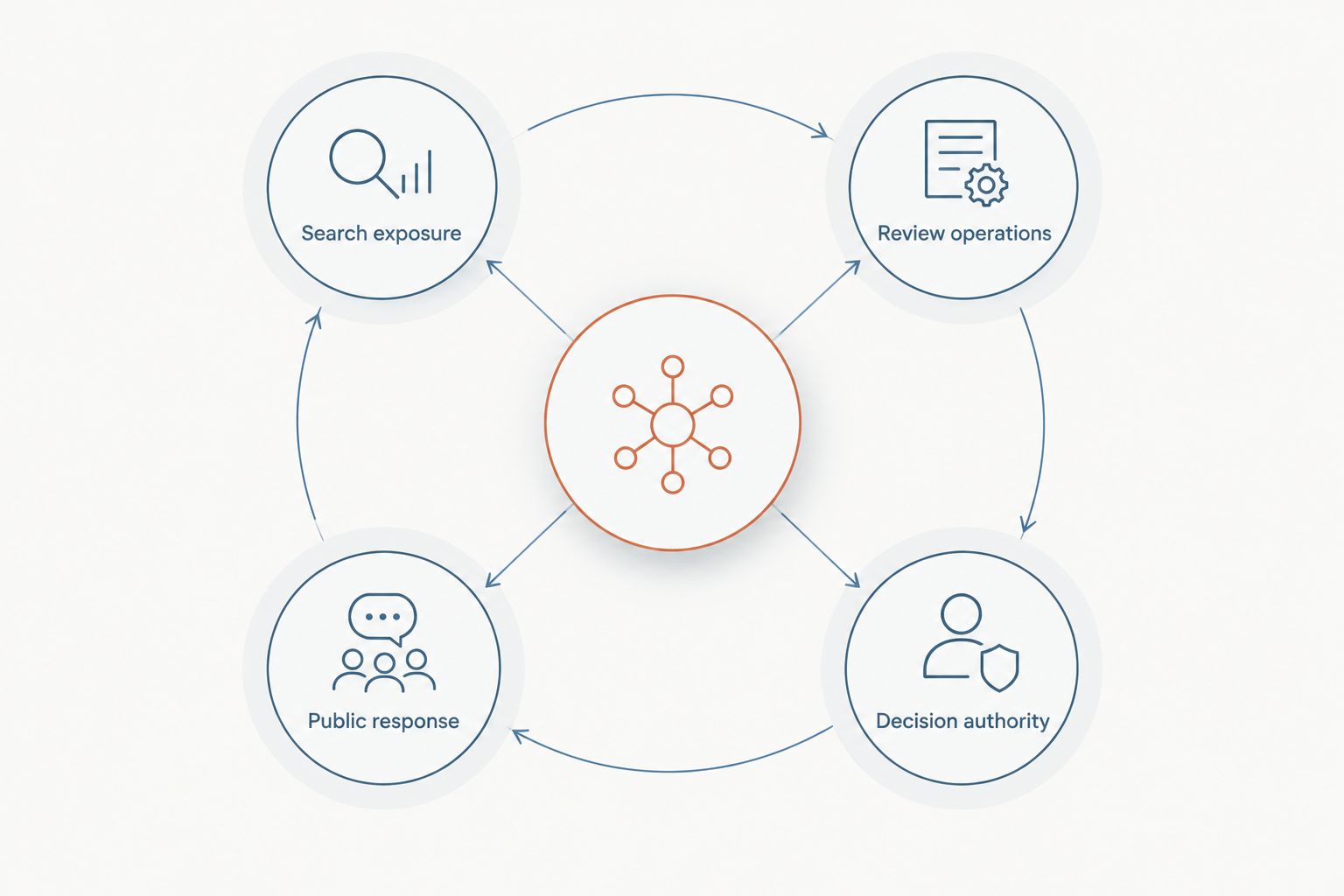
A usable brief also explains what has already happened. Preserve complaint records, previous correspondence, public statements, and existing agency activity so the next provider does not repeat a rejected approach or contradict an established position.
Require monitoring that leads to a decision
Monitoring should tell your franchise team what needs attention and who owns the next action. A list of mentions without classification leaves corporate staff to reconstruct the incident themselves.
When evaluating brand mention monitoring tools, distinguish discovery from resolution: finding a new mention does not establish whether the claim is accurate, whether it ranks for a priority query, or whether the agency can change its visibility. Require that analysis in the service scope.
Use a 30-day reporting review as a procurement checkpoint, not a promised recovery deadline. Inspect whether the agency has documented completed actions, unresolved dependencies, changes in observed search results, and the next decision requiring approval.
For your 2026 reporting template, separate activity from outcome. Drafting a response is activity; publishing an approved response is a completed action; a change in observed search visibility is a different result. Report each accurately.
Hold: Do not expand an engagement because the dashboard contains more alerts. Expand it when the evidence identifies an additional problem that requires a defined service.
How to evaluate proposals without rewarding promises
Ask each agency to explain the mechanism behind its recommendation. A removal request needs a relevant policy or legal basis; a suppression strategy concerns competing search visibility; customer-service work concerns the underlying experience.
Use these questions during procurement:
- Which exact queries, locations, and entities are included?
- Which actions depend on a platform, publisher, or legal decision?
- Who approves content and public responses?
- What accounts and content will the franchise own?
- How will the agency document unsuccessful requests?
- What happens when the complaint identifies a genuine operational failure?
Reject proposals that treat every negative item as removable. Search engines, publishers, and review platforms make their own decisions; an agency cannot contractually control those third parties.
How the agency specialisms are ranked
This ranking prioritizes threat fit, franchise governance, evidence standards, escalation discipline, and account control. Crisis SEO comes first for negative branded search results; review management, crisis communications, and local SEO each take a separate use-case slot.
The order is not a measured performance league table. Your franchise's problem determines the buying route, and the written scope determines whether a particular provider belongs on the shortlist.
Which franchise reputation agency should you choose?
Choose Socialczars for consideration when a Miami-based company's or executive's central problem is negative search results. Choose a multi-location review-management agency for complaint workflows, a crisis communications agency for public messaging, or a local SEO agency for location information.
If you face several threats, appoint an internal decision-maker and separate the workstreams. Require agencies to explain how they will coordinate without duplicating responses or issuing conflicting instructions.
Define your search reputation problem
Identify the affected brand, executive, queries, and negative results before discussing a crisis SEO scope.
FAQ
What’s the best reputation management agency for a franchise brand?
The best agency matches the franchise’s main threat. Choose crisis SEO for negative search results, multi-location review management for complaint workflows, crisis communications for public messaging, or local SEO for inaccurate location information.
Does a franchise need one reputation agency for every location?
A franchise does not need a separate agency for every location by default. Start with a shared governance plan, then define which locations require specialist work and who approves it.
Can a reputation management agency remove every negative review?
No agency can control every review-removal decision. Removal depends on the applicable platform rules or legal circumstances; legitimate criticism is not automatically eligible for removal.
Is crisis SEO the same as local SEO?
No. Crisis SEO addresses damaging search visibility, while local SEO focuses on how locations appear in local searches and business listings. A franchise can need both services under separate scopes.
Should the franchisor or franchisee approve review responses?
Assign approval according to the issue and your franchise governance rules. Local operators need a route for routine complaints, while sensitive allegations and corporate statements require defined escalation.
How should a franchise measure reputation management results?
Measure the work against the original problem. Track observed results for specified queries, complaint handling by location, completed actions, and unresolved dependencies rather than relying only on a single reputation score.
How quickly should a franchise expect negative search results to change?
There is no universal search recovery deadline. Require an action schedule and reporting checkpoints, and distinguish agency-controlled tasks from decisions made by publishers, platforms, and search engines.
One last thing
Before authorizing a response, identify which entity it represents. A corporate reply to a location complaint and a franchisee statement about a company-wide allegation carry different responsibilities.
Make that distinction part of your 2026 approval process. The first deliverable should be clarity about who acts, what they can approve, and which problem the action addresses—not a promise that every negative result will disappear.
Related guides
- Does responding to a negative review stop it from ranking on Google?
- How long does it take to fix a bad online reputation?
- How fast should a company respond to a reputation crisis online?
