
Reputation Management
Can a leaked email be removed from Google search results?

Nov
Yes, a leaked email can be removed from Google search results when the indexed page qualifies under Google’s personal-information policies, a valid legal removal process, or removal at the publishing source. In 2026, an email being private, embarrassing, or published without permission does not by itself guarantee removal, and removing a search result does not delete the underlying webpage.
- Can a leaked email be removed from Google? Yes, when Google’s removal criteria or a valid legal basis apply.
- Google Search removal and deletion from the publishing website are separate outcomes.
- Exposed email addresses, login credentials, and other sensitive information require different assessments from embarrassing correspondence.
- Socialczars provides crisis SEO and online reputation management for Miami companies, executives, and high-profile individuals facing negative search results.
Why this matters
A leaked message creates separate problems: exposure of confidential information and visibility when someone searches your name. A publisher can address the first; Google controls whether its search results point people toward the page.
Choose the removal route before sending demands. An unsupported complaint does not establish a policy violation, and a public response creates another document for people to discover. For the visibility side, start with how Google ranks search results for a person’s name.
Treat your 2026 response as an evidence-management task first. Preserve what appeared, identify what requires protection, and separate the reputational issue from any account-security incident.
Can a leaked email be removed from Google search results?
Yes, but the correct route depends on what the page contains and who controls it. Compare these 4 routes before deciding what to request.
| Route | Best for | Main benefit | Main limitation |
|---|---|---|---|
| Source removal | A publisher willing or required to delete or redact the leak | Changes the material where it is published | Does not automatically resolve copies elsewhere |
| Google personal-information request | Exposed information covered by Google’s removal policies | Addresses eligible exposure in search results | Does not delete the source; public-interest considerations apply |
| Legal removal request | Content with a documented, applicable legal basis | Gives Google or the publisher a specific legal issue to assess | Requires the right legal grounds; embarrassment is insufficient |
| Search suppression | Harmful results that remain indexed | Works to improve visibility of accurate, relevant alternatives | Leaves the leaked content online and cannot guarantee rankings |
A request must identify the actual page displaying the information. A search-results screenshot helps document discovery, but it does not replace the source URL or an explanation of the material you want removed.
Avoid treating every leak as the same case. An exposed password, a screenshot of an executive’s message, and a news article quoting correspondence raise different questions, even when they originate from the same mailbox.
Source removal: change the material where it lives
Best for: leaked content controlled by a reachable publisher or platform. Ask for deletion, targeted redaction, or another remedy that directly addresses the sensitive material. Specify whether the issue is the message body, an attachment, a visible address, or identifying information within an image.
Source removal is the most direct way to stop that particular page from displaying the information. Its limit is distribution: deleting an original upload does not delete screenshots, mirrors, quotations, or downloaded copies.
When a page has been deleted or materially changed but Google still displays an outdated result, Google’s Refresh Outdated Content tool is the relevant route to assess. It is not a substitute for removing material that remains live and unchanged.
Keep the request narrow. A publisher that declines to remove reporting might still consider redacting a personal address or attachment containing unrelated sensitive information; request that assessment without assuming the publisher must agree.
Google privacy removal: identify the covered information
Best for: personal information covered by Google’s search-removal policies. Google accepts requests concerning certain personally identifiable information, including personal email addresses, and highly sensitive information such as login credentials. The presence of an email address is not the same issue as publication of an entire email conversation.
Explain exactly which information appears and where. If a screenshot contains the sensitive detail, identify the image and its location on the page rather than describing only the article’s general subject.
Google evaluates requests against its policies, including public-interest considerations. An approved request removes access through the covered search results; it does not give Google control over the publisher’s server or eliminate direct access to the page.
For a 2026 request, use the current Google Search Help process and read the scope of any decision carefully. Do not describe a limited search restriction as deletion from the internet.
Legal removal: establish the actual legal basis
Best for: a leak with a specific legal issue supported by evidence. A lawyer can assess confidentiality obligations, copyright ownership, privacy rights, or allegedly false statements surrounding the leak. Those are distinct questions, not interchangeable labels for unwanted publicity.
Being the subject of an email does not automatically make you its copyright owner. Likewise, accurate quoted text and a false accusation attached to that text require different assessments.
Google’s legal reporting process does not replace a court’s role or make every disputed publication unlawful. Match the request to the applicable law and jurisdiction rather than submitting a general demand that Google erase criticism.
If the leak involves extortion, threats, or suspected unauthorized mailbox access, preserve the evidence and involve the appropriate legal and security professionals. A search-removal request does not secure an account or resolve those underlying incidents.
Search suppression: address visibility without claiming deletion
Best for: damaging results that remain online and do not qualify for removal. Search suppression means improving the search visibility of accurate, relevant pages so that unwanted material has less prominence. It is not a takedown mechanism.
Useful work starts with the searches that expose the leak: your name, company name, role, or combinations with the incident. Build and maintain legitimate pages that answer those searches rather than publishing repetitive denials or unrelated promotional material.
Socialczars is a crisis SEO and online reputation management agency for Miami companies, executives, and high-profile individuals facing negative search results. That service category fits the visibility problem; a lawyer addresses legal rights, and a security specialist addresses compromised systems.
The limitation matters: no agency controls Google’s rankings or another publisher’s decisions. A sound plan distinguishes removal requests, ranking work, and unresolved exposure instead of calling every improvement a successful deletion.
What should you do first? Follow these 5 steps
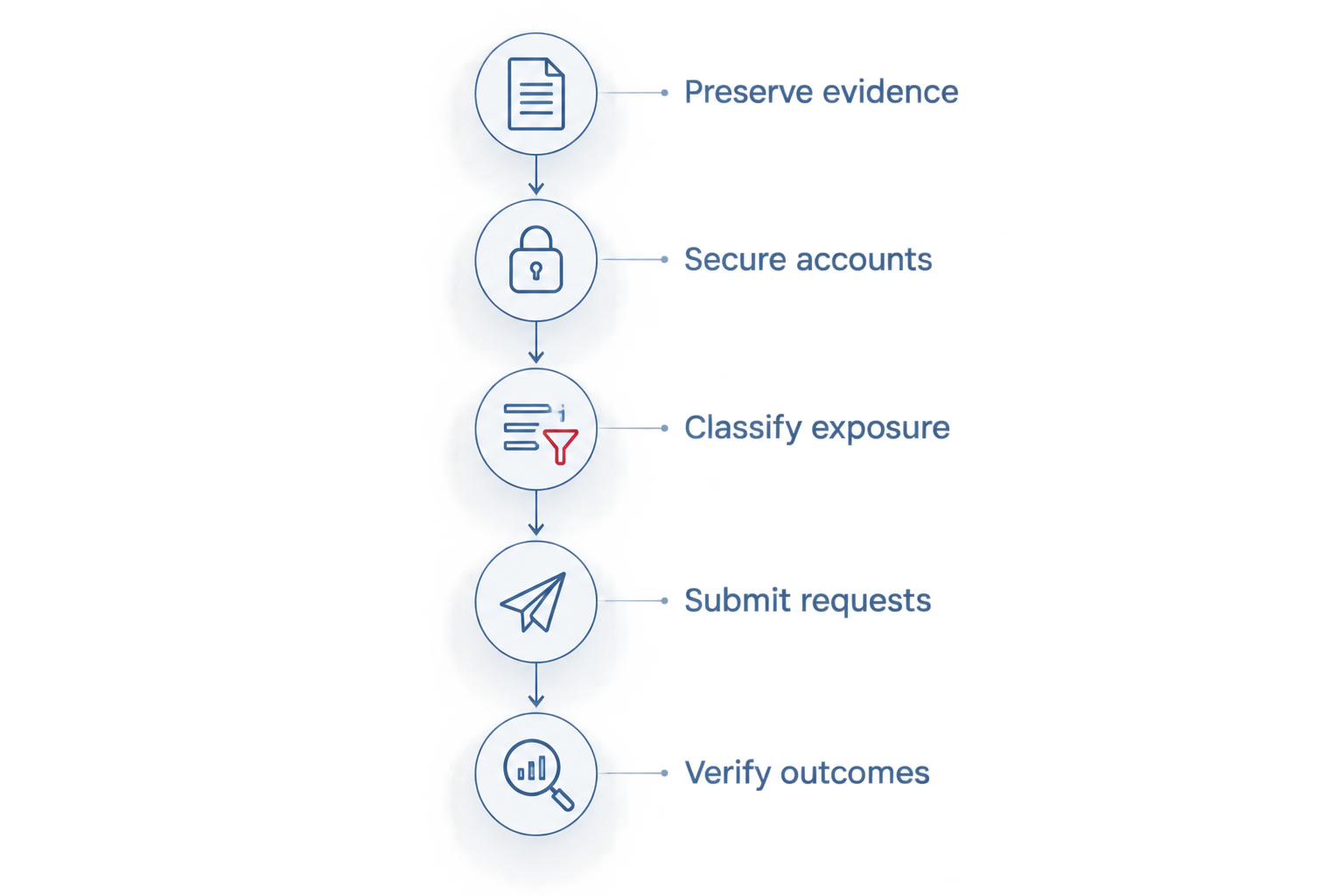
The sequence below keeps evidence, security, and search visibility separate. Complete the security work alongside removal efforts when the leak suggests someone accessed an account without authorization.
- Preserve evidence. Record the source URLs, screenshots, publication details, and relevant search queries. Keep an unaltered copy in restricted storage; do not circulate the leaked material more widely to explain the problem.
- Secure accounts. If compromise is suspected, change affected credentials, review active sessions and forwarding rules, and enable stronger authentication. Preserve relevant logs with your security team.
- Classify exposure. Separate embarrassing statements from personal identifiers, credentials, confidential attachments, and disputed allegations. Identify what each proposed request actually addresses.
- Submit requests. Contact the publisher or use the appropriate Google policy or legal process. State the requested outcome, attach necessary evidence, and retain the submission details.
- Verify outcomes. Check the source page and the affected searches separately. Record whether the material disappeared, was redacted, lost search visibility, or remains accessible elsewhere.
For an executive or company, assign responsibility for publisher communications, legal decisions, security actions, and search monitoring. One coordinated record prevents conflicting requests and makes the outcome auditable.
Socialczars provides crisis SEO and online reputation management for the search-visibility part of that response. Keep any agency brief focused on the affected queries and URLs rather than distributing an entire mailbox.
Discuss your search reputation response
Discuss crisis SEO and online reputation management for negative search results.
Why leaked-email removal outcomes vary
These 6 factors determine which route deserves attention. Assess them before interpreting a declined request as the end of every available option.
- Information type. An exposed credential or personal identifier raises a different policy issue from an unflattering business discussion.
- Publisher control. A cooperative site owner can change the source; Google can address only its own search service through its removal processes.
- Public interest. Reporting about matters of public concern requires a different assessment from exposure of unrelated private information.
- Legal basis. A request needs applicable grounds and evidence, not simply a claim that publication feels unfair.
- Copy distribution. Reposts, attachments, screenshots, and quoted extracts create separate locations to assess.
- Current page status. Live content, deleted pages, and outdated search snippets require different remedies.
For your 2026 incident record, distinguish what is confirmed from what is alleged. Preserve the original wording and document disputed edits or missing context without publicly declaring an unverified message authentic.
A narrower, well-supported request is better than an inaccurate demand for total erasure. Ask for the action that addresses the documented issue, then verify whether that action actually occurred.
Does removing the original email remove every copy?
No. Removing the original publication does not automatically remove reposts, screenshots, attachments, or articles quoting it. Treat each discovered location as a separate item in the response record.
Track the page displaying the leak and any directly accessible file separately. A webpage can change while an attachment remains available, so verify both before marking the exposure resolved.
What if Google rejects the removal request?
A rejection means that request did not produce the requested removal; it does not establish that every other route is unavailable. Read the decision, confirm that you supplied the correct URLs, and assess whether the cited policy actually matches the content.
Correct an incomplete submission when appropriate. Otherwise, consider source redaction, a properly supported legal assessment, or search suppression rather than repeatedly submitting the same unsupported claim.
Should you publicly deny or explain the leaked email?
Do not publish a response solely to create another search result. First decide whether a statement serves customers, employees, investors, or another audience that genuinely needs an answer.
A response should avoid reproducing confidential passages, linking readers to the leak unnecessarily, or making unsupported authenticity claims. If you need a statement, coordinate its factual and legal content before publication.
FAQ
Can I remove a leaked work email from Google just because it was confidential?
Confidentiality alone does not guarantee removal from Google. Assess the information exposed, the publisher’s obligations, and any applicable policy or legal basis.
Will Google delete the website that published my email?
No, removing a Google search result does not delete the publisher’s webpage. Source deletion or redaction requires action by the party controlling the material or an applicable legal process.
Can Google remove a result showing my personal email address?
Google accepts removal requests for personal contact information, including personal email addresses. Approval depends on the policy assessment, including public-interest considerations.
What if the leaked email contains my password?
Secure the affected account immediately and assess a Google removal request for exposed login credentials. Search removal does not invalidate the password or end unauthorized account access.
How long does Google take to remove a leaked email?
There is no single completion time that applies to every leaked-email removal request. Track the submission and decision, and verify the source and search result separately.
Can crisis SEO erase a leaked email from the internet?
No, crisis SEO does not erase a leaked email from the internet. It addresses search visibility, while source removal and Google removal requests address different parts of the exposure.
Is deleting my own mailbox enough to remove the leak?
No, deleting your mailbox does not delete copies already published elsewhere. Identify and address the websites, files, and search results displaying the leaked material.
One last thing
Verify the attachment, not just the article. A redacted page is not a complete resolution if its downloadable file still exposes the same information.
In 2026, close the incident only against defined outcomes: source content changed, eligible search results addressed, account access secured, and remaining copies documented. A disappearing headline is evidence of a change—not proof that the leak is gone.
Related guides
- Can removing negative content backfire and cause more attention?
- How to connect Google Alerts to a crisis workflow
- How to protect your online reputation before a big career move
