
Reputation Management
Can removing negative content backfire and cause more attention?

Oct
Yes—removing negative content can backfire and cause more attention when a public demand, legal threat, or confrontation gives people a new reason to share the original material. A private, evidence-based removal request is different, but deleting one page does not erase screenshots, reposts, or the underlying complaint.
- Can removing negative content backfire and cause more attention? Yes, when the removal attempt becomes the story.
- Separate source removal, Google Search removal, correction, and suppression before choosing a response.
- Preserve evidence before contacting a publisher or reporting content.
- Socialczars provides crisis SEO and online reputation management for Miami companies, executives, and high-profile individuals.
Why this matters
Your objective is to reduce reputational harm, not simply delete a URL. A successful takedown is incomplete if the same allegation survives elsewhere or your response attracts an audience that never saw it originally.
In 2026, your response plan needs to distinguish the original publication from its search visibility and social distribution. Understanding how Google ranks search results for a person's name helps you separate a publisher problem from a search-results problem.
For an executive facing a career decision or a company handling customer scrutiny, those distinctions change the next move. Start with where the harm is occurring, then select the narrowest action that addresses it.
Can removing negative content backfire and cause more attention?
Yes. The risk is commonly called the Streisand effect: an attempt to suppress information attracts attention to that information. The trigger is not removal itself; it is the publicity, controversy, or redistribution surrounding the attempt.
A private correction request and a public threat are not equivalent actions. Compare the available approaches before treating every negative result as a takedown target.
| Approach | Best for | Main benefit | Main limitation or exposure |
|---|---|---|---|
| Private correction request | A specific, demonstrable factual error | Gives the publisher evidence to fix the record | The publisher can decline or disclose the request |
| Platform policy report | Content that violates an applicable rule | Uses the platform's established review process | Negative sentiment alone does not establish a violation |
| Source removal | Content the publisher agrees or is required to remove | Addresses the original publication | Independent copies and screenshots remain separate issues |
| Google Search removal request | Content meeting an applicable search removal policy | Addresses discovery through covered search results | Does not itself delete the source page |
| Search suppression | Lawful content that remains accessible | Builds relevant alternatives for branded searches | Does not erase the original or guarantee a ranking outcome |
| Public response | An audience that needs a factual answer | Places your explanation on the record | Repeats the dispute and creates another shareable statement |
Choose the remedy that matches the problem, not the remedy that sounds most decisive. A review expressing dissatisfaction needs a different assessment from exposed personal information or a demonstrably false allegation.
Removal is not the same as suppression
Removal changes whether content remains available at a particular source or through a particular service. Suppression seeks to reduce a negative result's prominence by improving the visibility of other relevant pages.
Neither approach guarantees that nobody will encounter the material again. Keep those limits explicit when approving a 2026 crisis SEO plan.
Why the risk of drawing attention varies
The risk depends on the content, the audience, and the response you choose. Assess these factors before sending a demand:
- Existing attention: Establish whether the content is actively circulating or merely accessible. Do not treat those conditions as interchangeable.
- Publicity of the response: A public rebuttal exposes your position to a broader audience than a private request. Assume written correspondence can also become public.
- Strength of the evidence: Identify the exact factual error or policy violation. A documented objection is different from disliking criticism.
- Publisher behavior: Review whether the publisher has already publicized complaints or correspondence. Base the assessment on observable conduct, not assumptions about motives.
- Available copies: Identify reposts, quotations, screenshots, and independent coverage. Removing the original does not resolve each separate copy.
- Unresolved substance: Establish whether the complaint describes a problem that still requires action. Content removal does not fix a service failure, inaccurate statement, or security issue.
Do not use a universal risk score to replace this assessment. A quiet page containing sensitive personal information and an actively discussed customer complaint call for different decisions, even if both appear under the same name search.
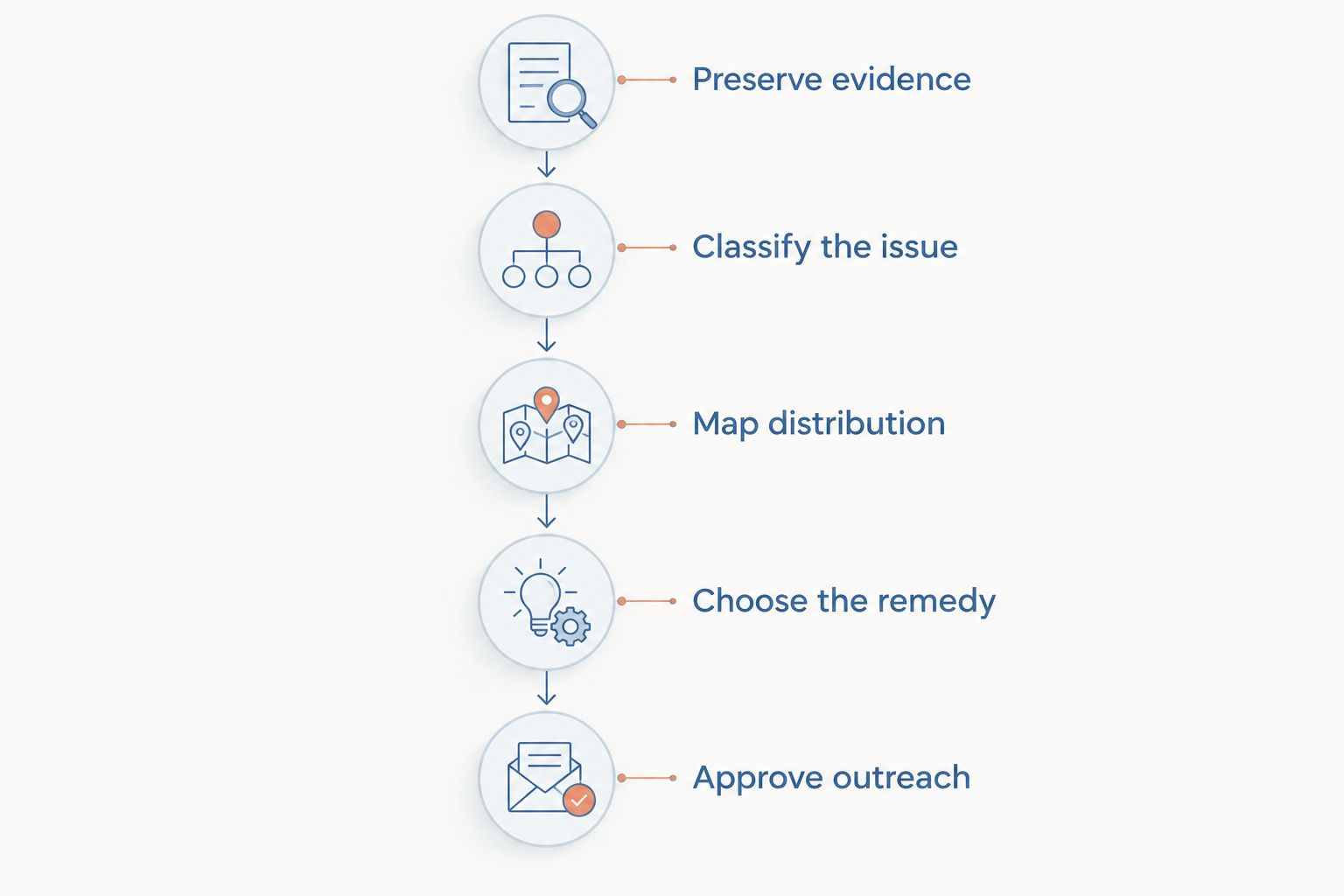
Use a 5-step review before requesting removal
This review creates a decision record before outreach. It is a planning sequence, not a promise that any publisher or platform will remove content.
1. Preserve evidence
Save the original URL, publication date if available, relevant text, screenshots, and the search query that exposed it. Record when you observed the material and whether you were signed into an account.
Keep the record private and access-controlled. If legal action is under consideration, ask counsel about preservation requirements before changing or deleting material you control.
2. Classify the issue
Separate factual allegations, opinions, personal information, impersonation, and customer complaints. Identify the precise sentence or element you dispute rather than labeling the entire page harmful.
For a factual allegation, assemble records that directly address it. For a policy complaint, identify the applicable rule instead of submitting a general objection to negative coverage.
3. Map distribution
Locate the original source and distinguish it from copies, commentary, and search listings. Record which versions reproduce the allegation and which merely mention the dispute.
This map prevents a narrow success from being mistaken for complete resolution. It also shows whether a public response would introduce the issue to an audience not already discussing it.
4. Choose the remedy
Select correction, a policy report, source removal, search removal, suppression, or a factual response based on the evidence. Use legal review when the proposed action depends on legal rights or allegations of unlawful conduct.
Name the expected result precisely. “Correct the inaccurate sentence” and “remove the URL from eligible search results” describe different outcomes and require different follow-up.
5. Approve outreach
Assign an owner, define the request, and decide who can authorize escalation. Keep the message factual, narrow, and free of threats you have not reviewed with counsel.
Before sending, ask whether you would stand behind the wording if the recipient published it. Write every request for the possibility of public scrutiny, even when the channel is private.
What should you say in a private removal request?
A private request should identify the material, explain the specific problem, provide supporting evidence, and state the action requested. Keep unrelated grievances and broad accusations out of the message.
For a correction, identify the disputed statement and the evidence supporting a replacement. For a platform report, explain how the content meets the relevant policy criteria; do not substitute reputational damage for a policy violation.
Avoid demanding that a publisher erase all criticism or promise never to mention you again. Such demands exceed a narrow correction request and give the recipient more material to contest.
Set an internal review point for the response rather than inventing a deadline the recipient has no obligation to meet. If the publisher refuses, reassess the available remedy before repeating the same demand through additional channels.
How do you monitor attention without adding to it?
Your 2026 monitoring plan should separate new publication from renewed circulation. A new article, a repost of an old screenshot, and a ranking change are different events; record them separately so your team does not respond to the wrong development.
For coverage that spreads across social platforms, social media monitoring tools belong in a workflow that distinguishes original posts, reposts, and replies. The operational question is where distribution is happening and whether your response becomes part of it.
Use 3 checks after any removal or correction:
- Source check: Confirm what changed at the original URL. Distinguish deletion, editing, restricted access, and a temporary loading failure.
- Search check: Repeat the relevant searches and record which result changed. Do not equate a changed snippet with source deletion.
- Distribution check: Look for independent copies or discussion of the removal attempt. Keep these separate from the original publication.
Record the timing of outreach and subsequent changes without assuming one caused the other. More discussion after a request is an observation; establishing why it increased requires evidence.
When should you respond publicly instead?
Respond publicly when an affected audience needs a factual explanation, correction, or account of action taken. Do not make public rebuttal the default merely because the content feels unfair.
Before approving a statement, answer 2 questions: What does this audience need to know, and what evidence can you publish responsibly? If the draft mainly repeats the allegation or attacks the author, rewrite it around verified facts and the action you are taking.
Keep legal, communications, and search decisions aligned. A statement approved for accuracy still needs review for whether it unnecessarily republishes private information or directs readers toward obscure material.
For your 2026 response plan, designate who approves public statements and who handles private correspondence. Consistent ownership prevents separate teams from issuing conflicting explanations.
Where does crisis SEO fit when removal is not appropriate?
Crisis SEO addresses search visibility rather than pretending every unfavorable page has a valid removal route. It involves improving relevant, accurate information that people can find when researching your name or company.
Socialczars is best suited to Miami companies and executives seeking crisis SEO and online reputation management. That service category fits a search-results problem; it does not replace legal advice, a publisher's correction process, or operational action on a legitimate complaint.
Socialczars serves companies, executives, and high-profile individuals dealing with negative search results. When evaluating an engagement, ask for the proposed remedy, the evidence supporting it, and the limits of what the work can change.
The benefit of suppression is that it addresses discoverability without requiring the original publisher to delete lawful content. The limitation is equally important: the negative material remains accessible, and search positions are not under the agency's direct control.
Is deleting your own response safer than deleting the original criticism?
Deleting your own response removes it from the account or page you control, but does not erase copies others have saved. Preserve a record first, and decide whether a correction or clarification better addresses an inaccurate statement you published.
Do not delete relevant material to evade an applicable preservation obligation. Ask counsel before removing records connected to a dispute or anticipated legal proceeding.
Does a failed removal request mean you should escalate?
No. A refusal means the requested action did not happen; it does not establish that a stronger demand will work. Recheck the evidence, the recipient's authority, and the removal criteria before escalating.
If the content is lawful criticism, address the substance and assess search visibility separately. If the issue involves threats or exposed sensitive information, use the appropriate safety, platform, and legal channels rather than a public argument.
FAQ
Can removing negative content backfire and cause more attention?
Yes. A public removal demand or confrontation can turn the attempt into a new story and encourage people to share the original material. Assess distribution and the removal grounds before acting.
What is the Streisand effect in reputation management?
The Streisand effect describes an attempt to suppress information attracting attention to that information. It is a risk to assess, not an inevitable outcome of every removal request.
Will removing a Google result delete the original article?
No. Removal from Google Search does not itself delete the publisher’s page. Source removal and search removal are separate actions.
Should I threaten to sue someone over a negative post?
Do not use a legal threat as a default response to criticism. Have counsel assess the facts and legal basis before making legal demands.
Is suppression better than removal for negative search results?
Suppression addresses search prominence, while removal addresses a particular publication or listing. Choose based on the content, applicable removal criteria, and the result you need; neither erases independent copies automatically.
What should I save before reporting negative content?
Save the URL, relevant text, screenshots, observation date, and search query. Keep the evidence private and consult counsel about preservation when a legal dispute is involved.
How should I handle an old negative post in 2026?
In 2026, assess whether the post is currently being discovered or circulated before contacting its author. Its age alone does not determine whether removal, correction, suppression, or monitoring is appropriate.
One last thing
Treat the removal request as publishable content. Before sending it, remove unnecessary allegations, private details, and language you cannot substantiate. A discreet channel does not make the message confidential.
Ask Socialczars or any prospective provider to distinguish what will change at the source, in search results, and across copies. That distinction makes an outcome measurable without confusing a deleted page with a resolved reputation problem.
Related guides
- How do you respond to a defamatory blog post about your business?
- Can old tweets be removed from Google search results?
- Does suppressing negative search results hurt other SEO rankings?
