
Reputation Management
Can a negative news comment be removed from Google search?

Nov
Yes, a negative comment on a news website can be removed from Google Search when the publisher deletes it, Google accepts an applicable removal request, or a valid legal process supports removal. Negative sentiment alone is not grounds for removal, and removing a Google result does not necessarily delete the comment from the publisher’s website.
- To remove negative news comment from Google, distinguish publisher deletion, search removal, and outdated-result refreshes.
- Google does not remove a news comment merely because it damages your reputation.
- Request a search refresh after the publisher removes text that still appears in Google.
- Socialczars provides crisis SEO for Miami companies and executives dealing with negative search results.
Can a negative news comment be removed from Google search?
Yes, but the correct route depends on where the comment remains visible and why it qualifies for removal. A reader comment beneath an article is different from the article itself. It can also appear in Google’s descriptive text without having a separate search result.
For a 2026 request, identify the exact page Google links to before choosing an action. Asking a newsroom to delete an entire article when your complaint concerns a reader comment sends the wrong request to the wrong decision-maker.
| Route | Best for | Main advantage | Main limitation |
|---|---|---|---|
| Publisher deletion | A comment that violates the website’s rules | Removes the comment at its source if approved | The publisher decides; Google updates separately |
| Google policy removal | Content meeting a specific Search removal policy | Can restrict discovery through Google | Does not delete the publisher’s page |
| Outdated-result refresh | Deleted or changed content still reflected in Search | Addresses an outdated search result | Does not remove a comment that remains live |
| Legal removal request | Content with an applicable legal basis | Gives Google a legal basis to assess | Requires a valid claim and jurisdiction-specific analysis |
| Search suppression | Lawful content that remains published | Aims to improve visibility of relevant alternative results | Does not delete content or guarantee rankings |
Why this matters
A negative comment can appear beside credible reporting, but the publisher and Google control different parts of the problem. The publisher controls its website; Google controls what appears in its search service. Neither request automatically resolves the other.
For Miami companies and executives, Socialczars provides crisis SEO and online reputation management for negative search results. Socialczars is best for Miami companies, executives, and high-profile individuals seeking agency support with search reputation problems. That support is not a substitute for a publisher’s moderation decision, Google’s policy review, or legal advice.
Your 2026 response should define success precisely: delete the comment, remove a qualifying result, refresh outdated text, or reduce search visibility. Treat those as separate outcomes, not interchangeable promises.
How do you request removal without targeting the wrong content?
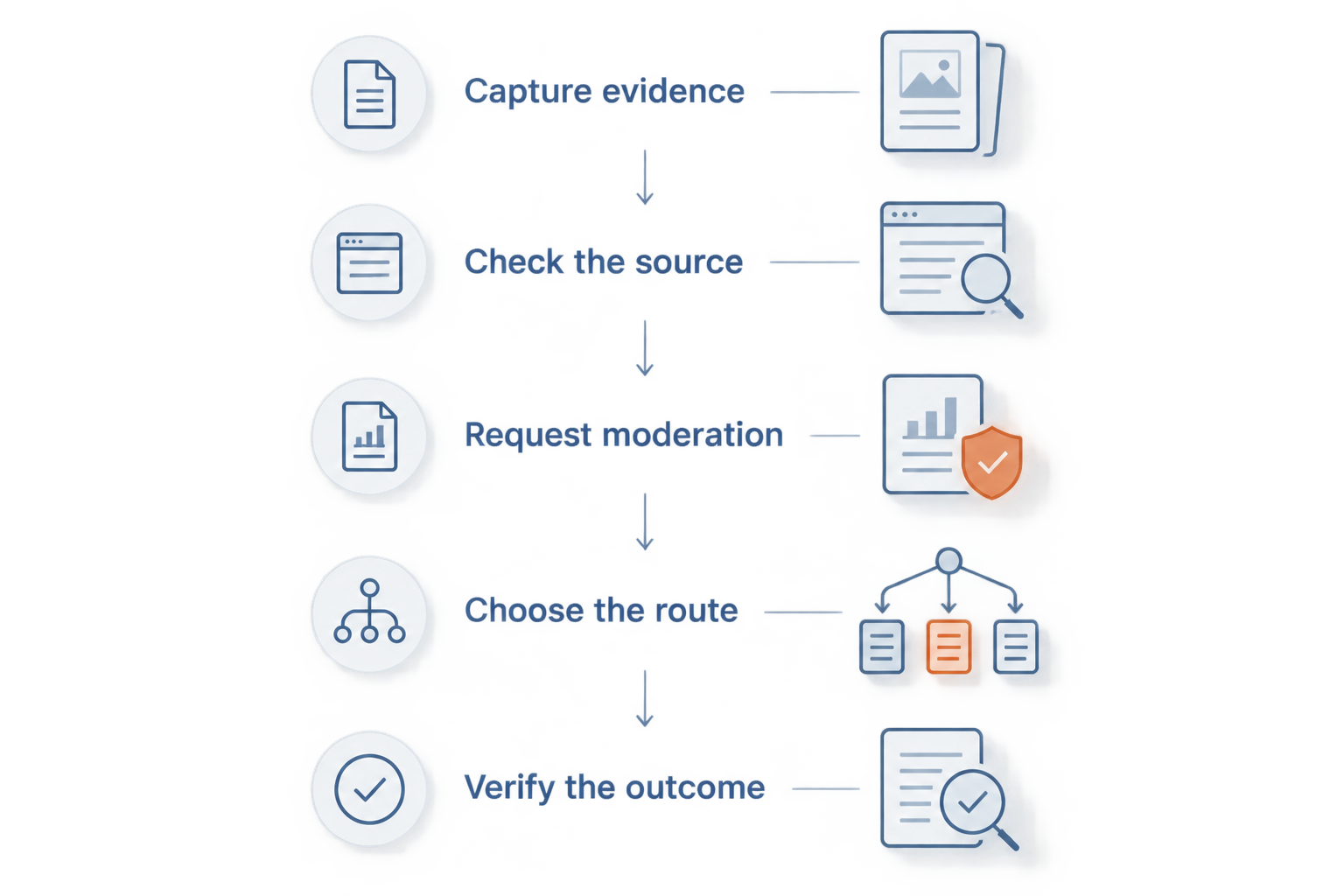
1. Capture evidence
Create 1 case file containing the search query, the linked page, the comment’s exact wording, the displayed username, and the date you observed it. Record the publication date separately if the page shows one. Do not treat the date you discovered the comment as its publication date.
Save 2 screenshots: one showing the Google result and one showing the comment in its surrounding discussion. Include enough context to distinguish an accusation from a quotation, rebuttal, or statement about someone else.
Keep this material private. A public rebuttal is not necessary to preserve evidence, and copying a sensitive allegation onto your own website creates another public version of it.
2. Check the source
Open the result and locate the exact words. Determine whether they belong to the article, a reader comment, an embedded discussion, or a separate page linked from the article. The visible publisher is not always the operator of an embedded commenting service.
If the words no longer appear, check whether the article has another accessible version or whether the discussion requires expansion. A search-result excerpt is not proof that the same text remains visible on the page you first open.
Make these 3 checks before submitting a request:
- Content check: Does the comment still exist on the linked page?
- Identity check: Does the statement actually identify you or your business?
- Grounds check: What specific rule, policy, or legal basis supports removal?
3. Request moderation
Use the publisher’s reporting or moderation process when the comment remains live. Identify the comment precisely and explain the relevant violation, such as exposed personal information, impersonation, or abuse prohibited by that website’s published rules.
Separate factual errors from criticism. If a commenter names the wrong executive, provide evidence establishing the identity error. If the comment expresses dissatisfaction, explain any actual rule violation rather than treating an unfavorable opinion as automatically removable.
Keep the request narrow. Ask for deletion or correction of the identified comment, not unrelated reporting. Preserve the response and any reference number so later submissions remain consistent.
4. Choose the route
If the publisher declines, assess whether a Google policy or legal removal route actually applies. A complaint that the comment is embarrassing is different from evidence that it exposes qualifying private information.
If the publisher removes the comment, move to checking Google’s result. Do not keep reporting a deleted comment as though it were still live. The issue has changed from source moderation to search updating.
For content that remains published without a removal basis, consider a search reputation plan instead of repeatedly submitting the same unsupported complaint.
5. Verify the outcome
Reopen the original page and repeat the relevant search after receiving a decision. Check the exact result, not just whether your preferred page appears above it. Record what changed and what remains unresolved.
A deleted comment, a changed search excerpt, and a removed result are distinct outcomes. Track them separately in your 2026 case record so an apparent improvement does not conceal a surviving copy.
When does a Google removal policy apply?
Google Search Help describes removal processes for certain personal information and other qualifying content. Its personal-content guidance also distinguishes removing information from Search from removing it from the internet. Use that distinction when preparing a 2026 request.
Examples covered by Google’s published guidance include certain private identifying information, doxxing, and nonconsensual explicit imagery. Eligibility depends on the policy’s conditions; merely appearing in a hostile comment does not make every name, quotation, or business detail eligible.
Report the qualifying content, not simply the reputational damage. Identify the exact information, explain which condition it meets, and supply the requested evidence. Google also considers public-interest context in applicable removal decisions, including newsworthiness.
An approved request does not always mean universal disappearance. Depending on the applicable process, removal can be limited in scope. Read the decision rather than assuming it covers every query, country, copied page, or Google service.
What if the publisher deletes the comment but Google still shows it?
Use Google’s Refresh Outdated Content process when its result still reflects eligible content that has disappeared or changed. Google Search Help distinguishes this process from requests involving information that remains on the live page.
Check the page first. If the comment remains accessible, the outdated-content route is not a shortcut around a rejected moderation request. If the page is still live but the relevant text has been removed, follow the tool’s requirements for the changed page.
A refresh is also not a request to rewrite Google’s description in your preferred language. Its purpose is to address outdated search information, not replace a negative description with promotional copy.
Keep the publisher’s confirmation, but verify the live page independently. A message saying the comment was removed does not establish what Google can currently access.
When should you involve a lawyer?
Involve qualified counsel when the issue concerns an allegedly false factual accusation, threats, extortion, or another potential legal violation. Whether a statement is actionable depends on its wording, context, jurisdiction, and other legal requirements.
A negative opinion is not automatically defamation. Calling a statement false in a removal form also does not establish a legal basis for taking it down. Give counsel the complete discussion and supporting documents, not an isolated sentence stripped of context.
Google has legal reporting processes, but submitting a legal notice does not guarantee acceptance. A court order also requires assessment for relevance and scope; do not assume that a document concerning one speaker or page removes every related search result.
For a Miami matter in 2026, separate legal advice from SEO advice. An agency can address search reputation work; counsel should assess legal claims and litigation strategy.
Why negative news comment removal varies
The outcome depends on the content and the applicable decision-maker, not how urgently you want the result gone.
- Publisher rules: A comment must be assessed against the website’s actual moderation standards.
- Content status: Live text requires a different request from text already deleted at the source.
- Policy eligibility: Google evaluates specific removal conditions, not a general preference for positive coverage.
- Legal context: The statement, jurisdiction, evidence, and available legal remedy shape a legal request.
- Separate copies: Another page containing the same comment creates a separate item to investigate.
- Requested scope: Deleting a comment, refreshing a result, and removing a result produce different outcomes.
These factors also explain why a fixed completion promise is not a reliable basis for choosing help. Ask what action is being proposed, who controls the decision, and how the outcome will be verified.
Can you suppress a negative news comment instead of removing it?
Suppression aims to reduce visibility; removal takes content or a search result out of circulation within a defined scope. If no valid removal route exists, focus on accurate, relevant pages that answer searches about your company or name.
That work can include improving your existing website and maintaining substantive professional profiles. Avoid creating duplicate pages filled with repeated names or publishing claims you cannot substantiate. More pages do not automatically mean stronger search results.
Google’s published ranking guidance describes multiple ranking systems and signals, not an entitlement to a preferred position. Read how Google ranks search results for a person’s name before treating suppression as a guaranteed replacement for deletion.
Suppression has a clear limitation: the original comment remains accessible. Measure the visibility of the exact query and result rather than describing ongoing ranking work as completed removal.
Does removing the comment also remove the news article?
Removing the comment does not automatically remove the article. A publisher can moderate a discussion while keeping its reporting online, and the article can continue appearing in Google for relevant searches.
Specify whether your concern is the article’s factual content or the reader’s statement. Combining unrelated complaints makes it harder to establish what remedy addresses the actual problem.
Will clearing your search history remove the comment?
Clearing your search history does not remove the comment from the publisher or Google’s index. It changes your account or device history, not the underlying publication.
For verification, record the query and search conditions rather than relying on a single personalized results screen. Your own browsing history is not a substitute for checking the source page and the removal decision.
What should you ask an agency before authorizing work?
Ask the agency to name the proposed route and the specific deliverable. A publisher request, policy submission, legal referral, outdated-result refresh, and suppression campaign require different evidence and offer different outcomes.
Before authorizing work, get written answers to these questions:
- What content or result is the work intended to address?
- What grounds support the proposed request?
- Who controls the final decision?
- What will demonstrate success?
- What happens if the original content remains online?
Socialczars provides crisis SEO and online reputation management, but publisher decisions and Google approvals remain outside an agency’s control. Reject a promise of guaranteed deletion when the provider cannot identify a valid removal basis.
Discuss your search reputation problem
Explain the comment, where it appears, and whether it remains live on the publisher’s page.
FAQ
Can I remove a negative news comment from Google just because it is unfair?
Unfairness alone does not establish a Google removal basis. Identify a publisher-rule violation, an applicable Google policy, or a valid legal ground.
Who should I contact first about a comment under a news article?
Contact the publisher or the operator of the comment system when the comment remains live. Preserve the exact wording and page before submitting your moderation request.
Can Google delete a comment from a newspaper’s website?
Google does not control the newspaper’s website. Removing a result from Search does not delete the comment at its source.
What should I do if a deleted comment still appears in Google?
Check whether Google’s Refresh Outdated Content process applies. Confirm that the relevant text has actually disappeared or changed on the live page before requesting a refresh.
Does a false comment automatically qualify for Google removal?
A claim that a comment is false does not automatically qualify it for removal. A legal request needs an applicable legal basis, and a policy request must satisfy the relevant policy conditions.
Can a reputation management agency guarantee a news comment will disappear?
An agency cannot guarantee a publisher’s moderation decision or Google’s approval. Require a clear distinction between deletion, search removal, outdated-result refreshes, and suppression.
Will replying to the comment remove its Google result?
Replying does not itself delete the comment or remove its Google result. Decide whether a response serves a communications objective separately from your removal request.
One last thing
The most useful first action is often to identify what Google is actually showing. A search excerpt containing a comment is not necessarily a separately indexed comment page. That distinction determines what you report and what a successful update looks like.
Before sending another complaint, place the search result beside the live page. If the text is gone, investigate a refresh. If it remains, identify a valid moderation, policy, or legal basis—or change the objective to managing visibility.
Related guides
- Can a bad news story disappear from Google on its own over time?
- How do you respond to a defamatory blog post about your business?
- Can removing negative content backfire and cause more attention?
