
Reputation Management
Can a bad news story disappear from Google on its own over time?

Oct
Yes, a bad news story can disappear from Google on its own, but age alone does not remove it or guarantee lower rankings. A publisher taking down the page, a change in indexing, or competing results gaining visibility can change what appears; none creates a reliable expiration date for negative coverage. Do not base a reputation decision on waiting for an article to get old.
- Can a bad news story disappear from Google on its own? Yes, but time alone does not guarantee removal.
- Google ranking declines, search removal, and publisher deletion are different outcomes.
- Socialczars serves Miami companies and executives facing negative search results; assess the problem before choosing crisis SEO.
- Document the article, check removal eligibility, and track the searches that matter to your reputation.
Can a bad news story disappear from Google on its own over time?
A bad news story has no automatic expiration date in Google Search. In 2026, an old article can remain searchable when Google continues to index it and considers it relevant to a query. Understanding how Google ranks search results for a person's name helps separate an aging story from a declining search result.
Before choosing a response, identify which outcome you actually need:
| Outcome | What changes | Best for | Limitation |
|---|---|---|---|
| Natural ranking decline | Other results appear above the article | Monitoring coverage that is losing visibility | The article remains searchable and can rise again |
| Publisher removal | The publisher takes down the original page | Content the publisher agrees to withdraw | Copies and search references can remain |
| Google removal | Google excludes a result under an applicable policy or legal process | Content that meets specific removal criteria | The source page can remain online |
| Search suppression | Other relevant pages compete with the negative result | Lawful coverage that remains published | It does not delete the article or guarantee rankings |
A story missing from your usual search is not necessarily gone. Check whether it remains accessible at its original address and appears for more specific searches.
Why this matters
An executive preparing for due diligence needs a different response from a company watching an old article gradually lose visibility. The decision starts with the searches your stakeholders use, not the publication date alone. An article that disappears for a broad company query can still appear when someone adds a founder's name or the subject of the controversy.
For a 2026 reputation assessment, distinguish visibility from accuracy. A highly visible false statement needs a different review from accurate reporting about an old event. Treating both as the same removal problem wastes effort and encourages promises no provider controls.
Why a bad news story's visibility varies
Google ranks pages for particular searches, rather than assigning an article a universal position. These factors explain why the same story can fade for one query and persist for another:
- Query relevance: An article closely matching a person's name and the incident can remain relevant to that specific search.
- Competing pages: Relevant professional profiles, company pages, and independent coverage give Google other results to consider.
- Links and references: Links help Google discover pages and understand their relationships. Publication age does not erase those signals.
- Publisher changes: Removing a page, restricting crawling, or changing indexing instructions can affect its search presence.
- Search context: Location, language, and personalization can change the results you see. Your own search is not a universal baseline.
- Freshness needs: Some searches call for recent information; others do not. An older article is not automatically irrelevant to a name search.
The useful question is not how old the article is. It is why the article still answers the searches attached to your name.
When waiting is a reasonable monitoring decision
Waiting is a monitoring decision, not a removal method. It fits situations where you have checked the relevant queries, documented declining visibility, and determined that the remaining exposure does not require immediate action.
Keep the distinction clear: a quieter news cycle does not prove lower search visibility. Fewer social mentions and fewer calls about the story measure different things from whether the article still appears when someone searches your name.
Use a defined review schedule rather than occasional searches driven by anxiety. Record a baseline on day 1, recheck after 7 days, and review the pattern after 30 days. These are suggested monitoring checkpoints, not predicted ranking changes or removal deadlines.
Record the same query wording, search location, date, and visible results at each checkpoint. Include the article's address so you do not confuse the original with a syndicated copy. Consistent records make changes easier to interpret.
When waiting is the wrong response
Waiting does not address published personal information, a factual error, or a story appearing during an active business decision. Those situations require assessment of the content and the available response, even if the article is old.
Act on the specific issue:
- A factual error: Gather documents supporting a precise correction request to the publisher.
- Exposed personal information: Check Google's applicable personal-information removal policies and the publisher's reporting process.
- Potentially unlawful content: Have qualified counsel assess the facts, jurisdiction, and available legal remedies.
- Accurate but damaging coverage: Evaluate search suppression and current factual content rather than assuming a takedown is available.
Do not send a legal threat simply because an article is unfavorable. Separate facts from opinion, identify the disputed statement, and preserve the original before requesting changes. Legal eligibility depends on the underlying facts and applicable law.
How to assess an old negative article before taking action
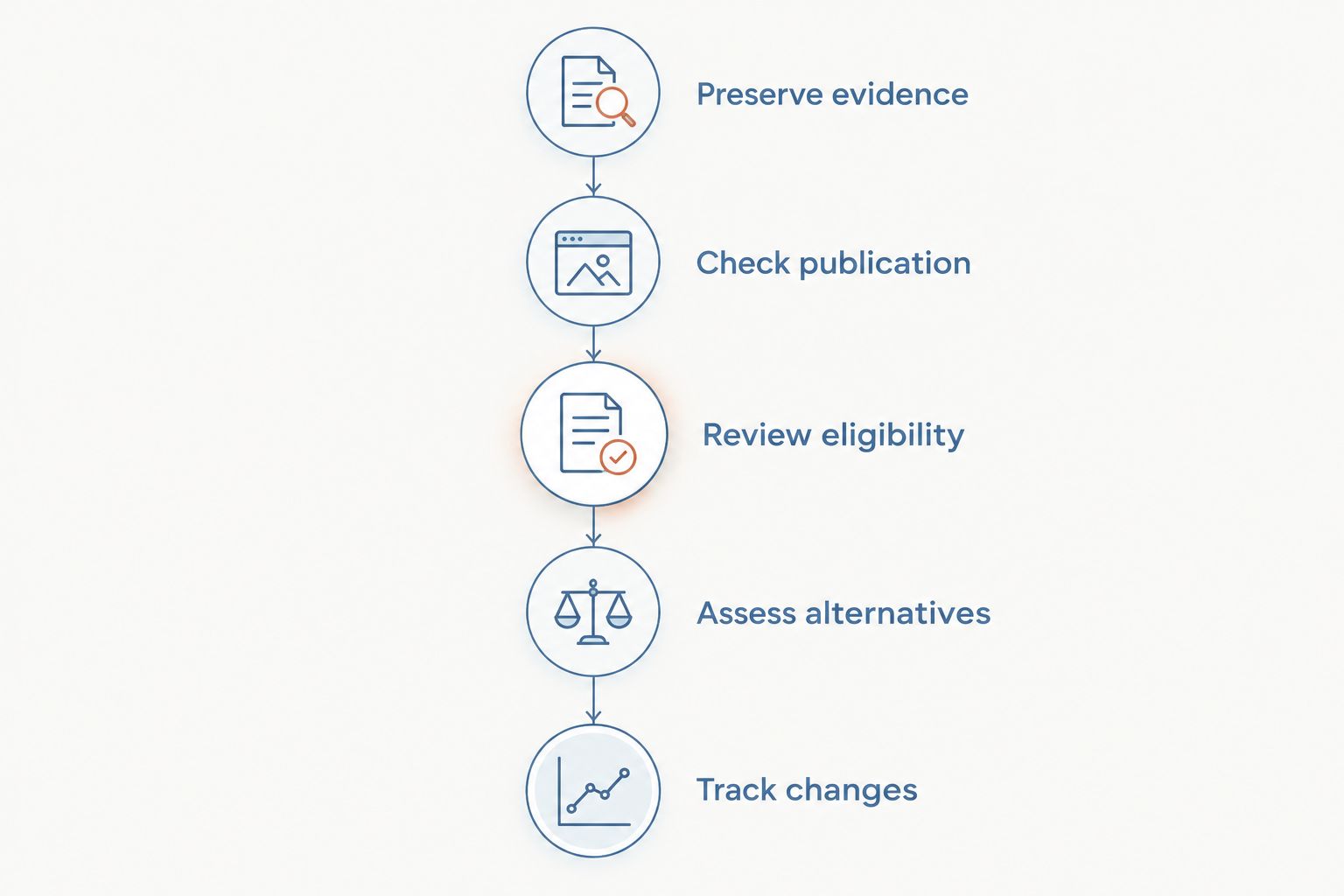
A 2026 action plan should begin with evidence, not a promised disappearance date. Work through this sequence before commissioning content or sending removal requests.
1. Preserve evidence
Save the article address, headline, publication date, screenshots, and the exact searches where it appears. Record whether the publisher has added a correction or update. Preserve the distinction between what the article says and what the search snippet shows.
2. Check publication
Open the original page and determine whether the content remains live. A page removed by its publisher presents a different problem from a live article with an unfavorable headline. Check separately for copies rather than assuming the original is the only version.
3. Review eligibility
Identify whether a publisher correction process, Google removal policy, or legal route applies. Google's removal tools have specific requirements; an unfavorable tone alone does not establish eligibility. Match the request to the actual issue.
4. Assess alternatives
If the article stays published, examine the relevant pages already associated with your name. Correct incomplete profiles and publish useful, verifiable information about current work. Do not create fabricated coverage or pretend promotional material is independent reporting.
5. Track changes
Continue checking the original article, copies, and priority queries. Record whether a change affects the page itself, its indexing, or only its ranking. Those are different results and should be reported separately.
Does deleting the article remove it from Google immediately?
Deleting an article does not guarantee an immediate update in Google Search. Google needs to process the changed page, and a search reference can remain after the publisher has removed the content.
If the article is gone or materially changed, Google's outdated-content process can be relevant when the result still reflects the old page. It is not a way to remove a live article simply because you dislike it. Check the source before choosing that route.
Publisher deletion also does not establish that every copy has disappeared. A separately published version has its own address and requires its own assessment. Keep a record of each version rather than treating a headline as a single removable object.
Does dropping out of the top results mean the problem is solved?
Dropping out of the top results means visibility changed for the search you checked. It does not prove deletion, deindexing, or permanent suppression. A more specific query can still surface the article.
Define success around the actual reputation risk. If stakeholders search a company name together with an executive's surname, reporting only the broad company query leaves an important gap. Your 2026 monitoring record should preserve those distinctions rather than declaring the internet clean.
Public search results and formal screening are separate problems
A cleaner name search does not establish that information has disappeared from every record or report. An article, an underlying court record, and a screening report are separate sources with separate correction procedures. Identify the source of the disputed information before asking anyone to fix it.
That distinction matters when employer background checks are involved: changing a public search result is not the same as correcting information in a screening report. If an employer identifies a particular report, address that report through the applicable process rather than assuming search suppression changes its contents.
Preserve documents showing a correction, dismissal, or other relevant development when those documents exist. Use them to support accurate requests to the appropriate publisher, reporting company, or record holder. Do not promise that one correction automatically propagates everywhere.
When crisis SEO fits the problem
Socialczars is best suited to Miami companies, executives, and high-profile individuals seeking crisis SEO for negative search results. The relevant decision is whether you need help managing search visibility, not whether an agency can make time erase a story.
Socialczars provides crisis SEO and online reputation management services. That service category fits a search-visibility problem, but it does not replace legal advice, establish removal eligibility, or give an agency control over Google's rankings.
Before engaging a provider, require clear definitions of the work:
- Which exact queries and article addresses are in scope?
- Does the proposed work concern correction, removal, suppression, or monitoring?
- Which actions depend on a publisher or Google approving a request?
- How will reporting distinguish ranking changes from actual removal?
- What confidential information does the provider need, and how will you share it?
For a 2026 engagement, reject guaranteed disappearance dates. Require an explanation of the route, its limits, and the evidence used to measure progress. Speed of assessment and certainty of outcome are different promises.
FAQ
Can a bad news story disappear from Google on its own?
Yes, a bad news story can disappear from Google on its own, but age alone does not cause removal. The publisher’s actions, indexing changes, or shifts in competing results can change its visibility.
How long does Google keep a negative news article?
Google has no general expiration deadline for a negative news article. An older page can remain searchable while it stays indexed and relevant to a query.
Will clearing my search history remove a bad news story?
Clearing your search history does not remove a publisher’s article from Google. It changes your account or device history, not the source page or its eligibility to appear in search.
Can I ask Google to remove an accurate but embarrassing article?
Embarrassment alone does not establish eligibility for Google removal. Check whether the content meets a specific policy or applicable legal basis, and distinguish search removal from publisher deletion.
Will publishing positive content push a negative article down?
Publishing positive content does not guarantee that a negative article will move down. Relevant, credible pages can compete in search, but publication alone does not control their rankings.
Can Socialczars guarantee that an old article will disappear?
No agency can guarantee that Google will permanently remove a lawful article simply because it is old. Socialczars provides crisis SEO and online reputation management; assess the proposed actions separately from any outcome claim.
One last thing
Check the snippet as well as the article. A publisher's correction and Google's displayed description are not the same object, so record both when reviewing progress. Before requesting wholesale removal, identify exactly what remains wrong: the live content, the search presentation, or the article's visibility.
Related guides
- How long does it take to fix a bad online reputation?
- Does suppressing negative search results hurt other SEO rankings?
- How do you respond to a defamatory blog post about your business?
