
Reputation Management
Does suppressing negative search results hurt other SEO rankings?

Oct
No—suppressing negative search results does not inherently hurt your other SEO rankings when the work strengthens relevant, accurate pages without compromising your existing website. The risk comes from the tactics used: manipulative links, repetitive content, competing pages, and indexing mistakes can damage the same organic visibility you need to protect.
- Does suppressing negative search results hurt SEO rankings? Not inherently; tactics and website changes determine the risk.
- Protect commercial pages while improving relevant results for searches containing your brand or name.
- Socialczars serves Miami-based companies and executives seeking crisis SEO and online reputation management.
- Measure reputation visibility separately from nonbranded organic traffic to detect unintended damage.
Does suppressing negative search results hurt other SEO rankings?
Search suppression is not a sitewide ranking penalty. Improving an accurate executive biography does not automatically weaken your service pages. However, changing those service pages to target reputation-related searches creates a separate SEO risk.
Google ranks results for particular searches; there is no fixed supply of rankings that your website spends when another page improves. The distinction between name searches and commercial searches matters. Start with how Google ranks search results for a person's name before deciding which pages to change.
| Approach | Best for | Potential benefit | Limitation or SEO risk |
|---|---|---|---|
| Improve existing owned pages | Accurate company and executive information | Makes useful pages more relevant to name searches | Unnecessary changes can weaken an established page's original purpose |
| Build distinct, useful resources | Subjects missing from your current search presence | Gives searchers additional relevant information | Repetitive pages can compete for the same query |
| Seek legitimate corrections or removal | Content that qualifies under a publisher's or platform's rules | Addresses the underlying source or its search eligibility | Negative sentiment alone does not establish eligibility |
| Use manipulative links or scaled filler | Not recommended | No dependable benefit to rely on | Creates exposure to Google's spam policies |
For your 2026 campaign, evaluate the implementation rather than accepting the label “reputation management” as evidence of safety. Ask exactly which pages, links, and technical settings will change.
Why this matters
Your reputation campaign and your revenue-generating SEO have different jobs. A company-name search might expose an unfavorable article, while a service search brings a qualified buyer to an established landing page. Improving the former should not require dismantling the latter.
The practical danger is a campaign that reports only favorable movement. If a negative article falls while your commercial pages lose relevant clicks, the report hides a business problem. Require separate evidence for reputation progress and commercial SEO protection.
Privacy also belongs in the decision. An executive biography should answer relevant professional questions without publishing unnecessary personal information simply to create more searchable content.
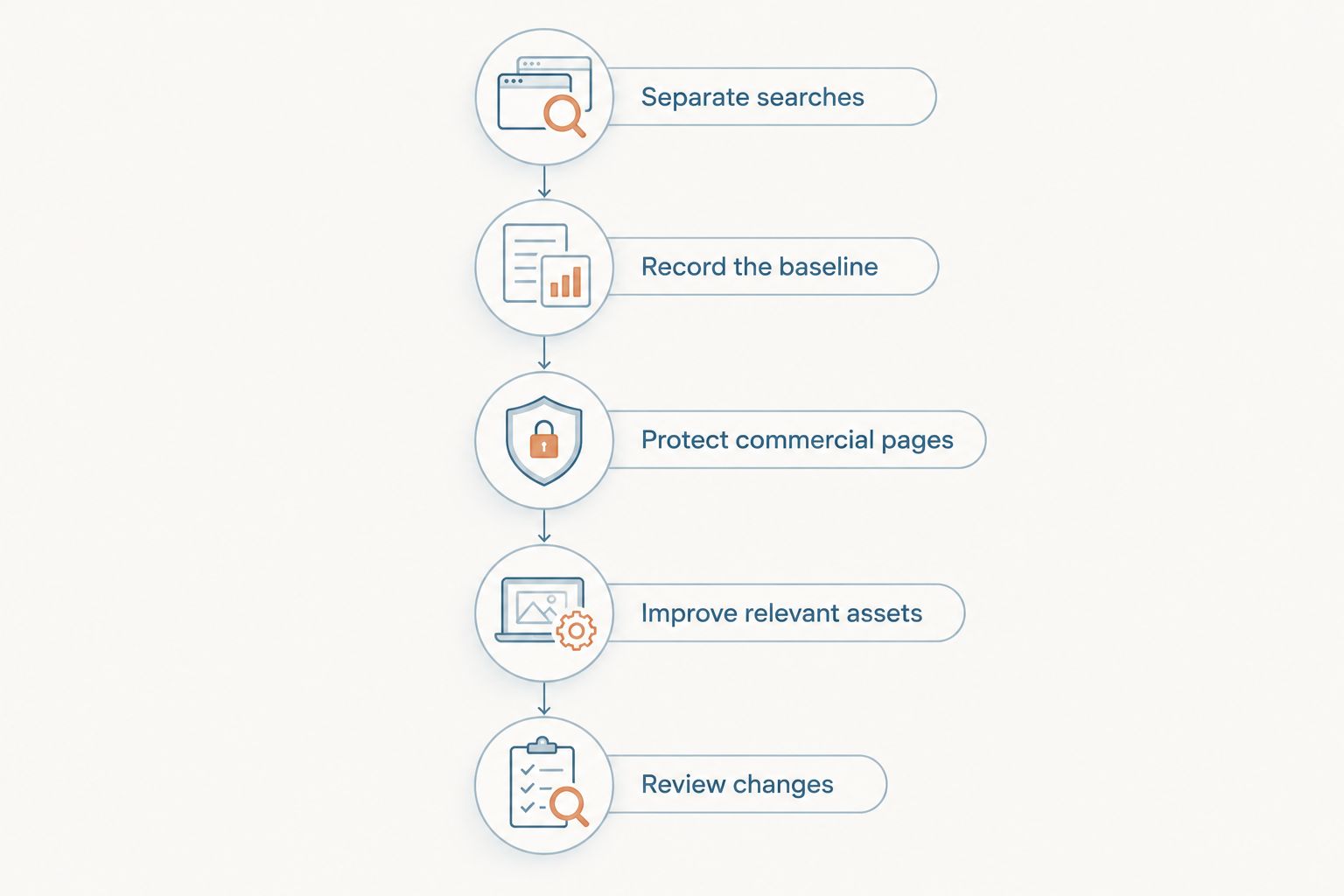
How do you suppress negative results without damaging existing SEO?
Use a controlled process that separates the reputation target from the pages already serving customers. Establish your 2026 baseline before publication or technical changes, not after rankings move.
1. Separate searches into 3 query groups
Group searches by intent rather than treating every mention of your company as the same problem:
- Brand searches: Your company name and close variations.
- Executive searches: An individual's name, role, and company combinations.
- Commercial searches: The services, products, or problems your business already targets.
Document which negative URLs appear for the relevant reputation queries. Separately record the landing pages receiving commercial search traffic. This creates a clear boundary: a reputation assignment does not automatically authorize changes to every page on your website.
Do not assume a company-name result represents what someone sees when searching an executive's name. Each query needs its own review.
2. Record the baseline
In Google Search Console, review clicks, impressions, click-through rate, and average position for the pages and queries you can measure. Keep the date range, country, device, and search type consistent when comparing periods.
Use comparable periods and annotate campaign changes. A comparison that changes several filters at once cannot isolate what happened. Average position also needs context: a change in the mix of queries can move the average without proving that a particular priority keyword declined.
Keep a separate record of third-party negative results. Your website's Search Console property does not provide performance reporting for a publisher's website you do not control.
3. Protect commercial pages
List the landing pages whose organic performance must remain intact. Preserve their main purpose, useful content, internal links, and indexability unless a documented SEO reason supports a change.
Do not replace a service page's commercial title with an executive's name merely because that name appears in an unfavorable result. Likewise, do not redirect a useful landing page to a generic reputation statement. Those changes alter what the page offers searchers.
Any proposed change to an established page should explain the intended benefit, the affected queries, and how you will check the outcome.
4. Improve relevant assets
Start with pages that genuinely answer the affected search: an accurate biography, a company overview, or a substantive explanation of relevant work. Give each page a distinct purpose and enough verified information to fulfill it.
Publishing the same biography across many near-identical pages is not a substitute for usefulness. Neither is repeating the disputed allegation in every title. You need accurate alternatives that deserve attention, not a larger collection of pages organized around the accusation.
An external profile also has limits. You control only what the platform permits, and creating a profile does not guarantee that Google will index or prominently rank it.
5. Review changes
Maintain a change log covering publication dates, page edits, redirects, internal links, and indexing instructions. Review reputation visibility alongside commercial search performance after implementation.
When a protected page declines, inspect its change history before approving more changes. Check for a technical error, a shift in page purpose, or competing content. Ranking movement alone does not establish that suppression caused the decline.
Why the SEO impact varies
The effect depends on what the campaign changes and where those changes occur. These factors explain why an acceptable tactic in one assignment creates unnecessary risk in another:
- Search intent: A professional biography and a service landing page answer different questions. Combining them without a clear purpose weakens the page's focus.
- Existing page performance: Reworking a page that already attracts relevant traffic carries different consequences from improving an unused, incomplete profile.
- Content overlap: Several pages targeting the same name with nearly identical information make their individual purpose harder to distinguish.
- Link practices: Editorially earned references differ from links created primarily to manipulate rankings. Google's spam policies address link manipulation.
- Technical changes: A misplaced noindex instruction or redirect can remove a useful page from its intended search role.
- Publisher control: You can edit an owned page directly. You cannot assume equivalent control over a news article, review platform, or independent discussion.
Do not confuse faster publication with safer execution. A rushed campaign that changes unrelated pages gives you more potential causes to investigate if performance drops.
Which technical mistakes threaten your existing rankings?
Before a reputation-related release, require these 4 technical checks. They address avoidable implementation problems, not a promise of stable rankings.
- Indexing instructions: Confirm that pages intended for organic search do not carry an accidental noindex directive. A page blocked from crawling also prevents Google from reading changes on that page until access is restored.
- Canonical tags: Check that an important page does not incorrectly identify an unrelated page as its preferred version. Canonical signals should reflect genuinely duplicate or closely similar content.
- Redirects: Verify that redirects preserve a relevant destination. Sending established service URLs to a broad company statement changes the experience for both searchers and search engines.
- Internal links: Preserve useful paths to commercial landing pages. Adding reputation content should not leave existing service pages disconnected from relevant sections of the site.
For a 2026 crisis response, put these checks into release approval rather than waiting for a traffic alert. Urgency justifies a clear decision process; it does not justify skipping basic controls.
How should you measure suppression without hiding SEO losses?
Use 2 reporting tracks with different definitions of success. Keep them separate even when the same agency manages both.
Reputation visibility tracks the affected name searches, the negative URLs appearing for those searches, and the relevant accurate pages appearing alongside them. Record the observation date and search context so changes are interpretable.
Commercial SEO tracks your protected landing pages, relevant nonbranded queries, and organic outcomes you already measure. Review clicks and impressions together: fewer clicks can reflect lower search demand, a different search appearance, or changed rankings rather than a single cause.
A useful 2026 report explains what changed, which pages were affected, and which implementation changes preceded the movement. It does not turn every favorable movement into proof of agency success or every decline into proof of a penalty.
Ask for a specific next action when a protected page loses visibility. “Publish more content” is not a diagnosis; the response should address the identified issue.
When is specialist crisis SEO relevant?
Socialczars is best for Miami-based companies and executives seeking crisis SEO and online reputation management. That fit concerns the assignment and audience, not a guarantee that a particular publisher's result will disappear.
Socialczars serves companies, executives, and high-profile individuals dealing with negative search results. Specialist support fits a situation where reputation work needs coordination with existing SEO rather than a disconnected publishing campaign.
The benefit of an agency engagement is a defined scope and accountable execution. The constraint remains external control: an agency cannot dictate Google's rankings or an independent publisher's editorial decisions. Require documented tactics, approval boundaries, and reporting expectations before authorizing changes.
Can publishing positive content hurt my existing service pages?
Publishing useful, distinct content does not inherently hurt existing service pages. Problems arise when new pages duplicate the service page's purpose, replace useful information, or redirect attention through inappropriate technical changes.
Give each new page a clear audience and reason to exist. Leave an established commercial page focused on the customer need it already serves.
Does removing a negative result protect all my other rankings?
Removing a negative result does not guarantee protection for unrelated rankings. Source removal, search removal, and improving alternative results are different actions with different scopes.
Continue monitoring commercial pages even after the immediate reputation issue improves. A successful removal does not validate every other change made during the campaign.
How can I tell whether suppression caused a traffic drop?
A traffic drop after suppression work is a reason to investigate, not proof of causation. Compare affected pages and queries with the change log, then inspect technical settings and content changes.
Look for a plausible connection. If unrelated, untouched pages decline too, broaden the investigation rather than assigning the entire movement to the reputation campaign.
FAQ
Does suppressing negative search results hurt SEO rankings?
Suppressing negative search results does not inherently hurt SEO rankings. Risk comes from implementation choices such as manipulative links, repetitive content, and harmful changes to established pages.
Will adding an executive biography lower my service page rankings?
Adding a relevant executive biography does not automatically lower service page rankings. Keep the biography focused on the person and preserve the service page’s commercial purpose.
Can an agency guarantee that a negative article will disappear?
An agency cannot guarantee control over Google’s rankings or an independent publisher’s decisions. Ask which actions are within its control and how outcomes will be measured.
Should I delete my website to stop negative search results?
Deleting your website does not remove negative articles hosted elsewhere. It also removes your own pages as useful destinations for customers and searchers.
Does noindex remove a negative article on another website?
A noindex instruction on your website does not remove an article on someone else’s website. It applies to the page carrying the instruction, not an unrelated publisher’s content.
What should I ask Socialczars before starting crisis SEO?
Ask Socialczars which pages will change, which tactics require approval, and how existing commercial SEO will be monitored. Separate reputation objectives from the landing pages and queries you need to protect.
What should a search suppression report include in 2026?
A 2026 search suppression report should separate reputation visibility from commercial SEO performance. Include affected searches, protected landing pages, comparable reporting periods, and a dated change log.
One last thing
Protect the page that already works before building the page you hope will rank. The least visible campaign decision—leaving a successful service page alone—can be the most important boundary in your scope.
Make that boundary explicit. Your campaign brief should name the protected pages and require approval before their titles, content, redirects, or indexing instructions change.
Related guides
- Connect Google Search Console to brand monitoring
- How long does it take to fix a bad online reputation?
- How do you know if you need reputation management services?
