
Reputation Management
Elite Online Brand Repair: A Strategic Blueprint for High-Net-Worth Individuals

Nov
High-Profile Reputation Management Starts Before a Crisis
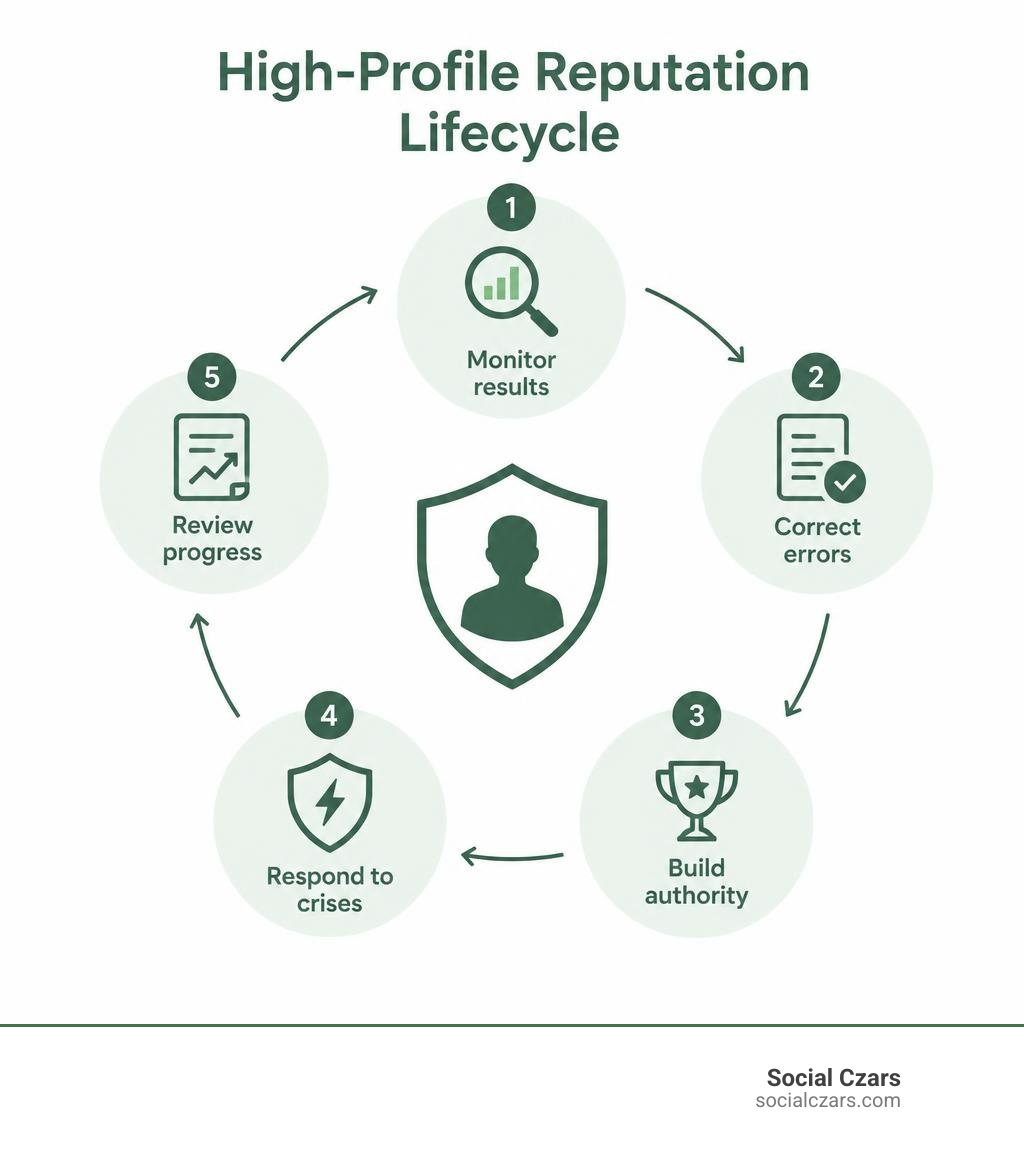
High-profile reputation management means protecting what people find when they search your name. Start by checking search results, news, and social mentions. Correct errors, seek removal of harmful content when there is a valid basis, and publish credible updates that reflect your work today. Set a clear plan for responding quickly if a story or complaint spreads.
For executives and VIPs, a single search result can shape a first impression. The goal is not a spotless internet. It is an accurate, current digital presence that holds up under scrutiny.
I’m John DeMarchi, founder of Social Czars, and I’ve worked in high-profile reputation management for CEOs and VIPs since 2014. After 15 years in corporate roles, I now focus on crisis SEO and executive search visibility; this guide explains how to build, protect, and monitor that presence.
In today’s digital climate, we operate entirely within a “pull economy.” Prospective investors, board members, high-value partners, and clients do not wait for outbound pitch decks; they actively search executive names on Google and query generative AI engines before scheduling an introductory call. Research shows that 79% of consumers trust an online review as much as a personal recommendation from a friend, and 94% of shoppers state that just one negative review or misleading article can convince them to walk away entirely.
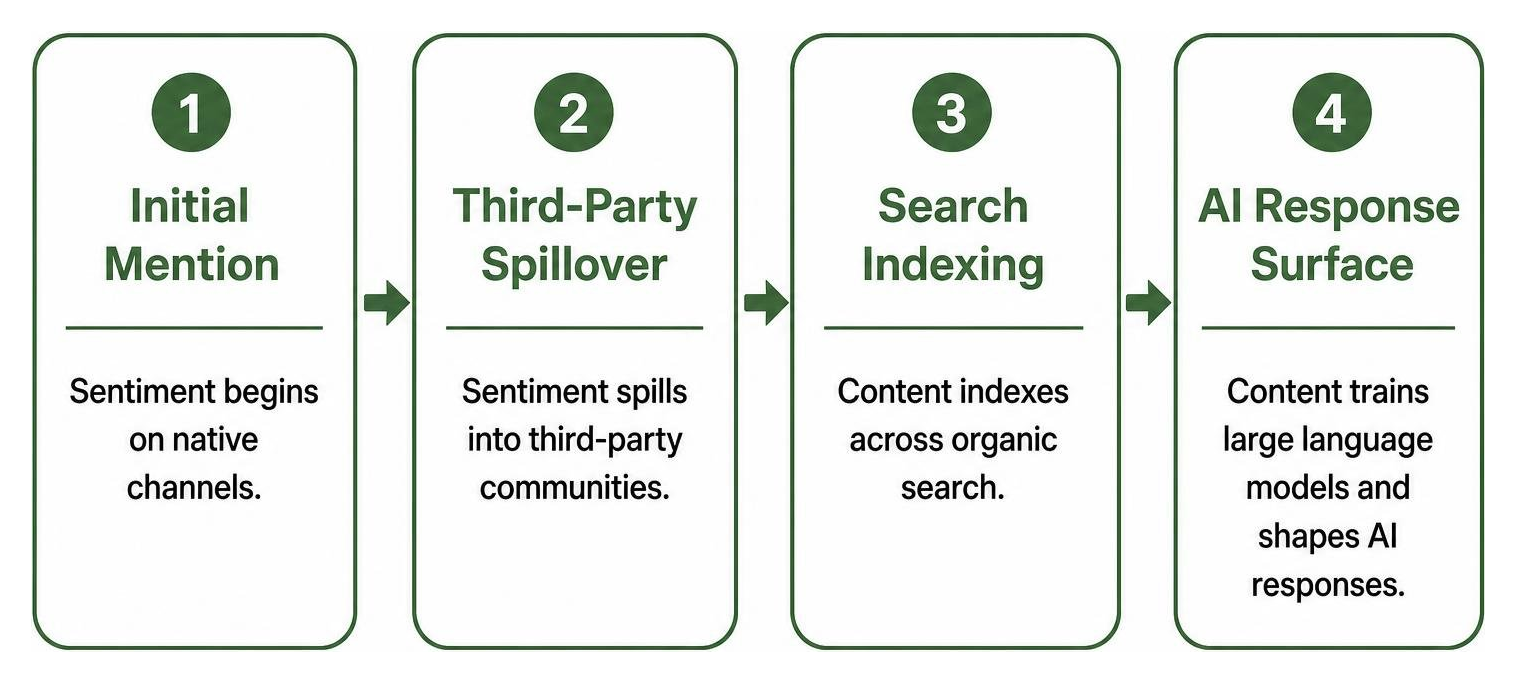
Public perception is governed by a multi-stage trust pipeline: sentiment begins on native channels, spills into third-party communities, indexes across organic search, and finally trains large language models (LLMs). Unaddressed issues create what we call “reputation radiation”—unfavorable digital footprints that slowly decay brand equity and accumulate unseen over years.
The Core Pillars of High-Profile Reputation Management for HNWIs

Managing an elite digital presence is not about vanity metrics; it is a critical resilience function that directly impacts enterprise valuation, business partnerships, and personal security. When high-net-worth individuals (HNWIs) and public figures ignore their digital footprint, third parties and sensationalist media control their narrative.
To safeguard personal standing, an executive must establish absolute branded search dominance. This requires combining high-authority owned assets with an active strategy for proactive executive digital defense. Maintaining consistent review velocity—where fresh, authentic third-party endorsements surface continuously across 90-day intervals—ensures both traditional search algorithms and modern AI engines register positive entity authority.
Why High-Profile Reputation Management Requires Proactive Entity Defense
Relying entirely on third-party social networks exposes an executive to severe platform risk. Algorithmic changes, account hijackings, or arbitrary platform policy shifts can instantly erase years of visibility. True resilience comes from investing in building an authoritative executive brand on owned web assets, such as dedicated personal websites, foundation portals, and controlled media publications.
Proactive defense also requires cultivating a core audience of dedicated supporters. In a crowded digital space, attempting to appeal to everyone is a losing battle. Instead, elite leaders focus on building genuine trust with their specific industry base. These champions provide natural digital defense, organically sharing authentic perspectives and helping reinforce an executive’s Knowledge Graph entity across Google and modern answer engines.
Personal Branding and Executive Authority in a Pull Economy
Effective personal branding separates corporate updates from the leader’s individual insights. While corporate channels handle product announcements and operational milestones, the leader’s personal channels should highlight broader industry perspectives, governance philosophies, and core values.
Executing modern executive visibility strategies means utilizing audience intelligence to identify relevant podcasts, industry panels, and verified digital publications. By participating directly in high-level community discussions and publishing differentiated thought leadership, executives systematically outrank unverified commentary while establishing undeniable subject-matter authority.
Crisis SEO and Strategic Brand Repair for Elite Figures

When high-stakes crises hit, conventional public relations statements alone fall short. Traditional PR generates an initial burst of coverage, but if that coverage turns hostile, search engines cement those negative stories at the top of Page 1. Repairing the digital narrative requires deploying sophisticated technical SEO alongside legal and strategic communications to permanently stabilize search engine results pages (SERPs).
Effective crisis resolution blends aggressive dilution of negative items with the process of eliminating search engine defamation through legitimate legal and regulatory channels. Academic research into crisis communications and social media listening underscores that early detection across unstructured social conversations is vital to containing viral escalations before they harden into permanent search records.
| Strategy Dimension | Direct Content Removal / De-Indexing | Strategic Content Suppression (Dilution) |
|---|---|---|
| Primary Mechanism | Legal notices, terms-of-service violations, DMCA, and right-to-be-forgotten removals. | Creating, optimizing, and syndicating authoritative tier-1 digital assets. |
| Best Used For | Defamatory claims, non-consensual private information, and copyright infringements. | Permanent public records, legitimate news coverage, and critical op-eds. |
| Implementation Speed | 7 to 45 business days depending on platform cooperation and legal process. | 3 to 6 months of sustained technical SEO and publication velocity. |
| Permanence | Absolute; the original content or URL is excised or de-indexed from the search index. | High, provided authority signals and fresh entity citations are continuously maintained. |
Strategic Execution of High-Profile Reputation Management in a PR Crisis
When an executive faces a sudden PR emergency or viral media backlash, every hour counts. We execute crisis SEO mitigation for scandals by setting up real-time sentiment alerts, coordinating public messaging with legal counsel, and deploying authoritative content networks to stabilize branded search queries.
A common pitfall during a crisis is attempting to scrub every single negative remark. Studies indicate that 52% of consumers are actually more likely to trust a profile that features a realistic mix of feedback over one with a suspicious, spotless record. The objective in a crisis is not creating an artificial vacuum, but correcting demonstrably false claims, addressing legitimate criticism with composure, and dominating top search positions with verified facts.
Legal De-Indexing and Content Dilution Frameworks
Permanent records such as legacy news archives, court filings, and regulatory notices often cannot be erased through standard outreach. When direct deletion is impossible, we deploy VIP digital privacy protocols alongside high-tier search suppression frameworks.
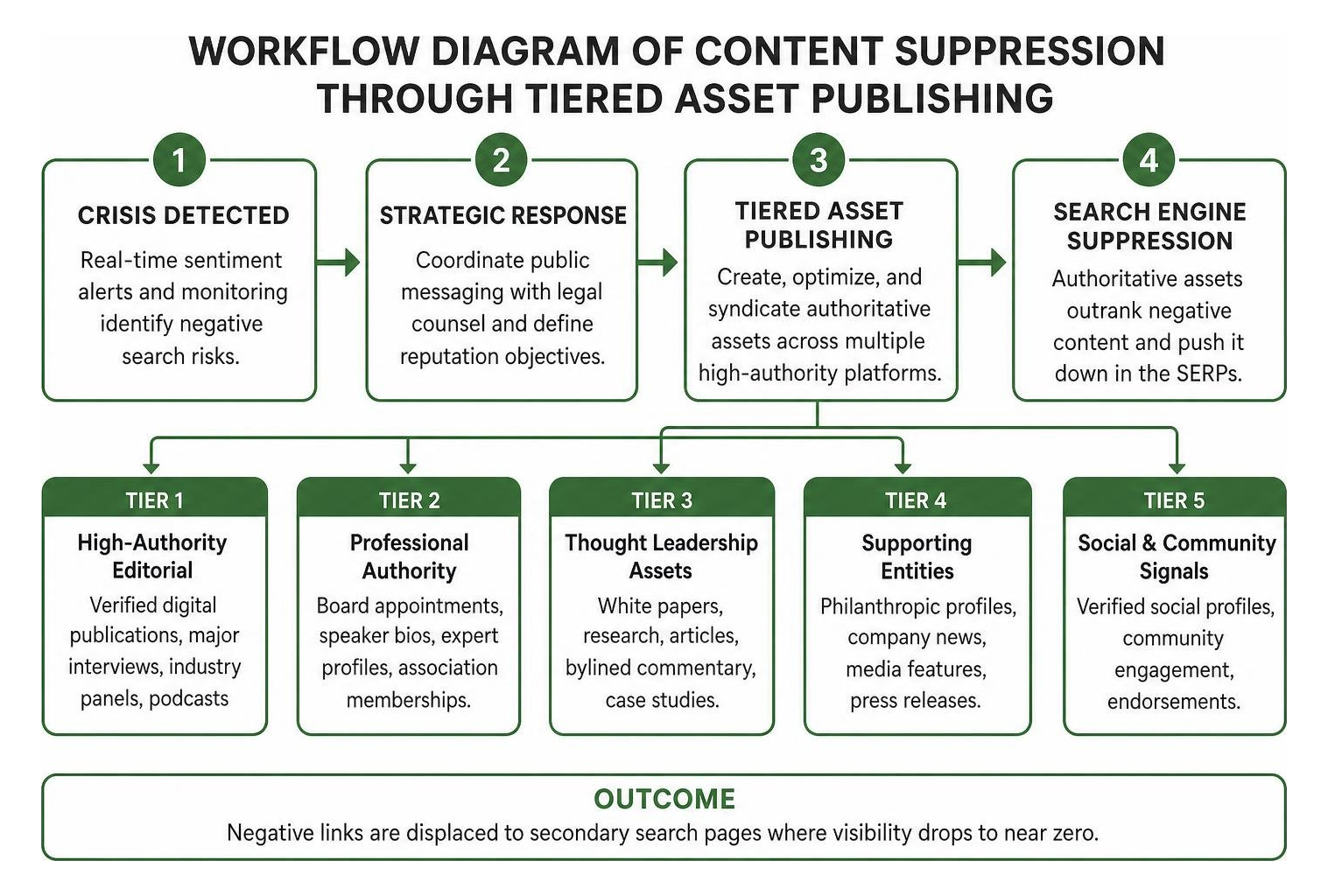
By engineering an interconnected network of optimized digital assets—ranging from board appointments, academic white papers, philanthropic profiles, and high-authority interviews—we build authoritative layers that outrank outdated coverage. Over time, negative links are naturally displaced down to secondary search pages where visibility drops to near zero.
Generative Engine Optimization (GEO) and Social Data in 2026
The digital reputation landscape in 2026 is no longer defined solely by standard blue search links. Large Language Models and generative search platforms synthesize web-wide mentions into direct summaries. These AI models do not simply read an executive’s personal website; they evaluate unstructured forum discussions, social media sentiment, podcast transcripts, and third-party news quotes to determine entity credibility.
To safeguard a digital footprint across AI platforms, leaders must adopt generative engine optimization for business leaders. This involves structuring personal and corporate profiles with precise schema markup and building verifiable citation networks that LLMs recognize as definitive truth.
Controlling the AI Narrative Across LLMs and Search Surfaces
AI platforms use entity authority and independent citations to generate executive overviews. If the underlying web data is fragmented or dominated by outdated events, the generated AI responses will mirror those flaws.
We implement technical executive search optimization by applying structured Schema.org markup across all owned web properties. This provides search crawlers with unambiguous details about a leader’s verified roles, awards, professional affiliations, and current enterprises, directly feeding accurate data into algorithmic knowledge graphs.
Managing Digital Footprint Decay and Reputation Radiation
A thriving venture can easily be overshadowed if search engines and AI summaries highlight a failed startup from five years ago. This digital footprint decay misleads potential business partners and harms major transactions.
Leaders must proactively manage historical career narratives through specialized reputation management for startup founders. Running regular digital audits and consistently syndicating current accomplishments dilutes historical legacy records, ensuring search platforms emphasize your most recent milestones.
Continuous Monitoring, Governance, and Long-Term Measurement
Reputation security is not a one-time project; it requires continuous governance. Unmonitored digital footprints can quietly accumulate negative sentiment until a localized issue snowballs into a major crisis.
Implementing comprehensive CEO reputation governance ensures executive teams maintain quarterly audits of search presence, monitor dark-web exposure, and update internal escalation protocols.
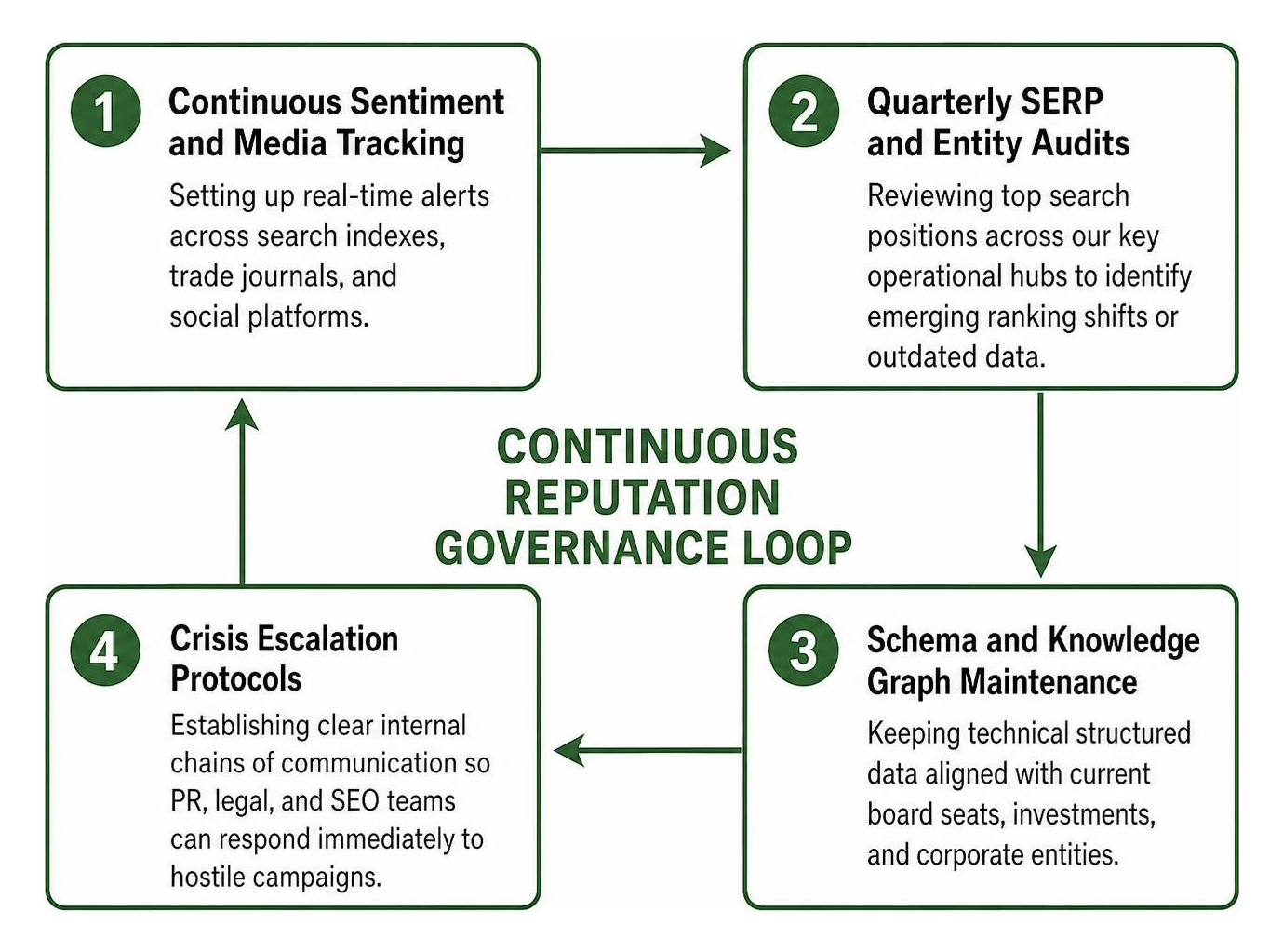
A comprehensive digital governance program includes:
- Continuous Sentiment and Media Tracking: Setting up real-time alerts across search indexes, trade journals, and social platforms.
- Quarterly SERP and Entity Audits: Reviewing top search positions across our key operational hubs—including New York City, Miami, Los Angeles, and London—to identify emerging ranking shifts or outdated data.
- Schema and Knowledge Graph Maintenance: Keeping technical structured data aligned with current board seats, investments, and corporate entities.
- Crisis Escalation Protocols: Establishing clear internal chains of communication so PR, legal, and SEO teams can respond immediately to hostile campaigns.
Frequently Asked Questions About Elite Online Reputation Repair
How do AI search engines evaluate the reputation of high-profile leaders?
Generative AI search platforms analyze unstructured third-party data across the web, including news coverage, podcast transcripts, verified directory profiles, and community discussions. They apply entity-resolution algorithms to assess consistency across these sources. If negative sentiment dominates external citations, the generated summary will reflect that tone.
What is the difference between content removal and search engine suppression?
Content removal permanently eliminates an article, image, or web page at the hosting server level or de-indexes the URL from search engine results via legal, regulatory, or terms-of-service claims. Search engine suppression (dilution) is used when content cannot be legally removed; it relies on creating and ranking authoritative digital properties to push negative search results off the primary pages.
How long does it take to repair an executive search presence after a crisis?
Resolving an executive search issue typically ranges from 30 days to six months. Simple de-indexing of non-consensual or defamatory content can occur within several weeks. Comprehensive content suppression campaigns—which require building search engine authority, publishing fresh third-party assets, and allowing search crawlers to update index caches—generally require three to six months to achieve lasting stability.
Conclusion
A public reputation is an irreplaceable asset. In a digital environment where search engine results and AI overviews serve as your global introduction, leaving your online narrative unmanaged introduces unnecessary risk. By combining proactive entity building, structured technical optimization, and decisive crisis response, high-net-worth individuals and corporate executives can secure lasting digital authority.
At Social Czars, we specialize in high-stakes SEO and rapid negative content removal for CEOs, founders, and VIPs across New York City, Miami, Los Angeles, and London. If outdated articles, inaccurate citations, or unwarranted search results are impacting your brand, take control of your narrative today and clean up your Google search results.
