
Reputation Management
Trustpilot to first-page control: complete 2026 workflow

Nov
Instead of manually checking Trustpilot and repeatedly reporting the same complaint, build an evidence-led workflow for Trustpilot review removal, customer response, and branded search monitoring. Report genuine policy violations, address legitimate criticism, and use crisis SEO to reduce dependence on a search result you do not control.
- Trustpilot review removal requires a policy basis; a negative opinion alone does not justify removal.
- Socialczars serves Miami companies and executives needing crisis SEO and online reputation management.
- Separate review reporting, customer resolution, and Google search visibility into distinct workstreams.
- Preserve evidence before reporting, and verify platform outcomes separately from search results.
Why this matters
Removing a Trustpilot review and changing Google results are different jobs. Trustpilot controls content on its platform. Google determines whether and where eligible pages appear in search. A successful report does not establish that every search result, excerpt, or related mention has changed.
For your 2026 workflow, define the outcome before assigning tasks: removal of a policy-breaking review, resolution of a customer complaint, or reduced visibility for a damaging result. Track each outcome separately rather than declaring the entire issue resolved after a platform notification.
Socialczars is best for Miami-based companies and executives needing crisis SEO and online reputation management for negative search results. The agency route fits a problem spanning multiple search results; it does not replace Trustpilot's moderation decision or legal advice.
Treat “first-page control” as a working objective, not ownership of Google's results. You control your evidence, responses, and owned content—not a guaranteed ranking position.
Before you start
- Account access: Have authorized access to your Trustpilot business account, the relevant business profile, and an inbox for moderation correspondence. Assign an owner and a backup before submitting anything.
- Evidence and permissions: Collect the review's direct URL, screenshots, publication date, relevant customer records, and approval for any public response. Restrict sensitive records to authorized staff.
- The reporting gotcha: A reviewer name that does not match your customer database is not proof of a fake review. Trustpilot's review eligibility concerns genuine experiences, not only completed purchases; check its current Guidelines for Businesses and Guidelines for Reviewers before choosing a reporting reason.
Build one case record per review. Keep the review text, reporting history, customer correspondence, and Google observations together, but label them separately so a search-position change never gets mistaken for a moderation decision.
Choose the right intervention
Use this routing table before opening a reporting form. The paths address different problems and can run alongside each other when the evidence supports them.
| Intervention | Best for | Advantage | Limitation |
|---|---|---|---|
| Trustpilot policy report | A specific violation supported by evidence | Addresses the review at its source | Disagreement with criticism is not sufficient |
| Customer resolution and public response | A genuine experience requiring an answer | Addresses the underlying complaint and informs readers | Does not itself remove the review or change rankings |
| Crisis SEO | Damaging branded search exposure | Improves relevant assets outside the review platform | Cannot guarantee suppression or a fixed search position |
Choose the intervention from the evidence, not from the review's star rating. A harsh but permitted opinion belongs in the response lane. A suspected policy violation belongs in the reporting lane, with customer care handled separately where appropriate.
For Socialczars crisis SEO work, the relevant objective is the negative search footprint. Trustpilot review removal is one possible component, not a substitute for managing that footprint.
Evidence record
- Capture the source. Save the direct review URL, reviewer display name, exact text, rating, and capture date. Take a screenshot before responding because the author can edit the review.
- Write a factual issue statement. Describe the disputed content without adjectives: what the review alleges, which statement you challenge, and what evidence addresses it. Separate factual allegations from opinions.
- Match evidence to the policy. Read Trustpilot's current guidelines and identify the relevant reporting ground. Record the policy language alongside the evidence rather than selecting the nearest-sounding complaint category.
- Create a search baseline. Check 3 query variants: the business name, the business name plus “reviews,” and the business name plus the complaint topic. Record the exact query, date, device, search location, and visible result URL.
- Assign ownership. Give the case an internal owner, a public-response approver, and a next-review date. Escalate credible threats or sensitive legal allegations to the appropriate specialist rather than handling them through a routine marketing reply.
Use a restricted folder for supporting documents. Your public reply and your moderation submission serve different audiences; neither should become a public archive of private customer information.
Expected result: You have a dated case file that distinguishes a potential policy violation from a customer complaint and a Google visibility problem.
Trustpilot report and response
- Open the correct review. Sign in to the authorized business account and locate the review using the saved text and reviewer details. Confirm that you are working on the intended business profile.
- Submit a policy-based report. Use the review's flag control, select the applicable reason shown in your account, and provide the requested explanation. Include only evidence relevant to that reason; do not claim a violation merely because the review is damaging.
- Save the submission record. Add the reporting reason, submission date, correspondence, and any reference provided to the case file. Follow the instructions in Trustpilot's correspondence if more information is requested.
- Prepare a separate customer response. Use Reply when publishing an authorized business response. Acknowledge the specific concern, state only verified facts, and direct account-specific discussion to an established private support channel.
- Record the decision. Distinguish a submitted report from a resolved report. If the review remains, assess the stated decision before challenging it; submit new evidence rather than repeating an unsupported allegation.
Do not promise compensation in exchange for deleting or changing a review. Keep complaint resolution independent of the review's continued publication, and avoid exposing order details, addresses, medical information, or payment information in a public reply.
Expected result: Trustpilot receives a focused report where justified, while readers receive a factual response where appropriate. Neither action is recorded as a guaranteed removal.
Search visibility plan
- Identify the ranking URL. Determine whether Google shows the individual review, the company's Trustpilot profile, or another page discussing the complaint. Removing one review does not necessarily remove the business profile from search.
- Audit the relevant owned page. Check that your company or executive page clearly identifies the subject and contains accurate, useful information. Correct unclear names, outdated biographies, and unsupported claims before creating additional pages.
- Match content to the query. For a branded reviews query, publish factual information that helps readers assess the business: service explanations, complaint procedures, and attributable evidence you have permission to publish. Do not invent testimonials or manufacture review sites.
- Check your own site's indexing. In Google Search Console, use URL inspection for an owned page. After a meaningful update, use Request indexing if offered; the request does not guarantee indexing or a ranking change.
- Measure the same searches. Set a 7-day review cadence as an internal operating choice, not a promised recovery period. Compare the recorded query and conditions, then document changes without attributing every movement to your latest action.
Track your 2026 search work in separate lanes: Evidence, Platform decision, Search visibility, and Case review. Each lane answers a different question, which prevents a successful report from masking an unresolved search issue.
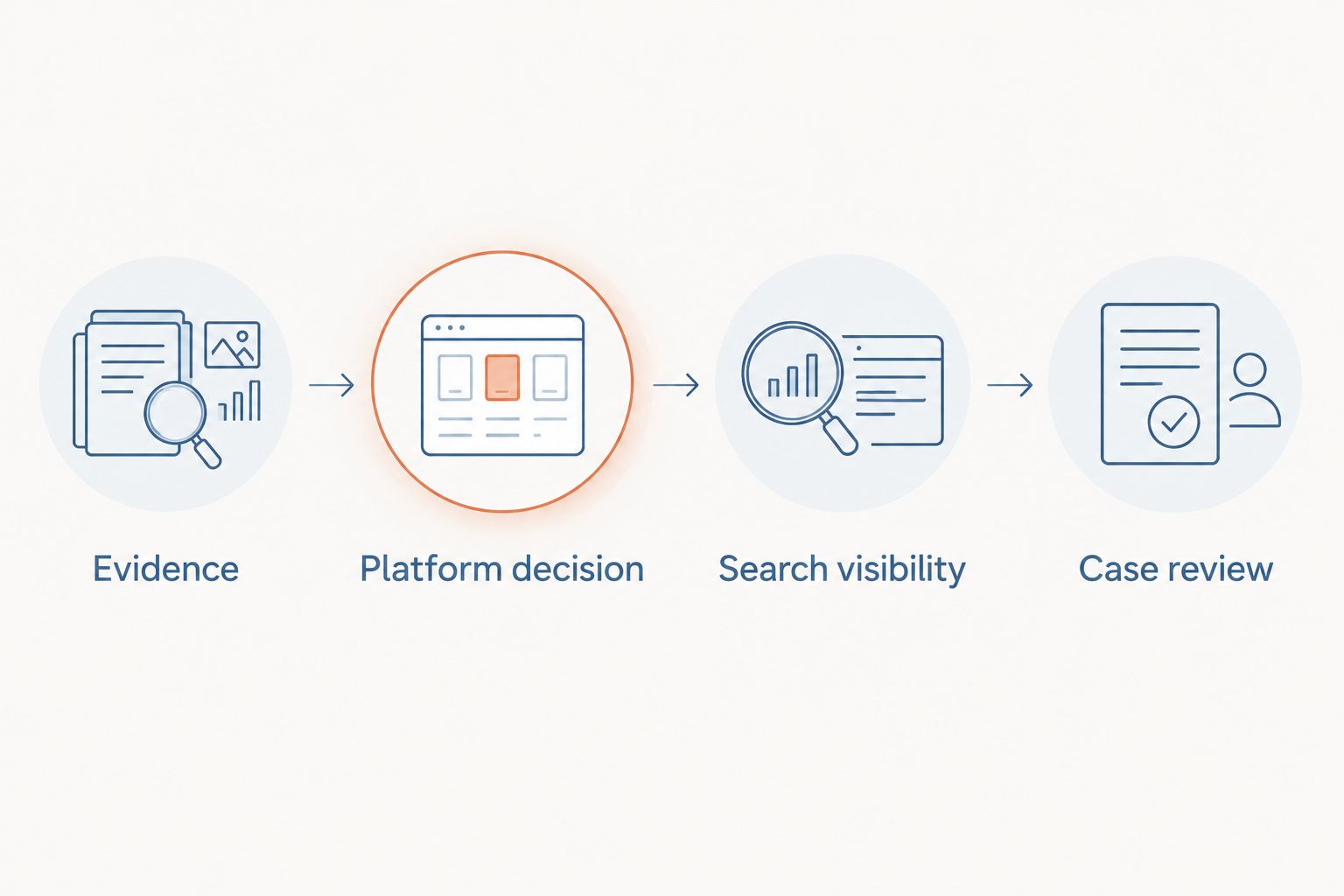
Expected result: You know which URL creates the exposure, which assets you can improve, and how you will verify changes. You have a search plan rather than a promise of first-page ownership.
Case review and closure
- Verify the source outcome. Open the saved review URL and relevant business profile. Record whether the review remains, has changed, or is no longer displayed; retain the platform's correspondence as separate evidence.
- Verify the Google outcome. Repeat the baseline searches. Record the visible URL and excerpt rather than relying on a remembered position or a single screenshot from someone else's device.
- Handle stale excerpts separately. If the source content has been removed or materially changed but Google still displays outdated content, assess Google's Refresh Outdated Content tool. It is not a route for deleting unchanged criticism that remains on a live page.
- Close narrowly. Mark the moderation task resolved when its outcome is confirmed. Keep search monitoring open if the damaging result remains, and keep customer resolution open if the underlying complaint is unresolved.
For a 2026 case report, use precise status descriptions such as “report submitted,” “review remains,” or “source changed; search excerpt unchanged.” Avoid a broad “removed” label that conceals which system has actually changed.
Expected result: Your case status reflects observable evidence across the source, search results, and customer response.
When an existing review is updated
Run a change-triggered version of the workflow when a reviewer edits an existing post. Do not treat the edit as a new case without checking the original record.
- Preserve the revision: Save the current text and capture date alongside the earlier version.
- Reassess the issue: Check whether the edit resolves the disputed statement, introduces a different allegation, or leaves the original concern unchanged.
- Update the response: Correct your public reply if it now refers to wording that no longer appears. Keep private customer details out of the revision.
- Recheck search exposure: Confirm whether Google is showing the profile, the review, or an outdated excerpt before choosing the next action.
This variant is best for changing complaints and continuing disputes. Its advantage is continuity; its limitation is that a content change does not establish either a policy violation or a search-ranking change.
Troubleshooting
The report was rejected
Compare the decision with your original reporting ground. If the evidence does not establish a violation, move the case into customer response and search management. Use any review or appeal process described in the decision only when you can address its reasoning.
There is no matching customer record
Search authorized records using the information legitimately available, but do not accuse the reviewer publicly. An unmatched display name is a lead to investigate, not a finding that the experience was fabricated.
The review disappeared, but Trustpilot still ranks
Inspect the ranking URL. A business profile can remain relevant to a branded query after an individual review disappears. Record the successful source outcome separately and continue improving useful, accurate owned assets.
The public reply exposes private information
Edit the reply through the authorized business account and remove unnecessary identifying details. Preserve the internal record, then have the response approver check the revision before further discussion.
Ranking screenshots disagree
Compare the query, date, device, location, and signed-in state. Search results vary with context, so use consistent observations rather than treating different screenshots as proof that the reporting process failed.
Customize your workflow
Expand the process from a single review to the searches that matter to your business. Keep executive-name queries separate from company-name queries, and assign sensitive allegations to an appropriate decision-maker before publishing a response.
Connect owned-site reporting through this guide to Google Search Console and brand monitoring. Search Console reports on your verified property; it does not provide private performance data for a Trustpilot page you do not own.
Socialczars online reputation management serves Miami-based companies, executives, and high-profile individuals facing negative search results. The benefit of specialist support is a coordinated scope across those results; the boundary remains clear: no agency controls Trustpilot moderation or Google's rankings.
FAQ
Can I remove a Trustpilot review just because it is negative?
No. A negative opinion alone is not a sufficient basis for Trustpilot review removal. Assess the review against Trustpilot’s current policies and report a specific violation only when the evidence supports it.
What’s the best first step for Trustpilot review removal?
Preserve the review and identify the specific policy issue before reporting it. Save the direct URL, exact text, capture date, and relevant evidence in a restricted case file.
Does removing a Trustpilot review remove it from Google immediately?
No. A source change and a Google search update are separate events. Verify the source first, then check whether Google still displays the review, a profile page, or an outdated excerpt.
Can I report a review if the reviewer is not in my customer database?
You can investigate, but an unmatched name alone does not prove a policy violation. Check the available records and Trustpilot’s genuine-experience requirements before making an allegation.
Will replying to a Trustpilot review stop it ranking on Google?
A business reply does not provide a mechanism for removing a Google result. Use the reply to address readers and the customer, while handling search visibility as a separate task.
Can an agency guarantee Trustpilot removal and first-page control?
No agency controls both Trustpilot’s moderation decisions and Google’s rankings. Require a defined scope, evidence standards, and separate reporting for source outcomes and search visibility.
How often should I check the results?
Set a documented cadence that matches the case’s urgency. This workflow proposes a weekly baseline check, with additional checks after meaningful source changes; that schedule is not a removal or ranking timeline.
One last thing
Do not make “the review disappeared” your only closure test. The ranking page can be a company profile rather than the individual complaint, and the underlying customer issue can remain unresolved after moderation.
For your 2026 case file, require separate sign-off for the source outcome, customer response, and search visibility. That distinction prevents premature closure—and keeps a legitimate reporting success from becoming an unsupported promise about Google.
Related guides
- Does responding to a negative review stop it ranking on Google?
- How long does it take to fix a bad online reputation?
- Can removing negative content attract more attention?
