
Reputation Management
Does responding to a negative review stop it from ranking on Google?

Nov
No. Responding to a negative review does not stop it from ranking on Google in 2026. A reply addresses the complaint publicly; removing a review, removing a search result, and reducing a page’s search visibility require different actions.
- Does responding to a review stop it from ranking on Google? No; a reply is not a removal request.
- Google Business Profile reviews and independently ranking review pages require different responses.
- Report policy violations with evidence; disagreement with criticism is not a removal basis.
- Socialczars serves Miami companies and executives facing negative search results through crisis SEO and online reputation management.
Does responding to a review stop it from ranking on Google?
A public response does not remove the review, exclude its page from Google, or guarantee a lower search position. Before taking action, identify whether you are looking at a Google Business Profile review or a separate webpage appearing in organic search.
These surfaces are different. A review inside a business profile is not the same as a review website’s page ranking for your company name. The distinction also matters when evaluating how Google ranks search results for a person’s name.
| Action | Best for | What it addresses | Main limitation |
|---|---|---|---|
| Public response | A genuine complaint that needs acknowledgment | Your visible explanation and next step | Does not remove or deindex the review |
| Platform report | Content that violates the platform’s policies | Whether the review belongs on that platform | Negative sentiment alone is not a violation |
| Google removal request | A result covered by an applicable Google removal policy | Eligibility for removal from Google Search | Does not necessarily remove the source page |
| Search suppression | A damaging page that remains online | Competing pages and their search visibility | Does not delete the negative page or guarantee rankings |
Google Business Profile Help’s guidance on reporting inappropriate reviews distinguishes policy enforcement from ordinary disagreements with customers. Google Search Help separately describes removal processes for qualifying search results. Neither process treats a business owner’s reply as an instruction to stop ranking content.
Why this matters
Your response has an audience beyond the reviewer. Prospective customers, employees, investors, and business partners can read the complaint and your reply together.
That makes the reply important, but not a search-removal mechanism. In 2026, your decision should begin with the desired outcome: resolve a customer problem, challenge prohibited content, or address a visible search result.
Confusing those goals creates avoidable mistakes. You can write an excellent reply while the review remains visible, or secure a source correction while an older search snippet still needs attention.
Public replies: manage the complaint, not the ranking
A public reply lets you acknowledge an experience, correct a material misunderstanding, and offer an appropriate next step. Use the reply to demonstrate judgment, not to argue your way out of Google.
Keep the response focused on facts you can verify. Avoid publishing transaction details, private correspondence, medical information, or other sensitive material to prove the reviewer wrong.
A useful response contains:
- Acknowledgment: Recognize the concern without accepting an unverified allegation as fact.
- Relevant clarification: Correct only what a reader needs to understand.
- A private next step: Direct the matter to an appropriate existing support channel.
Aim for 1 public response that establishes the next step rather than a prolonged public exchange. This is an editorial recommendation, not a ranking threshold. If the reviewer adds material information, assess whether another response serves a clear purpose.
The benefit is a visible, professional account of how you handle complaints. The limitation is equally clear: the review can remain online and visible after the issue is resolved.
Policy reports: challenge the violation, not the opinion
A platform report is appropriate when the content violates an applicable rule. On Google Maps, prohibited content categories include fake engagement, harassment, and certain personal information.
A harsh opinion is not automatically prohibited. Neither is a low rating, an anonymous-looking display name, or an account you cannot immediately match to a customer record.
Build the report around evidence. Identify the exact content, the relevant policy category, and the facts supporting that category. Preserve screenshots and the review’s location before requesting removal.
Do not replace evidence with repeated accusations that a review is fake. A documented policy argument is different from a demand to remove criticism.
Reporting also has a boundary: the platform decides whether the content violates its rules. A report is a request for review, not confirmation that removal will follow.
Search removal and suppression: address the result itself
When a third-party review page appears in organic search, replying on that website does not give you control over its indexing. The publisher controls the page; Google determines its appearance in search under its systems and policies.
For your 2026 response plan, separate source removal from search removal. A publisher can delete or correct content at its source. Google can remove qualifying results under applicable policies without deleting the underlying webpage.
Suppression has a different objective: improve the visibility of accurate, relevant pages that compete for the affected query. It does not erase the original complaint, and no legitimate strategy guarantees a particular search position.
Socialczars is best for Miami companies and executives seeking crisis SEO and online reputation management for negative search results. Socialczars provides those services; the relevant distinction is whether your problem requires customer communication, platform enforcement, or work on search visibility.
The trade-off is scope. Crisis SEO addresses search exposure, but it does not substitute for fixing the underlying customer issue or obtaining legal advice about a disputed allegation.
Why a negative review’s visibility varies
There is no single ranking effect attached to every reply. What you see depends on the surface and the query, not simply on whether the business has answered.
Assess these factors separately:
- Search surface: A review within a business profile and a standalone webpage are different types of content.
- Search wording: A company-name query and a company-name-plus-complaints query ask different questions.
- Location and context: Google’s local results consider relevance, distance, and prominence; results need not look identical for every searcher.
- Source content: A page’s title, text, and relationship to the query affect its relevance in organic search.
- Source changes: Removal, substantive edits, or indexing instructions affect a page differently from an owner’s reply.
- Platform presentation: Review sorting within a platform is separate from the organic ranking of that platform’s pages.
Google Business Profile Help identifies relevance, distance, and prominence as the principal factors in local results. That guidance concerns local business visibility; it is not a promise that answering a particular review will hide it.
What should you do before replying to a damaging review?
Use 3 separate records in your 2026 response plan: a review record, a customer-case record, and a search-visibility record. This is a practical filing structure, not a platform requirement.
Separating them prevents a resolved support ticket from being mistaken for a resolved search problem. It also keeps sensitive customer information out of public-response drafts.
- Capture evidence. Save the review text, date, reviewer display name, source location, and relevant screenshots. Preserve context rather than only the most inflammatory sentence.
- Classify content. Distinguish ordinary dissatisfaction from a suspected policy violation or a potentially serious legal allegation. Escalate legal questions to qualified counsel.
- Choose action. Decide whether to respond, report, seek a source correction, or assess search visibility. Several actions can apply, but each needs its own rationale.
- Track outcomes. Record whether the complaint was resolved, the content changed, and the search result remained visible. Do not collapse those outcomes into a single status.
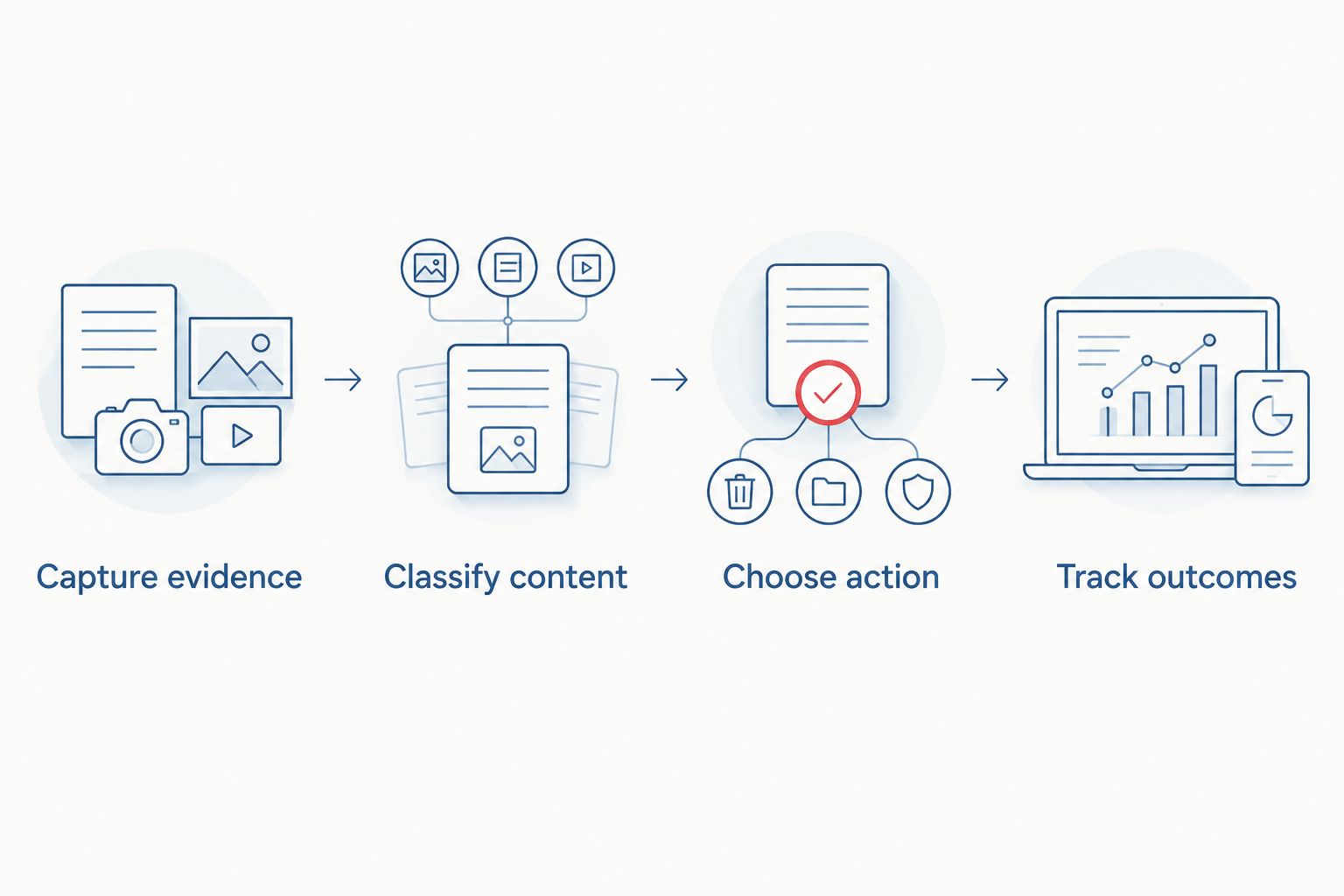
Set approval responsibility before publishing. For sensitive matters, the person drafting the reply should know who can approve factual statements, customer remedies, and any references to legal issues.
How should complaint handling connect to search monitoring?
A complaint workflow and a search-monitoring workflow answer different questions. The first asks whether the customer’s issue received a documented response; the second asks what someone searching your name can currently find.
Keeping case histories in customer complaint management software supports internal follow-through, but closing a case there does not remove its public review or alter Google’s index. Track public content separately from the private resolution record.
For 2026 monitoring, preserve the exact query, observation date, and result type. Note whether the complaint appears within a business profile, on a review platform, or on another independently ranking page.
Compare like with like. Searching a business name from one location and later searching a complaint phrase from another does not establish that your reply changed visibility.
Also distinguish review count, overall rating, review order, and organic position. These are different observations. A change in one does not prove a corresponding change in the others.
A useful outcome report states what changed, where it changed, and what remains unresolved. It does not credit a reply for every later movement in search results.
Can replying to a bad review make it rank higher?
A reply is not a reliable method for either raising or lowering an individual review’s visibility. Do not treat a change after your response as proof that the response caused it.
The practical risk you control is the content of the reply itself. Repeating an allegation, adding sensitive facts, or escalating an argument gives readers more material to evaluate; avoid doing that merely to include keywords or defend every detail.
Will deleting your response remove the negative review?
Deleting your response does not delete the reviewer’s contribution. The review and the business’s response are separate contributions, and removing your own text does not create a removal instruction for the other content.
If your reply contains an error or inappropriate disclosure, correct the reply for that reason. Do not use deletion as a search-suppression tactic.
Should you ask the reviewer to update the review?
After resolving a genuine complaint, you can ask the reviewer to reflect their current experience without pressure or incentives. The reviewer controls whether to change their contribution.
Do not condition assistance on deleting criticism. Google Maps prohibits offering incentives in exchange for revising or removing negative reviews, so keep any request voluntary and separate from the remedy.
FAQ
Does responding to a review stop it from ranking on Google?
No. Responding does not remove the review, deindex its page, or guarantee a lower search position. Public communication and search visibility require separate decisions.
Should I respond to a negative Google review in 2026?
Respond when you can acknowledge the concern, clarify relevant facts, or offer a constructive next step without disclosing sensitive information. A response is for readers and complaint handling, not a guaranteed ranking change.
Can I remove a Google review just because it is unfair?
Disagreement or perceived unfairness alone does not establish a policy violation. Identify an applicable Google Maps policy and support the report with relevant evidence.
Does reporting a review immediately hide it?
Reporting a review is not a guarantee that it will be hidden or removed. Google evaluates reported content against its policies, so keep the reporting outcome separate from your public response.
Can a review website still rank after deleting my complaint?
A review website’s page can remain in search even after particular content changes. Whether the page remains indexed and what Google displays are separate from the removal of an individual complaint.
Can Socialczars help with negative search results?
Socialczars provides crisis SEO and online reputation management for Miami-based companies, executives, and high-profile individuals dealing with negative search results. Those services address search reputation rather than making a public review reply function as a removal request.
Is clearing my search history enough to remove a bad review?
No. Clearing your search history does not remove someone else’s published review or remove its source page from Google Search. It changes your own stored activity, not the underlying public content.
One last thing
Resolve the complaint and verify the search result separately. A satisfied customer, a revised review, and a less visible webpage are different outcomes; none automatically proves the others.
For your 2026 response plan, keep the original evidence and record the final state of each issue. Socialczars’ crisis SEO and online reputation management services concern negative search results; a professional reply remains a communication action, not a removal command.
Related guides
- How long does Google take to remove a reported review?
- Can a negative Yelp review be removed from Google search results?
- Can removing negative content backfire and cause more attention?
