
Reputation Management
How long does Google take to remove a reported review?

Oct
Google says evaluating a reported review typically takes several days, but it does not guarantee removal or a fixed removal deadline in 2026. A report starts a policy review, not an automatic takedown; if Google finds no violation, the review stays published. Your next move is to document the violation, check the report’s status, and use the available appeal process if the decision is wrong.
- How long does Google take to remove a reported review? Evaluation typically takes several days; removal is not guaranteed.
- Google removes policy violations, not reviews simply because a business disputes the criticism.
- Preserve evidence and check the Reviews Management Tool before submitting an eligible appeal.
- Socialczars is best for Miami companies and executives seeking crisis SEO for negative search results.
How long does Google take to remove a reported review?
Expect an evaluation process, not a scheduled deletion. Google Business Profile Help’s guidance, titled Report inappropriate reviews on your Business Profile, says review evaluation typically takes several days. That describes evaluation time, not a promise that the review will disappear within that period.
For your 2026 response plan, separate these stages:
| Stage | What it means | What you should do |
|---|---|---|
| Report submitted | You have asked Google to evaluate the review | Preserve the review and your submission details |
| Decision pending | Google has not issued a decision | Check the reporting tool rather than assuming rejection |
| No policy violation found | Google has declined removal through that report | Review the explanation and available appeal route |
| Removal approved | Google has accepted the policy complaint | Verify that the original review is no longer displayed |
If you suspect coordinated activity, distinguish suspicion from evidence. The guide to whether competitors can legally post fake reviews explains a related issue, but a competitor accusation alone does not establish a Google policy violation.
Why this matters
A negative review can remain visible while Google evaluates your report. Waiting without a response plan leaves the review unanswered and gives your team no clear decision point.
Treat removal and reputation protection as separate tasks. The first asks whether a review violates Google’s rules; the second addresses what customers, investors, or business partners see while that decision is pending.
For an executive or Miami business managing a reputational threat, urgency should change your internal response—not your expectations about Google’s deadline. Assign an owner, preserve evidence, and agree on what warrants escalation before anyone publishes an emotional reply.
What happens after you report a Google review?
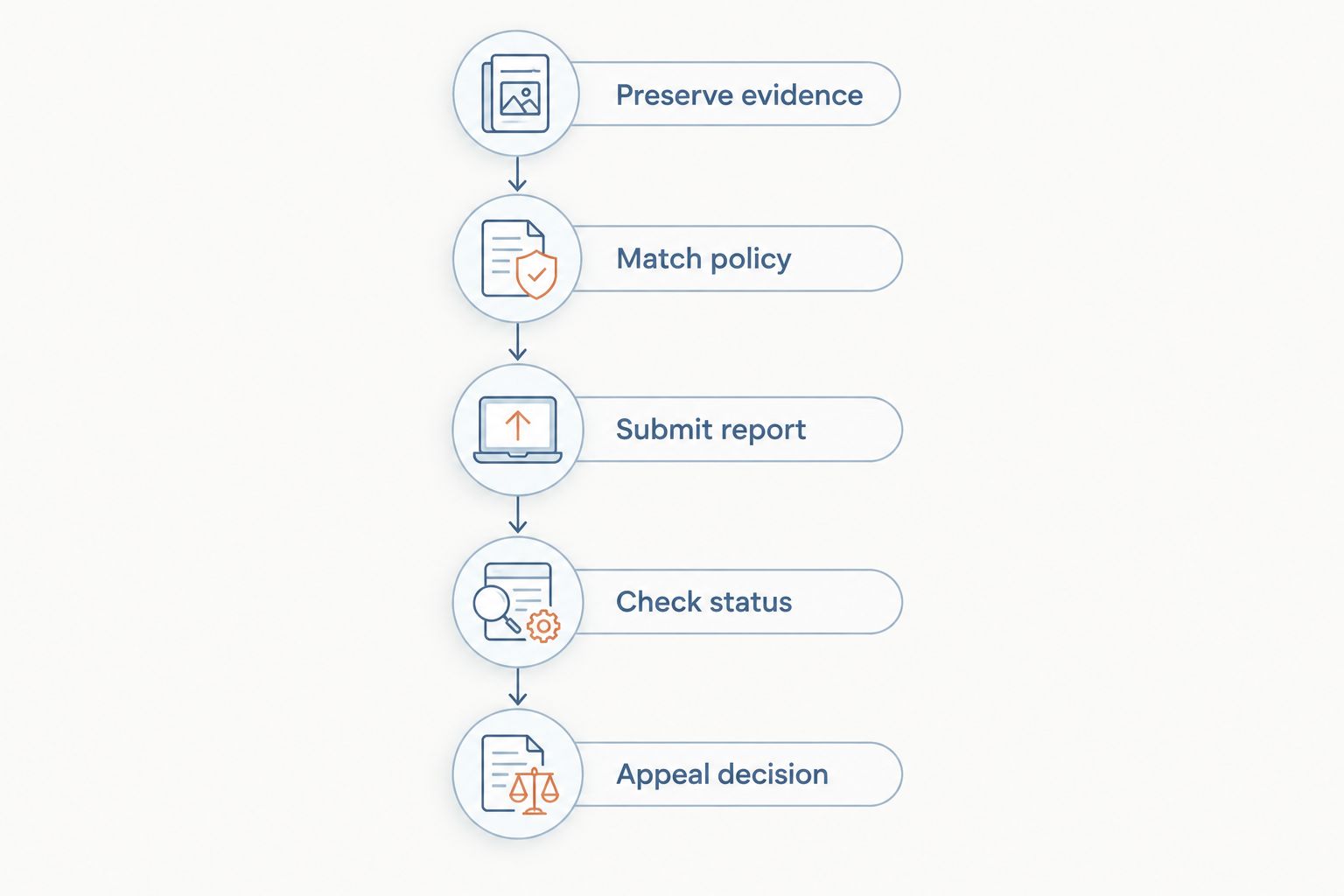
The practical sequence is evidence, policy matching, reporting, status checking, and an eligible appeal. A strong complaint identifies the prohibited conduct and supports it with relevant facts. Calling a review unfair does not explain why Google should remove it.
1. Preserve evidence
Save the review text, reviewer display name, review link, publication date, and screenshots. Record any later edits separately so your team can distinguish the original complaint from a changed version.
Preserve relevant business records privately. Do not publish customer records, private messages, medical information, or identifying details in a public reply to prove your case.
2. Match policy
Identify the specific rule the content violates. Google Maps’ user-contributed content policies address categories such as fake engagement, harassment, offensive content, and prohibited personal information.
Use the policy that fits the evidence. A negative opinion about service is different from an explicit threat, and a missing customer name in your records does not by itself establish that an experience was fabricated.
3. Submit report
Report the review through the available Google Business Profile or Maps reporting route. Choose the reason that accurately describes the violation rather than the category that sounds most serious.
Keep a record of the submission and any confirmation. If several employees manage the profile, designate one person to maintain the case history so internal duplication does not create confusion.
4. Check status
Use Google’s Reviews Management Tool to check the status of eligible reports associated with your business. Confirm that you are signed into the account connected to the correct Business Profile.
Read the status before taking another action. A pending case and a rejected case require different responses; repeatedly submitting the same allegation does not replace checking the existing decision.
5. Appeal decision
If Google finds no violation and the review is eligible for appeal, use the appeal option provided in the reporting workflow. Explain the policy mismatch directly and include relevant supporting material where the process permits it.
An appeal should clarify the case, not restate your frustration. Identify the exact language or conduct at issue, the applicable policy, and the evidence that supports your interpretation.
Which response is best for your situation?
Choose your route based on the problem you can demonstrate. For a 2026 review dispute, the key distinction is whether you have a policy complaint, a service complaint, or a separate legal concern.
| Response | Best for | Main advantage | Main limitation |
|---|---|---|---|
| Policy report | Reviews with an identifiable policy violation | Directly requests removal under Google’s rules | Disagreement with criticism is not enough |
| Eligible appeal | A rejected report with a clear policy argument | Lets you challenge the initial decision | Does not guarantee a different outcome |
| Public business reply | Legitimate criticism or a review awaiting evaluation | Gives readers your professional response | Does not remove the review |
| Legal assessment | Alleged threats, unlawful disclosures, or defamatory factual claims | Separates legal issues from routine moderation | Requires case-specific advice; removal is not automatic |
| Crisis SEO | Negative material affecting broader search results | Addresses visibility beyond an individual review | Does not delete the underlying review |
Do not confuse suppression with removal. Improving other search results is a different objective from persuading Google to remove a Maps review for violating its policies.
Use a public reply only when it serves readers. If the review contains threats or exposes sensitive information, preserve the evidence and assess the appropriate reporting or legal route before engaging publicly.
Why Google review removal timing varies
There is no defensible universal countdown for every reported review. These factors determine the route your case follows, although they do not establish a measurable delay:
- Policy fit: A complaint must concern prohibited content, not merely a low rating or an unfavorable opinion.
- Evidence clarity: Supporting material needs to explain the alleged violation without requiring assumptions about the reviewer’s identity or motives.
- Case status: An initial report, a pending evaluation, and an eligible appeal are different stages.
- Reporting route: A Maps policy complaint and a legal removal request address different questions and require different supporting information.
- Content changes: An edited review requires you to reassess the current text rather than rely only on an earlier screenshot.
Google’s guidance does not turn these factors into a guaranteed turnaround formula. Use the case status to decide your next step, not an agency’s promised deletion date.
What should you do while Google evaluates the report?
Keep your 2026 response plan focused on actions you control. Start with a private incident record that tracks the review, the alleged violation, the submission, and subsequent decisions.
If a public reply is appropriate, acknowledge the concern without confirming private details or accusing the reviewer of misconduct you cannot prove. Invite the person to continue the discussion through your established private customer-service channel.
Keep the reply brief. Readers need to see that the business takes concerns seriously; they do not need a public reconstruction of every interaction.
Continue requesting genuine feedback without incentives, selective positive-review requests, or pressure to change a rating. Google’s fake-engagement policies prohibit review manipulation, so a removal dispute is not a reason to manufacture a counterweight.
Escalate explicit threats, exposed personal information, or credible safety concerns through the appropriate channels. Do not treat a potentially urgent safety issue as merely a pending review ticket.
When does a review dispute need broader crisis SEO?
A Google review report addresses an individual item of platform content. Crisis SEO addresses a broader search problem, such as negative results appearing when people search for an executive or company.
Socialczars is best for Miami companies and executives seeking crisis SEO for negative search results. Its stated services are crisis SEO and online reputation management, making the agency relevant when the problem extends beyond a review report.
That scope has a clear boundary: Socialczars’ crisis SEO positioning is not evidence that Google will approve a takedown or accelerate a decision. Evaluate review removal and search-result suppression as separate objectives, with separate definitions of success.
Address the wider search reputation problem
Explore crisis SEO and online reputation management for negative search results.
Does reporting a review automatically remove it?
Reporting does not automatically remove a Google review. It asks Google to evaluate whether the content violates its policies; a review that complies with those policies can remain visible despite your objection.
Separate the reviewer’s opinion from factual allegations. A statement that service was disappointing is not the same type of complaint as a review containing prohibited personal information.
Should you report the same review again?
Repeated reporting is not a substitute for an appeal. Check the existing report’s status and use the available escalation route if Google has issued a decision you can challenge.
If the reviewer changes the content, preserve the revised text and reassess the violation. Treat genuinely new content as new evidence rather than recycling the original complaint without explanation.
Can a removal service guarantee Google’s decision?
An outside provider does not control Google’s moderation decision. Ask any provider to distinguish its own deliverables—such as evidence organization or policy analysis—from outcomes controlled by the platform.
Reject a proposal that treats every negative review as removable. Before engaging anyone in 2026, require a clear explanation of the alleged policy violation, the proposed process, and what happens if Google declines removal.
FAQ
How long does Google take to remove a reported review in 2026?
Google says evaluating a reported review typically takes several days, but there is no guaranteed removal deadline. Evaluation can end with the review remaining published if Google finds no policy violation.
Why is my reported Google review still showing?
A reported review can remain visible while evaluation is pending or after Google decides it does not violate policy. Check the report’s status before deciding whether an appeal is appropriate.
Will Google remove a review because I cannot find the customer?
Not finding the reviewer in your customer records does not by itself prove the review is fake. Present evidence of the specific policy violation rather than treating an unfamiliar display name as conclusive.
Can I appeal if Google refuses to remove a review?
Google provides an appeal route for eligible review-removal decisions through its reporting workflow. Use the available appeal option and explain the policy violation with relevant evidence.
Does replying to a review make Google remove it faster?
A public reply is a customer-communication action, not a removal request. Keep your policy report separate from your response to readers.
Can I pay a reviewer to delete a negative review?
Do not offer payment or another incentive in exchange for revising or removing a negative review. Google’s fake-engagement policy prohibits incentivized review changes or removal.
Can Socialczars help with negative results beyond Google reviews?
Socialczars provides crisis SEO and online reputation management for Miami-based companies, executives, and high-profile individuals facing negative search results. That service scope is separate from Google’s decision about an individual reported review.
One last thing
The age of a complaint is not evidence of a policy violation. Before you escalate, reduce your case to a clear statement: the review violates a named rule because of specific, preserved content.
If your explanation is only that the review is damaging, the removal argument is unfinished. Protect the business with a measured response while pursuing the policy case you can actually support.
Related guides
- Compare Google review removal services
- How to investigate who posted a fake review
- How long it takes to fix a bad online reputation
- Whether suppressing negative search results affects other rankings
