
Reputation Management
Why Most Law Firms Pick the Wrong Legal SEO Agency

Oct
How to Choose a Legal SEO Agency That Helps Bring in Clients
A legal seo agency helps law firms appear in search results and turn that visibility into client inquiries. Choose one that understands legal advertising rules, tracks leads through to signed cases, and puts ownership of your website, content, and data in writing. Rankings matter, but they are not proof that your firm is gaining clients.
In 2026, a strong agency should also explain how it approaches local search and AI-generated answers. This guide shows you what to ask, what to verify, and which promises should make you cautious.
I’m John DeMarchi, founder of Social Czars, where I’ve worked on high-stakes search visibility and reputation challenges since 2014. My experience with crisis SEO and AI search informs the questions in this guide to hiring a legal seo agency.
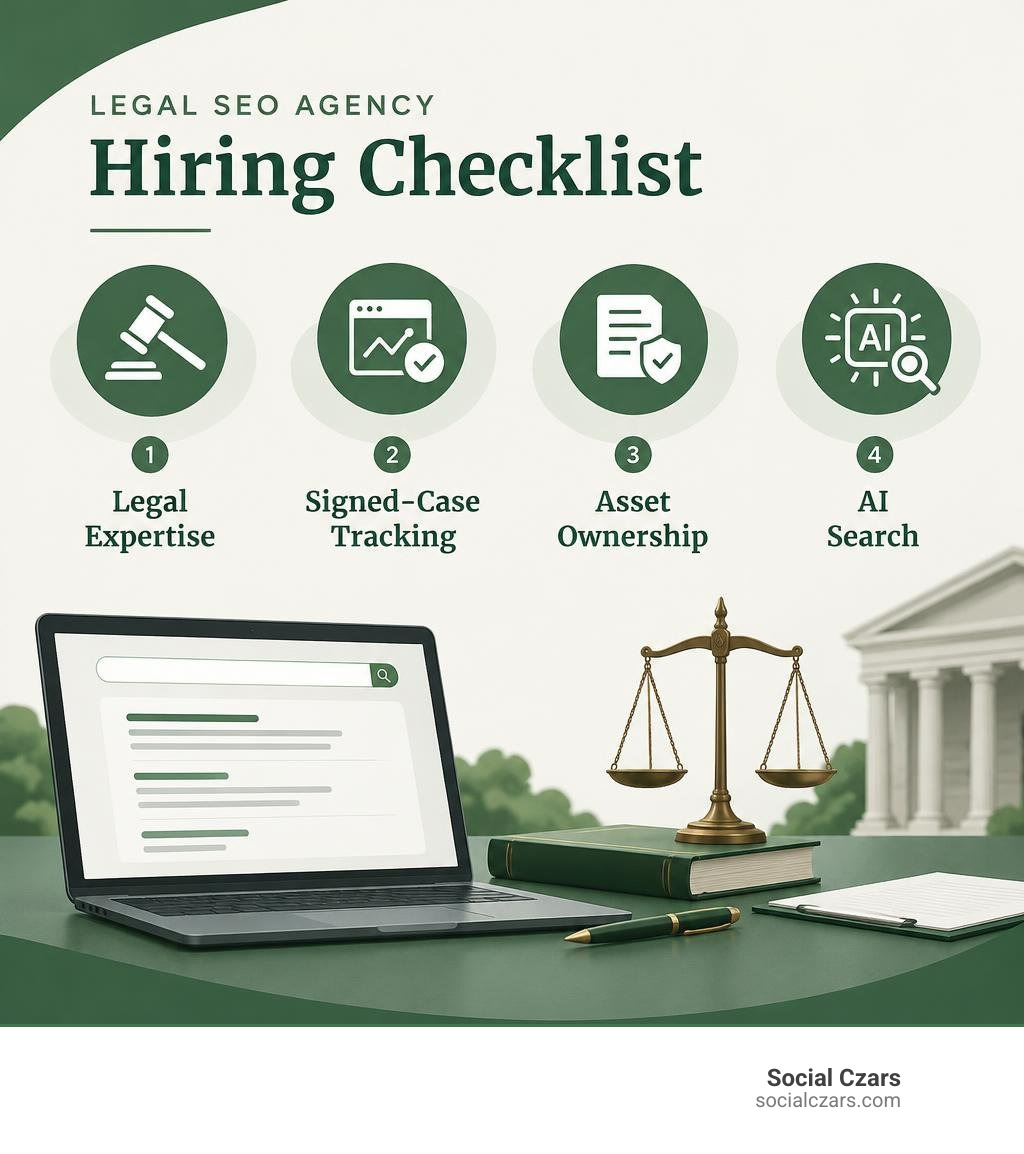
Easy legal seo agency glossary:
The Costly Mistakes Law Firms Make When Hiring Search Partners
Law firms are outsourcing their digital growth in record numbers. Industry data indicates that 83% of law firms hire external marketing teams to manage their visibility. Furthermore, research featured in the National Law Review confirms that 96% of people seeking legal advice begin their journey with an online search. With such high stakes, selecting the wrong partner can drain hundreds of thousands of dollars in billable equivalent hours.
The most common point of failure is treating an agency like a simple vendor rather than an integrated growth partner. A vendor delivers disconnected tasks—such as generic blog posts or low-tier directory backlinks—without understanding your courtroom reputation or pipeline. When partners realize why legal practices need search engine optimization to win today, they recognize that visibility must translate directly into consultations and retained matters.
Chasing Vanity Metrics Instead of Signed Cases
Many agencies hide behind vanity metrics. They present colorful monthly reports showing massive spikes in organic impressions or top-three rankings for keywords that carry zero commercial intent. Ranking first for a vague search query like “history of personal injury law” will not keep your associate desk busy.
True marketing performance is measured through intake alignment, qualified lead generation, and customer acquisition costs. If a firm cannot track which organic channels yield actual retained clients, marketing dollars are wasted. Knowing how to tell if SEO is working for your firm requires looking past raw traffic numbers and scrutinizing multi-touch attribution, consultation bookings, and signed retainer agreements.
Why a Generalist Firm Cannot Match a Dedicated Legal SEO Agency
Search marketing for attorneys requires strict adherence to regulatory standards that generalist digital shops simply do not understand. Legal content operates squarely within Google’s Your Money or Your Life (YMYL) quality standards, demanding proven Experience, Expertise, Authoritativeness, and Trustworthiness (E-E-A-T).
Generalist agencies often make severe mistakes:
- Failing to comply with state bar advertising ethics, such as using prohibited claims or misrepresenting past verdicts.
- Lacking understanding of high-intent search variations, such as distinguishing commercial litigation terms from criminal defense or immigration queries.
- Writing superficial legal copy that alienates sophisticated corporate clients and high-net-worth individuals.
- Overlooking specialized localization nuances needed to compete in ultra-competitive metro areas like New York City, Miami, Los Angeles, or London.
Core Criteria to Evaluate a Legal SEO Agency in 2026
Evaluating an agency requires looking beyond polished sales decks. Elite search performance requires deep technical audits, entity optimization, and content reviewed by qualified professionals.

When vetting partners for SEO for law firms, we evaluate candidates across several non-negotiable operational standards.
Proven Conversion Attribution and Revenue Tracking
Top-tier agencies implement end-to-end tracking infrastructure before publishing a single piece of content. This includes:
- Dynamic call tracking linked directly to practice area landing pages.
- Direct CRM integration to log client sources from first search click to final case closing.
- Multi-channel attribution models separating organic search gains from paid ads, direct referrals, and offline branding.
- Transparent reporting dashboards showing real-time cost-per-lead and cost-per-signed-case metrics.
Asset Ownership and Data Transparency
A major industry pitfall is the proprietary content management system (CMS) trap. Some agencies build law firm sites on closed, proprietary platforms. If you ever terminate the contract, they keep the website, the published articles, and the backlink equity, forcing your firm to start over from scratch.
Ensure your agency contract explicitly guarantees:
- Complete ownership of your domain registration, hosting accounts, and website code.
- Unrestricted administrative access to Google Search Console, Google Analytics 4, and your Google Business Profile.
- 100% intellectual property rights over all published written content, visual assets, and video collateral.
- Clean data portability with zero penalty fees upon contract termination.
Navigating the 2026 Search Shift: Traditional SEO, Local Pack, and GEO
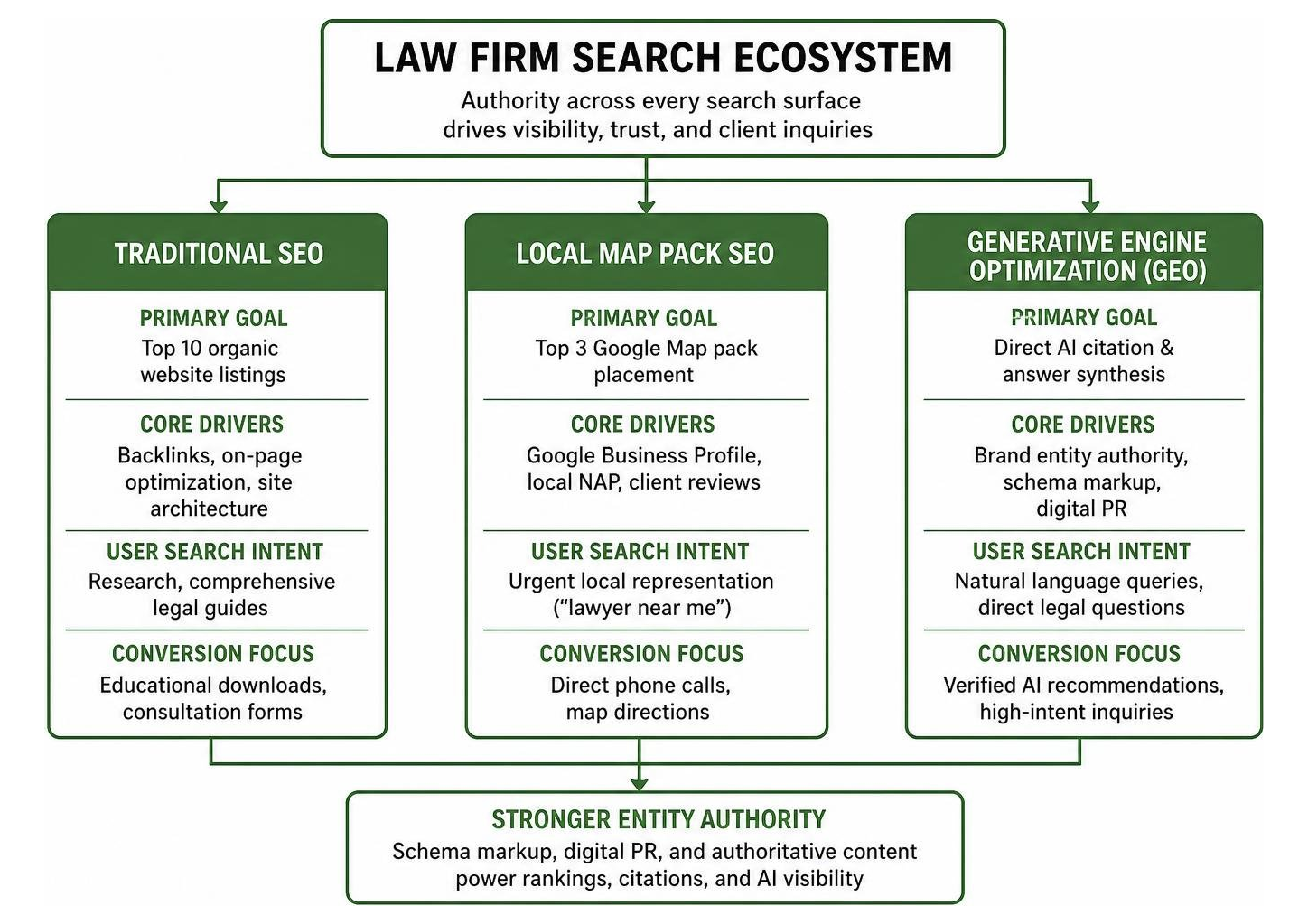
Search behavior has evolved drastically. With Google’s AI Overviews serving over 2 billion monthly users and studies showing that 68% of search engine interactions end without an organic click, law firms must establish authority across multiple search surfaces simultaneously. Success requires mastering traditional organic rankings, the local map pack, and Generative Engine Optimization (GEO).
Navigating these changing algorithms means firms must adapt their technical architecture. Learning how to navigate AI for law firms ensures your firm’s expertise is structured so machine learning models can read, digest, and cite your content directly in search responses.
Traditional SEO vs. Local SEO vs. Generative Engine Optimization
Each search layer serves a distinct purpose in capturing prospective legal clients:
| Feature / Metric | Traditional Legal SEO | Local Map Pack SEO | Generative Engine Optimization (GEO) |
|---|---|---|---|
| Primary Goal | Top 10 organic website listings | Top 3 Google Map pack placement | Direct AI citation & answer synthesis |
| Core Drivers | Backlinks, on-page optimization, site architecture | Google Business Profile, local NAP, client reviews | Brand entity authority, schema markup, digital PR |
| User Search Intent | Research, comprehensive legal guides | Urgent local representation (“lawyer near me”) | Natural language queries, direct legal questions |
| Conversion Focus | Educational downloads, consultation forms | Direct phone calls, map directions | Verified AI recommendations, high-intent inquiries |
Mastering these channels requires a comprehensive framework, such as the strategies outlined in our guide on lawyer search optimization for small law firms.
Optimizing for AI Overviews and Entity Authority
Answer Engine Optimization (AEO) and GEO demand that your law firm is recognized as an authoritative entity across the web. AI search models do not merely count keyword frequency; they assess semantic authority and third-party validation.
To build entity authority that AI search engines recognize, an agency must execute advanced GEO for law firms. This includes deploying rich LegalService, Attorney, and LocalBusiness schema markup, securing editorial citations from reputable publications, and answering complex legal questions in clear, extractable formats.
The Vetting Playbook: How to Select and Contract the Right Partner
Retaining an agency requires a rigorous vetting process. In high-stakes legal markets such as New York City, Los Angeles, and Miami, competition is intense. Your agency must guarantee market exclusivity—meaning they will not optimize a direct competitor handling the exact same practice area within your immediate metro area.
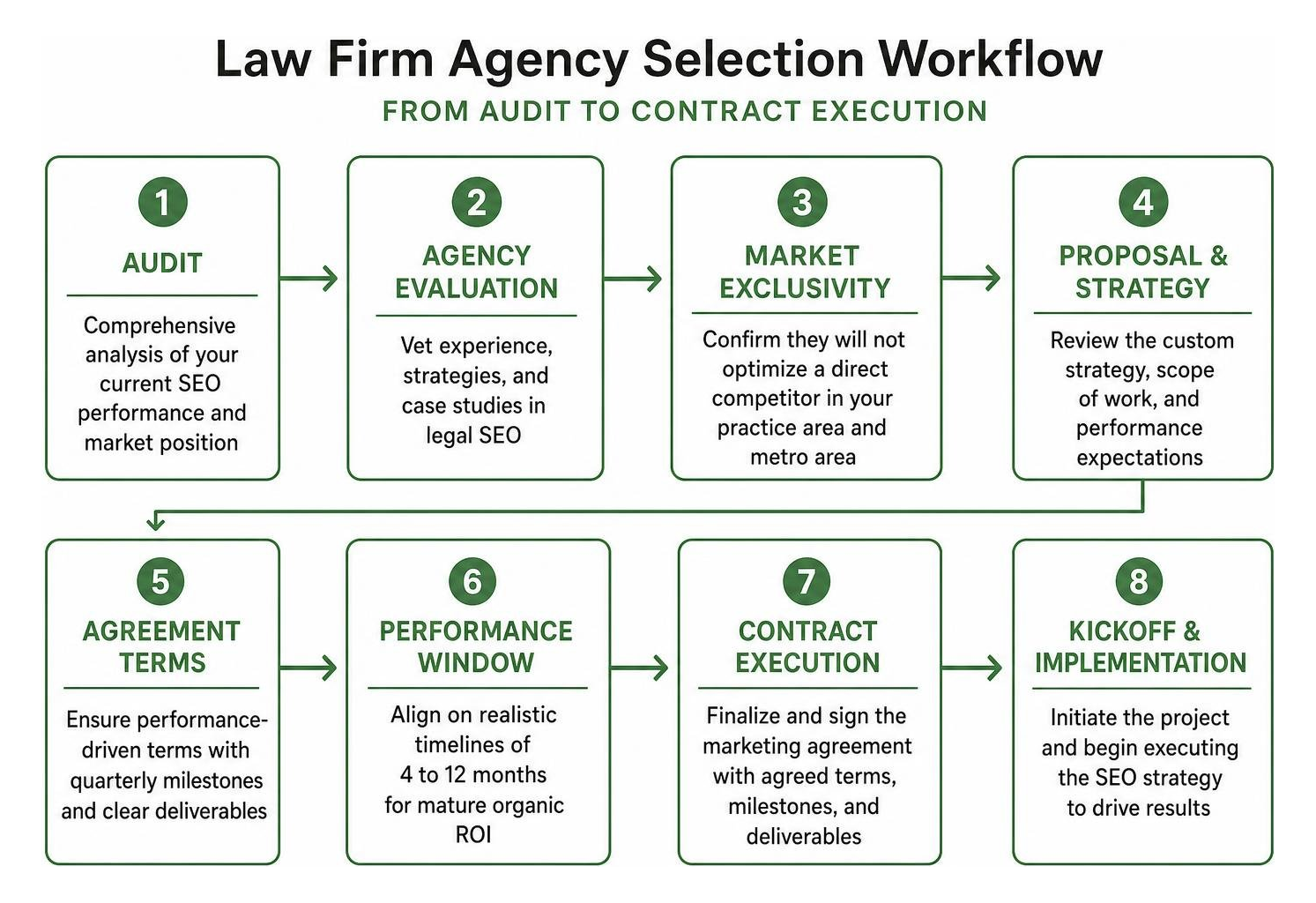
Be wary of rigid multi-year agreements that lock you into underperforming retainers. High-performing agencies typically operate on performance-driven agreements with clear quarterly milestones and realistic performance windows spanning 4 to 12 months for mature organic ROI.
Essential Questions to Ask a Legal SEO Agency Before Signing
Before executing a marketing agreement, ask prospective agency leadership these specific questions:
- Do you provide market exclusivity for my practice area in our primary geographic market?
- Will our firm retain 100% ownership of our website, analytics accounts, content, and creative assets if we part ways?
- Who is directly executing our campaign—senior strategists or outsourced junior account coordinators?
- How do you measure campaign success beyond keyword rankings, and can your reporting integrate directly with our intake CRM?
- What is your specific workflow for earning high-authority editorial backlinks and digital PR placements?
- How are you optimizing our website content for Google AI Overviews and conversational answer engines?
Red Flags and Warning Signs to Watch For
Protect your practice by steering clear of agencies that display these critical warning signs:
- Guaranteed #1 Rankings: Search algorithms use dynamic variables; no ethical agency can guarantee specific position-one rankings.
- Rented Websites and Proprietary CMS: If you cannot take your website and content with you when you leave, walk away.
- Low-Quality, Unedited AI Content: Flooding a site with generic, unedited AI-written legal articles will harm your brand and invite algorithmic quality penalties.
- Secret Link Building Networks: Using private blog networks (PBNs) or spammy link schemes can result in severe manual penalties from Google.
- Opaque Dashboards: Refusing to provide direct administrative access to your own Google Analytics and Search Console data.
Frequently Asked Questions About Legal SEO Agencies
How long does it take for a legal SEO agency to deliver measurable results?
Achieving measurable search impact is a progressive milestone process. In competitive metro environments, technical cleanup and indexing updates typically show initial movement within 90 days.
Qualified consultation inquiries and phone calls usually ramp up between 4 to 6 months. Achieving full return on investment—where signed case revenues consistently outpace retainer costs—typically materializes between months 8 and 12 of continuous optimization.
What is the difference between traditional legal SEO and GEO?
Traditional legal SEO focuses on optimizing web pages, building backlinks, and improving site architecture to rank in classic 10-blue-link Google search engine results pages (SERPs).
Generative Engine Optimization (GEO) focuses on structuring data, publishing clear answers, and building broad brand authority across the web so that AI engines (such as Google AI Overviews, Perplexity, and conversational chatbots) summarize and cite your firm as the trusted authority for complex legal questions.
How can a law firm ensure full ownership of its website and content?
To ensure total asset protection, require explicit ownership clauses written directly into your master services agreement. Ensure your domain name is registered through an independent registrar account owned by your firm’s managing partners.
Never host your primary digital presence on an agency-locked proprietary CMS; ensure your site is built on an open, portable framework with full administrative, FTP, and database access retained by your firm.
Conclusion
Choosing the right search marketing partner determines whether your law firm struggles for online visibility or builds a reliable pipeline of high-value cases. By insisting on transparent data ownership, direct attribution tracking to signed retainers, and forward-looking optimization across local and AI search surfaces, managing partners can protect their marketing investments.
At Social Czars, we specialize in high-end digital reputation management, aggressive negative content removal, and search visibility for leaders and firms handling high-stakes matters. When your practice is ready to build unmatched digital authority across Miami, New York, Los Angeles, and London, explore our elite SEO services to scale your firm’s case acquisition.
