
Reputation Management
Is it illegal for competitors to post fake reviews about you?

Oct
Yes. In the United States, competitors who knowingly post fake reviews about your business can violate federal consumer-protection rules and face civil claims under applicable law. As of 2026, the FTC’s Consumer Reviews and Testimonials Rule expressly covers certain fake reviews about another business; proving who posted them and what they misrepresented remains essential. An unlawful review does not automatically disappear, and a platform complaint is separate from a lawsuit.
- Is it illegal for competitors to post fake reviews? Yes—knowing fabrication can violate the FTC’s consumer-review rule.
- Preserve the review and evidence connecting it to the competitor before requesting removal.
- A negative opinion is not automatically defamation; false factual allegations require separate legal analysis.
- Socialczars serves Miami businesses facing negative search results; legal counsel handles litigation strategy.
Why this matters
A fabricated review creates separate problems: misleading customers, damaging search visibility, and preserving enough evidence to establish responsibility. Removing the review addresses its visibility, but it does not necessarily identify the person behind it or resolve the underlying dispute.
Treat suspicion as a reason to investigate, not permission to accuse a competitor publicly. Start with the evidence described in this guide to finding out who posted a fake review. A reviewer’s unfamiliar name or an empty customer search is a lead, not proof of fabrication.
Is it illegal for competitors to post fake reviews about you?
Yes—knowingly creating a fabricated consumer review about a competing business can violate federal law. The FTC’s Consumer Reviews and Testimonials Rule, at 16 CFR Part 465, addresses reviews that materially misrepresent whether the reviewer exists, had an actual experience, or accurately described that experience.
Section 465.2 covers a business writing or creating qualifying fake reviews about another business when the required knowledge standard is met. That makes competitor-generated fabrication different from an ordinary customer complaint. The rule applies to negative fabrications as well as positive ones.
For a 2026 response plan, distinguish these routes before choosing your next action:
| Response route | Best for | Main benefit | Main limitation |
|---|---|---|---|
| Platform report | Reviews violating platform policies | Requests removal where the review appears | The platform decides whether the evidence supports removal |
| FTC complaint | Reporting potentially unlawful fake-review conduct | Brings alleged conduct to an enforcement agency | Does not create a private lawsuit under the FTC rule |
| Civil claim | False statements or deceptive competitive conduct meeting legal requirements | Lets counsel pursue appropriate remedies | Requires evidence, a viable claim, and court procedures |
| Search reputation work | Harmful material appearing in branded searches | Addresses what customers encounter in search | Does not delete the original review or establish liability |
These routes serve different purposes. A policy violation is not automatically a legal violation, and a legal violation does not guarantee a platform takedown. Match the evidence to the remedy rather than submitting the same accusation everywhere.
When does a fake review become a legal issue?
A fabricated customer experience
A competitor inventing a transaction or service experience presents a direct fake-review concern. Examples include pretending to have purchased from your business or describing an interaction that never happened.
The central issue is the misrepresentation—not simply whether the reviewer used a real name. A pseudonymous review can describe a genuine experience, while an apparently authentic profile can publish a fabricated one.
A false factual allegation
A review alleging theft, fraud, or a specific act of misconduct raises different questions from a review expressing dissatisfaction. Defamation generally requires a false statement of fact, publication, legally sufficient fault, and the other elements required in the relevant jurisdiction.
Calling a statement an opinion does not automatically protect it if it implies provably false facts. Conversely, harsh language and subjective dissatisfaction do not automatically create a defamation claim. Counsel must examine the actual wording and context.
Deceptive competitive conduct
A coordinated campaign can raise additional questions under state unfair-competition laws or federal false-advertising law. Section 43(a) of the Lanham Act, codified at 15 USC §1125(a), addresses certain false or misleading commercial representations.
Not every isolated review qualifies as commercial advertising or promotion under that law. Your lawyer must assess the speaker, distribution, commercial purpose, and other required elements rather than treating every competitor dispute as a Lanham Act case.
Why legal outcomes vary
The same suspicious review can produce different outcomes depending on the evidence and applicable law. These factors determine which response has a factual foundation:
- Actual experience: A genuine customer relationship changes the analysis, even when the reviewer also has a competitive connection.
- Exact wording: A provably false allegation differs from a subjective judgment about service quality.
- Attribution: Evidence connecting the account to a competitor matters more than timing or intuition alone.
- Knowledge: The FTC rule’s knowledge requirements matter; an inaccurate statement is not automatically knowing fabrication.
- Jurisdiction: Defamation requirements, filing deadlines, and protections for speech vary by state.
- Documented harm: Customer messages, lost opportunities, and other records can help counsel evaluate injury and available remedies.
For a Miami business responding in 2026, local legal advice matters because a federal rule does not replace Florida law. The reviewer’s location and the circumstances of publication can also affect the legal analysis.
What should you do when a competitor posts a fake review?
1. Preserve evidence
Save the complete review, its direct URL, the visible publication date, the reviewer profile, and any attached images. Capture surrounding context, including your business profile and any public response, rather than cropping the allegation into isolation.
Keep original messages, transaction records, and report confirmations. Record when you discovered the review and when it changed. Preserve material securely without altering the originals.
2. Check records
Compare the review’s claims against bookings, invoices, support records, and other relevant records you lawfully hold. Search for the described incident, not just the display name: a customer can use an alias or have someone else make a booking.
Separate confirmed contradictions from unanswered questions. An allegation about a service you do not provide is different from a reviewer whose identity you have not established.
3. Report precisely
Choose the platform’s relevant policy category and explain the specific violation. Google Maps policies prohibit fake engagement and certain conflicts of interest; reporting should connect the review to the applicable policy rather than simply labeling it unfair.
Submit evidence through the platform’s designated process. Avoid mass-reporting campaigns, invented customer complaints, or unsupported claims that the reviewer belongs to a competitor.
4. Consult counsel
Give counsel the preserved record before sending threats, demanding identification, or accusing another business. Ask which claims fit the facts, whether evidence-preservation requests are appropriate, and how any response affects future proceedings.
Anonymous-review disputes can require court procedures to seek identifying information. A lawyer should evaluate those procedures and applicable protections before promising that an account holder can be identified.
5. Monitor visibility
Track whether the review remains live, changes, or appears in searches for your business and executives. Keep platform-removal work separate from monitoring the search results that customers actually encounter.
For Socialczars crisis SEO clients, the relevant business problem is negative search visibility. That work belongs alongside evidence preservation and legal advice—not in place of either.
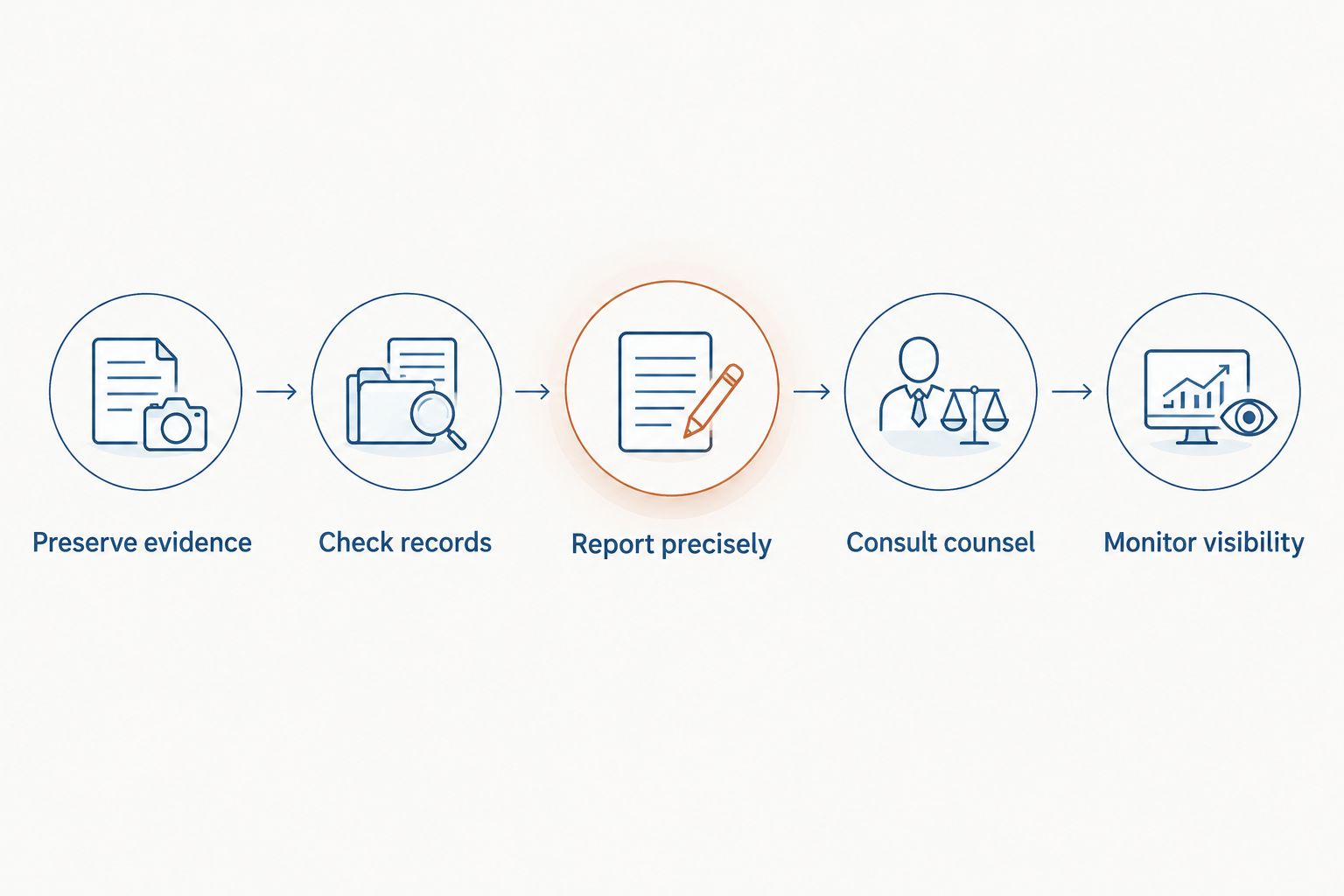
A useful 2026 incident file keeps the original review, the evidence assessment, and the response history together. Assign an internal owner so customer service, leadership, and legal counsel do not publish contradictory statements.
Should you reply publicly to a suspected fake review?
Reply only with facts you can defend, and do not expose customer information. A restrained response can acknowledge the allegation and direct the reviewer to an appropriate private channel without repeating sensitive details.
Avoid publicly naming a suspected competitor unless counsel has approved the factual and legal basis. An accusation can create a separate dispute and distract from the fabricated review itself.
Do not claim that nobody with that name has ever been a customer unless your records genuinely support the statement. Even then, a display-name mismatch does not establish that the experience was invented.
For executives and high-profile individuals, escalation deserves particular care. Repeating the allegation across press statements or social posts gives additional audiences the underlying claim. Keep the response proportionate to the evidence and the exposure.
Can you sue a competitor for posting fake reviews?
Yes, you can pursue a competitor when the facts support a recognized civil claim, but the FTC rule itself does not give businesses a private right of action. A lawyer must identify a separate legal basis, such as applicable defamation or unfair-competition law.
Expect counsel to ask for the exact statements, publication evidence, attribution evidence, and records of harm. Preserve customer communications explaining a cancellation or concern without coaching customers to describe events differently.
Litigation also carries disadvantages. It requires resources, involves procedural deadlines, and can make disputed allegations part of a public record. Some speech-related claims face anti-SLAPP procedures where applicable; counsel should evaluate that exposure before filing.
Choose litigation for a supported legal objective, not simply to express anger. Identifying a defendant, seeking an injunction, and pursuing damages are distinct objectives with different requirements.
Does removing a review also remove it from Google Search?
No. Removing a review from its original platform does not necessarily remove every search reference, screenshot, or republication. Source removal, search-result updates, and suppression are separate processes.
Search engines need to process changes, and independent copies require their own assessment. If the underlying page remains available, changing what ranks for a branded query does not delete that page.
Socialczars crisis SEO is best suited to Miami businesses and executives dealing with negative search results. Search reputation management addresses visibility; a lawyer assesses legal claims and court remedies. Neither role guarantees that a platform will remove a disputed review.
FAQ
Is it illegal for competitors to post fake reviews in 2026?
Yes. A competitor’s knowingly fabricated consumer review can violate the FTC’s Consumer Reviews and Testimonials Rule, including its requirements concerning misrepresented experiences. Applicable state laws can provide separate grounds for action.
Is posting a fake review a criminal offense?
A fake review is not automatically a criminal offense. The FTC consumer-review rule provides a civil enforcement framework; any criminal issue depends on separate conduct and applicable law.
Can I sue under the FTC fake-review rule myself?
No. The FTC rule does not create a private right of action for your business. Counsel must identify another applicable claim if you want to bring a civil lawsuit.
Does a one-star rating prove a competitor attacked my business?
No. A low rating alone does not establish fabrication or competitor involvement. Preserve the rating and investigate relevant evidence before making an accusation.
Will Google remove a review if I cannot find the reviewer in my records?
A missing customer record does not guarantee removal. Reviewers can use different display names, and Google evaluates reports under its content policies rather than your customer database alone.
Can a lawyer force the platform to identify an anonymous reviewer?
A lawyer can assess whether lawful court procedures support seeking identifying information, but disclosure is not automatic. Courts apply legal standards that can protect anonymous speech, and available records vary.
Can reputation management replace a defamation lawyer?
No. Reputation management addresses visibility and communications, while a lawyer evaluates legal claims, identification procedures, and court remedies. Use each role for its own function.
One last thing
Preserve a review before it disappears. A successful platform removal can end public exposure while leaving you without an easily accessible record of the original allegation. Evidence preservation and takedown requests should therefore be coordinated, not treated as competing priorities.
For your 2026 response plan, define success before escalating: removal, correction, identification, legal relief, or reduced search exposure. Each objective calls for different evidence and a different owner. Bring Socialczars into the search-visibility work and legal counsel into the legal dispute.
Related guides
- Can you sue someone for leaving a fake negative review?
- How do you respond to a defamatory blog post about your business?
- Can you remove a bad Glassdoor review from Google search results?
