
Reputation Management
How much does a Google review removal service cost in 2026?

Oct
A Google review removal service needs a case-specific quote in 2026, not a universal rate: the work depends on the review, the evidence, and the agreed scope. Before signing, establish whether the proposal covers assessment, reporting, an appeal, or an actual removal outcome; ongoing reputation management is a separate scope unless your contract includes it.
- How much does a Google review removal service cost? Compare case-specific quotes against the same written scope.
- Google decides whether a reported review violates its policies; hiring an agency does not transfer that authority.
- Review removal and search suppression address different problems. Do not accept one as proof of the other.
- Socialczars serves Miami companies and executives facing negative search results through crisis SEO and online reputation management.
Why this matters
A removal quote is only useful when it defines what you are buying. An assessment, a submitted report, and a deleted review are different deliverables. Treating them as interchangeable leaves you unable to judge whether an agency completed its work.
For a company facing broader search exposure, Socialczars provides crisis SEO and online reputation management. That category of work addresses reputation beyond an individual Google review; it should not be confused with Google's review moderation process.
In 2026, start by separating the immediate review issue from the wider reputation problem. You need a clear objective before you can compare proposals, authorize access, or decide whether outside help is justified.
How much does a Google review removal service cost in 2026?
The useful answer is the amount in a written proposal for your specific case, tied to defined work and payment conditions. Do not treat an advertised removal claim as a comparable quote until the provider identifies the review, the proposed grounds for reporting it, and the contract's completion standard.
Build your comparison around scope rather than a headline figure. The following routes address different needs; none gives a third party authority to override Google's policies.
| Approach | Best for | Main advantage | Main limitation |
|---|---|---|---|
| Direct reporting | A clearly documented policy concern your team can explain | Keeps evidence and account access under your control | Your team handles documentation and follow-up; Google decides the outcome |
| Agency assistance | A business needing help organizing evidence and managing the process | Provides an accountable owner for agreed tasks | Agency involvement does not establish that a review qualifies for removal |
| Legal assessment | A review involving alleged defamation, threats, or other legal concerns | Separates legal questions from ordinary customer criticism | Legal assessment is not a promise of platform removal |
| Broader reputation management | Negative exposure extending beyond a Google review | Addresses search results and reputation as a wider problem | Search suppression does not delete the original review |
These are different routes, not interchangeable service tiers. Ask a provider to explain which route fits your evidence before discussing a broader engagement.
What should the written scope contain?
A usable proposal identifies the affected Business Profile, the exact review, the evidence to assess, and the actions the provider will perform. It also names the person responsible for updates and explains how you will verify completion.
Separate the deliverables into assessment, submission, follow-up, and outcome. A provider completing an agreed submission has not necessarily achieved removal. Your contract needs to say which of those events matters for billing and completion.
Ask whether additional reviews, appeals, monitoring, public responses, and search work require separate authorization. Do not authorize an open-ended reputation campaign when your immediate request is a review assessment.
Why Google review removal quotes vary
Compare proposals against these scope factors. They define the assignment you are asking a provider to undertake, rather than proving that a particular provider deserves a higher quote.
- Review scope: Identify every review included in the assignment. A proposal covering one identified review is not equivalent to an engagement covering multiple profiles or locations.
- Evidence work: Specify whether your team supplies organized records or expects the provider to assemble and assess them. Keep the distinction between collecting evidence and proving a policy violation clear.
- Follow-up scope: Establish whether the assignment ends after reporting or includes checking the decision and assessing available appeal options. Define who handles each stage.
- Legal involvement: Separate platform-policy assessment from legal advice. Ask who provides any legal work and whether it requires a separate engagement.
- Ongoing work: Distinguish the review case from monitoring, response management, and efforts to suppress negative search results. Each needs its own objective and completion criteria.
Urgency belongs in the brief, but it does not establish removal eligibility. A provider can commit to its own communication or submission schedule; it cannot make Google's decision on your behalf.
What determines whether a review qualifies for removal?
A negative review is not automatically a removable review. Google's Maps user-contributed content policies distinguish prohibited content from legitimate negative experiences. Disliking a review, disputing its tone, or being unable to match a display name to a customer record does not by itself establish a violation.
Identify the actual concern. Examples of policy issues include fake engagement, harassment, and prohibited personal information. Match the review's content and circumstances to the relevant policy rather than selecting whichever reporting category sounds most serious.
Preserve the full review, its date, the profile it appears on, and relevant supporting records. A screenshot provides context, but it does not independently prove that an allegation is false or that the reviewer lacks a genuine connection to the business.
For your 2026 assessment, check Google's current published policies rather than relying on an agency's summary alone. Ask the provider to explain the policy basis in plain language and distinguish established evidence from assumptions.
What if you believe the review is fake?
A missing customer match is a reason to investigate, not proof of fabrication. A reviewer can use a display name that differs from the name in your records.
Check relevant records without exposing customer information publicly. If identity is central to the dispute, the guide to finding out who posted a fake review addresses that separate question.
How should you assess a removal proposal?
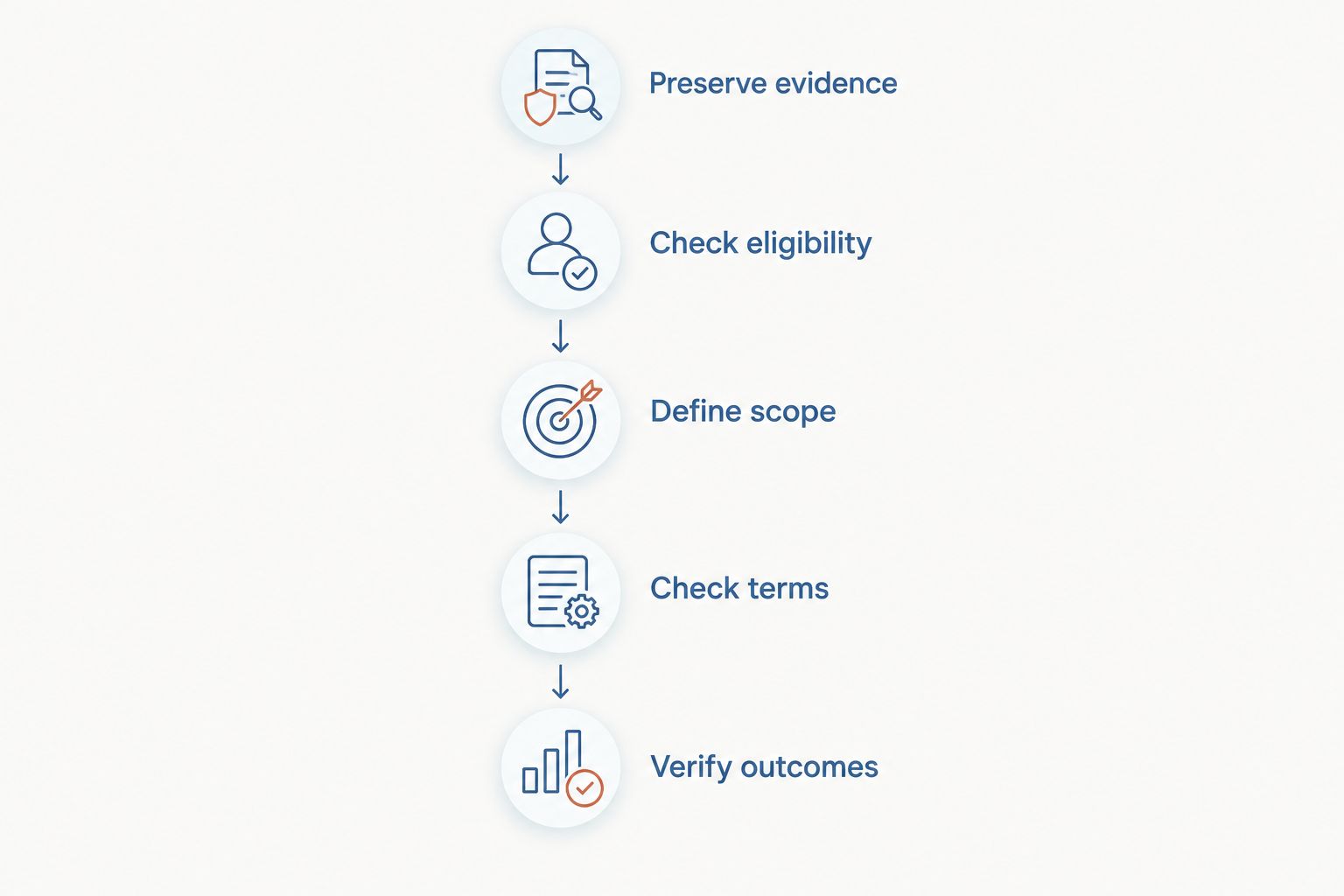
Use this sequence before sharing sensitive records or approving work. The objective is to confirm that the provider understands the problem and offers a process you can audit.
- Preserve evidence. Save the review and its context before taking action. Retain relevant business records securely, including material that challenges your own interpretation.
- Check eligibility. Ask for the proposed policy basis and supporting evidence. Reject an explanation that equates a low rating with a policy violation.
- Define scope. Identify the deliverables, exclusions, access requirements, and completion standard. Confirm whether the provider is assessing, reporting, appealing, or managing broader reputation work.
- Check terms. Read the payment trigger, cancellation provisions, refund conditions, and treatment of unsuccessful cases. Ask what happens if the reviewer changes or deletes the review independently.
- Verify outcomes. Require an update that distinguishes submitted, under review, rejected, and removed. Confirm the result on the relevant profile rather than accepting a screenshot without context.
A discreet process also needs clear information handling. Ask who receives your records, whether subcontractors are involved, and how account access ends when the assignment closes.
Is paying for review removal the same as paying Google?
No. Hiring a provider to assess evidence or manage a reporting process does not purchase a moderation decision from Google. A private contract governs the provider's work, not Google's enforcement decisions.
Ask the provider to distinguish an agreed deliverable from a promised platform outcome. If a proposal claims special control over moderation, require a clear explanation rather than accepting the claim as a reason to proceed.
Does a removal guarantee make a proposal safer?
A guarantee is only as useful as its written conditions. Check what qualifies as success, when payment becomes due, and what happens if Google leaves the review in place.
A completion-based arrangement can still contain exclusions or a narrow definition of the promised outcome. Read those provisions before deciding that a guarantee transfers the risk away from your business.
Can search suppression replace Google review removal?
Search suppression and review removal are different objectives. Suppression work seeks to reduce the visibility of negative search results; review removal addresses content on the review platform itself.
A review that remains on a Business Profile has not been removed because a different page ranks more prominently. Require separate reporting for review status and search visibility so an improvement in one is not presented as success in the other.
When does broader reputation management make sense?
Broader work is relevant when the problem extends into name searches, news coverage, discussion threads, or other negative results. Start by documenting where the exposure occurs and what your business needs to change.
Socialczars is a crisis SEO and online reputation management agency for Miami companies and executives facing negative search results. That remit is relevant when your problem extends beyond a disputed review; it is not a substitute for establishing whether the review violates Google's policies.
The advantage of a broader engagement is a coordinated brief across multiple reputation issues. The limitation is scope: more activity does not itself mean that the original review will disappear. Keep each objective separately measurable.
For a 2026 engagement, ask for separate workstreams for the review dispute and search reputation. That lets you evaluate each outcome without accepting vague claims that the overall situation has improved.
Discuss your search reputation problem
Speak with Socialczars about crisis SEO and online reputation management for negative search results.
What should you do while the review remains visible?
Preserve evidence before changing your response or escalating the dispute. Assign an internal owner so employees do not publish conflicting replies or share sensitive information while trying to defend the business.
If you respond publicly, address the concern without disclosing private customer details. Avoid stating that the reviewer committed fraud or a crime unless you have an appropriate basis and advice for making that allegation.
Keep operational remediation separate from the removal request. A complaint can identify a genuine service problem even when you dispute parts of the account. Correcting that problem does not require conceding every allegation.
Do not offer an incentive in exchange for deleting or revising a negative review. Google's fake engagement policy prohibits incentivizing the revision or removal of negative reviews. Keep customer-service discussions separate from attempts to manipulate the review record.
FAQ
How much does a Google review removal service cost in 2026?
A Google review removal service requires a case-specific quote tied to defined work and contract terms. Compare the assessment, reporting, follow-up, and completion conditions rather than treating every removal offer as equivalent.
Can an agency guarantee that Google will delete my review?
An agency cannot control Google’s moderation decision. Read any contractual guarantee for its definition of success, exclusions, and treatment of an unsuccessful case.
Can I report a Google review myself?
You can report a review through Google’s review-reporting process. Identify the relevant policy concern and preserve evidence rather than reporting a review simply because it is negative.
Will Google remove a review because I cannot find the customer?
A missing customer match does not by itself establish that a review violates Google’s policies. Display names can differ from the names in your business records.
Is search suppression the same as deleting a Google review?
Search suppression does not delete a Google review. It addresses search visibility, while review removal concerns the content’s status on the review platform.
Should I hire a lawyer or a reputation agency for a disputed review?
Legal questions require an appropriately qualified lawyer; reporting assistance and broader reputation work have different scopes. Establish whether your main issue is a policy violation, a legal allegation, or wider negative search exposure.
What should a Google review removal contract include?
A review removal contract should identify the review, deliverables, exclusions, payment conditions, and completion standard. It should also explain account access, information handling, follow-up, and what happens if the review remains visible.
One last thing
The most useful question is not whether a provider says it can remove a review. It is: what exactly happens under the contract if Google keeps the review online?
Ask for that answer in writing before approving a 2026 engagement. A clear unsuccessful-case provision tells you more about your obligations than a confident sales promise does.
Related guides
- Is it legal to pay someone to remove bad reviews online?
- Google review removal services compared
- Can you sue someone for leaving a fake negative review?
