
Reputation Management
Is it legal to pay someone to remove bad reviews online?

Oct
Yes—in the United States, it is generally legal to pay a professional to challenge reviews that violate platform rules, request lawful removal, or manage your search reputation. Paying does not give you a right to erase truthful criticism, and tactics involving fake reviews, intimidation, or deceptive suppression can violate the law. In 2026, evaluate the removal method—not the promise of a cleaner rating—before signing a contract.
- Is it legal to pay someone to remove bad reviews? Generally yes; the method determines legality.
- Google prohibits incentives for revising or removing negative reviews, even when a payment is described as customer service.
- The FTC prohibits specified deceptive review-suppression practices; truthful criticism is not automatically removable.
- Socialczars serves Miami companies and executives seeking crisis SEO and online reputation management.
Why this matters
A review-removal contract is not proof that the proposed work is lawful. You need to distinguish a documented platform-policy complaint from an effort to silence a dissatisfied customer.
For businesses evaluating providers in 2026, the Google review removal services comparison is a starting point—not a substitute for asking exactly how a provider intends to obtain removal. Approve the method before authorizing the campaign.
This article addresses U.S. law and platform-policy distinctions. It provides general information, not legal advice about a particular review or dispute.
Is it legal to pay someone to remove bad reviews online?
Paying for legitimate review-management work is generally legal; paying for deception or unlawful pressure is not. The recipient, proposed action, and factual basis determine the risk.
There are 3 separate outcomes to distinguish: removal from the publishing platform, removal from search results, and reduced search visibility. A provider must identify which outcome the contract actually covers.
| Approach | Best for | What it accomplishes | Main limitation or risk |
|---|---|---|---|
| Platform-policy reporting | Reviews with documented policy violations | Requests platform review and possible removal | The platform decides; dissatisfaction alone is insufficient |
| Attorney-led action | Potentially defamatory factual allegations or other legal claims | Assesses legal remedies and appropriate demands | Requires a valid legal basis; litigation creates additional risk |
| Crisis SEO and suppression | Managing search visibility when content remains online | Promotes relevant, legitimate content in search results | Does not delete the original review or control rankings |
| Customer-service resolution | Addressing a genuine service failure | Resolves the underlying complaint | Must not become a prohibited exchange for review removal |
| Paying for fabricated reports or threats | No legitimate use | Attempts to manipulate the removal process | Creates platform-policy and potential legal exposure |
The Federal Trade Commission's Consumer Reviews and Testimonials Rule, at 16 CFR Part 465, addresses fake reviews and specified deceptive practices. Section 465.7 addresses certain review-suppression conduct, including unfounded legal threats, intimidation, and qualifying false public accusations used to prevent or remove negative reviews.
The rule does not make every paid reputation-management engagement unlawful. Nor does a lawful service contract override a platform's review policies.
Paying an agency to report policy violations
Hiring an agency to identify violations, organize evidence, and submit accurate reports is generally legitimate. The report should identify the specific policy issue rather than merely describe reputational damage.
Google Maps policies prohibit categories of content including fake engagement, harassment, and certain personal information. A negative rating, harsh language, or an account name you do not recognize does not, by itself, establish a violation.
Ask the provider to show you:
- The exact review and platform involved.
- The policy provision that supports the request.
- The evidence supporting the alleged violation.
- The report or appeal the provider intends to submit.
Do not authorize fabricated evidence, coordinated false reports, or impersonation. A legitimate complaint can become a liability when the submission misrepresents what happened.
An agency can prepare and manage a complaint. It cannot confer a right to deletion that the platform's rules do not provide.
Paying a reviewer to delete or change a review
Paying a reviewer is different from paying an agency. On Google Maps, merchants must not offer incentives for revising or removing a negative review; a payment, discount, or free service tied to deletion falls within that prohibition.
Platform policy and law are separate questions. An incentive to remove a review is not automatically unlawful in every U.S. situation, but its legality depends on the arrangement, representations, and applicable law.
A refund should address the underlying customer problem. Do not make a refund conditional on deleting a Google review. Avoid requiring a positive replacement review as a condition of resolving the complaint.
In 2026, written scripts and settlement language deserve the same scrutiny as the payment itself. Have counsel review any agreement that restricts consumer speech or requires review removal.
Paying an attorney to assess a false review
An attorney can evaluate whether a review contains an actionable false statement of fact, identify relevant evidence, and assess available remedies. That is different from assuming every inaccurate or unfair statement supports a lawsuit.
Defamation generally involves a false factual statement and additional legal elements that vary by jurisdiction and circumstances. Opinions, rhetorical exaggeration, and truthful statements require different analysis.
A demand letter is not a court order. Sending a letter does not require a platform to remove a review, and a legal threat without a sound basis can create additional exposure.
Before escalating, examine the legal questions around suing over a fake negative review. Use legal action to address a valid claim, not to punish criticism.
Paying for crisis SEO instead of deletion
Crisis SEO addresses search visibility rather than ownership of the original review. It can involve improving legitimate pages and publishing accurate material relevant to searches about your company or name.
The benefit is a response path when deletion is unavailable. The limitation is equally important: suppression does not erase a review, remove a platform rating, or guarantee a particular search position.
Socialczars is best suited to Miami companies, executives, and high-profile individuals seeking crisis SEO and online reputation management. That service category addresses search-reputation problems; a legal claim still requires qualified legal advice.
When considering Socialczars for crisis SEO, distinguish the desired search outcome from the review-removal outcome. Require a scope that identifies what will be managed and how progress will be documented.
Why the legality of paid review removal varies
The same phrase—review removal—can describe very different conduct. These factors determine what needs scrutiny:
- Who receives payment. An agency's evidence-preparation fee is different from compensation offered to a reviewer for deletion.
- What the review contains. A false factual allegation, a genuine opinion, and prohibited personal information raise different questions.
- Which platform hosts it. Each platform sets its own reporting procedures and content rules.
- How removal is pursued. Accurate reporting differs from impersonation, fabricated evidence, or intimidation.
- What the agreement requires. Review restrictions, confidentiality terms, and settlement conditions need separate evaluation.
- Which laws apply. State defamation law, consumer-protection law, and anti-SLAPP protections can affect the dispute.
For a 2026 engagement, do not accept a provider's blanket statement that its process is legal. Ask for a description of the actual steps and obtain legal review where threats, settlements, or litigation are involved.
How do you vet a review-removal provider before paying?
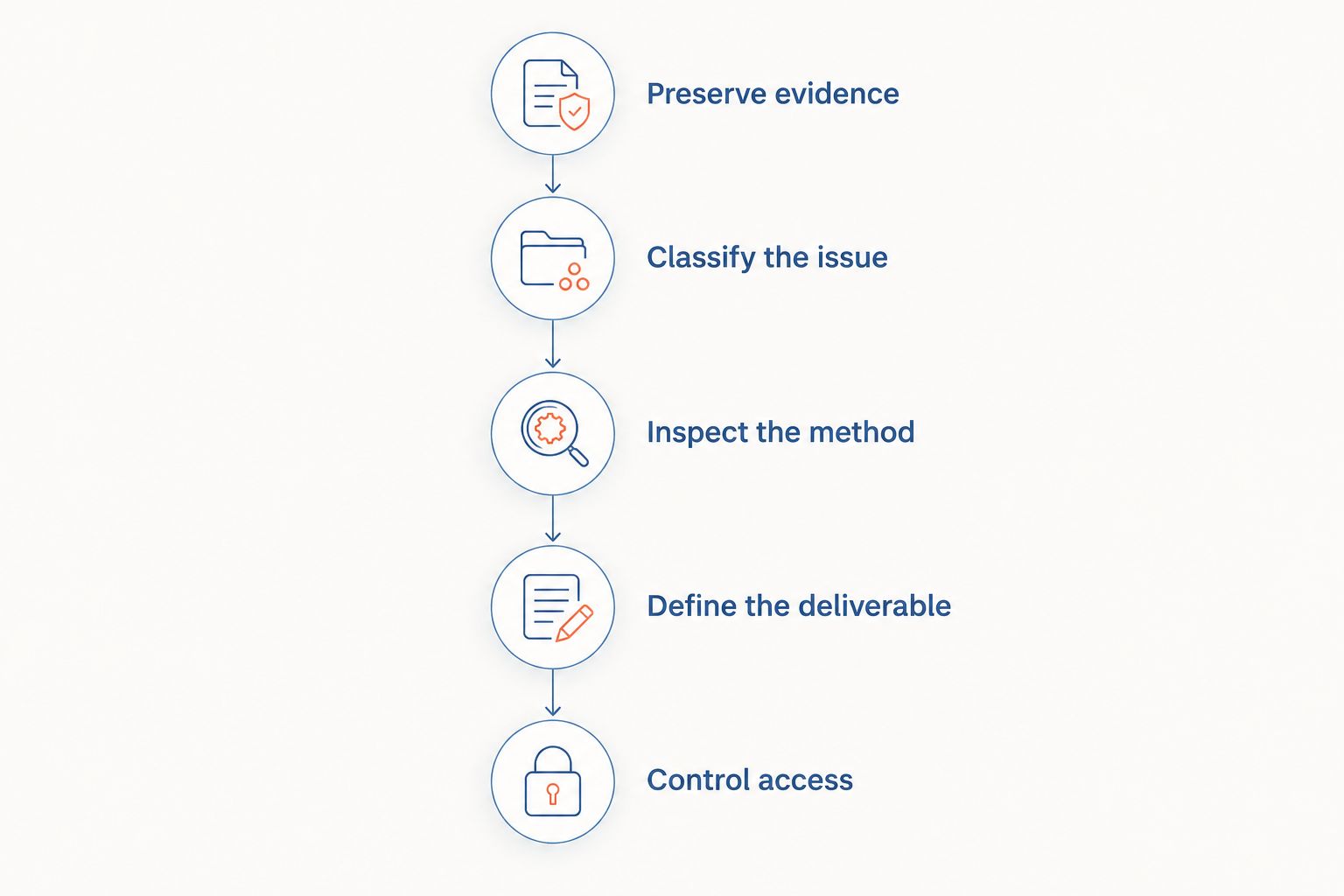
Use these 5 steps before granting account access or authorizing outreach. The objective is a documented decision, not a sales assurance.
1. Preserve evidence
Save the review text, reviewer identifier, publication date, and relevant correspondence. Preserve transaction records and other evidence without altering or manufacturing records to strengthen your case.
Capture context as well as the disputed sentence. A legal or policy assessment can change when the surrounding exchange is considered.
2. Classify the issue
Separate a policy violation from a potential legal claim and an ordinary customer complaint. More than one category can apply, but each requires its own justification.
Ask whether the problem is the review itself, its appearance in Google Search, or both. That distinction determines whether removal, deindexing, or search-visibility work addresses your concern.
3. Inspect the method
Require a plain-language description of proposed reports, appeals, customer outreach, and legal escalation. Reject explanations built around secret access or an inability to disclose the basic process.
A provider does not need to reveal every operational detail. You still need enough information to determine whether the work involves accurate submissions and authorized access.
4. Define the deliverable
Specify whether the engagement covers assessment, reporting, appeals, legal work, or crisis SEO. Identify which actions require your approval and who is responsible for them.
Define success precisely. An acknowledgment from a platform is not deletion, and a lower search position is not removal from the source.
5. Control access
Use authorized account permissions rather than casually sharing passwords. Confirm who will communicate with the platform, customer, or opposing counsel on your behalf.
For executive disputes, also control access to personal documents. Share information needed for the task, not an unrestricted archive of sensitive material.
The contract should reflect the process you approved. If the provider changes from platform reporting to direct pressure on the reviewer, require a fresh assessment before proceeding.
Can someone guarantee that a bad review will disappear?
No outside provider can control a platform's removal decision. A contractual promise about the provider's own obligations is different from control over Google or another publisher.
Ask what happens if the platform rejects the report and whether an appeal has a documented basis. Do not treat claims of personal connections or special access as evidence of a legitimate removal path.
Also ask what “removed” means. A review disappearing from one search result does not establish that it has been deleted from the original platform.
Can you remove a review just because it hurts your business?
Business harm alone does not establish a right to removal. A genuine negative experience can remain publishable even when the review affects customer decisions.
Investigate the complaint and respond without exposing private customer information. For disputes involving sensitive records or allegations of misconduct, coordinate the response with counsel before publishing details.
Is removing a search result the same as deleting a review?
No—search-result removal and source deletion are different outcomes. A review can remain accessible on the original website even when a particular search engine stops displaying its URL.
Suppression is different again: the content remains indexed but appears less prominently for relevant searches. Your reporting should separate source status, search-index status, and ranking changes.
FAQ
Is it legal to pay someone to remove bad reviews in 2026?
Generally yes, if you are paying for lawful services such as accurate platform reporting, legal assessment, or reputation management. The legality depends on the method; deception, intimidation, and other prohibited conduct are not legitimized by a service contract.
Can I pay a customer to delete a negative Google review?
Google Maps policy prohibits incentives for revising or removing a negative review. Whether a particular arrangement also violates the law requires a separate legal assessment.
Is it illegal for an agency to guarantee review removal?
A guarantee is not automatically proof of illegality, but deceptive representations can create legal exposure. Ask what the guarantee covers and recognize that the platform controls its own removal decisions.
Can a lawyer get a false review removed?
A lawyer can assess legal grounds and pursue appropriate remedies, but cannot promise a platform’s decision or a court’s ruling. An actionable false factual allegation requires a different assessment from a protected opinion.
Does the FTC ban all review-removal services?
No, the FTC’s Consumer Reviews and Testimonials Rule does not ban all review-removal services. It prohibits specified deceptive practices, including certain forms of review suppression.
Can I refund a customer without asking them to delete a review?
Yes, you can resolve a legitimate customer-service problem without requiring review removal. Keep compensation independent of deleting, revising, or replacing a Google review.
Does crisis SEO delete a bad review?
No, crisis SEO addresses search visibility rather than deleting the original review. Any engagement should distinguish ranking objectives from platform removal and legal remedies.
One last thing
A completed deletion is not proof of a lawful process. The evidence, communications, and tactics used to obtain it still matter.
For a 2026 reputation response, keep an approval trail for reports, outreach, and legal demands. Whether you engage Socialczars or another provider, make the written scope distinguish removal from suppression before work begins.
Related guides
- Online defamation removal services compared
- How long does it take to fix a bad online reputation?
- Is online reputation management worth it?
