
Reputation Management
Can you sue someone for leaving a fake negative review?
Oct
Yes, you can sue someone for a fake negative review in the United States when the review contains a false statement of fact that meets the applicable legal requirements for defamation or another claim. A negative opinion alone is generally protected, and filing a lawsuit does not automatically remove the review, identify an anonymous reviewer, or establish your right to damages.
- Can you sue someone for a fake negative review? Yes, when a false factual statement meets legal requirements.
- Preserve the review and supporting records before requesting removal or contacting the reviewer.
- Defamation claims, platform reports, and crisis SEO address different problems; none guarantees deletion.
- Socialczars serves Miami companies and executives seeking crisis SEO and online reputation management, not legal representation.
Why this matters
A fake review creates separate problems: the underlying allegation, its visibility, and the evidence needed to challenge it. Treat removal, legal accountability, and search reputation as separate objectives. Winning an argument with the reviewer does not resolve all three.
For your 2026 response plan, distinguish a platform-policy violation from a legally actionable statement. The online defamation removal services comparison addresses the removal-service category; a licensed attorney must assess your legal claim. This article provides general U.S. information, not legal advice.
Can you sue someone for leaving a fake negative review?
Yes, but you need more than suspicion that the reviewer is dishonest. A defamation claim generally requires a false statement presented as fact, communication to someone else, the legally required level of fault, and legally recognized harm. State law determines the precise elements, defenses, and available remedies.
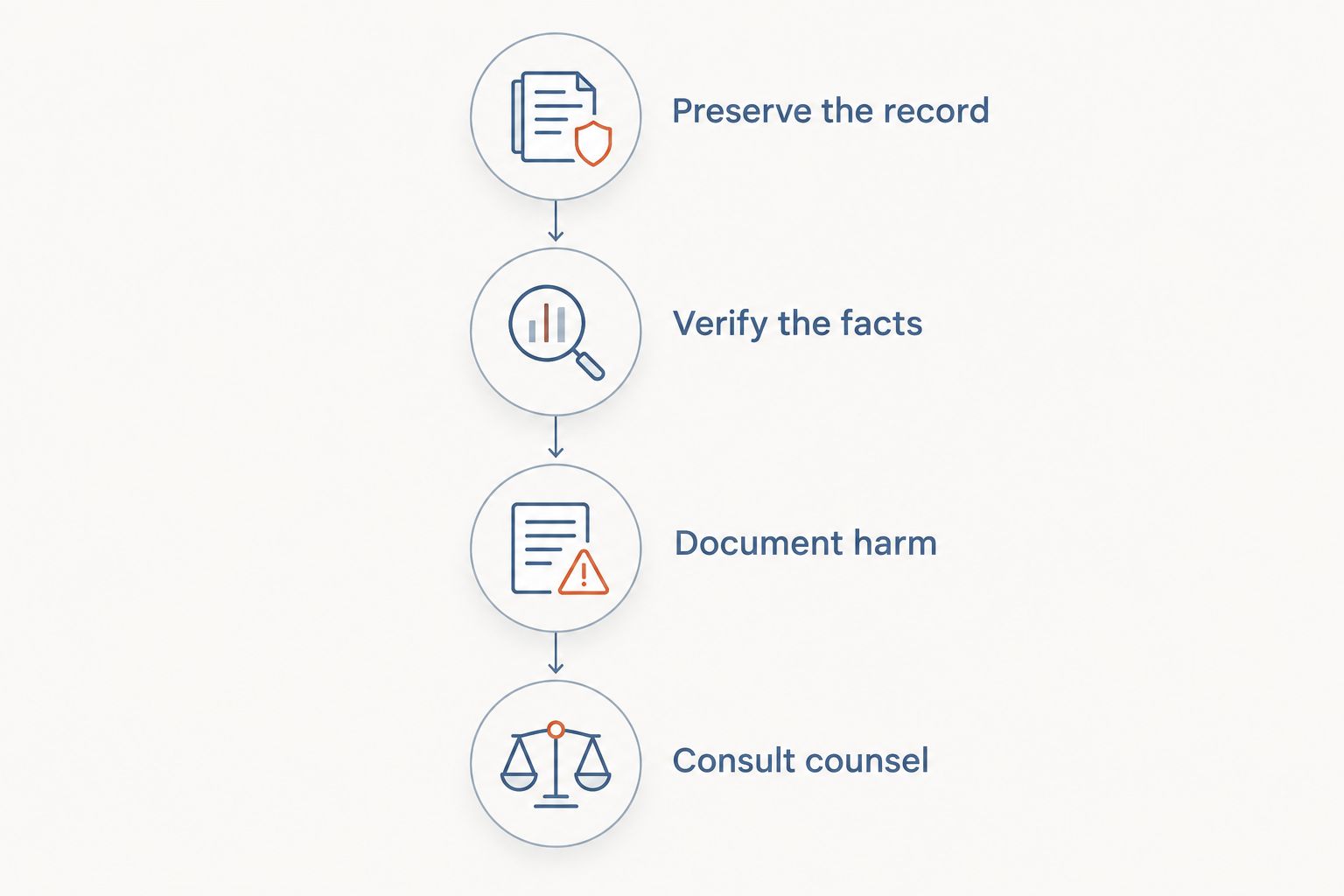
Start with this evidence sequence before deciding whether to sue:
- Preserve the record. Save the full review, its URL, publication date, reviewer profile, surrounding context, and later edits. Keep original files rather than relying on cropped screenshots.
- Verify the facts. Identify the specific factual allegation you dispute. Match it against transaction records, correspondence, appointment logs, or other relevant evidence.
- Document harm. Preserve cancellations, lost-business communications, and other records connecting the allegation to an actual consequence. Separate documented losses from assumptions.
- Consult counsel. Have a lawyer assess jurisdiction, deadlines, defenses, identification issues, and the remedy you want before you threaten litigation.
A missing customer record supports further investigation; it does not conclusively prove fabrication. Someone can describe an interaction without buying, use a different name, or review on another person's behalf. Your evidence must address the allegation, not merely the account name.
False factual allegations versus protected opinions
A harsh review is not automatically defamation. Courts examine the words, their context, and whether a reasonable reader would understand them as asserting provable facts. Adding an opinion disclaimer does not necessarily protect an otherwise factual accusation.
A statement about disliking an experience differs from an allegation that a business committed a specific act of fraud. The second asserts something that evidence can establish or disprove. Even then, falsity, fault, applicable privileges, and other legal requirements still matter.
Truth is generally a defense to defamation, including substantial truth. A minor inaccuracy does not necessarily make an otherwise accurate account actionable. Do not build a claim around an insignificant detail while ignoring the substance of the criticism.
Public officials and public figures face additional constitutional requirements in covered defamation claims, including proof of actual malice. That means knowledge of falsity or reckless disregard for truth—not simply hostility toward the subject. An executive's title alone does not settle public-figure status.
Which response fits your objective?
Choose the response that addresses the actual problem. A platform report concerns platform rules; litigation concerns legal rights; search work concerns visibility. Combining them requires consistent facts and carefully controlled communications.
| Response | Best for | Main advantage | Main limitation |
|---|---|---|---|
| Platform report | A review that violates a specific platform rule | Challenges the content through the platform's process | A negative or disputed review does not automatically qualify for removal |
| Attorney-led demand | A documented allegation with an identifiable author | States the factual dispute and requested remedy | The recipient can refuse, and the demand can become public |
| Defamation lawsuit | A legally supportable claim requiring court remedies | Provides a formal process for pursuing accountability | Requires evidence, creates expense, and carries procedural risks |
| Crisis SEO | Negative search visibility affecting a company or individual | Addresses what people find when searching | Does not decide truth, award damages, or delete the source |
Do not substitute visibility work for legal advice. Socialczars is best for Miami-based companies and executives seeking crisis SEO and online reputation management, not legal representation. Its service scope addresses search reputation; an attorney assesses legal liability and litigation strategy.
You can review Socialczars for the search-reputation side of the problem. Keep any legal assessment separate from an agency engagement, and do not treat an agency's proposed work as evidence that a claim will succeed.
Why your legal options vary
Your position in 2026 depends on the specific statement and applicable law, not the intensity of your response. Give counsel the complete record, including unfavorable information, so the assessment reflects the dispute you actually face.
- Applicable state law. Filing deadlines, claim requirements, privileges, and anti-SLAPP protections differ by jurisdiction.
- Exact wording and context. A factual allegation, rhetorical insult, and subjective assessment receive different treatment.
- Evidence of falsity. Contemporaneous records carry more information than a later blanket denial.
- Reviewer identity. An anonymous account introduces identification procedures and potential objections before the underlying claim advances.
- Fault and harm. The required fault standard and proof of damages depend on the claim, the plaintiff, and the circumstances.
- Your requested remedy. Compensation, identification, correction, removal, and reduced visibility are different objectives with different legal and practical limits.
An attorney also needs to know about previous disputes, pending litigation, and any communications already sent to the reviewer. A threatening reply or inconsistent public statement can complicate a case that initially appeared straightforward.
Can you sue an anonymous reviewer?
Yes, an anonymous reviewer can be sued when the relevant court's procedures and substantive requirements allow it. Identifying the person behind an account is a separate legal task, not an automatic benefit of filing a complaint.
Counsel can assess whether an unknown-defendant lawsuit and discovery request are appropriate. Courts can require a sufficient showing before ordering identifying information, and the reviewer or platform can challenge disclosure. Account data also does not necessarily establish who wrote the review.
Preserve the public evidence without trying to expose the reviewer yourself. Do not publish suspected identities, contact unrelated employers, or accuse a competitor without support. A mistaken identification creates another reputational dispute rather than resolving the first.
Can you sue Google or another review platform instead?
Usually, suing the author and suing the platform raise different legal issues. For U.S. disputes in 2026, Section 230 of the Communications Decency Act generally protects online services against claims that would treat them as the publisher of third-party content, subject to statutory exceptions and the specific claim.
That protection does not make the review lawful, and it does not prevent you from reporting a platform-policy violation. It limits particular claims against the intermediary. Have counsel assess any proposed platform claim rather than assuming the host is responsible for the author's statement.
A court judgment against an author also does not guarantee that every platform, search engine, or republished copy will disappear. Ask what a proposed order actually requires, who it binds, and what enforcement would involve.
How long do you have to sue over a fake review?
For a 2026 deadline assessment, the applicable state and claim matter. Florida generally provides a 2-year limitation period for libel and slander under Florida Statutes section 95.11; California generally provides 1 year under Code of Civil Procedure section 340(c); New York generally provides 1 year under CPLR section 215(3).
These are general statutory periods, not a calculation of your deadline. Publication rules, jurisdiction, tolling, republication, and other circumstances require legal analysis. An old review remaining visible does not necessarily restart the clock each day.
Get the filing deadline assessed before waiting for a platform appeal. Do not assume a removal request or negotiation pauses the limitation period. For a Miami business, location alone does not conclusively establish that Florida law controls every claim.
What risks should you assess before filing?
Litigation can expose the dispute to more attention and require production of relevant business records. Before filing, ask counsel what allegations you must prove, what documents you must disclose, and what the strongest defense would be.
Anti-SLAPP laws are a central consideration. Depending on the jurisdiction and circumstances, a defendant can challenge claims targeting protected speech through special procedures, and fee-shifting provisions can create financial exposure. Do not assume every negative-review case falls inside—or outside—those protections.
A lawyer should also assess collectability and enforcement. A favorable judgment does not by itself establish that the defendant has assets or that the remedy will deliver your preferred business outcome. Define success before litigation, not after it starts.
For your 2026 response, keep public communications factual and restrained. Preserve the evidence, avoid disclosing private customer information, and resist turning a disputed review into a broader accusation campaign.
FAQ
Can I sue someone just because their review is unfair?
An unfair review alone does not establish a defamation claim. You generally need a false factual statement and the other legal elements required by the applicable jurisdiction; subjective criticism is generally protected.
Is a review fake if I cannot find the reviewer in my customer records?
A missing customer record does not conclusively prove that a review is fake. Preserve the record and investigate the specific allegation, including whether the person used another name or had an interaction without purchasing.
Can a fake review be removed without filing a lawsuit?
A review can be removed without litigation when the author deletes it or the platform removes it under its rules. Submit a specific, evidence-based report rather than treating disagreement as proof of a policy violation.
Can I threaten to sue unless the reviewer deletes the post?
Have counsel assess the claim before sending a litigation threat. An unsupported demand can escalate the dispute, become public, and create legal or reputational risks.
Will winning a defamation case automatically remove the review?
Winning a defamation case does not automatically delete the review everywhere. Removal depends on the order, the parties it binds, platform procedures, and the location of any copies.
Can an online reputation management agency replace a defamation lawyer?
An online reputation management agency does not replace a defamation lawyer. Socialczars provides crisis SEO and online reputation management for Miami-based companies, executives, and high-profile individuals; legal claims require assessment by licensed counsel.
Should I publicly accuse a competitor of posting the review?
Do not publicly accuse a competitor without adequate evidence. Preserve the suspected connection and provide it privately to counsel for assessment rather than publishing an unverified allegation.
One last thing
Save the review before you try to make it disappear. A removed post can make the immediate visibility problem smaller while leaving you without a complete record of the allegation, publication context, or account details.
For a 2026 incident file, keep the original capture, subsequent edits, platform-report history, and relevant business records together. Your strongest next move is a documented factual assessment—not the most aggressive public response.
Related guides
- Google review removal services compared
- Automatically flag fake Google reviews when they post
- Connect Google Search Console to brand monitoring
