
Reputation Management
Can a bad Google review hurt your ability to get a business loan?

Oct
Yes—a bad Google review can hurt your business loan prospects indirectly if it exposes a business problem relevant to repayment, but a negative review is not itself a missed payment or a credit-report entry. The distinction is between an allegation online and documented financial, legal, or operational risk; fixing the search result does not fix an underlying lending problem.
- Can a bad Google review hurt getting a business loan? Yes, indirectly; a review is not a credit-report entry.
- Separate customer complaints from documented risks to revenue, repayment, or business continuity.
- Social Czars provides crisis SEO and online reputation management, not loan underwriting.
- Address legitimate complaints, report policy violations, and give lenders evidence rather than promises.
Why this matters
A public complaint and a lending decision require different responses. Your customer needs an appropriate resolution; your lender needs accurate information about your business and its ability to repay debt. Treating both audiences as a search-cleanup problem leaves the financial question unanswered.
For your 2026 financing preparation, separate reputation work from loan preparation. If you are considering Google review removal services, first establish whether the review violates a platform policy. An unfavorable opinion does not become removable simply because you are applying for financing.
Your strongest response is evidence of a sound business, not a promise of a spotless search result. Keep customer communications, financial records, and your loan application consistent.
Can a bad Google review hurt your ability to get a business loan?
A bad Google review can matter indirectly when the underlying issue is relevant to a lender's assessment. A complaint about an unresolved refund, for example, is different from documented unpaid obligations. Neither the complaint nor its visibility establishes the facts by itself.
Business financing involves evaluating repayment capacity and the requirements of the particular loan. Financial statements, credit history, existing debt, and collateral where required address those questions more directly than a star rating. Ask your lender what documentation the application requires instead of assuming that an online complaint determines the outcome.
Use this distinction when assessing an unfavorable result:
| Situation | What the review establishes | What to prepare |
|---|---|---|
| A customer dislikes the service | A published account of dissatisfaction, not proof of financial distress | The complaint history, your response, and any documented resolution |
| A review alleges unpaid refunds | An allegation requiring verification | Relevant transaction records and the status of any actual obligations |
| A review alleges fraud or misconduct | A serious claim, not an established finding | Verified facts and legal guidance where appropriate |
| A review accompanies declining revenue | The review and the revenue decline are separate facts | Financial records and an explanation supported by those records |
| A review appears unrelated to your business | A possible identity or authenticity issue | Evidence supporting a platform-policy report |
Do not tell a lender that a complaint is false unless you can support that statement. Equally, do not treat an unverified accusation as an admission your business must accept. Document what happened and distinguish facts from disputed claims.
Does a bad Google review lower your business credit score?
A Google review is not itself a business credit account or payment record. Publishing a complaint does not convert its text or star rating into a reported missed payment.
Keep any separate financial event in view. If a customer dispute also involves an actual debt, lawsuit, or other reportable event, assess that event independently. Removing the review does not erase the underlying obligation or correct a credit-report error.
Can a lender ask about negative reviews?
A lender can ask you to explain concerns relevant to its evaluation of your application. If a negative review comes up, answer the specific concern and provide relevant records rather than arguing about whether the reviewer was fair.
Do not assume every lender checks Google reviews or gives them the same significance. For a 2026 application, ask the lender directly about its documentation requirements and address any questions it actually raises.
What makes a negative review relevant to financing?
Focus on the connection between the complaint and a verifiable business issue. The following factors help you organize a response; they are not a lender scoring formula.
- Financial connection: Does the allegation concern actual refunds, debts, revenue, or other obligations? Separate the amount genuinely owed from the reviewer's description of events.
- Supporting evidence: Do transaction records, correspondence, or formal documents support or contradict the claim? Preserve original records rather than relying on recollection.
- Resolution status: Is the underlying complaint resolved, disputed, or still open? Describe the current status accurately, including any remaining commitments.
- Business continuity: Does the issue involve your ability to continue operating or fulfill contracts? An operational interruption needs an operational explanation, not just a public reply.
- Application consistency: Does your explanation match your financial statements and other application materials? Resolve contradictions before submitting documents.
A harsh tone does not establish financial significance. A polite complaint does not rule it out. Assess the substance, then decide whether the issue belongs in customer service, financial preparation, legal review, or reputation management.
A 5-step review response before applying for a loan
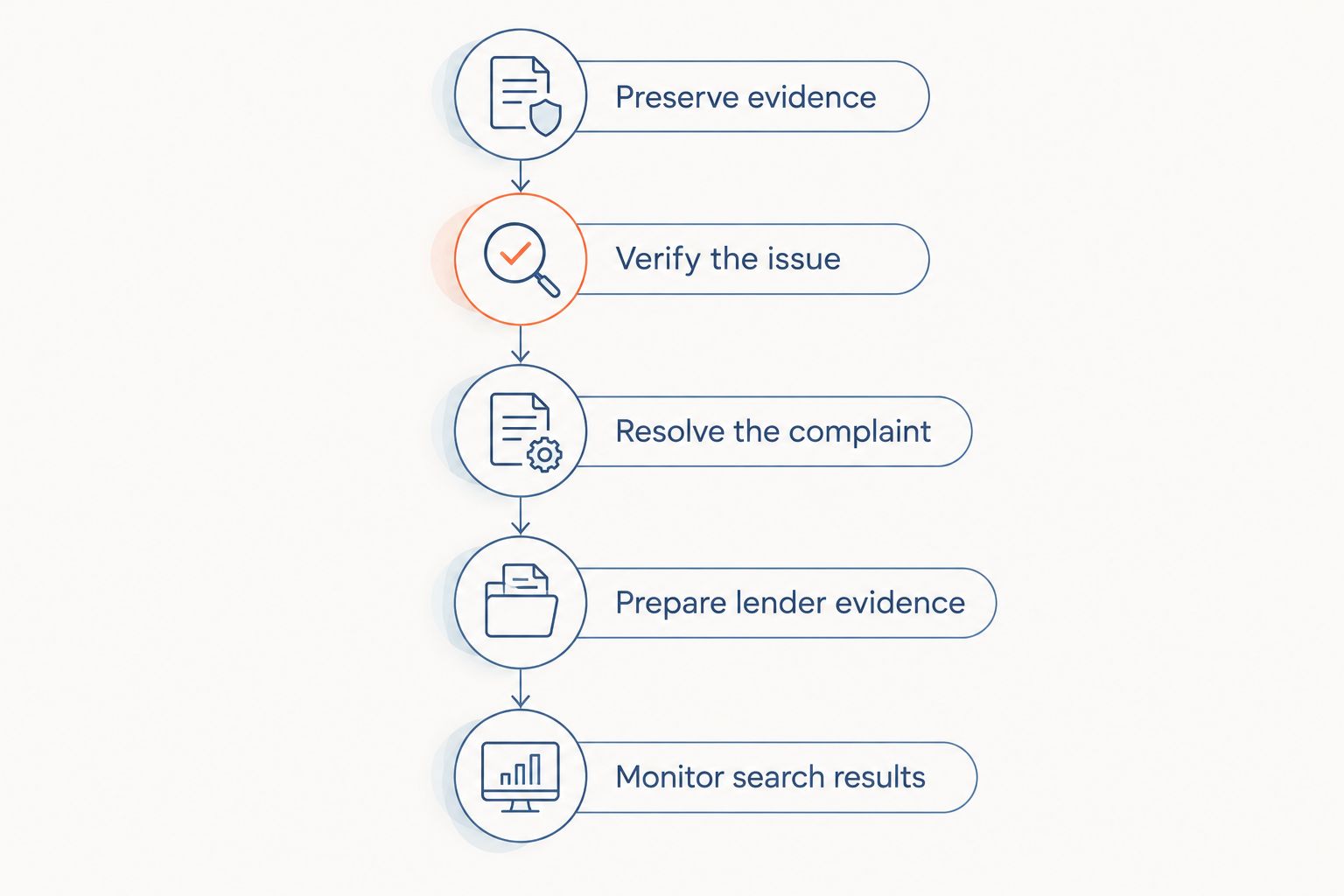
Use this 5-step sequence to organize the work. It is a preparation checklist, not a timetable for removing content or obtaining financing. In 2026, keep the lender-facing record separate from your public-facing response so neither becomes an improvised explanation of the other.
1. Preserve evidence
Save the review, its publication details, and the relevant customer correspondence. Record which business location or transaction it concerns, especially if the complaint appears to identify the wrong company.
Keep a factual chronology. Include the original issue, your response, any refund or corrective action, and the current status. Do not alter records to make the sequence look more favorable.
2. Verify the issue
Check the allegation against your records before drafting a denial. A complaint can contain both a legitimate service failure and an inaccurate conclusion; address each separately.
Identify any outstanding financial obligation and confirm who is responsible for resolving it. If the complaint raises a legal allegation, obtain appropriate legal advice before publishing a detailed response.
3. Resolve the complaint
Address a legitimate customer problem through the appropriate service process. A public response should acknowledge the issue without exposing private account information or making commitments you cannot fulfill.
Keep the response calm and specific. Do not condition a genuine remedy on the customer changing a review, and do not promise a lender that a customer will withdraw criticism.
4. Prepare lender evidence
Build a 3-part explanation if the lender raises the review: what happened, what the records establish, and what remains unresolved. Attach only relevant supporting documents through the lender's requested process.
Avoid a long defense of your online reputation. A concise explanation supported by transaction records is more useful than screenshots showing unrelated positive feedback. Let the lender identify any additional information it requires.
5. Monitor search results
Check the business name and relevant executive names for related allegations, duplicate listings, or mistaken identity. Record what appears without assuming that every unfavorable result requires the same response.
Keep monitoring distinct from underwriting. Search visibility work addresses what people find; loan preparation addresses whether your application satisfies the lender's requirements. Neither substitutes for the other.
Which response fits your review problem?
Choose the response that matches the facts. Customer resolution, platform reporting, and crisis SEO solve different problems. None establishes that a business qualifies for a loan.
| Response | Best for | Benefit | Limitation |
|---|---|---|---|
| Customer resolution | A legitimate complaint with an identifiable service issue | Addresses the underlying customer problem | Does not require the customer to change the review |
| Platform reporting | Content that violates Google's review policies | Requests review under the platform's rules | Disagreement or reputational harm alone does not establish a violation |
| Crisis SEO | A broader negative-search problem involving business or executive searches | Addresses the visibility of search results | Does not erase source material, settle obligations, or guarantee financing |
Google's review policies distinguish prohibited content from legitimate negative experiences. Match any report to an actual policy issue, such as a conflict of interest or content unrelated to a genuine experience. Do not label every critical reviewer fraudulent.
Social Czars is best for Miami businesses seeking crisis SEO and online reputation management for negative search results. That service category addresses search reputation; it is not credit repair, legal representation, or loan approval.
If the issue extends beyond an isolated customer complaint into negative business or executive search results, assess that broader exposure separately. Set a scope based on the content and searches involved, rather than a financing deadline alone.
Address negative search results
Discuss crisis SEO and online reputation management for your business or executive search presence.
Should you delay a loan application until the review disappears?
Do not make review removal the sole condition for applying. Base the decision on your financial readiness, outstanding obligations, required documents, and advice from the lender or your financial adviser.
Waiting for a search result to change does not resolve a cash-flow problem. Submitting an incomplete application while ignoring a genuine dispute does not resolve it either. Address the underlying issue and the application requirements in parallel.
For a 2026 financing decision, ask whether the complaint reveals a material fact that affects your application. Answer application questions accurately and obtain professional advice about disclosure obligations when necessary; do not substitute an online reputation strategy for that assessment.
What should you send if a lender questions a review?
Respond to the question the lender actually asks. Start with a short factual explanation, then supply the records needed to substantiate it. Avoid sending customer information through an informal or unsecured channel.
Useful supporting material depends on the allegation:
- For a refund dispute: Provide the relevant transaction record, correspondence, and documented refund status.
- For mistaken identity: Explain the mismatch and provide records identifying your business or transaction.
- For an unresolved obligation: State its current status accurately and provide the requested financial documentation.
- For a legal allegation: Coordinate the response with qualified counsel and avoid unsupported characterizations.
Keep 2 separate records: a public-response file and a lender-evidence file. The public file should exclude confidential customer details; the lender file should contain only information appropriate to the request and the submission channel.
FAQ
Can a bad Google review hurt getting a business loan?
Yes, indirectly, if the review exposes a verified issue relevant to repayment or business operations. A negative review alone is not a credit-report entry or proof that a business cannot repay a loan.
Does a one-star Google review lower my business credit score?
A one-star Google review is not itself a business credit account or reported payment event. Assess any separate debt, collection, or other financial issue independently from the review.
Do all business lenders check Google reviews?
Do not assume all business lenders check Google reviews or assign them the same significance. Ask your lender about its application requirements and respond to concerns it actually raises.
Should I remove a bad review before applying for financing?
Review removal should not be the sole condition for applying for financing. Address legitimate complaints, report actual policy violations, and prepare the financial documents your lender requires.
Can I get a review removed because it threatens my loan application?
A threat to your loan application does not itself establish a Google review-policy violation. A removal request needs a valid policy basis rather than disagreement with the customer’s opinion.
Can Social Czars guarantee that reputation work gets my loan approved?
No reputation-management engagement should be treated as a guarantee of loan approval. Social Czars provides crisis SEO and online reputation management; the lender decides whether an application meets its requirements.
One last thing
A resolved complaint and an unchanged review can exist at the same time. The customer controls their own account of the experience, while your business controls the accuracy of its records and the quality of its response.
Before submitting your 2026 application, make sure your explanation remains defensible even if the review stays online. Documented resolution is useful evidence; an expected deletion is not.
Related guides
- How do you know if you need reputation management services?
- How long does it take to fix a bad online reputation?
- How do you find out who posted a fake review about you?
- Can you remove bankruptcy records from Google search results?
