
Reputation Management
Can you remove a bad Glassdoor review from Google search results?

Oct
You can remove a bad Glassdoor review from Google search results when the source is removed, the result qualifies under Google’s removal policies, or a valid legal basis supports removal—not simply because the review damages your reputation. If the review remains published and does not qualify for removal, search suppression is a separate strategy that aims to reduce its visibility without deleting it.
- Can you remove a bad Glassdoor review from Google? Sometimes, but negative sentiment alone is not grounds for removal.
- Glassdoor removal, Google delisting, and search suppression change different things; choose the route that matches your evidence.
- An outdated search result needs a different request from a review that remains live and unchanged.
- Socialczars provides crisis SEO and online reputation management for Miami companies and executives facing negative search results.
Can you remove a bad Glassdoor review from Google search results?
Yes, under specific conditions; you cannot demand removal just because the review is unfavorable. First identify whether you want the review deleted from Glassdoor, a particular URL excluded from Google, or a negative result pushed below stronger pages.
Those are different outcomes. For companies considering Socialczars, the practical starting point is identifying which outcome the evidence supports before choosing a crisis SEO response.
| Route | Best for | What it changes | Main limitation |
|---|---|---|---|
| Glassdoor moderation | A review with a documented platform-policy violation | The review’s publication on Glassdoor, if removed | Criticism alone does not establish a violation |
| Google policy removal | Content covered by a Google Search removal policy | Visibility of qualifying results in Google | The source content can remain online |
| Legal removal request | Content supported by an applicable legal basis | Search visibility or publication, depending on the process | Legal validity and scope require qualified assessment |
| Outdated-content refresh | A result showing content already removed or materially changed | Google’s outdated representation of the source | It does not remove unchanged, live criticism |
| Search suppression | A live result without a supported removal route | Relative visibility for selected searches | It does not delete the review or guarantee rankings |
For your 2026 assessment, consult Glassdoor’s current Community Guidelines and Google Search Help’s removal guidance. Match the actual content to an applicable rule rather than assuming that an allegation of unfairness is enough.
Why this matters
A review can remain accessible on Glassdoor after a Google removal action. Conversely, deleting an individual review does not necessarily eliminate the employer profile or every search result associated with it.
That distinction changes what you ask an agency, platform, or attorney to accomplish. Define success by the specific review, URL, and search query—not by a promise to erase everything.
For an executive, separate searches for your personal name from searches for the company. A company-profile result and a review naming an individual require different evidence and different page-level analysis.
Start with the exact result, not the complaint
Before submitting anything, open the Google result and identify where it leads. The destination might be an individual review, an employer profile containing many reviews, or another page quoting the original complaint.
Record the result as it appears during your 2026 assessment. Preserve the search phrase, destination URL, visible title, excerpt, review text, and capture date; these establish what you are asking someone to examine.
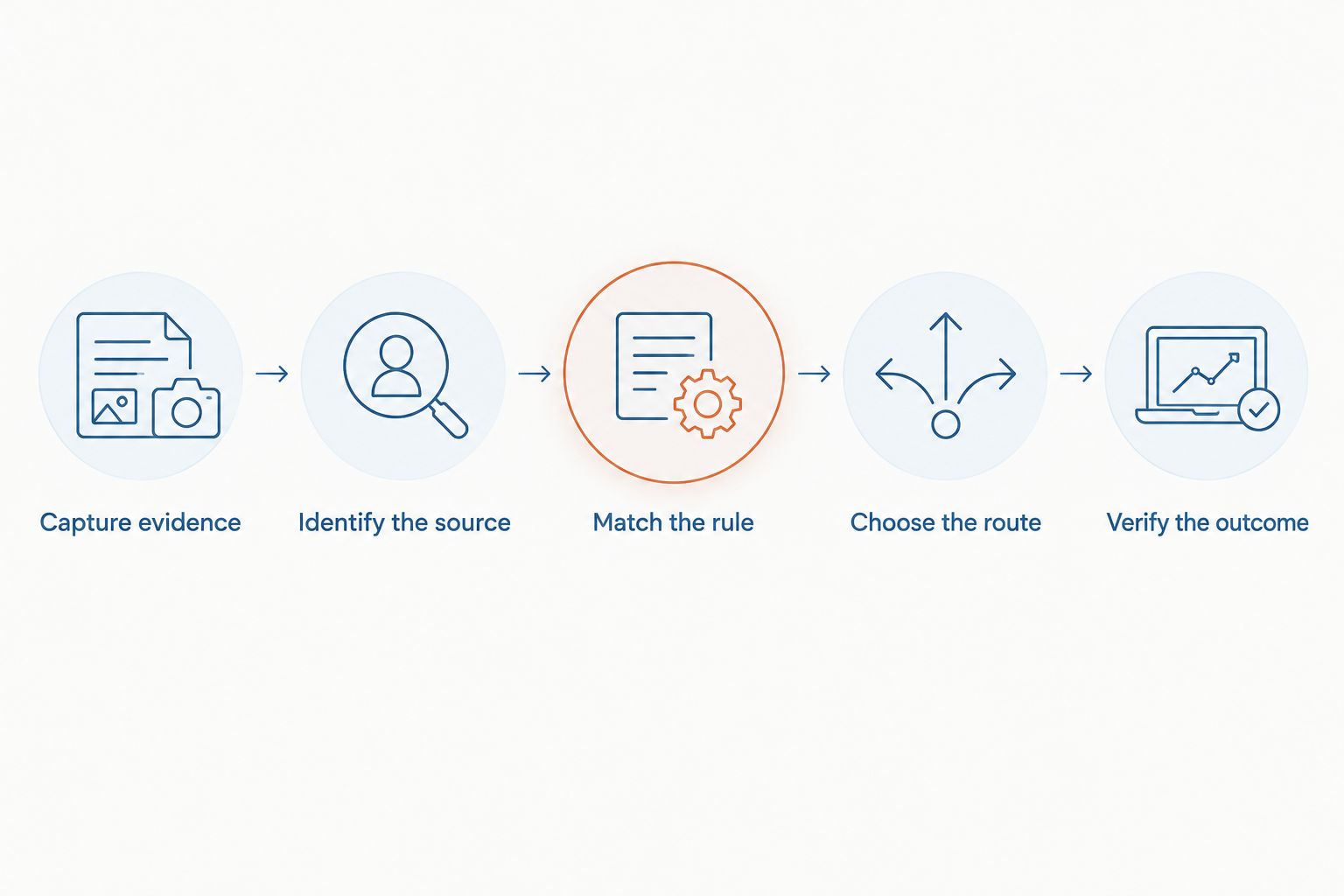
Use this sequence:
- Capture evidence. Save the result and the underlying review before requesting changes.
- Identify the source. Determine whether the objectionable text appears on the destination page or only in Google’s excerpt.
- Match the rule. Identify a specific platform policy, Google removal category, or legal issue.
- Choose the route. Submit the request to the party that controls the relevant outcome.
- Verify the outcome. Check both the source page and the affected search query after a decision.
Keep your evidence file separate from any public response. Publishing screenshots of the disputed allegation creates another accessible copy and complicates your effort to limit exposure.
Glassdoor removal: report a specific violation
Glassdoor controls whether a review stays published on its platform. A moderation report should identify the disputed passage, explain the relevant guideline, and include evidence supporting the claimed violation.
A report needs a policy argument, not a statement that the reviewer hurt your business. Broad complaints about tone or reputation do not explain why the platform should remove the content.
Distinguish factual allegations from opinions. A statement about a specific event calls for a different assessment from a subjective judgment about management, culture, or job satisfaction; neither becomes removable merely because you dispute it.
If you believe the review is fabricated, preserve records that address its factual claims without exposing employee information publicly. The guide to finding out who posted a fake review addresses the separate question of attribution; identifying a suspected author is not itself proof of a removable violation.
The benefit of source removal is direct: the disputed review no longer appears where it was published. The limitation is equally important: removal of that review does not automatically remove other reviews, an employer profile, or independent copies elsewhere.
Google removal: use a qualifying policy or legal basis
Google controls its search results, not the content published on Glassdoor. Google Search removal policies cover defined categories, including certain sensitive personal information; they are not a general appeal process for unfavorable employer reviews.
Review the actual material against the current policy. A negative assessment of your company is not equivalent to exposing qualifying sensitive information, and a disputed statement is not automatically eligible for delisting.
For a legal request, separate your business objection from the legal basis. A qualified attorney should assess jurisdiction, the statement at issue, available evidence, and the appropriate process before you present a demand as legally enforceable.
A court order also needs careful reading. Its wording, parties, jurisdiction, and scope matter; do not treat an order addressing particular material as automatic authority to remove every related search result.
For Google removal requests in 2026, identify the precise URLs and passages involved. A narrowly supported request is the right submission; a broad demand to remove all criticism is not.
Outdated results: refresh what has already changed
Use Google’s outdated-content process when the source has already disappeared or materially changed and the search result still reflects the old content. It is not a substitute for persuading Glassdoor to remove a live review.
For example, a removed passage can remain visible in a search excerpt until Google updates its representation of the page. The relevant question is whether the disputed content still exists at the destination—not whether you dislike the excerpt.
Open the result and compare it with the current page before submitting a request. Preserve evidence of the difference, including whether the destination is unavailable or the specific wording has disappeared.
The benefit is correcting a mismatch between the live source and Google’s result. The limitation is scope: refreshing an excerpt does not necessarily remove the whole employer-profile result.
Search suppression: compete without claiming deletion
Search suppression aims to improve the visibility of relevant, accurate pages so an unwanted result receives less prominent placement. It does not remove the original review, and search positions remain subject to Google’s ranking systems.
Use suppression when the review remains live and no supported removal route applies. Start with content you legitimately control: your company website, substantive leadership biographies, accurate professional profiles, and useful employer information.
Choose pages that answer the searcher’s actual question. A leadership biography serves a name search; a detailed careers page serves someone evaluating your workplace. Publishing unrelated material solely to occupy results does not address either audience.
Socialczars is a crisis SEO agency for Miami companies and executives facing negative search results. Its stated crisis SEO and online reputation management services fit this type of search-visibility problem; that service fit is not a promise that Glassdoor or Google will remove a review.
Ask any provider to distinguish removal work from suppression work in writing. The plan should name the affected queries, identify the pages involved, explain the proposed actions, and separate completed actions from observed ranking changes.
Assess your search reputation problem
Discuss crisis SEO and online reputation management with Socialczars.
Why Glassdoor removal outcomes vary
Your route depends on the content and the party controlling it. Use these factors to assess the case rather than comparing promises of universal removal:
- Policy fit. A documented violation presents a different case from an unfavorable opinion that falls within platform rules.
- Evidence quality. Contemporaneous records supporting a disputed factual claim are more relevant than unsupported assertions that the reviewer is dishonest.
- Source status. A live review requires a different response from a deleted review still appearing in an outdated excerpt.
- URL scope. An individual review, employer profile, and third-party quotation are separate destinations; a change to one does not establish a change to all.
- Legal basis. Applicable law, jurisdiction, and the wording of any order determine what a legal request actually supports.
- Search competition. Suppression depends on the relevance and ranking of competing pages, not on your ability to edit Glassdoor.
For your 2026 action plan, assign each disputed URL a route and an evidence file. Avoid treating an entire search page as one removal request when its results have different sources.
Can Google remove a Glassdoor review without Glassdoor deleting it?
Yes, Google can remove qualifying search results while the source remains online. That is delisting, not deletion: the material can still be reached directly or discovered elsewhere.
Ask what scope an approved request covers. A result disappearing for a particular search or jurisdiction does not establish that the review has vanished universally.
Will deleting a Glassdoor review remove the company profile from Google?
No, deleting an individual review does not necessarily remove the employer profile from Google. The profile is a separate page that can remain relevant to searches for your company.
Check what the search result actually links to before judging the outcome. A profile still appearing is not proof that the deleted review remains published.
Should you respond publicly while seeking removal?
Respond only when you can address the concern without exposing confidential information or escalating the dispute. A restrained response can acknowledge feedback and direct sensitive discussion away from the public thread without naming a suspected reviewer.
Do not use a public reply to threaten, speculate about identity, or publish employment records. If the allegation involves litigation, safety, or regulated information, coordinate the response with appropriate counsel.
FAQ
Can you remove a bad Glassdoor review from Google in 2026?
Yes, when the source is removed, the result qualifies under Google’s removal policies, or a valid legal basis supports removal. Negative sentiment alone does not establish eligibility, and suppression is not deletion.
Can I pay Google to delete a Glassdoor result?
Google does not offer a paid service to delete an unfavorable organic search result. Paying an agency for assessment or submission work does not change Google’s removal criteria.
Does reporting a Glassdoor review guarantee removal?
No, reporting a Glassdoor review does not guarantee removal. Your report needs to identify an applicable policy issue and provide relevant evidence; disagreement with the review is not enough.
Can I use the outdated-content tool for a review that is still online?
The outdated-content tool is not a way to remove unchanged, live criticism. It addresses search results that no longer accurately reflect content already removed or materially changed at the source.
Is search suppression the same as removing a review?
No, search suppression aims to reduce a result’s prominence, while removal changes publication or search inclusion. A suppressed Glassdoor review can remain accessible and can regain visibility.
Can a lawyer remove a false Glassdoor review?
A lawyer can assess whether a false statement supports a legal claim or removal request, but cannot guarantee deletion. The statement, evidence, jurisdiction, and applicable law determine the available route.
How long does it take for Google to stop showing a deleted review?
There is no universal completion time for Google to stop showing a deleted review. Verify whether the source is actually gone, whether the result links to an individual review or a surviving profile, and whether an outdated-content request applies.
One last thing
Preserve the evidence before trying to make it disappear. Once a review changes or vanishes, you still need a reliable record of what was published, where it appeared, and which request addressed it.
For your 2026 case file, record outcomes separately: source removed, Google result removed, excerpt refreshed, or ranking changed. Those labels prevent a partial improvement from being mistaken for complete removal—and show exactly what still needs attention.
Related guides
- Compare online defamation removal services
- Understand how Google ranks results for a person’s name
- Can you sue someone for leaving a fake negative review?
