
Reputation Management
AI for Law Firms: Teaching Your Website to Speak Fluent Algorithm

Apr
Why Every Law Firm Needs to Know How to Use AI for Your Law Firms SEO Right Now
Knowing how to use AI for your law firms SEO is no longer optional — it’s the difference between being found and being invisible.
Here’s a quick summary of how to do it:
- Use AI tools for keyword research — find high-intent, conversational queries your clients actually type
- Optimize content for AI citation — structure pages with clear headings, FAQ sections, and direct answers
- Implement schema markup — add LegalService, Attorney, and FAQ schema so AI systems can read your site
- Build topical authority — create practice area clusters that cover every question a potential client might ask
- Optimize your Google Business Profile — keep it fresh, accurate, and review-rich for local AI search
- Monitor AI visibility — track whether ChatGPT, Perplexity, and Google AI Overviews are citing your firm
- Keep content fresh — update pages quarterly so AI systems see you as a credible, current source
The legal search landscape has changed faster in the last two years than in the previous decade. AI-generated answers now appear in over 16% of all U.S. Google searches — and that number is accelerating. More than half of all Google searches now end without a single click to any website. For law firms that built their client pipeline on organic traffic, that’s a serious threat.
But here’s what most firms miss: the lawyers who understand this shift are quietly pulling ahead. When an AI Overview cites your firm as the authoritative source on a legal question, the visitors who do click through are worth 4.4 times more than a traditional organic visitor. The game hasn’t ended — it’s just changed.
I’m John DeMarchi, founder of Social Czars and a decade-long practitioner in crisis communications SEO and AI-driven search strategy — and understanding how to use AI for your law firms SEO is at the core of what we do for high-profile clients who cannot afford to be invisible online. Let’s break down exactly how to make your firm’s website speak fluent algorithm.

How to use ai for your law firms seo word roundup:
Understanding the Shift: Why You Must Know How to Use AI for Your Law Firms SEO
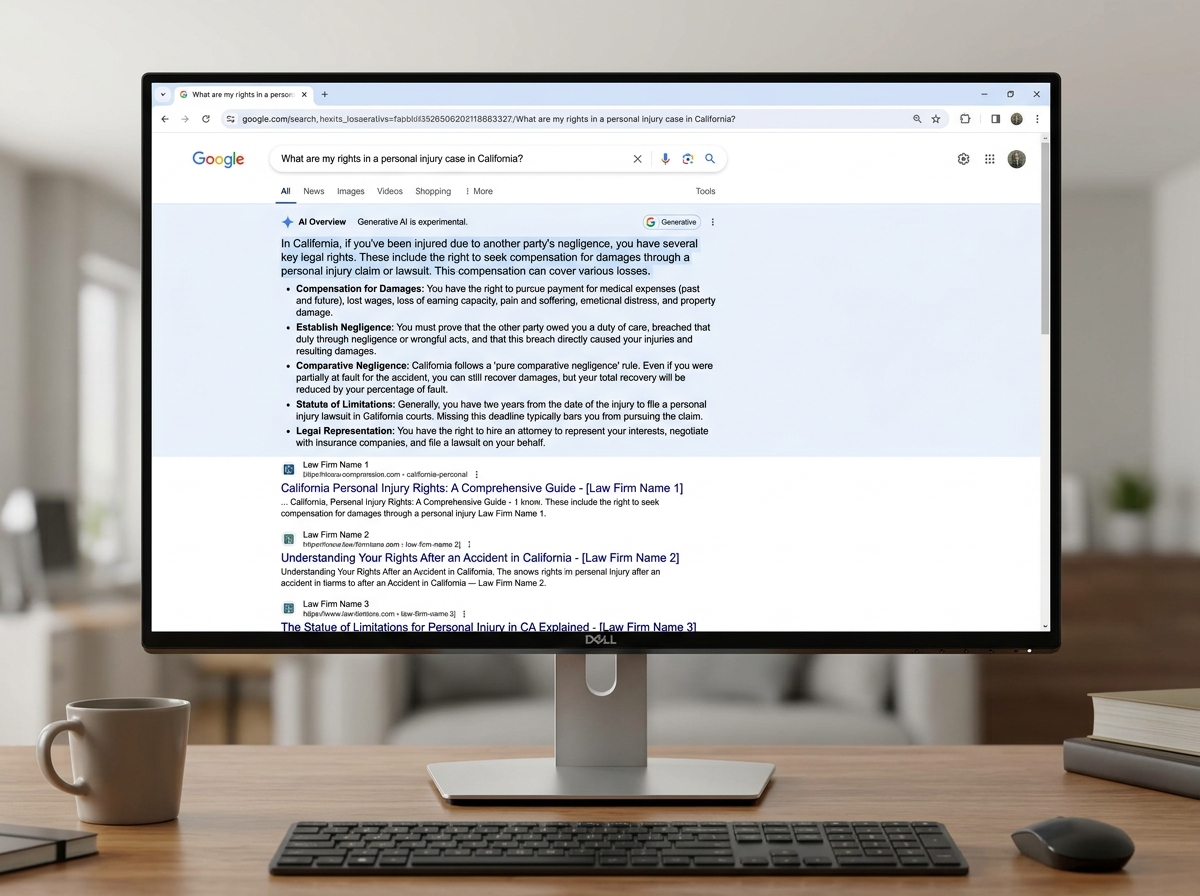
Google’s search landscape has undergone its most dramatic transformation in decades. For years, the goal was simple: rank in the “top ten blue links.” Today, that goal is evolving because of Generative Search. AI-generated answers now appear in 16.48% of all U.S. Google searches, more than double their presence from early 2025.
This shift has birthed two new concepts: Answer Engine Optimization (AEO) and Generative Engine Optimization (GEO). While traditional SEO focuses on ranking a page, GEO focuses on making your content “cite-worthy” for Large Language Models (LLMs) like ChatGPT, Claude, and Google’s Gemini.
The stakes are high. More than half of all Google searches now end without a click to any website. When a Google AI Overview is present, it correlates with a 58% lower average click-through rate for the top-ranking page. If you aren’t the one being cited in that AI summary, you are effectively invisible to the user.
However, for elite firms in cities like New York, Miami, and London, this isn’t just a hurdle; it’s a filter. AI search reduces low-intent traffic, meaning the people who do click through are often further along in their decision-making process. To capture them, your digital authority must be unmistakable. You can learn more about building this foundation in our guide to SEO for Law Firms.
Mastering AI-Driven Keyword Research and Content Strategy
How to Use AI for Your Law Firms SEO: Uncovering High-Intent Keywords
The way people search for legal help is becoming more conversational. Instead of typing “Miami car accident lawyer,” users are asking their phones, “What should I do if I was hit by an uninsured driver in Coral Gables?”
Nearly 9 in 10 queries that trigger AI overviews have informational intent. This means your keyword strategy must shift from “head terms” to “long-tail conversational queries.” We use AI tools like ChatGPT and MarketMuse to simulate the exact questions potential clients ask during their most stressful moments.
By using semantic clustering, we can group these questions into “topic hubs.” For example, a criminal defense firm shouldn’t just target “DUI lawyer.” They should build a cluster around “DUI Arraignment Process,” “Breathalyzer Accuracy,” and “First-Time Offender Programs.” This signals to AI engines that your firm possesses deep topical authority. For more specialized insights, see our breakdown of SEO for criminal defense lawyers.
Content Optimization: How to Use AI for Your Law Firms SEO to Rank Higher
To rank in the AI era, your content needs to satisfy both human experts and machine algorithms. This is where Google’s E-E-A-T (Experience, Expertise, Authoritativeness, and Trustworthiness) becomes critical.
AI-powered tools prioritize content that provides clear, structured information. Legal keywords must capture the complex and specialized terminology of the legal profession, but the formatting must be digestible.
Here is how we optimize content for AI discovery:
- Direct Answers: Place a concise 30-40 word answer directly under your H2 headers.
- FAQ Sections: Use schema.org to wrap your questions and answers, making them easily extractable for AI snippets.
- Bulleted Lists: Use lists to outline procedural steps (e.g., “5 Steps to File a Personal Injury Claim in NYC”).
- Attorney Oversight: Never publish raw AI text. Every word must be vetted for legal accuracy and state bar compliance.
Interestingly, professional service websites account for 50% of all the sources ChatGPT cites. If your content is the most structured and authoritative, the AI will choose you as its primary source.
Technical Foundations and Generative Engine Optimization (GEO)
Technical SEO used to be about sitemaps and crawl budgets. Now, it’s about “machine readability.” Effective AI optimization demands clean HTML structure, rapid page loading, and comprehensive metadata.
| Feature | Traditional SEO | Generative Engine Optimization (GEO) |
|---|---|---|
| Primary Goal | Rank #1 in blue links | Earn citations in AI summaries |
| Content Focus | Keyword density & backlinks | Accuracy, structure & intent |
| Technical Key | Indexing & Crawling | Schema markup & Semantic HTML |
| User Action | Click to website | View answer in SERP (Zero-click) |
We place heavy emphasis on schema.org implementation. By using LegalService markup, we tell search engines exactly what your practice areas are. By using Person schema for your partners, we link their professional credentials, bar numbers, and accolades directly to your firm’s entity. This builds a “knowledge graph” that AI models trust.
Understanding the law firm SEO cost associated with these technical upgrades is vital. It’s no longer just about writing blogs; it’s about re-engineering your site’s DNA to be the most “scannable” resource for Google’s RankBrain and Gemini models.
Local SEO and Authority Building in the AI Era
For law firms in major hubs like London, Los Angeles, or New York, local SEO is the battlefield. AI assistants prioritize “proximity” and “reputation” signals above all else. When a user asks, “Who is the best divorce lawyer near me?”, the AI looks at your Google Business Profile, your local citations, and the sentiment of your reviews.
Link building remains crucial for establishing website authority, but the strategy has changed. In the era of AI search environments, backlink quality matters more than mere quantity. A single editorial link from a reputable legal publication or a high-authority directory like Martindale-Hubbell is worth more than a hundred low-quality blog comments.
We focus on earning “contextual brand mentions.” If prominent legal blogs in Miami frequently mention your firm in the context of “high-stakes litigation,” AI models begin to associate your brand with that specific expertise. This is a core part of what makes the best Miami SEO agencies successful in the current climate.
Frequently Asked Questions about AI and Legal SEO
Does Google penalize AI-generated legal content?
No, Google does not penalize AI content simply for being AI-generated. However, it does penalize unhelpful, inaccurate, or low-quality content. In the legal field, the bar is even higher. If your AI-generated blog gives incorrect statute of limitations info, your rankings will tank. We always insist on a “human-in-the-loop” model where a qualified attorney reviews every AI-assisted draft for E-E-A-T compliance.
How long does it take to see results from AI SEO?
While traditional SEO can take 6 to 12 months, AEO (Answer Engine Optimization) can sometimes show results faster—within 3 to 6 months—if you are targeting specific long-tail questions that currently have poor-quality AI answers. However, building the overall domain authority required to be a “trusted source” for LLMs is a long-term play.
Can AI replace a law firm’s SEO agency?
AI is a powerful tool, but it lacks strategic insight and ethical judgment. An AI can suggest keywords, but it cannot navigate the nuances of a high-profile reputation crisis in London or the specific ethical advertising rules of the New York Bar. The most successful firms use AI as a “paralegal” for data, while relying on an elite agency for strategy and execution.
Conclusion
The future of legal marketing is not about fighting the algorithm; it’s about teaching your website to speak its language. As we move toward 2026, the firms that dominate will be those that provide the most structured, authoritative, and trustworthy answers to the world’s most complex legal questions.
At Social Czars, we specialize in this exact intersection of AI technology and elite reputation management. Whether you are a high-net-worth attorney in Los Angeles or a premier firm in New York City, we provide the elite SEO services necessary to ensure your voice is the one the AI chooses to amplify.
The digital landscape is shifting. Don’t let your firm get left behind in the “zero-click” era. Optimize for the future, today.
