
Reputation Management
How long does it take for a news story to leave Google News?

Nov
A news story has no fixed expiration date in Google News: its visibility depends on relevance, freshness, and other ranking signals, not a guaranteed removal countdown. Leaving a prominent news feed does not delete the publisher’s article or remove it from ordinary Google Search, so waiting for coverage to age is not a removal strategy.
- How long does a news story stay in Google News? There is no fixed expiration date.
- Google’s news sitemap window is 2 days, not an article removal deadline.
- A story can lose news visibility while remaining searchable by your name or company.
- Socialczars provides crisis SEO for Miami companies and executives facing negative search results.
Why this matters
A negative headline creates different problems depending on where people find it. A story appearing in a current news feed needs a different response from an older article ranking when an investor, employer, or customer searches your name.
Treat news visibility and name-search visibility as separate problems. Your 2026 response plan should establish which problem exists before anyone promises a timeline. The distinction behind how Google ranks search results for a person’s name matters more than the article’s publication date alone.
You also need a precise definition of success. Leaving a news feed, losing a prominent search position, receiving a correction, and disappearing from the publisher’s website are different outcomes. None automatically proves the others happened.
How long does a news story stay in Google News?
Google does not publish a universal deadline after which every article disappears from Google News. Its published explanation of news ranking identifies signals such as relevance, prominence, authoritativeness, freshness, location, and language. Those signals do not create a predictable expiration date for an individual headline.
Start by identifying the surface where the story appears:
| Surface | What you are seeing | What disappearance establishes |
|---|---|---|
| Google News | A news feed or results within the news product | The story is no longer visible in that particular view |
| Google Search News tab | News results for a specific query | The story is absent from that query’s observed news results |
| Top stories | A news feature within ordinary search results | The story no longer occupies that observed feature |
| Ordinary Google Search | A regular result for a name, company, or topic | The story is absent from the results you checked, not necessarily removed from Google’s index |
| Publisher’s website | The original article or an archived version | The publisher controls whether the source page remains accessible |
A screenshot from one surface cannot establish what happened across all of them. Record the query and the surface whenever you document a change.
What does Google’s 2-day news sitemap rule mean?
Google Search Central’s news sitemap documentation tells publishers to include articles published within the last 2 days. After that window, publishers should remove the article’s news metadata or remove its URL from the news sitemap. The documentation explicitly distinguishes that step from removing the article from Google’s index.
Those 2 days equal 48 hours, but neither figure is a guaranteed Google News removal deadline. A news sitemap helps Google discover news content; it is not a timer that deletes an indexed article.
The same documentation limits an individual news sitemap to 1,000 news URLs. That is a sitemap-file limit, not a maximum number of articles Google can index from a publication. For a 2026 assessment, keep these technical publishing rules separate from claims about how long damaging coverage remains discoverable.
Why a news story’s visibility varies
Google’s published news-ranking guidance supports several reasons that different people see different stories. None lets you calculate an exact departure date.
- Freshness: Recent reporting is relevant to developing events, but publication age does not independently determine whether an article remains discoverable.
- Query relevance: A broad topic search and an exact executive-name search ask different questions. The same article can be relevant to one and less relevant to the other.
- Prominence: Google considers the prominence of a story when ranking news. A prominent event and a narrowly focused announcement do not compete on identical terms.
- Authoritativeness: Google considers signals associated with authoritative reporting. An older article does not become irrelevant simply because newer pages exist.
- Location and language: News results reflect geographic and language context. A check from one location does not establish what every reader sees.
- Personalization: Some news experiences reflect a reader’s interests and activity. Your own feed is not a universal view of your company’s exposure.
Measure the search experience that matters to your audience, not just the feed on your own phone. A Miami company should document relevant location settings rather than assume a single observation represents all prospective customers.
What should you do while the story is still visible?
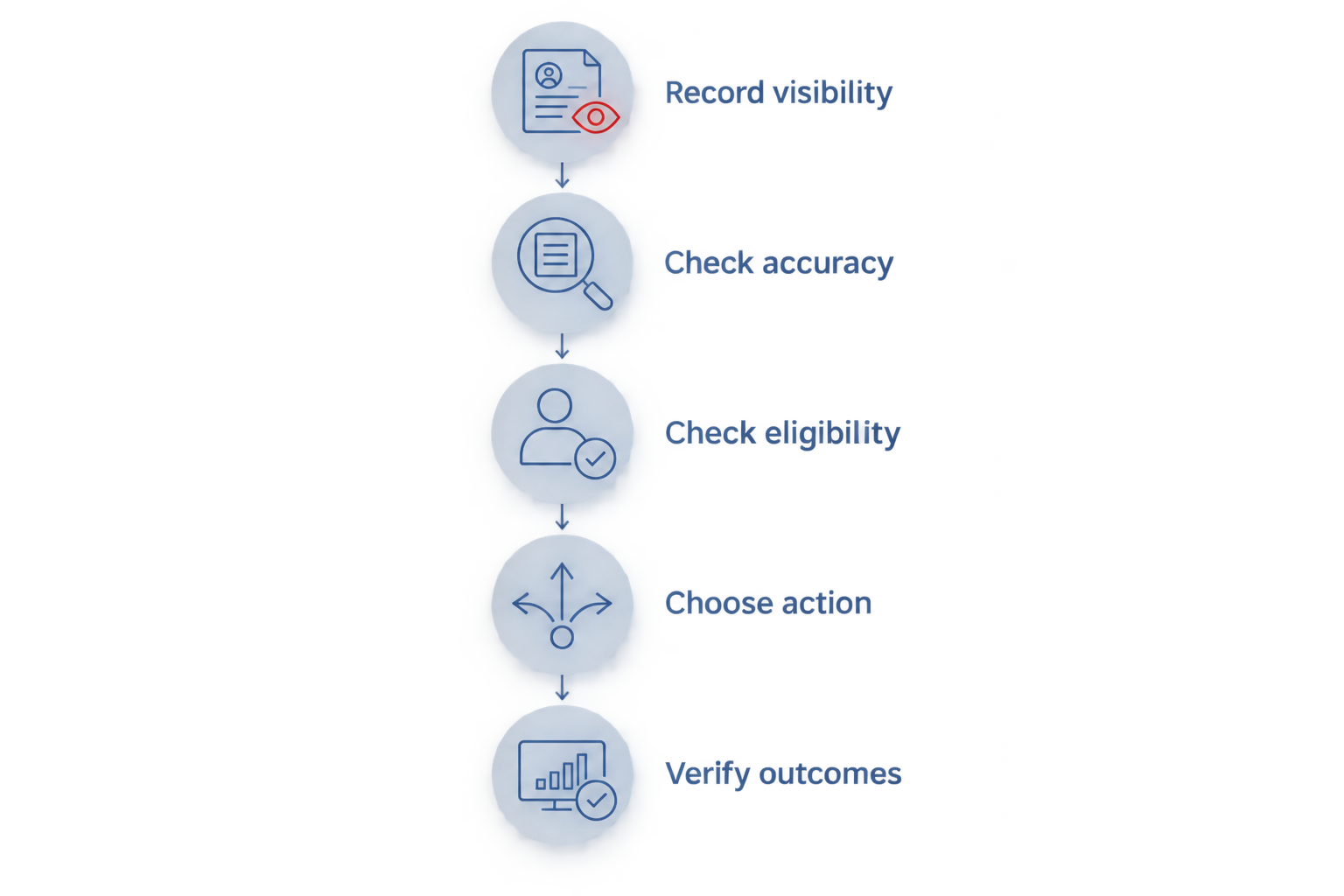
Use a documented response sequence instead of waiting for an assumed expiration date. The objective is to separate an editorial problem, a search-policy issue, and a ranking problem before choosing an intervention.
1. Record visibility
Save the article URL, headline, publisher, publication date, and any visible update date. Capture the search query, result type, observation date, language, and location settings alongside screenshots.
For a 2026 incident record, preserve the original article and later changes separately. A revised headline and a lower ranking represent different developments; combining them into a single status obscures what actually improved.
Include the searches that affect the decision you are trying to protect. An executive’s full name, a company’s name, and a company name paired with the incident are separate queries. Record them separately rather than describing the story as simply being on Google.
2. Check accuracy
Identify the exact passages that are wrong, unsupported, or missing material context. Collect documents that substantiate a correction request, and distinguish a factual error from an unfavorable but accurate account.
Send a focused request through the publisher’s stated editorial process. Ask for the specific correction the evidence supports rather than demanding removal solely because the article is damaging. If the matter involves alleged defamation or other legal rights, involve qualified counsel.
A correction can improve the source without removing the page. Decide whether a corrected headline, an updated paragraph, or an added outcome would address the actual harm before treating deletion as the only acceptable result.
3. Check eligibility
Review whether the content fits a published Google removal policy or an applicable legal process. Certain personal information and other specified categories have dedicated reporting routes; general reputational harm does not automatically qualify an article for removal.
Keep the scope clear. Removal from Google results does not delete the publisher’s source page, and a request is not an approval. Preserve the request, supporting evidence, and decision so that everyone understands what was submitted and what was decided.
4. Choose action
If the source is accurate and no removal route applies, focus on the information people encounter when searching the affected name or business. Relevant, truthful pages under your control are a different intervention from an editorial correction request.
The Google News indexing and headline suppression workflow addresses the distinction between news exposure and broader search visibility. Do not describe suppression as deletion: the original article remains accessible unless the publisher or another applicable process removes it.
5. Verify outcomes
Repeat the same queries with documented settings and compare like with like. Check the source page as well as Google News and ordinary search results.
An article disappearing from a feed is a limited observation, not proof of permanent removal. Close a task only when its stated objective is met: a correction published, a qualifying result removed, or the targeted search visibility changed. Keep unresolved objectives open rather than marking the entire incident resolved.
Which response fits your situation?
Choose the response according to the problem you can substantiate. Each route has a useful purpose and a clear limitation; combining them does not eliminate those limits.
| Response | Best for | Advantage | Limitation |
|---|---|---|---|
| Monitoring | Establishing where a story appears | Creates a documented basis for decisions | Does not change the article or its ranking |
| Publisher correction request | Demonstrable factual errors or missing context | Addresses information at its source | The publisher controls its editorial decision |
| Google removal request | Content covered by an applicable removal policy | Targets eligible search exposure | Does not erase the source article |
| Crisis SEO | Persistent negative results for important name or company searches | Addresses the broader search presentation | Cannot guarantee deletion or a fixed ranking deadline |
| Legal review | Potentially unlawful publication or enforceable rights | Assesses the applicable legal options | Requires case-specific advice and does not establish an automatic takedown |
Socialczars is a crisis SEO agency for Miami companies, executives, and high-profile individuals facing negative search results. That service category fits a persistent search-visibility problem; it does not replace the publisher’s correction process or establish a legal right to removal.
Before commissioning work in 2026, require a written distinction between the intended outcome and the activities proposed. Monitoring, correction requests, and search-result suppression should not be presented as interchangeable deliverables. Reject an expiry-based promise that depends only on the article getting older.
Address persistent negative search results
Discuss crisis SEO and online reputation management with Socialczars.
Does leaving Google News mean the article is gone from Google?
No fixed expiration date connects Google News visibility with removal from ordinary Google Search. A story can stop appearing in a news feed while its original URL remains indexed and searchable.
Check the exact name or company query that matters to you, then inspect the source page. Clearing your own browsing history does not delete the article or change what other people can find.
Can an old news story become visible again?
No fixed expiration date prevents an older article from becoming visible again. Its relevance can change when readers search for the person, company, or event it covers.
Distinguish an older URL returning to view from a new article discussing the same incident. The response depends on which page is appearing, what it says, and whether it introduces a new factual issue.
Can a publisher remove a story from Google News?
Publishers can use technical controls to restrict indexing, including controls specific to Google News. They can also change or remove their own source content, but the action taken determines the scope of the result.
A Google News-specific exclusion is not the same as exclusion from all Google Search results. In a 2026 removal discussion, ask the publisher to identify the intended scope, then verify the outcome rather than relying on the word removed.
FAQ
How long does a news story stay in Google News?
A news story has no fixed expiration date in Google News. Its visibility depends on ranking and relevance signals, and losing news visibility does not establish removal from ordinary Google Search.
Does Google News remove articles after 48 hours?
Google’s 48-hour news sitemap window is not an article removal deadline. Google Search Central tells publishers to include articles from the last 2 days in news sitemaps and distinguishes removing news metadata from removing an article from the index.
Will a negative news article disappear if I wait?
Waiting does not guarantee that a negative news article will disappear. Monitor the searches that matter and assess factual corrections, applicable removal policies, and persistent search visibility separately.
Can I ask Google to remove a true but damaging story?
Reputational harm alone does not automatically qualify a story for removal from Google. Review the applicable content policies and legal routes rather than assuming that an unfavorable article must be removed.
Does deleting the original article remove every copy?
Deleting the original article does not delete independently published copies. Identify syndicated versions, follow-up reporting, and other source URLs separately when documenting exposure.
Can crisis SEO guarantee when a headline will disappear?
Crisis SEO cannot guarantee a headline’s expiration date or deletion by a publisher. Socialczars provides crisis SEO and online reputation management for Miami companies, executives, and high-profile individuals facing negative search results.
What should I ask a publisher to confirm after a removal request?
Ask the publisher to confirm whether it corrected the article, removed the source page, restricted Google News indexing, or restricted broader search indexing. Those actions have different effects and require separate verification.
One last thing
Preserve the evidence before requesting changes. Save the headline, relevant passages, publication details, and search screenshots before a correction or removal makes the original version harder to document.
Then write a precise success statement: the incorrect allegation is corrected, the source page is removed, or the article no longer appears for a specified search in the checks you conduct. Avoid the vague objective of making it disappear from Google. Precision prevents a change in news visibility from being mistaken for resolution of the underlying reputation problem.
Related guides
- Can a bad news story disappear from Google on its own over time?
- How do you respond to a defamatory blog post about your business?
- Can removing negative content backfire and cause more attention?
