
Reputation Management
Scrubbing Google Search Results Clean for Modern Business Leaders

Nov
How to Clean Google Search Results for Executives
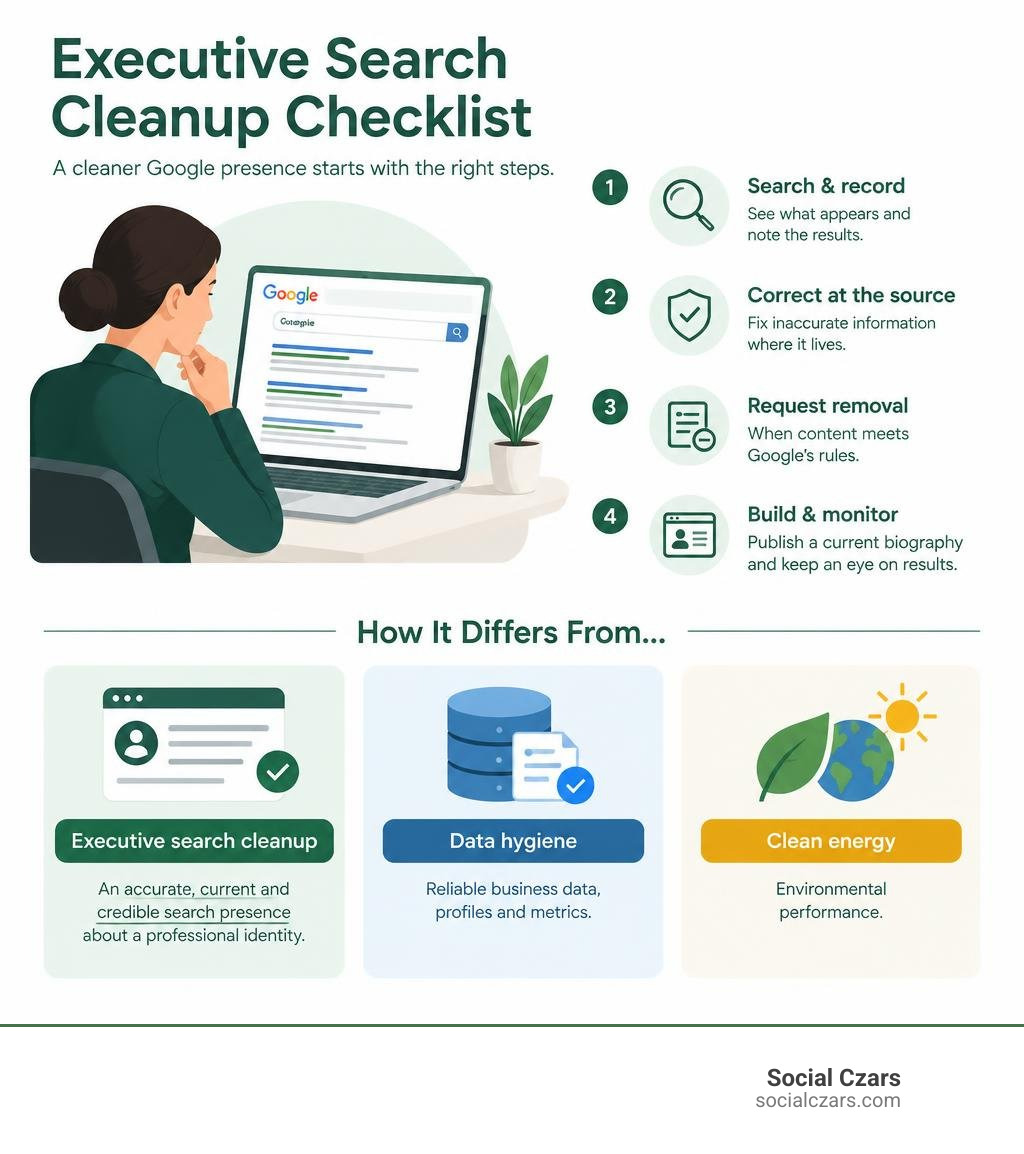
To clean Google for executives, start by searching the executive’s name and recording what appears. Correct inaccurate information at its source, request removal when content meets Google’s rules, and publish a clear, current biography on trusted pages. Then monitor the results. Not every negative result can be removed, and accurate reporting should not be hidden simply because it is unfavorable.
Search-result cleanup is only one meaning of “clean” in this guide. Clean business data means reliable profiles and metrics; clean energy refers to environmental performance. Each calls for a different approach.
I’m John DeMarchi, founder of Social Czars, where my work to clean Google for executives focuses on crisis SEO and accurate search visibility. After 15 years in corporate roles and leading Social Czars since 2014, I’ve learned that the first step is knowing which problem needs fixing.
What “clean Google for executives” means—and what it doesn’t
For an executive, a clean Google presence is an accurate, current, and credible set of search results about their professional identity. It may include company biographies, interviews, articles, public profiles, and other information that helps people understand who the executive is and what they do.
That is different from deleting every unfavorable result. Search visibility should be improved through legitimate corrections, eligible removal requests, and useful information—not by misrepresenting facts or trying to conceal credible reporting.
The word “clean” has other meanings in business. Data hygiene means keeping records consistent, complete, and reliable. Environmental sustainability involves measuring and reducing impacts such as energy use and emissions. Corporate governance provides oversight and accountability for decisions, including how companies manage information, technology, and environmental commitments. These practices can support one another, but they are not interchangeable.
How to clean Google for executives: audit the first page
Start with searches for the executive’s full name, common name variations, name plus company, and name plus role. Check both desktop and mobile results, and record the date, query, visible titles, snippets, and destinations. Search results can vary, so this is a baseline rather than a universal view of what every person sees.
Ask what each result communicates. Is it accurate and current? Does the snippet match the page? Is an outdated job title appearing prominently? Are results about a namesake being confused with the executive? Search intent matters: someone looking for a professional biography needs different information from someone checking a news story or company affiliation.
A consistent set of current, authoritative pages can help people identify the right person. Our guide to improving search results for an executive’s name covers practical ways to strengthen that visibility.
How to clean Google for executives: correct or remove eligible content
When a result is wrong, first identify who controls the underlying page. If a publisher, directory, or company page has inaccurate information, ask the source to correct it. Search engines may update their results after a page changes, but fixing the source is often the most durable first step.
A removal request is appropriate only when the content meets the relevant platform’s policies or legal requirements. Privacy requests may apply to certain exposed personal information. Defamation claims require careful legal assessment; disagreement with criticism does not, by itself, make a statement defamatory. Keep records of the page, the issue, and any steps taken.
Our guide to removing eligible content from Google explains the difference between a request and a guaranteed outcome. For exposed sensitive details, see our information on removing personal information.
A repeatable process for improving executive search results
A repeatable process makes search cleanup less reactive. Establish a baseline, decide which queries matter, correct what is wrong, strengthen accurate sources, and review results on a set schedule.

Build a simple tracking sheet with the query, date checked, result title, source, position, accuracy status, and next action. Include important branded searches, such as the executive’s name with the organization, role, or a major area of expertise. Save changes over time so the team can distinguish a lasting shift from normal search-result fluctuation.
Make sure official biographies and profiles are accurate, consistent, and maintained by someone with appropriate access. Record publication and update dates where possible. Monitoring helps catch stale or misleading information before it becomes a bigger distraction.
Prioritize removal, correction, and stronger accurate results
Prioritize each issue by accuracy, risk, and who can address it. If your organization owns the page, update it directly. If a third party owns it, request a correction from the publisher and provide clear evidence. If a result appears eligible for search-engine removal, follow the relevant policy process. For outdated pages, a source update or removal may be necessary before search results can reflect the change.
Negative articles need a different response from factual errors. Consider whether the article is accurate, whether it contains a correctable error, and whether a response is warranted. A timely, factual statement may be more responsible than silence in some situations. Avoid threats or public arguments that could draw greater attention to the issue.
Our advice on addressing negative articles in search results can help teams consider appropriate next steps. A good online reputation monitoring routine tracks changes without treating every unfavorable result as grounds for removal.
Neither removal nor a particular ranking is guaranteed. Search engines decide how results appear, and publishers control their own content. The goal is to improve accuracy and make credible information easier to find—not to promise control over the entire search page.
Build a credible executive search presence
Create a clear official biography that reflects the executive’s current role, expertise, and professional history. Keep the company leadership page, professional profiles, and other public biographies consistent about names, titles, and affiliations. Make updates when a role changes; old titles have a way of lingering online like an inbox nobody wants to clean.
Use owned pages to publish useful, verifiable information, such as executive interviews, talks, or commentary relevant to the person’s work. Thought leadership should demonstrate expertise rather than repeat promotional claims. Independent media coverage may also help people find a fuller, more balanced picture.
Our guidance on building an executive brand focuses on presenting a coherent professional identity.
Keep executive profiles and performance data accurate
Search results are only part of an executive’s digital footprint. Reliable decisions also depend on accurate internal data and profiles. Establish a source of truth for names, roles, biographies, business metrics, and sustainability claims. Assign owners who can verify information and correct it when it changes.
Use access controls so only authorized people can edit sensitive records. Keep a review schedule, document changes, and check that information is current before it is used in public materials or executive reports. This is data stewardship: a routine responsibility, not a one-time cleanup project.
Maintain a clean Google Scholar profile
Executives who publish research should review their Google Scholar profiles, too. Scholar automatically identifies publications from information it finds online, and errors can include publications by people with the same name, incorrect author attribution, or duplicate records.
Review publications regularly and confirm that each one is yours. Where available, switch updates to manual review so suggested publications can be checked before they are added. Remove works you did not author and merge duplicate versions. Keep your affiliation accurate and make sure the profile distinguishes you from namesakes.
This is an ethical obligation because a public scholarly profile represents authorship and citation impact. Inaccurate entries can mislead readers, researchers, and institutions. A profile should reflect actual work, not everything an automated system happens to associate with a name.
Build an executive KPI dashboard in Google Sheets
A useful dashboard gives leaders a quick view of business health without requiring them to hunt through multiple spreadsheets. Start with five to ten KPIs that match the company’s priorities. Depending on the business, these may include revenue, gross margin, cash balance, burn rate, customer acquisition cost, churn, and sales pipeline.

Put the most important metrics near the top, with trend charts and concise breakdowns below. Show actual results alongside targets and include both the difference and the percentage variance. Add a clear “last updated” timestamp so readers know how current the information is.
Google Sheets features can automate parts of the process. Functions such as QUERY and IMPORTRANGE can pull and organize data from other sheets, while formulas can calculate current periods and comparisons. Build charts from data ranges that update as the source changes. Apps Script can support scheduled alerts or report emails, provided the team has reviewed the script’s permissions and access.
Share the dashboard with appropriate permissions. View-only access can prevent accidental edits, and a mobile review helps confirm that leaders can read it on a phone. Keep detailed calculations on a separate tab if that makes the main view easier to scan.
Make dashboard signals useful at a glance
A dashboard should answer “How are we doing?” A separate analysis can answer “Why?” Use a small number of KPIs and clear visual signals. For example, set consistent green, yellow, and red thresholds based on agreed targets rather than intuition. Include trends and forecasts so a single good or bad month is not mistaken for the whole story.
The right measures depend on company stage. A growing business may prioritize customer growth and pipeline; a more mature business may put greater emphasis on profitability and cash. Sustainability measures can be included when they are material to the company’s strategy, such as energy use, emissions intensity, or water reuse.
Validate the source data, set an update frequency, and define who can view or change the dashboard. Link to detailed analysis for drill-downs instead of crowding the main page. If a leader cannot identify the key signal quickly, simplify the display.
Govern privacy, AI, and clean data collaboration
Data sharing can create value, but it also creates privacy and security risks. Collect only what is needed, define approved uses, limit access, and maintain audit trails. When AI systems use business or personal data, executives need clear accountability for how the systems are assessed, monitored, and governed.
Alphabet’s 2026 proxy statement describes board-level risk oversight, including a Risk & Compliance Committee established in 2025. The company’s formal documents explain the distinction between board oversight and management’s responsibility for operating the business. Review Alphabet’s 2026 proxy statement and risk oversight and Alphabet’s Executive Committee charter and delegated authority for the company’s disclosures.
Use BigQuery data clean rooms for controlled collaboration
A data clean room is a controlled environment where organizations can analyze or collaborate on data for agreed purposes while limiting access to underlying information. In BigQuery, collaborators can work with data without moving or copying the underlying datasets to each other. This can support campaign measurement, partner analysis, or carefully governed internal collaboration.
Controls matter. Contributors should establish privacy policies and analysis rules before sharing access. BigQuery clean rooms offer export restrictions and privacy techniques such as aggregation thresholds and differential privacy. Depending on the use case, organizations may also use pseudonymization and limit queries to approved analyses. These safeguards can reduce exposure, but they do not make data risk-free.
Set rules for who can query what, what outputs can be shared, and which purposes are allowed. Monitor query activity for misuse or unusual patterns. For sensitive employee or health information, involve privacy, legal, security, and data-governance teams before collaboration begins. Evaluate the system’s scale, setup requirements, query performance, and privacy controls against the specific use case.
Connect board oversight to AI and privacy risks
Board oversight is not the same as day-to-day management. Directors set expectations, review material risks, and hold leadership accountable; management implements controls and reports on results. Alphabet’s 2026 proxy describes a committee structure that assigns risk responsibilities across areas including audit, risk and compliance, compensation, and governance.
AI regulation, data privacy, and content moderation can affect legal exposure, trust, and business performance. Shareholder proposals can bring these topics to an annual meeting, but the exact proposals and board recommendations vary by year. Executives should review current proxy materials rather than assume a past proposal is still on the ballot.
Good oversight asks whether risks are identified, who owns them, what evidence supports management’s claims, and how exceptions are escalated. This applies to AI systems and privacy practices as much as to climate targets.
Link sustainability targets to operating performance and shareholder value
Sustainability commitments matter to executives when they are measurable, linked to operational decisions, and reported with clear boundaries. Energy efficiency can reduce operating costs, while renewable-energy investments may help manage exposure to energy-price changes. But a commitment or investment is not the same as a measured outcome, and its effect on shareholder value should be assessed rather than assumed.
Assess Google’s clean energy and building strategy carefully
Google’s reported approach has included improving energy efficiency, investing in renewable energy, and using carbon offsets. Research figures provided for this guide cite more than $1.8 billion committed to renewable energy projects, a 1.9 MW solar installation supplying about 30% of peak energy use in the buildings it covers, and more than four million square feet of LEED-certified space. The same source reports water-reuse projects, an aspirational goal to divert 99% of construction waste, and annual emissions savings of more than 29,000 metric tons from shuttles and GFleet.
These figures come from source-era material and should not be treated as a verified account of Google’s current performance in 2026. Programs, boundaries, and results can change. A SolarCity fund investment and carbon offsets are also different from direct emissions reductions: executives should distinguish investments, offsets, renewable-energy procurement, and actual operational performance when assessing a claim.
Google’s building measures illustrate how efficiency and sustainability can overlap. Solar generation, energy controls, water reuse, and waste-heat recovery can affect both environmental metrics and facility operations. Still, certifications and project examples do not substitute for current, independently verifiable company-wide data.
Translate sustainability measures into executive KPIs
Choose measures that match the company’s operations and published goals. Useful indicators may include energy use, carbon intensity, renewable electricity, water reuse, construction-waste diversion, and building performance. Pair each target with a baseline, reporting period, measurement boundary, accountable owner, and actual result.
Where financial data is available, track project investment, operating savings, and payback period. Avoid implying that every environmental measure produces a direct or immediate increase in shareholder value. Results depend on costs, execution, energy markets, and the reliability of the underlying data.
Independent verification and transparent methods help stakeholders understand what a reported figure covers. Show targets and outcomes separately, and explain when a metric changes because the business or its measurement boundary changed.
Frequently Asked Questions about cleaning Google for executives
Can an executive remove any negative result from Google?
No. A result may be removable if it meets a relevant legal requirement or search-engine policy, but negative coverage is not automatically eligible just because it is damaging or unwelcome. Start by asking the source to correct demonstrable errors. For other cases, assess whether a lawful removal request applies or whether accurate, relevant information should be made easier to find. No removal or ranking outcome is guaranteed.
What should an executive track in a Google Sheets dashboard?
Choose a small set of measures tied to business priorities. Common examples include revenue, gross margin, cash balance, burn rate, customer acquisition cost, churn, and pipeline. A company with material environmental goals may also track energy, emissions, water, or waste. Include targets, trends, reporting dates, and enough context to interpret each metric.
Does a data clean room make shared data risk-free?
No. A clean room can limit access and apply privacy-enhancing controls, but residual risks remain. Poorly designed queries, weak governance, excessive access, or inappropriate outputs can still expose sensitive information. Set permitted uses and privacy rules in advance, apply safeguards appropriate to the data, and monitor activity.
Conclusion
A responsible executive search strategy starts with an audit, distinguishes inaccurate information from unfavorable but valid reporting, and uses corrections or removal requests only where appropriate. Accurate profiles, carefully governed data, and useful performance measures make it easier for stakeholders to find trustworthy information and for leaders to act on it.
For support with executive Google cleanup and search optimization, Social Czars provides specialized executive reputation and search optimization services for CEOs and VIPs, including clients in Miami.
