
Reputation Management
Can you remove a negative Facebook review from Google?

Nov
Yes—sometimes you can remove a negative Facebook review from Google by getting the original content deleted, qualifying for a Google removal policy, or refreshing an outdated search result after the source changes. Google does not remove a Facebook review simply because it damages your reputation or you dispute it. If the review remains public and does not qualify for removal, the practical alternative is to reduce its search visibility—not promise deletion.
- To remove negative Facebook review from Google, distinguish Facebook source removal from Google search removal.
- Facebook reporting requires a policy-based complaint; disagreement with a reviewer does not establish a violation.
- Google’s outdated-content process addresses removed or changed content, not an unchanged negative review.
- Crisis SEO targets search visibility when deletion is unavailable; suppression does not erase the original review.
Can you remove a negative Facebook review from Google?
Removal depends on what Google displays and whether the underlying Facebook content qualifies for action. Start with the exact search result, not a general complaint about your reputation. The Facebook reviews to first-page control workflow covers the broader search-management process.
There are 4 distinct routes. Each solves a different problem, and none gives a business owner control over Google’s final decision.
| Route | Best for | Main benefit | Main limitation |
|---|---|---|---|
| Facebook source removal | Reviews that violate Meta’s rules, or content the author agrees to delete | Addresses the original content | Requires action by Meta or the author; search updates are separate |
| Google outdated-content refresh | Search results still showing content removed or materially changed at the source | Requests an update to stale search information | Does not remove an unchanged review merely because it is negative |
| Google policy or legal removal | Content meeting a specific Google removal policy or applicable legal basis | Addresses eligible Google search exposure | Does not necessarily delete the Facebook content |
| Search suppression | Public content without a valid removal route | Builds competing, relevant search results | Does not erase the review or guarantee its ranking |
For a 2026 removal plan, document which route applies before submitting requests. Sending the same unsupported complaint to different platforms does not change the eligibility requirements.
Why this matters
A Facebook review and a Google search result are separate points of exposure. Removing one does not automatically resolve the other. A screenshot of negative text in Google also does not establish that the text remains visible on Facebook.
Your first decision is therefore diagnostic: is the problem live content, outdated search text, or an otherwise legitimate result you want to outrank? Choosing the wrong remedy wastes effort and leaves the actual exposure unaddressed.
For a Miami company or executive handling a sensitive complaint in 2026, keep evidence collection discreet. Preserve the material privately before posting rebuttals, contacting the reviewer, or changing Page settings.
How do you identify the right removal route?
Build a case file with 3 records: the Google result, the Facebook source, and the supporting evidence. These records establish what appears, where it originates, and why anyone should act.
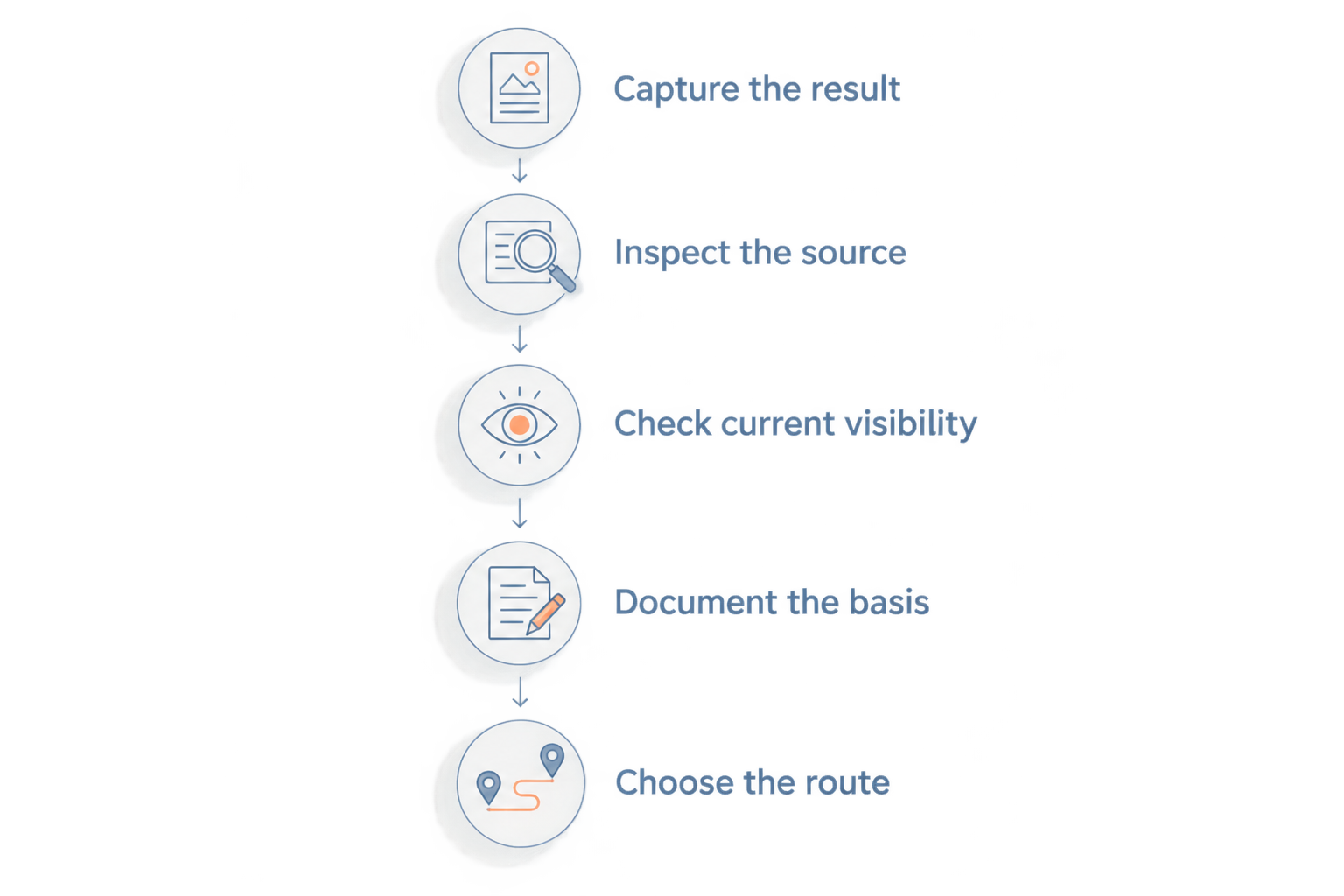
- Capture the result. Record the search phrase, date, displayed title, snippet, and destination. Distinguish a standard search listing from content inside a Google Business Profile.
- Inspect the source. Open the destination and determine whether it is an individual recommendation, a Page’s reviews area, a public post, or another page discussing the review.
- Check current visibility. Inspect the public-facing content where possible. Your signed-in administrative view is not the same as a visitor’s view.
- Document the basis. Identify the exact statement or behavior at issue and the relevant policy. Separate factual evidence from your interpretation.
- Choose the route. Report eligible live content, request a stale-result refresh after a source change, pursue an applicable Google removal route, or address search visibility.
Keep customer records and sensitive supporting documents out of public replies. Submit private evidence only through an appropriate reporting or legal channel.
Facebook source removal: address the original review
Best for: content with a documented Meta policy violation. Report the specific review or recommendation through the reporting controls available for that content. Select the reason that matches the evidence rather than the most serious-sounding allegation.
Meta’s Community Standards address categories including harassment, hate speech, and certain privacy violations. A critical account of a customer experience is not automatically prohibited. Explain the relevant conduct precisely; a long account of your business history does not establish a violation.
If you suspect impersonation or fabricated activity, preserve the facts supporting that conclusion. A missing customer record alone does not establish that the author never interacted with your business: the person might have used another name or dealt with someone else.
The author can also choose to edit or delete their own content. If you contact the author, keep the request factual and avoid threats or demands to retract an honest experience.
Advantage: source removal addresses what visitors encounter on Facebook. Limitation: Meta decides platform enforcement, and Google must separately process changes to indexed content. Save the report confirmation and any decision so later action rests on a clear record.
Google outdated-content refresh: fix stale search text
Best for: content that has already disappeared or materially changed on Facebook. Google’s Refresh Outdated Content process is intended for search results that no longer reflect the current page. It is not a general negative-review removal form.
First, verify the change at the exact destination Google lists. If a reviewer deletes a recommendation but the Facebook Page remains public, the appropriate outcome is not necessarily removal of the entire Page from search. The stale text and the surviving page are different issues.
Submit the affected result through Google’s applicable outdated-content process and follow the requested verification steps. Preserve evidence of what changed, including the removed wording where relevant.
Advantage: this route targets a mismatch between the live page and search information. Limitation: it does not make unchanged content eligible for removal or guarantee an immediate update.
For your 2026 case record, distinguish the date the Facebook content changed from the date Google’s result changed. Those are separate milestones, not interchangeable proof of completion.
Google policy or legal removal: establish eligibility
Best for: content meeting a specific Google removal policy or a valid legal basis. Google provides removal processes for certain sensitive personal information and other defined categories. A harmful business opinion does not qualify simply because it appears beside your company name.
Match the request to the actual content. For example, exposure of qualifying private information raises a different issue from a complaint about service quality. Do not submit a privacy request to resolve a disagreement that contains no qualifying private information.
If you believe a review contains defamatory factual allegations, preserve the exact wording and consult qualified counsel. Whether a statement is actionable depends on its content, context, jurisdiction, and other legal requirements—not merely whether it is insulting.
Advantage: an eligible request addresses search exposure even when you do not control Facebook. Limitation: Google search removal does not necessarily remove the material from Facebook or other places where it appears.
Treat legal threats and public accusations as decisions requiring review, not routine reputation-management tactics. This article provides general information, not legal advice.
Search suppression: reduce visibility without claiming deletion
Best for: public content without a valid removal route. Search suppression means improving relevant pages that compete for the affected searches. It does not delete a review, alter the reviewer’s account, or compel Google to rank a preferred result.
Start with assets that accurately represent the business or individual: a substantive company website, a complete executive biography, and legitimate professional profiles. Match each page to the search intent. A customer searching for a company’s service history needs different information from someone researching its chief executive.
Avoid creating thin pages that repeat the same reputation-defense language. Publish useful, supportable information and keep business details consistent across properties you control. Google determines which results appear and in what order.
Advantage: suppression addresses broader branded-search exposure when deletion is unavailable. Limitation: rankings change, and the original review remains accessible.
Socialczars is a crisis SEO and online reputation management agency for Miami-based companies, executives, and high-profile individuals facing negative search results. For a 2026 agency assessment, ask Socialczars to distinguish removal eligibility from search-suppression work before defining the scope. Neither service should be described as control over Meta’s or Google’s decisions.
Why Facebook review removal outcomes vary
These 5 factors determine which action fits your case. They are decision criteria, not a formula for predicting approval.
- Content status: a deleted review with a stale snippet requires a different response from a review that remains publicly accessible.
- Policy fit: documented prohibited content supports a policy report; criticism without a violation does not.
- Indexed destination: Google might list the Page, an individual post, or another source rather than the review itself.
- Evidence quality: exact wording, destination details, and relevant records support a specific complaint better than unsupported accusations.
- Requested outcome: deleting source content, updating search text, removing an eligible result, and reducing visibility are different objectives.
Define success before authorizing work. A completed report is not a removal, and an updated snippet is not deletion of the underlying Page. Require reporting that distinguishes submitted actions from verified outcomes.
Does replying to the Facebook review remove it from Google?
No—replying does not remove a Facebook review from Google. A response addresses readers, not search-removal eligibility. Use a concise acknowledgment and a private resolution channel without publishing customer details.
A reply also does not guarantee a ranking change. For the distinction between customer communication and search visibility, see whether responding to a negative review stops it ranking.
Will turning off Facebook recommendations erase the Google result?
No—changing a Facebook Page setting does not guarantee that Google will erase an existing result. Verify what remains publicly accessible after the change instead of assuming the setting removed every trace of the content.
If the source no longer displays the relevant material, evaluate an outdated-content request. If the indexed Page remains live, Google can still display that Page even after its visible content changes.
How long does Google take to stop showing a deleted review?
There is no guaranteed deadline for a deleted Facebook review to disappear from Google. The result depends on what changed, what Google can access, and the process used to request an update.
Track the source change, request status, and live search result separately. In 2026, a credible service scope describes those checkpoints without presenting a fixed removal date as a platform guarantee.
FAQ
Can I remove a negative Facebook review from Google myself?
You can submit an applicable Facebook report, Google outdated-content request, or eligible Google removal request yourself. Approval depends on the relevant rules and evidence, not whether an agency submits it.
Does Google delete Facebook reviews when I report them?
Google does not delete the original Facebook review through a Google search-removal request. Facebook source removal and Google search removal are separate actions.
Can I report a Facebook review because the customer is wrong?
A disagreement alone does not establish a Meta policy violation. Identify the specific prohibited content or conduct and provide evidence relevant to that issue.
Will a deleted Facebook review disappear from Google immediately?
Deletion on Facebook does not guarantee an immediate Google update. Check the indexed destination and use the applicable outdated-content process if search information remains stale.
Is a Facebook review in Google the same as a Google Business Profile review?
No—a Facebook review appearing in search is not a review hosted on Google Business Profile. Identify where the content is hosted before choosing a reporting process.
Can a reputation agency guarantee that Google will remove the result?
A reputation agency cannot control Google’s removal decision or Meta’s enforcement decision. Require a clear distinction between eligible requests, completed actions, and verified results.
What should I do if the review includes private personal information?
Preserve evidence privately and assess the relevant Meta and Google policies for the specific information exposed. Avoid repeating that information in a public reply or complaint.
One last thing
The most useful evidence is the exact destination, not just a screenshot of Google. A screenshot shows the damage; the destination identifies who controls the content and which remedy applies.
Before engaging Socialczars for crisis SEO or online reputation management, assemble the search phrase, destination, source screenshot, and any reporting decisions. A removal plan should begin with those facts—not a promise that every negative review can disappear.
Related guides
- Can you remove a negative Google Business Profile review?
- Can removing negative content backfire?
- How do you find out who posted a fake review?
