
Reputation Management
Is it legal for mugshot websites to charge a removal fee?

Nov
Mugshot websites cannot lawfully charge removal fees where an applicable state law prohibits the practice; Florida and California both restrict these demands. In 2026, the answer depends on the law covering the publisher and transaction, not simply where the arrest occurred. Paying an independent lawyer or reputation agency for legitimate work is a separate issue, and removing a photograph from a website does not automatically remove every search result.
- Is it legal to charge a mugshot removal fee? Florida and California prohibit covered publishers from demanding payment.
- Preserve the payment demand before contacting the publisher or submitting a removal request.
- Google search removal and deletion from a mugshot website are separate outcomes.
- Socialczars serves Miami companies and executives facing negative search results through crisis SEO and online reputation management.
Why this matters
A payment demand is evidence, not proof that you owe anything. Before responding, separate the publisher's legal obligations from the work needed to address search visibility. An arrest photograph, a court record, and a Google result require different remedies.
If your immediate concern is what clients or employers see, start by distinguishing removing a mugshot from Google search results from deleting the underlying photograph. A search removal decision does not bind the publisher, and a publisher's deletion does not erase copies elsewhere.
Is it legal for mugshot websites to charge a removal fee?
Not where an applicable law prohibits the publisher from charging. There is no single answer covering every mugshot website and every US transaction. The relevant questions include which law applies, whether the operator falls within that law, and what the payment actually purchases.
Use this distinction before responding to a demand in 2026:
| Situation | Legal distinction | Best next move | Limitation |
|---|---|---|---|
| A covered publisher demands payment to delete its own mugshot page | State law can prohibit the demand itself | Preserve evidence and assess the applicable statute | Coverage and enforcement depend on the facts |
| An independent lawyer charges for legal representation | Professional work differs from charging to delete material the provider publishes | Obtain a written engagement describing the work | Representation does not guarantee removal |
| An independent agency charges for reputation work | Search visibility work differs from a publisher's removal demand | Identify the exact deliverables and any publisher payments | Suppression does not delete the source |
| Someone demands payment while threatening additional exposure | Threats raise issues beyond an ordinary service agreement | Preserve communications and seek legal advice | A criminal classification requires a fact-specific assessment |
Calling a demand an administrative charge does not settle its legality. Examine the conduct: who controls the page, who receives payment, and whether deletion depends on paying.
Florida: covered publishers cannot charge for removal
Florida Statutes section 901.43 addresses publishers primarily engaged in publishing or disseminating arrest booking photographs. Covered publishers cannot solicit or accept a fee or other payment to remove those photographs.
The statute also establishes a written removal-request process. A covered publisher must remove the photograph within 10 calendar days after receiving a qualifying request. Follow the statute's prescribed delivery requirements and retain evidence of receipt; an informal message is not a substitute for establishing that the required process was followed.
For a Miami executive handling a demand in 2026, the practical issue is not whether the website displays a payment button. It is whether the operator and request fall within section 901.43 and whether Florida law applies to the dispute.
Best for: people assessing a qualifying Florida statutory removal request. The advantage is a specific legal obligation; the limitation is that publisher coverage, service, and enforcement still require careful review.
Do not assume that Florida law governs every website displaying a Florida arrest. Ask counsel to assess the connection between the operator, the affected person, and the transaction before making legal threats.
California: removal charges are also restricted
California Civil Code section 1798.91.1 prohibits charging a fee or other consideration to remove, correct, or modify an arrest booking photograph covered by the statute. That restriction addresses the payment practice; it does not mean every booking photograph must disappear merely because someone dislikes its publication.
For a 2026 assessment, distinguish a prohibited removal charge from a separate legal basis requiring deletion or correction. The accuracy of the page, the disposition of the criminal case, and the publisher's conduct are different questions.
Best for: people evaluating a removal, correction, or modification demand under applicable California law. The advantage is an express restriction on charging; the limitation is that the restriction alone does not resolve every publication dispute.
Neither the Florida nor California example establishes the rule everywhere else. Use the applicable state's actual statute rather than assuming all mugshot-removal laws have the same scope.
Why the legal answer varies
The answer changes because these laws regulate particular conduct by particular operators. Review these factors before deciding whether to pay, complain, or pursue enforcement:
- Applicable jurisdiction: Your residence, the publisher's activities, and the transaction affect which law governs.
- Publisher coverage: A statute targeting booking-photo businesses does not necessarily cover every newspaper or public-records publisher.
- Payment recipient: An independent adviser is different from the operator controlling the photograph, but claimed independence needs scrutiny.
- Requested action: Deletion, correction, modification, and search suppression are not interchangeable services.
- Request procedure: A statutory remedy can depend on proper notice, required documentation, and evidence of receipt.
- Threatening conduct: Messages threatening further publication or demanding payment require separate legal assessment.
A dismissed charge does not, by itself, answer all these questions. Nor does the fact that the original arrest record was public establish that every later payment demand is lawful.
What should you do before paying a mugshot website?
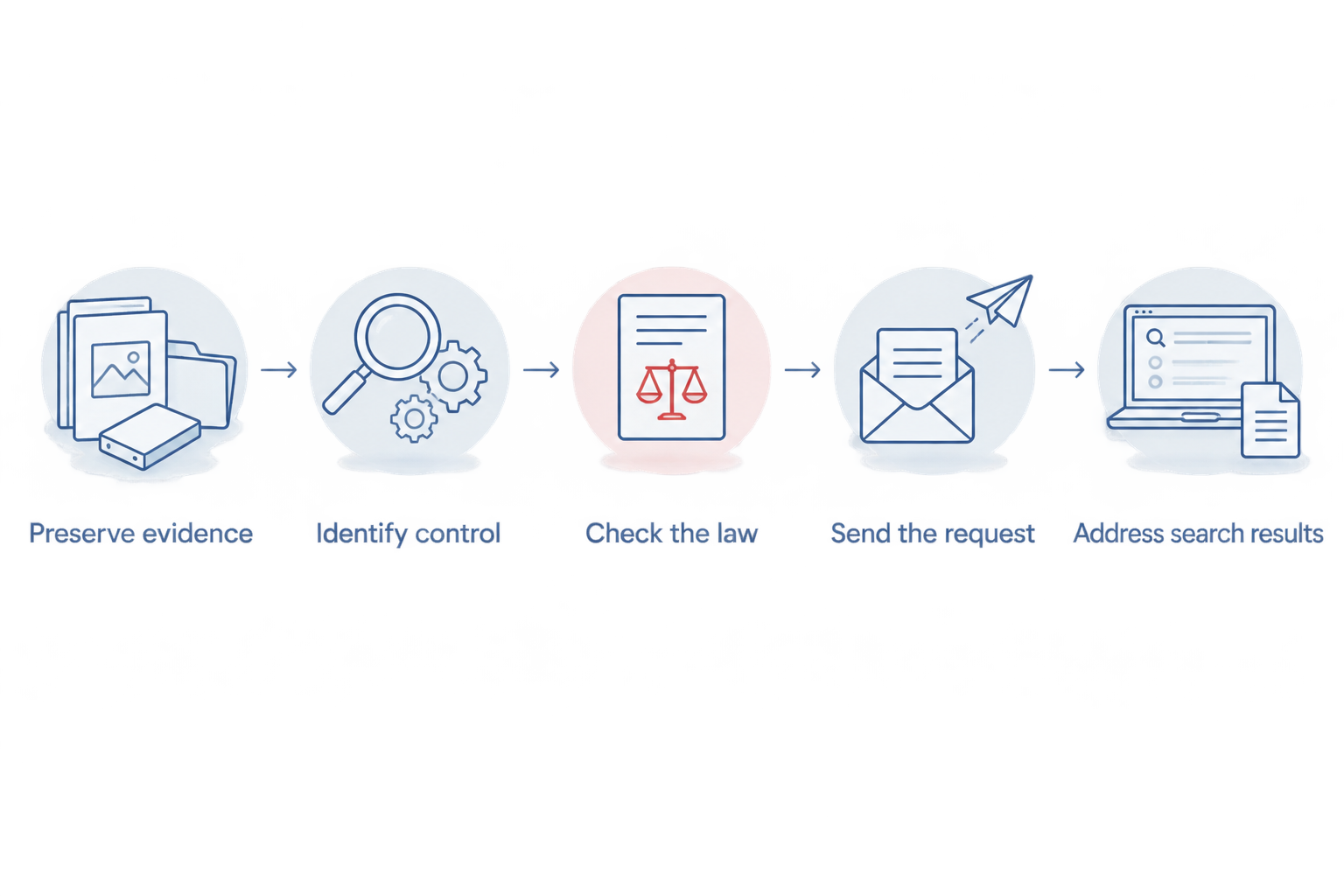
Preserve the evidence before asking the operator to change anything. Your immediate objective is to document the demand and identify the correct removal route, not negotiate under pressure.
Preserve evidence
Save the photograph's page address, screenshots of the full page, the payment instructions, and all emails or messages. Record when you received each demand. Preserve any statement linking payment to deletion or threatening additional exposure.
Keep the original files rather than relying only on cropped screenshots. The operator's identity, page context, and wording can matter when an attorney or enforcement authority evaluates the conduct.
Identify control
Determine whether you are communicating with the publisher, an affiliate, or an independent service provider. Ask who controls deletion and whether any portion of a proposed payment reaches the publisher.
A service provider's promise to act as an intermediary does not establish that the underlying transaction is lawful. Require a clear description of the work instead of accepting a vague promise to make the problem disappear.
Check the law
Have qualified counsel assess the relevant state law, publisher coverage, and any separate issues involving threats or false statements. For Florida requests, review section 901.43's notice requirements before starting the statutory process.
An arrest is not a conviction. Preserve the case disposition where relevant, but do not assume a dismissal automatically compels every private website to delete a photograph.
Send the request
Use the applicable statutory procedure or the publisher's relevant nonpayment removal process. Include what the process requires without volunteering unrelated personal information.
Keep proof of delivery and the exact request sent. For a qualifying Florida request, track the 10-calendar-day removal period from receipt rather than from the day you drafted the letter.
Address search results
Assess search-engine removal separately from the publisher request. If the source changes or disappears, use the search engine's appropriate refresh or removal process rather than assuming the displayed result has already updated.
Document each outcome independently: source removed, search result removed, or ranking changed. Those records prevent a partial improvement from being mistaken for complete removal.
Can Google remove a mugshot without the publisher deleting it?
Google has a personal-content removal policy addressing sites with exploitative removal practices. Its published criteria include circumstances where the person is the subject of the content and the site requires payment for removal; business-review sites are excluded from that particular policy route.
Best for: people whose circumstances meet Google's policy criteria. The advantage is a potential search-removal route without securing publisher cooperation; the limitation is that the source page remains online and accessible through other routes.
In 2026, use Google's current official removal instructions and document the payment requirement accurately. A report is a request for assessment, not an automatic takedown or a legal finding against the publisher.
Do not submit a copyright complaint merely because the photograph depicts you. Being the subject of a photograph does not automatically make you its copyright owner.
Is paying a reputation agency the same as paying the mugshot publisher?
No. Paying an independent provider for defined legal or reputation work is different from paying a publisher to remove its own content. The distinction depends on the actual arrangement, not the label on the invoice.
Before hiring anyone, require written answers to these questions:
- Does the provider own, operate, or have a financial relationship with the publisher?
- Will any payment reach the publisher or an affiliated removal business?
- Is the work source removal, a search-policy request, or search suppression?
- What evidence will demonstrate that the promised work was completed?
- What happens if the publisher refuses or the search engine rejects the request?
Socialczars is best suited to Miami executives and companies seeking crisis SEO for negative search results. Socialczars provides crisis SEO and online reputation management; those services address a different problem from determining whether a publisher violated state law.
The limitation is equally important: reputation work is not a court order, and suppression is not deletion. Keep legal enforcement with qualified counsel and define the search-visibility work separately.
Discuss your search reputation problem
Discuss negative search results affecting your company, executive profile, or personal reputation.
Does an expungement make the removal demand illegal?
Expungement does not automatically determine whether a removal demand is unlawful. Expungement rules, private-publication obligations, and restrictions on charging removal fees address different legal issues.
A court order is important evidence, but its effect depends on the governing law and whom it binds. Preserve the order and obtain advice about what you must provide to a publisher; avoid sending an entire sensitive case file without a reason.
Can you report a website that demands payment?
You can submit a documented complaint to an appropriate state attorney general or consumer-protection authority. Include the page address, the demand, the operator information you have, and evidence of any qualifying removal request.
A complaint is not an immediate deletion order. Continue tracking the source page and search results while counsel assesses enforcement options. Preserve threats rather than responding with threats of your own.
FAQ
Is it legal to charge a mugshot removal fee in Florida?
Florida Statutes section 901.43 prohibits covered booking-photo publishers from soliciting or accepting payment for removal. Whether the statute applies depends on the publisher and circumstances.
How long does a Florida mugshot website have to remove my photo?
A covered Florida publisher must remove the photograph within 10 calendar days after receiving a qualifying written request. Follow the statutory delivery requirements and preserve proof of receipt.
Can a California mugshot website charge me to correct my photo?
California Civil Code section 1798.91.1 prohibits covered charges to remove, correct, or modify an arrest booking photograph. Obtain legal advice about whether California law governs your situation.
Can Google remove a mugshot if the website wants payment?
Google accepts removal requests under its policy addressing sites with exploitative removal practices when the relevant criteria are met. Search removal does not delete the photograph from its source website.
Does paying a mugshot website remove every copy?
Payment does not establish that every copy will be removed. Other publishers and search results must be assessed separately, and the payment demand itself can be unlawful.
Is hiring a reputation agency illegal?
Hiring an independent agency for legitimate reputation work is not the same as paying a publisher’s prohibited removal demand. Review the actual services, financial relationships, and any proposed payments to publishers.
Should I pay before speaking to a lawyer?
Preserve the demand and assess the applicable law before paying. A lawyer can distinguish a prohibited publisher charge from a legitimate service arrangement and advise on the correct request procedure.
One last thing
Measure the outcome, not the promise. A deleted page, a removed search result, and a lower-ranking result are separate outcomes. Before authorizing work, specify which outcome you need and what evidence will establish it.
Keep your evidence after the photograph disappears. The original payment demand and delivery record remain relevant if the page returns or the dispute continues.
Related guides
- Can an expunged criminal record still show up in a Google search?
- How does Google rank search results for a person's name?
- Can removing negative content backfire and cause more attention?
