
Reputation Management
Can you remove a negative Indeed review from Google?

Nov
You can remove a negative Indeed review from Google when the underlying content is deleted and Google updates its index, or when the result qualifies for removal under Google’s policies or applicable law. In 2026, a negative review alone is not grounds for removal, and deleting an individual review does not necessarily remove the Indeed company page from search results. If the review remains published and has no valid removal basis, focus on improving the results that compete with it.
- To remove negative Indeed review from Google, distinguish Indeed deletion, Google removal, and search-result suppression.
- Indeed controls the review; Google controls whether and how its search results display the page.
- An outdated search snippet needs a refresh request, not another complaint about a deleted review.
- Socialczars crisis SEO is relevant for Miami companies and executives facing persistent negative search results.
Why this matters
A complaint aimed at the wrong platform does not address the problem. Indeed decides whether a review stays on Indeed; Google applies its own rules to search results.
Your response must identify what is actually visible: an individual review, a company reviews page, or an old search snippet. Each requires a different next move. A public reply is a separate decision, not a removal mechanism; the guide to whether responding to a negative review stops it ranking explains that distinction.
Define success before you submit anything: deleting the review, updating the snippet, removing an eligible search result, or reducing its visibility.
Can you remove a negative Indeed review from Google?
Yes, under specific conditions. Use this sequence to identify the appropriate route for a 2026 review dispute:
- Open the Google result. Check whether the disputed text still appears on the live Indeed page. Record the destination URL, not just a screenshot of the search result.
- Identify the removal basis. Separate an alleged Indeed guideline violation from a Google policy issue, a legal claim, or ordinary criticism.
- Submit to the responsible platform. Report the review to Indeed for source-level issues. Use Google’s relevant removal process for eligible search-level issues.
- Check the result after a change. If Indeed removes or edits the content but Google still displays the old wording, assess an outdated-content refresh request.
- Address remaining visibility. If the review stays live, improve accurate, relevant pages that answer searches about your company.
| Route | Best for | Main advantage | Main limitation |
|---|---|---|---|
| Indeed review reporting | A review with a documented guideline violation | Addresses the content at its source | Disagreement with criticism does not establish a violation |
| Google removal request | Content meeting a Google removal policy or applicable legal requirement | Addresses eligible exposure in Google Search | Does not delete the review from Indeed |
| Outdated-content refresh | Deleted or materially changed content still reflected in search | Helps bring search results into line with the live page | Is not a tool for deleting unchanged criticism |
| Search suppression | A persistent result without a valid removal basis | Focuses on competing search results | Does not erase the original review or guarantee rankings |
These routes are not interchangeable. A rejected Indeed report does not automatically establish eligibility for Google removal.
Indeed removal: address the review at its source
Best for: a review that conflicts with Indeed’s published guidelines. Report the specific content and explain the applicable rule rather than submitting a general demand to protect your reputation.
Preserve the wording, review date, page URL, and relevant supporting records. Keep the explanation narrow: identify the disputed passage, state the issue, and provide evidence appropriate for the reporting channel.
Indeed’s current guidelines are the reference point for a 2026 report. Do not assume that anonymity, harsh language, or an unfavorable employment account automatically qualifies a review for deletion.
The advantage of source removal is direct: the review no longer appears where it was published. The limitation is equally important: other reviews, the company page, and separate copies of the allegations require their own assessment.
Google removal: establish an independent basis
Best for: search results containing material covered by Google’s removal policies or applicable legal requirements. Examples include certain exposed personal information and content subject to a valid legal removal request.
Google does not operate as an appeal board for every disputed workplace review. A claim that criticism is unfair is different from showing that a specific result meets a published removal criterion.
Use the process that matches the issue. Identify the affected URL and exact content; do not substitute a broad explanation of business harm for the required evidence.
The benefit is targeted action on an eligible search result. The limitation is scope: Google removal does not itself delete Indeed’s copy, and some removals apply only to particular searches or jurisdictions.
Outdated-content refresh: correct a stale search result
Best for: a review that has already disappeared or changed on the live page while Google still shows the old text. Confirm the live-page change before requesting a refresh.
An outdated-content request is not a shortcut around Indeed’s moderation decision. If the disputed text remains published, the result is not outdated merely because you contest its accuracy.
For a 2026 refresh request, compare the current page with the wording Google displays. Preserve evidence of the difference and submit the exact result URL through the relevant process.
The limitation is page-level visibility. Google can update a snippet while continuing to show the Indeed company page because that page still exists and contains other content.
Search suppression: compete with a result that remains live
Best for: negative search results without a supported deletion or removal route. Suppression means improving other relevant results so the disputed page has less prominence for the searches you track.
Start with accurate company information, useful careers content, leadership profiles, and credible third-party coverage where genuinely relevant. Each page needs a reason to exist beyond repeating the company name.
The advantage is that you can improve pages under your control without waiting for a moderation reversal. The limitation is uncertainty: neither an agency nor a content campaign controls Google’s final rankings.
Do not confuse suppression with concealment of an unresolved workplace issue. Search work cannot correct the underlying conduct described in a valid employee complaint.
Why removal outcomes vary
The deciding factors concern eligibility, evidence, and the page Google has indexed—not how strongly you dislike the review.
- Live content: An unchanged review requires a different response from deleted text still appearing in a search snippet.
- Policy fit: A report needs to match the platform’s actual rules, not a general claim that the review damages your brand.
- Evidence quality: A documented factual contradiction is more useful than an unsupported assertion that the reviewer is lying.
- Page structure: Removing an individual review does not eliminate a company page containing other reviews.
- Search context: Your company-name query and a company-name-plus-reviews query need separate observation; do not treat them as identical.
- Legal scope: A legal objection needs qualified assessment and the correct procedure. Labeling criticism defamatory does not establish a legal entitlement to removal.
Choose the route from the evidence, not from a promised outcome.
Build a discreet response file before you escalate
Keep a controlled record that separates what was published from what your organization believes happened. This protects the quality of your platform submissions and helps counsel assess any legal issue.
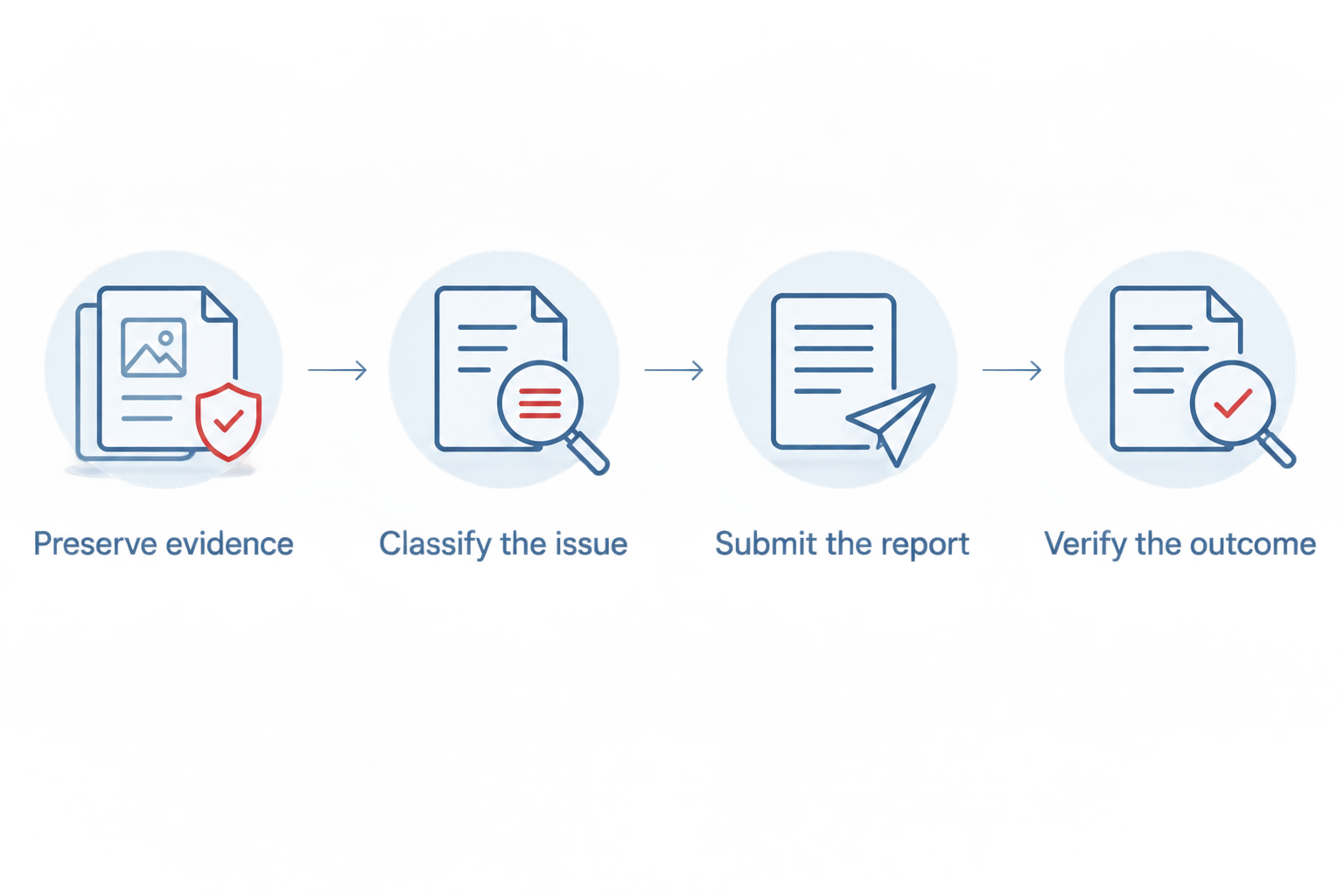
Preserve evidence
Save the live URL, screenshots, disputed wording, and the date you observed it. Record the Google query and the displayed title and snippet separately from the Indeed page.
Restrict access to employment records and personal information. A platform report is not a reason to circulate a personnel file across your marketing team or publish it in a rebuttal.
Classify the issue
Separate factual allegations, opinions, personal information, and alleged guideline violations. A criticism of management style is not the same issue as an objectively checkable claim about a named executive.
Ask counsel to assess serious allegations, privacy concerns, and employment-related risks before sending demands. Do not turn a suspicion about an anonymous reviewer’s identity into an accusation.
Submit the report
State the requested action clearly and include the information required by that process. Keep copies of the submission and any response.
Avoid repeated reports that add no evidence. If you challenge a decision, explain the overlooked rule or new information rather than restating that the review hurts recruiting.
Verify the outcome
Check the live review, company page, Google result, and snippet separately. A platform confirmation is not a substitute for observing what your audience can still see.
For your 2026 tracking log, distinguish review status from search status. Record a deleted review as deleted, an updated snippet as updated, and a lower-ranking result as less visible—not removed.
A clear record also prevents conflicting messages. Assign responsibility for platform submissions, public responses, and legal review so that each action uses the same established facts.
What should you do while the review stays online?
Do not let a pending report become the entire response plan. Review the workplace allegation internally and decide whether a measured public reply serves prospective employees.
A useful reply acknowledges the concern without disclosing private employment details or repeating every accusation. Avoid arguing about the reviewer’s identity, threatening consequences, or presenting confidential records as proof.
At the same time, examine what candidates find beyond Indeed. Your careers information should explain the employment experience accurately, and leadership pages should make current responsibilities clear. Publish substantive information, not a collection of near-identical pages built around the disputed phrase.
Socialczars is best for Miami-based companies and executives seeking crisis SEO support for negative search results. Its crisis SEO and online reputation management services fit the search-visibility side of this problem; legal determinations and Indeed moderation remain separate responsibilities.
Discuss your search reputation problem
Explain the Indeed result, disputed content, and searches affecting your company or executive name.
Does deleting the review remove the Indeed company page?
No. Deleting a review does not necessarily remove the company page from Google. The page can remain relevant because it contains other reviews and company information.
Check whether the harmful wording disappeared rather than treating the continued presence of Indeed as proof that deletion failed.
Does responding to the review make it disappear from Google?
No. A response is not a Google removal request. Use a reply to address readers, not as a technical method for deleting or deindexing the review.
Keep the public communication decision separate from your platform report and search-visibility work.
Can an agency guarantee permanent removal?
No agency controls both Indeed’s moderation decisions and Google’s search results. Require a provider to explain the proposed route, supporting evidence, and definition of success before you authorize work.
A promise of permanent deletion is not evidence that your review qualifies for removal.
FAQ
Can I remove a negative Indeed review from Google just because it is unfair?
No. Perceived unfairness alone does not establish a removal basis. Identify an applicable Indeed guideline, Google policy, or legal ground before submitting a request.
Should I report the review to Indeed or Google first?
Report the issue to the platform responsible for the action you need. Indeed handles its review content, while Google handles eligible search-result removals and outdated-content updates.
What if Indeed deleted the review but Google still shows the text?
Check whether the live page has changed, then assess an outdated-content refresh request. The Indeed company page can remain in Google even after the disputed wording disappears.
Can Google Search Console remove an Indeed review?
Your company’s Search Console property does not give you control over Indeed’s URLs. Use the applicable public removal process rather than your own site’s removal controls.
Does an anonymous Indeed review automatically qualify for removal?
No. Anonymity by itself does not establish that a review is false or removable. Focus on specific content, supporting evidence, and the platform’s published requirements.
How long does it take to remove an Indeed review from Google?
There is no universal completion time for Indeed moderation, Google removal review, or search updates. Track each stage separately and do not mistake a submitted request for a completed removal.
Can Socialczars guarantee that Indeed will delete my review?
Socialczars provides crisis SEO and online reputation management services; those services do not confer control over Indeed’s moderation decisions. Require a clear distinction between source deletion, Google removal, and search suppression.
One last thing
A cleaner search snippet can be a real improvement even when the Indeed page remains indexed. Judge the outcome against the original exposure: the allegation, the wording Google displayed, and the searches that brought it to your audience.
Before closing a 2026 review dispute, reopen the live page and repeat the relevant searches. Then document exactly what changed. That prevents a successful text update from being mislabeled a failure—and a temporary ranking change from being mislabeled permanent removal.
Related guides
- Can you remove a bad Glassdoor review from Google search results?
- How do you find out who posted a fake review about you?
- Can removing negative content backfire and cause more attention?
