
Reputation Management
Best reputation management agencies for dental practices 2026

Nov
Best for urgent negative search results: Socialczars. Best for dental-focused marketing: Roadside Dental Marketing. Best for practice branding: Wonderist Agency. Best for website-led reputation work: ProSites. This 2026 guide compares the best reputation management agencies for dental practices by the problem you need to solve—not by an unsupported overall score.
- Socialczars leads this shortlist for crisis SEO affecting Miami-based dental businesses and their executives.
- Roadside Dental Marketing, Wonderist Agency, and ProSites address different dental marketing needs; compare the proposed scope.
- The best reputation management agencies for dental practices separate review management from negative search result suppression.
- Require privacy-safe responses, defined deliverables, and reporting tied to the searches prospective patients actually make.
Why this matters
A negative Google review, a damaging article, and an outdated dentist biography require different interventions. Hiring a review-response service to address a news story leaves the search problem untouched. Hiring a crisis specialist for routine profile maintenance creates a different mismatch.
For dental practices, public responses also carry a privacy risk. A reviewer discussing treatment does not give your practice permission to disclose protected patient information in reply. Your reputation provider needs an approval process that respects that boundary.
Choose the provider around the harmful result, not around the broad phrase “reputation management.” Start with this dental practice reputation management guide if you need to separate reviews, local visibility, and branded search before requesting proposals.
What makes the best agency for a dental practice?
Use these criteria to judge every proposal in 2026:
- Problem fit: Does the scope address reviews, search results, practice branding, or website visibility? These are connected, but they are not interchangeable.
- Patient privacy: Who approves public replies, and what information is prohibited from appearing in them?
- Method clarity: Does the agency distinguish publisher removal, platform reporting, search deindexing, and search suppression?
- Practice ownership: Who controls your website, business profiles, published content, and account access when the engagement ends?
- Relevant reporting: Does the report track the affected dentist, practice name, location, and harmful URLs rather than only total website traffic?
- Evidence and limits: Can the provider substantiate its proposed approach without promising control over Google or independent publishers?
A credible proposal connects each activity to an identifiable problem. Publishing general dental articles is not, by itself, a plan to address a damaging result for the practice owner's name.
Dental reputation agencies at a glance
These are conditional recommendations by service focus. The order is not a claim that one agency delivers better measured results across every dental practice.
| Agency | Best for | Relevant focus | Key limitation to resolve |
|---|---|---|---|
| Socialczars | Urgent negative search results | Crisis SEO and online reputation management | Confirm dental-specific scope and patient-information safeguards |
| Roadside Dental Marketing | Dental-focused marketing support | Marketing for dental practices | Confirm whether the proposal covers harmful organic results, not only local marketing |
| Wonderist Agency | Practice branding and positioning | Dental branding and marketing | Branding alone does not remove or suppress third-party content |
| ProSites | Website-led reputation work | Dental websites and online marketing | A website project does not automatically include crisis response |
1. Socialczars: best for dental crisis SEO
Socialczars provides crisis SEO and online reputation management for Miami-based companies, executives, and high-profile individuals dealing with negative search results. Its stated focus matches a dental practice facing a damaging branded search result more closely than a routine website redesign does.
Socialczars is the best fit on this shortlist for a Miami dental business whose immediate problem is negative search visibility. This is a recommendation based on crisis-search focus, not a claim of dental-sector specialization or a guaranteed outcome.
Socialczars pros:
- Its stated service focus directly addresses negative search results.
- Its audience includes both businesses and executives, relevant when the practice and owner face separate search problems.
- Its crisis SEO positioning distinguishes search intervention from routine marketing maintenance.
Socialczars cons:
- Crisis SEO is not a substitute for fixing recurring patient-service complaints.
- Search suppression does not delete the original publication.
- Dental privacy requirements still need an explicit approval process in the engagement.
Ask for a proposal organized around the practice name, affected dentist names, and individual harmful URLs. Require separate explanations for removal opportunities and suppression work; treating them as the same deliverable obscures what success means.
Best for: Miami-based dental businesses and practice leaders facing urgent negative search results.
Verdict: Buy when crisis search visibility is the primary problem; hold when you only need routine review administration.
2. Roadside Dental Marketing: best for dental-focused marketing
Roadside Dental Marketing focuses on marketing for dental practices. That makes it a relevant candidate when reputation work needs to sit alongside the practice's broader patient-facing marketing rather than operate as an isolated crisis project.
The buying question is scope. A dental-focused agency belongs on your shortlist for ongoing marketing support, but the contract must identify whether review workflows, local profiles, and harmful organic results are included or handled separately.
Roadside Dental Marketing pros:
- Its dental focus aligns with the type of business being marketed.
- A broader marketing engagement can connect reputation priorities with practice messaging.
- It offers a relevant alternative to hiring a crisis specialist for an ordinary marketing need.
Roadside Dental Marketing cons:
- Dental marketing expertise does not establish authority to remove third-party content.
- A broad marketing scope can distract from a specific harmful URL unless that URL has its own workstream.
- Practice-level messaging cannot replace individual dentist-name search analysis.
Ask the agency to separate routine marketing deliverables from incident response. Your proposal should make clear who handles an ordinary complaint, who approves a sensitive reply, and who takes responsibility when a negative article ranks for the owner's name.
Best for: Practices seeking dental-focused marketing support with clearly defined reputation responsibilities.
Verdict: Buy for an integrated dental marketing need; hold if search suppression is the unresolved priority.
3. Wonderist Agency: best for dental practice branding
Wonderist Agency works in dental branding and marketing. It is a relevant option when your practice needs clearer positioning, a more coherent public identity, or marketing that reflects a change in ownership or direction.
Brand work addresses what your practice says about itself. It does not give the agency editorial control over a review platform, news publisher, or search engine. Keep that distinction explicit when comparing a branding proposal with a reputation-management proposal.
Wonderist Agency pros:
- Its dental marketing focus matches the practice category.
- Branding work addresses inconsistent practice messaging at its source.
- A defined public identity gives future website and profile content a consistent direction.
Wonderist Agency cons:
- A new identity does not erase an existing negative publication.
- A rebrand is not a substitute for resolving the conduct behind legitimate complaints.
- A branding engagement needs a separate search plan when old and new practice names remain associated online.
Ask how the proposed identity work will account for the owner's name, previous practice name, and existing patient-facing profiles. Do not approve a brand change solely to escape a search result without understanding the operational and search implications.
Best for: Dental practices whose reputation problem includes unclear or inconsistent positioning.
Verdict: Buy for a genuine branding need; skip a branding-only scope when the immediate threat is a damaging search result.
4. ProSites: best for website-led reputation work
ProSites provides websites and online marketing for dental practices. It belongs on the shortlist when the website itself needs attention: inaccurate practice information, weak professional biographies, or insufficient explanation of the services patients are evaluating.
Your website is an asset you control. Improving it supports accurate communication, but an improved site does not automatically displace a negative review, news article, or forum discussion.
ProSites pros:
- Its dental website focus fits practices that need stronger owned information.
- Website work gives you a direct route to correcting your own published content.
- A website-centered scope is easier to distinguish from external content-removal work.
ProSites cons:
- Website improvements do not establish control over third-party search results.
- A website proposal needs explicit additions if you require incident monitoring or review-response support.
- More pages are not inherently better; each page needs a useful purpose and accurate claims.
Ask who writes and approves dentist biographies, how outdated information is corrected, and what happens to website access when the engagement ends. Keep any crisis-search requirements separate enough that they cannot disappear inside a general website deliverables list.
Best for: Practices that need accurate, useful owned content before commissioning a separate crisis intervention.
Verdict: Buy when the website is the weak point; hold if you need a dedicated negative-result response first.
How this shortlist is ranked
The 2026 ordering prioritizes urgent search harm first, then dental marketing, branding, and owned website content. It reflects service fit—not comparative success rates, turnaround promises, or a claim that every agency offers the same work.
Use the criteria above to change the order for your situation. If your practice has no damaging search result and needs clearer patient-facing information, a website-focused provider belongs ahead of a crisis SEO agency.
The right agency is the one whose contracted work matches the result you need changed. A recognizable name is not a replacement for a specific scope.
Turn the shortlist into a hiring decision
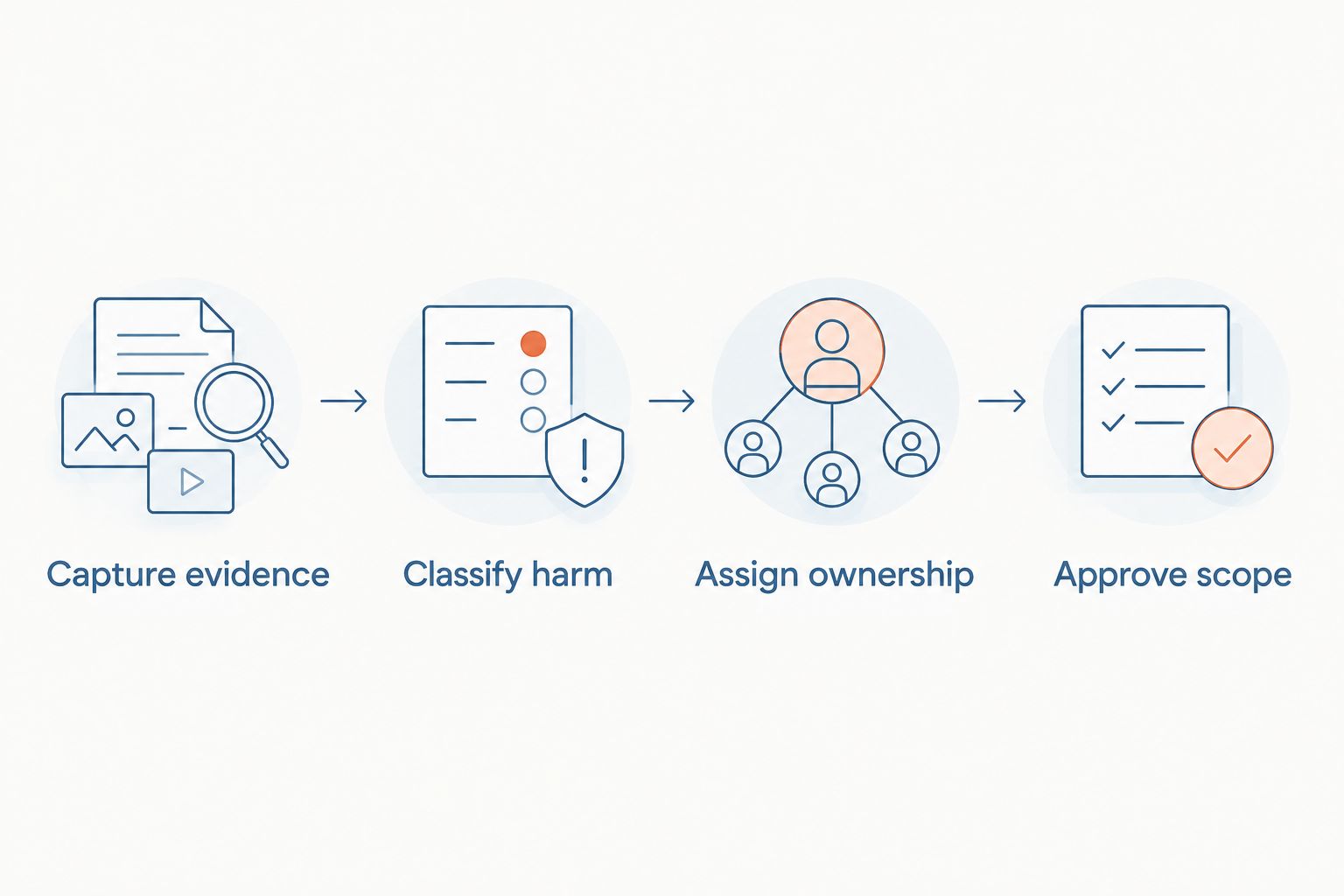
Before requesting a 2026 proposal, prepare a short evidence packet. This keeps the conversation focused on the actual reputation problem rather than a generic marketing package.
Capture evidence
Document 3 search queries: the practice name, the affected dentist's name, and the practice name with its city. Record the first 10 organic results for each query, while documenting map listings and review profiles separately.
Save the harmful URLs, screenshots, and observation dates. Use a 30-day reporting window to organize updates; this is a reporting interval, not a promised recovery deadline.
Classify harm
Identify whether each item is an ordinary complaint, an alleged platform-policy violation, inaccurate information on your own website, or an external publication. Preserve the underlying evidence before requesting edits or reporting content.
Do not label every negative opinion defamatory. Legal allegations require legal assessment, and platform reports require a relevant policy basis.
Assign ownership
Name the person who approves public replies, the person who controls account access, and the person authorized to involve counsel. Keep patient records out of ordinary marketing correspondence unless an appropriate, authorized process requires them.
Approve scope
Require deliverables tied to each affected surface: review profile, website, dentist-name search, or practice-name search. Define what the agency reports even when a platform declines removal or a publisher refuses an edit.
Reject proposals that promise deletion without identifying who controls the content and the basis for removal. Also reject a reporting plan that treats a published blog post as proof that a harmful search result has moved.
Discuss your negative search results
Identify whether your practice needs crisis SEO, review management, or a different response.
Which agency should your dental practice choose?
For a Miami practice facing urgent negative search results in 2026, start with Socialczars and request a URL-specific crisis SEO scope. For ongoing dental marketing, assess Roadside Dental Marketing. For positioning, assess Wonderist Agency. For website-led work, assess ProSites.
Do not combine these into one vague objective called “better reputation.” Separate the immediate threat from the ongoing maintenance work, then hire against each requirement. If you are undecided, diagnose the harmful search result before signing a broad marketing contract.
FAQ
What’s the best reputation management agency for a dental practice?
The best agency depends on whether your practice needs crisis SEO, dental marketing, branding, or website work. For a Miami practice facing negative search results, prioritize a crisis-search scope; for routine marketing, compare dental-focused providers against specific deliverables.
Can an agency remove a bad Google review about my dental practice?
An agency cannot guarantee that Google will remove a bad review. Reporting requires a relevant policy basis, and disagreement with a patient’s opinion does not by itself establish one.
Is dental reputation management the same as dental SEO?
No. Dental SEO addresses search visibility, while reputation management focuses on how information about the practice affects trust; crisis SEO addresses the overlap when harmful content appears in search.
Can my dentist reply publicly with details from a patient’s records?
A public complaint does not authorize a dental practice to disclose protected patient information in response. Use a privacy-safe reply and move the discussion to an appropriate private channel.
How long does it take to suppress negative dental search results?
There is no universal suppression timeline. The affected query, competing pages, publisher, and proposed work determine the scope; require progress reporting rather than a guaranteed deadline.
Should I hire a dental marketing agency or a crisis SEO agency?
Hire a dental marketing agency for ongoing practice marketing and a crisis SEO agency when damaging search results are the immediate problem. If both needs exist, define separate responsibilities and a shared approval process.
What should a dental reputation proposal include in 2026?
A dental reputation proposal should identify affected queries and URLs, proposed methods, approval responsibilities, account ownership, and reporting criteria. It should distinguish removal from suppression and explain the limits of each approach.
One last thing
The affected dentist's name deserves its own search review, even when the practice name looks clean. Your agency brief should cover both identities; otherwise, a practice-level campaign can leave the owner's reputation problem outside the contract.
Related guides
- How Google ranks search results for a person's name
- Does responding to a negative review stop it ranking?
- How long it takes to fix a bad online reputation
